A Guinea-Bissau Map has to explain a country whose western edge is broken into estuaries, tidal channels, peninsulas, and offshore islands rather than a single smooth coastline. Senegal borders the north, Guinea lies to the south and east, and the mainland widens inland toward Gabú. Bissau occupies a small coastal area near the center of the national shoreline, while the Bolama and Bijagós island group spreads southwest into the North Atlantic.
The supplied set contains three matching regional views: a pastel color map with names, a labeled black-and-white map, and a blank administrative outline. Each published preview is a 1,200 × 849-pixel WebP image using the same landscape frame. That shared geometry allows a teacher to place a reference beside an exercise, or a designer to switch between a labeled figure and an open annotation base without rebuilding the page.
Eight regions—Cacheu, Oio, Bafatá, Gabú, Biombo, Bolama, Quinara, and Tombali—are represented together with the autonomous sector of Bissau. The map also provides neighboring-country and ocean context, but it does not show roads, relief, settlement networks, or a distance scale. Its main value is therefore administrative orientation: seeing how the broad eastern regions connect with the fragmented coast and the offshore territory.
Table of Contents
Guinea-Bissau Map Overview
The mainland pattern becomes easier to read from west to east. Cacheu fills much of the northwestern coast, Biombo forms a smaller coastal unit beside Bissau, and Oio stretches across the north-central interior. Farther east, Bafatá and Gabú create two large vertical areas, with Gabú reaching the country’s eastern boundary. South of the main coastal channels, Quinara and Tombali occupy the lower mainland while Bolama is associated with the island group to the southwest.
This Guinea-Bissau Map gives extra visual weight to the coastline because water divides many shapes that would otherwise seem adjacent. Narrow inlets cut deeply into Cacheu, Biombo, Quinara, and Tombali, and the archipelago contains numerous separate island outlines. The labeled versions use dashed guides around part of the island area, helping readers distinguish its administrative placement without drawing a false continuous land boundary across the sea.
Bissau is marked inside a very small coastal sector between Biombo and the channels leading toward Quinara. Its label requires more careful placement than the large inland names, while Bolama must remain readable among many detached shapes. These differences explain why the same text size and orientation cannot be applied uniformly across the country.
Included Map Versions
Every Guinea-Bissau Map in the set preserves the same regional boundaries, island outlines, and surrounding-country frame. What changes is the amount of information layered over that base. The labeled maps support immediate identification, whereas the outline asks the reader to add names or categories. Moving among the three views makes the collection suitable for both explanation and active learning.
- Color regional map: pastel fills separate adjoining mainland regions, the Bissau sector, and the island territory.
- Labeled monochrome map: regional names, Bissau, neighboring countries, ocean text, boundaries, and island guides remain without color fills.
- Blank outline map: names, fills, and dashed guides are removed while the administrative divisions, intricate coast, and islands remain.
The label styling should be treated as part of the artwork rather than as a complete administrative table. For example, some Portuguese diacritics are not displayed in the visible names. A formal report should confirm spelling, administrative terminology, and boundary dates with a current authoritative source before publication.
Regional Color Map
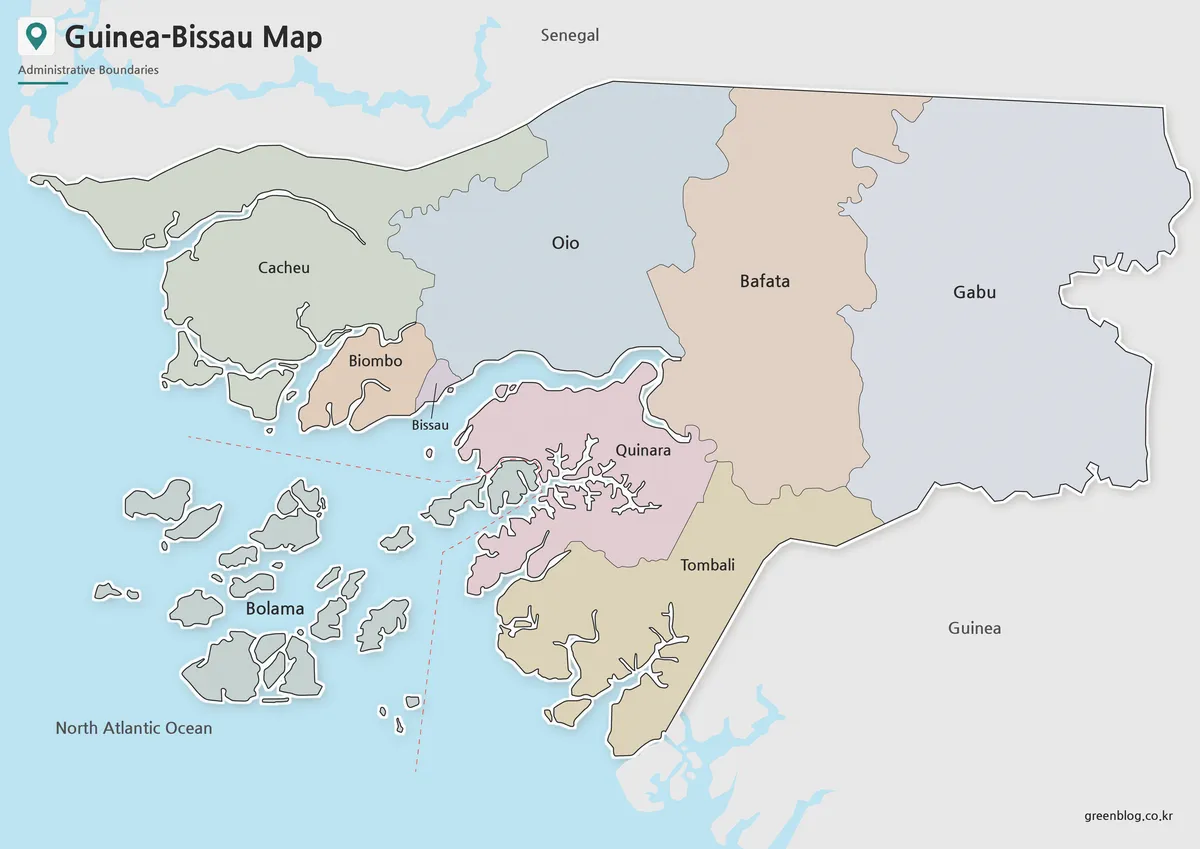
The color Guinea-Bissau Map gives the clearest separation where land and water repeatedly interrupt the regional pattern. Pale fills distinguish Biombo from Cacheu and Bissau, keep Quinara separate from Tombali, and show the contrast between the broad eastern blocks of Bafatá and Gabú. Blue water makes the estuaries and archipelago part of the composition instead of leaving them as unexplained white gaps.
Use this version for a country-introduction slide, a regional reference, or an answer key paired with the blank outline. The palette only separates administrative areas; it does not encode population, vegetation, language, climate, or economic activity. Any thematic overlay should therefore have a separate legend and source date so readers do not interpret the original colors as data.
The surrounding gray land also supports orientation. Senegal’s position above the northern border and Guinea’s placement along the south and east are immediately visible, while the ocean label anchors the offshore islands. This context is especially helpful in a West Africa lesson where the country’s compact mainland could otherwise be mistaken for an isolated coastal shape.
Black and White Printable Map
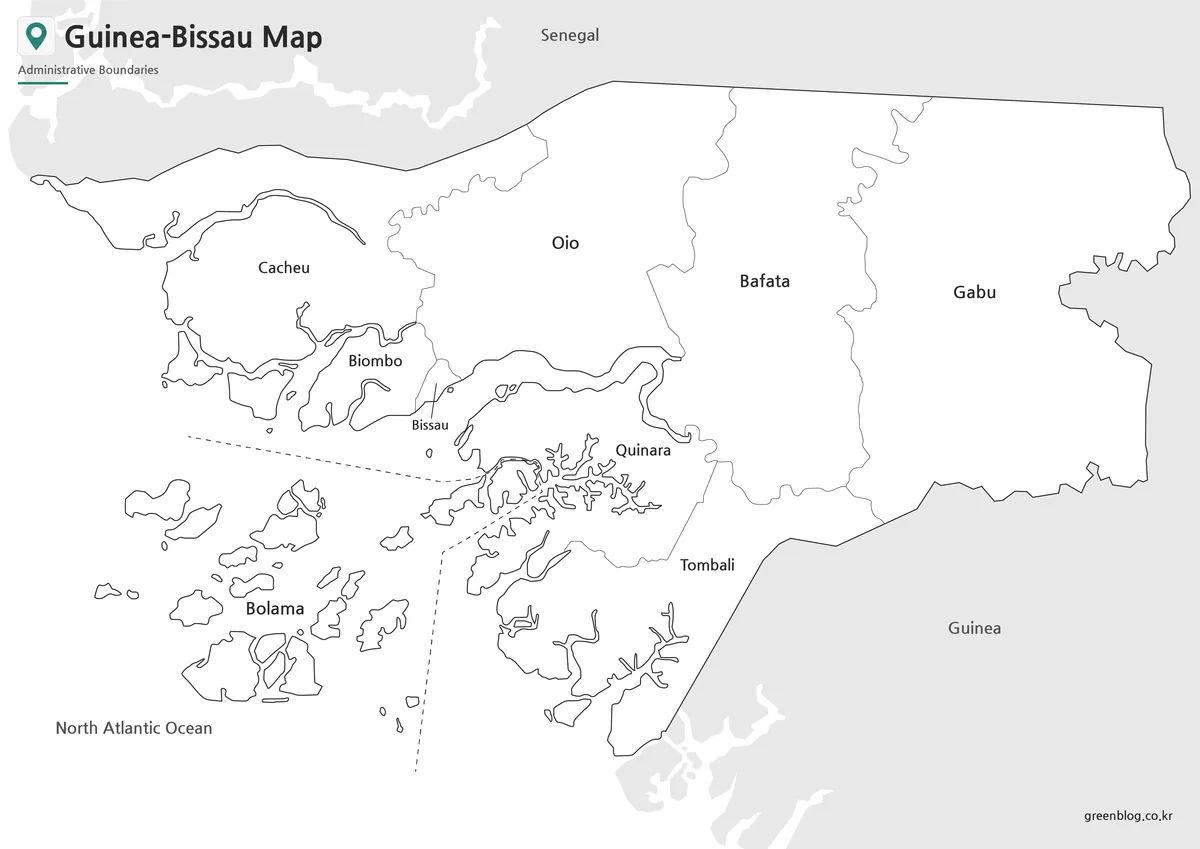
The monochrome Guinea-Bissau Map retains all regional names and the coastal context while removing the pastel treatment. Its white interiors fit grayscale handouts, study packets, and reports in which color would compete with surrounding tables or notes. Pencil marks and highlighter groups can also be added without first covering a colored background.
Print testing should focus on the smallest and most fragmented details. Bissau’s short label sits close to narrow channels, Bolama appears among numerous islands, and the dashed guides may weaken when the page is reduced. Preserve the 1,200 × 849 aspect ratio, avoid repeated recompression, and check a proof at the intended output size before distributing a worksheet.
The absence of color does not turn the image into a blank exercise. Names, national neighbors, the ocean label, and region boundaries remain available for reference, making this the better choice when identification is still required. Learners can use it before moving to the unlabeled version for recall.
Blank Outline Map for Editing
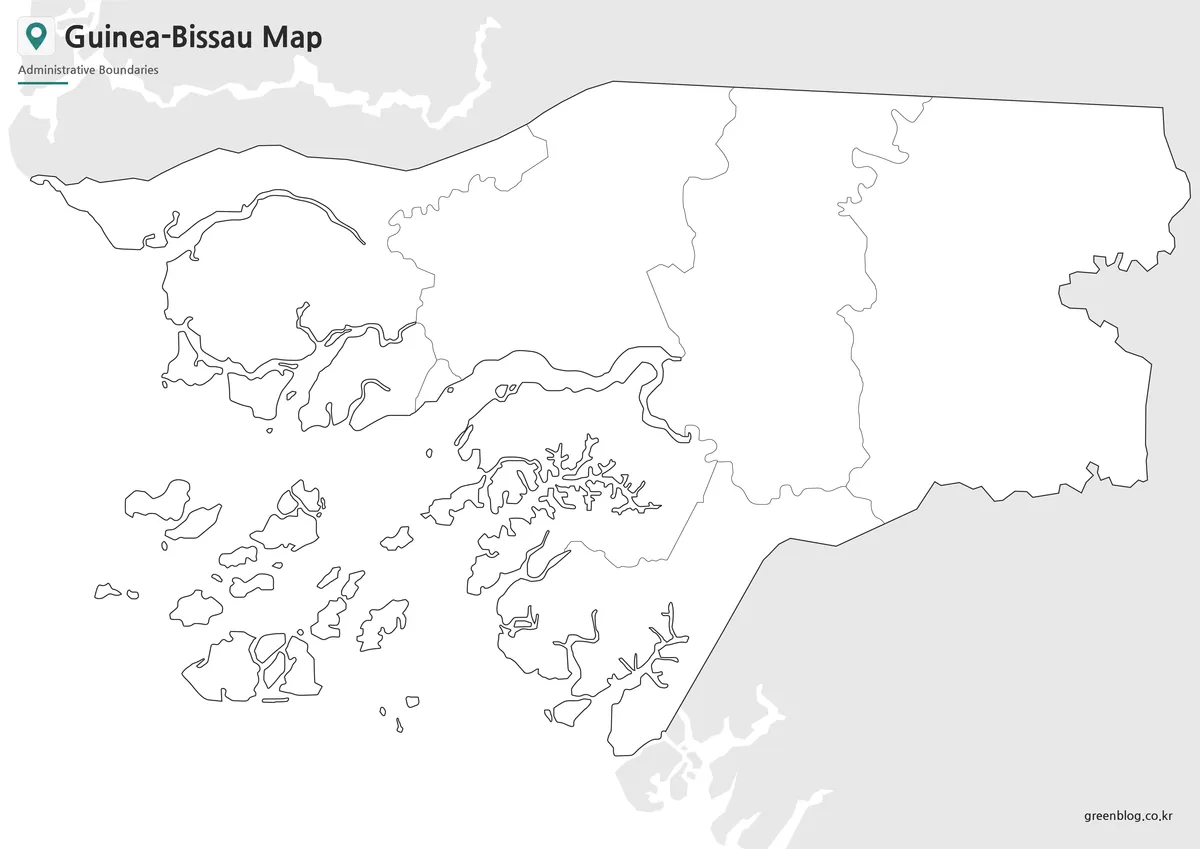
The blank Guinea-Bissau Map removes labels and fills but keeps the internal regions, coastline, and offshore shapes. Students can place Bissau, identify Senegal and Guinea, label the eight regions, or mark the Bolama/Bijagós island area. A project creator can instead add sourced statistics, selected symbols, or regional categories without having to erase existing text.
This image is a flat raster preview, not a confirmed vector or layered source file. Enlarging it beyond the available pixel dimensions may soften the narrow coast and small islands, so annotations should be tested at the final size. Cropping should also be conservative: the scattered western and southern islands are meaningful geography, not unused margin.
A useful classroom sequence is to shade mainland regions first, then add Bissau and the island territory as separate tasks. That order makes the exceptional parts of the administrative layout more noticeable. For a thematic graphic, retain enough empty water around the archipelago to keep added labels from covering the island outlines.
Built for Printing and Presentation Use
Choosing a Guinea-Bissau Map depends on whether the audience needs quick recognition, readable names, or open space. Color works best on a screen when regional separation must be immediate. Monochrome supports labeled documents and handouts, while the outline is suited to quizzes and custom annotations. The three files share a common base, so a presentation can move between them without shifting the country’s position.
Landscape orientation gives the long east–west mainland and western islands enough room on one page. The composition also reserves space above and below for Senegal and Guinea, making the international setting clear without adding a second locator panel. For smaller layouts, the island cluster will usually need more attention than Gabú or Bafatá because detached shapes disappear sooner than large inland areas.
None of the versions includes transport routes, city networks, terrain, or travel time. A route-planning project needs a current transport source, and a formal administrative project needs a dated boundary reference. The supplied graphics are strongest when used for regional orientation, label practice, and carefully documented overlays.
Practical Ways to Use This Map
A labeled Guinea-Bissau Map can anchor a West Africa comparison by showing the country between Senegal and Guinea and distinguishing the inland east from the Atlantic-facing west. The blank version can turn the same geography into a task rather than a passive reference. Readers might classify mainland and island areas, trace the national border, or connect regional names to a separate table.
- Pair the color map with the outline for an eight-region and Bissau labeling activity.
- Enlarge the Bissau–Biombo coast and Bolama islands on a second slide when presenting to a room.
- Use the monochrome view beside a regional table, linking entries with short numbered callouts.
- Add a separate Africa locator map when the audience may not know the country’s position on the Atlantic coast.
For any added dataset, distinguish observation from the original artwork. A legend should explain new colors or symbols, a source line should identify the data, and a date should show when the information applies. These steps are particularly important when compact coastal areas receive several annotations and visual crowding could imply a relationship that the base map does not contain.
Frequently Asked Questions
What is included in this Guinea-Bissau Map collection?
The collection includes a color regional map, a black and white printable map, and a blank outline map.
Can I use the map for classroom printing?
Yes. The black and white version is designed for worksheets, handouts, reports, and other printed educational materials.
Does the map include island areas?
Yes. The map includes the coastal and island-based regions, including the Bolama and Bijagós area.
Which version is best for editing?
The outline map is the best choice for editing, coloring, labeling, and infographic work.
Map File Information
Select the color reference, labeled monochrome view, or blank regional outline according to your lesson, presentation, print, or annotation task.
- Included Versions: Color · Black and white · Outline
- File Type: Image files
- Intended Use: Regional reference, classroom activities, presentations, and annotation
Related Maps
Additional Resources
- UNESCO Bolama-Bijagós Biosphere Reserve — Learn why the archipelago’s islands, tidal environments, and coastal ecosystems are geographically distinctive.
Green Map creates custom-edited map images using open geographic data sources such as geoBoundaries, Natural Earth, OpenStreetMap, and government open data.
These maps are edited visual materials, not raw data files, and are provided for education, documents, presentations, and graphic reference.