This Mali Map set presents the country in three practical views: a color reference, a black-and-white labeled sheet, and a blank boundary worksheet. Each image uses the same eight-region layout, marks Bamako, and keeps Mali’s long north-to-south shape easy to recognize. The collection works best for lessons about an earlier administrative arrangement, map-reading practice, simple presentation graphics, and activities that need a clean base.
Before using the files, note their date context. The images label Kayes, Koulikoro, Sikasso, Segou, Mopti, Gao, Tombouctou, and Kidal. They do not depict Mali’s current 19-region organization. In May 2023, Mali’s Ministry responsible for territorial reform announced a new national administrative map covering 19 regions and the District of Bamako. Treat these downloads as a clear representation of the older eight-region scheme, not as a current official boundary source.
The three previews are 1200 by 849 pixels and use WebP format. Their shared proportions make it straightforward to switch between the labeled and blank versions in a lesson or slide deck without rebuilding the layout. Review print size and legibility in your own software before producing a large poster.
Table of Contents
What This Mali Map Shows
The country outline dominates the page, with the narrow northern section extending toward Algeria and the denser group of southern regions spreading toward Senegal, Guinea, and Burkina Faso. Mauritania is labeled to the west, Niger to the east, and the other neighboring countries appear outside the national boundary. These external labels help learners orient Mali within inland West Africa without turning the sheet into a crowded continental map.
On the labeled versions, Bamako appears as a star in the south-western part of the country, within the area drawn as Koulikoro. A separate “Bamako” label and leader line identify the capital. Bamako is administered as a district rather than one of the eight regions represented by the large colored areas, so the star should not be read as an additional regional polygon.
The spelling “Segou” is shown without the accent used in “Ségou,” while “Tombouctou” follows the French form commonly used for the region associated with Timbuktu. Keeping these visible spellings in mind is useful when students compare the image with atlases or English-language references.
Administrative Date Note
Boundaries are the most important limitation of this set. The artwork reflects the classic eight-region division, a framework often encountered in older school materials. Mali later added regions, and the 2023 reorganization expanded the official national structure to 19 regions plus the District of Bamako. New regions and their boundaries are therefore absent here.
That does not make the files unusable; it defines the correct use. Choose them when the subject is historical change, when a source explicitly refers to the eight-region framework, or when a simple outline is more important than current administrative precision. For present-day government, elections, logistics, humanitarian operations, or statistics, consult a dated official map and match every dataset to the same boundary edition. Do not transfer current regional figures onto these older shapes without explaining the mismatch.
Color Labeled Map
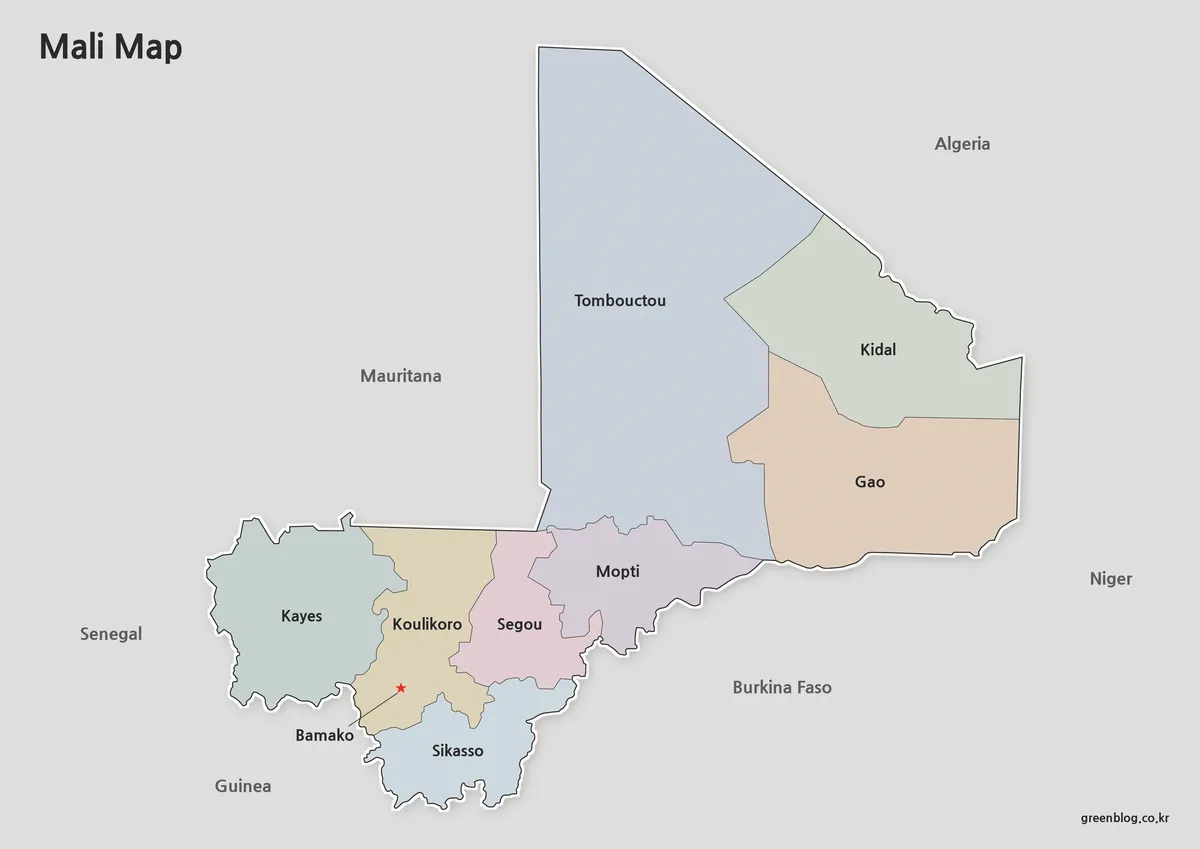
Muted colors separate the eight areas while preserving readable black labels. The enormous northern Tombouctou area is pale blue, Kidal is green, Gao is tan, and the smaller southern and central regions use distinct soft tones. A red star makes Bamako easy to locate. This version is the strongest choice for a projector, a quick geographic orientation, or an exercise asking learners to compare relative regional size and position.
Color is only a visual key; it does not encode population, climate, elevation, security conditions, or political affiliation. Add a separate legend if you overlay data, and state that the base boundaries are historical. The pale palette also leaves room for arrows or short notes, although dark annotation colors will remain easiest to see.
Black-and-White Labeled Map
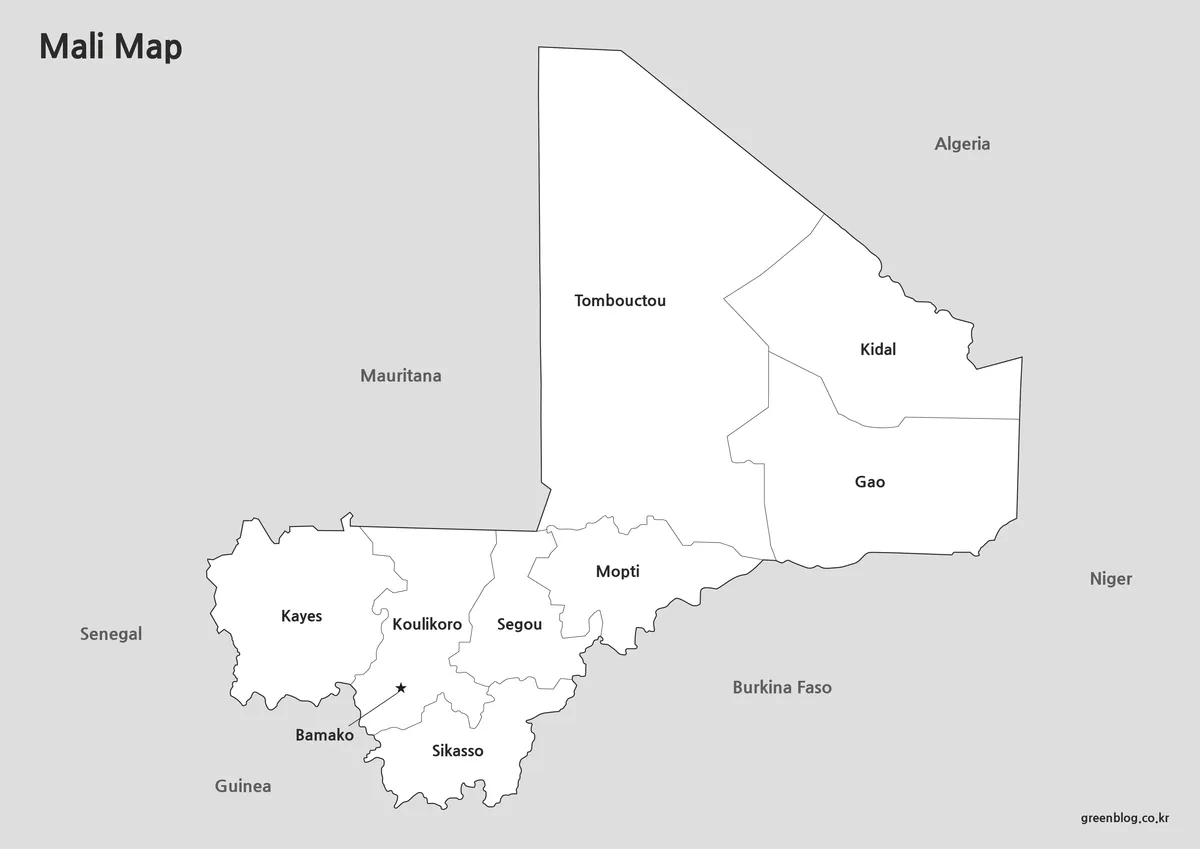
The monochrome sheet retains every regional and neighboring-country label from the color version. A black star replaces the red capital symbol, and thin gray internal lines divide the regions. Because the background remains white, this edition suits handouts, reports, and student notes where colored fills would distract from text or consume extra ink.
For a useful reading task, ask students to trace a route from Senegal toward Niger and list the regions crossed, or compare which regions touch an international border. Questions should be framed around what is actually shown. The sheet has no cities other than Bamako, no roads, rivers, scale bar, coordinates, or north arrow, so it should not be presented as a navigation map.
Blank Boundary Map
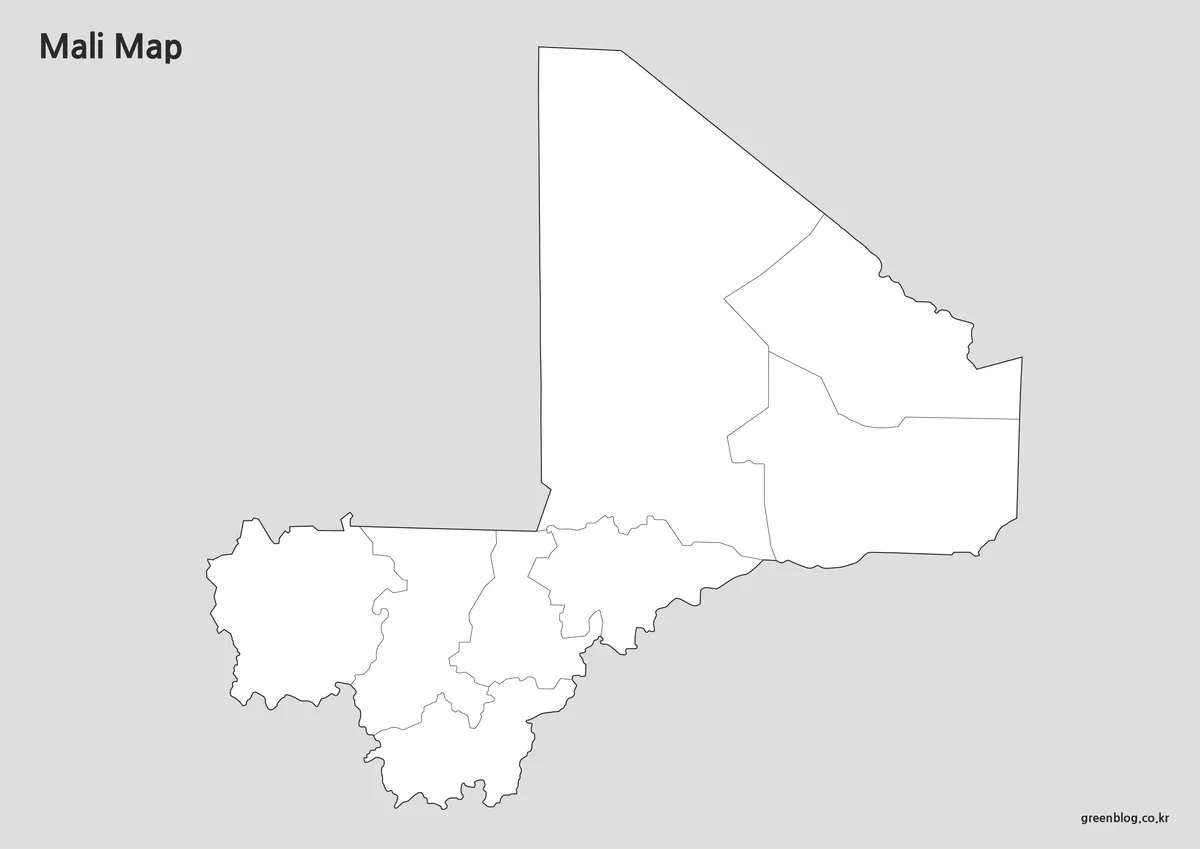
The blank edition removes place names, neighboring-country labels, fills, and the Bamako marker while retaining the country silhouette and eight internal areas. It can serve as an answer-free worksheet paired with either labeled version. Students might write the region names, mark the capital, add neighboring countries around the perimeter, or color selected areas according to a teacher-provided key.
It is also a useful tracing base for a timeline activity: place this historical framework beside a current official map and identify where newer regions changed the administrative pattern. Keep the original unedited file as an answer reference, use a duplicate for annotations, and export the finished work under a new filename. Since the preview is a raster image rather than a vector file, enlarging it far beyond its native dimensions may soften the boundary lines.
Choosing a Version for Class or Design
- Color: best for projected explanations and fast visual separation of the eight regions.
- Black and white: best for labeled reference sheets, reports, and economical printing.
- Blank outline: best for quizzes, labeling practice, custom notes, and boundary-comparison exercises.
Whichever Mali Map version you choose, add a date or a note such as “eight-region historical layout” in the assignment or caption. This small step prevents viewers from assuming that the image represents current administration. For accessible materials, do not rely on color alone: retain text labels, patterns, or a written key for any information you add.
Frequently Asked Questions
What map types are included in the collection?
The collection includes a color administrative map, a black and white labeled map, and a blank outline map.
Is the outline version editable?
Yes. The outline map is designed for editing, annotation, infographic creation, and custom geographic projects.
Which version is best for printing?
The black and white map is often the most practical choice for printing because it maintains readability while reducing ink usage.
Can these maps be used for educational projects?
Yes. The maps are suitable for classroom activities, presentations, worksheets, and regional geography studies.
Map File Information
The download groups the three map styles shown above. Check the historical-boundary note before using them as administrative references.
- Included Files: Three map styles shown above
- File Type: ZIP archive
- Intended Use: Printing, education, presentations, and map-based projects
Related Maps
Additional Resources
For the current framework, consult the Malian government’s 2023 administrative map announcement, which describes the national map, 19 regional maps, and the District of Bamako.
Green Map creates custom-edited map images using open geographic data sources such as geoBoundaries, Natural Earth, OpenStreetMap, and government open data. These maps are edited visual materials, not raw data files, and are provided for education, documents, presentations, and graphic reference.