A Panama Map has to explain a country that curves between two continents and two major bodies of water while remaining only a narrow land corridor in many places. Costa Rica lies beyond the western edge, Colombia is labeled at the southeast, the Caribbean Sea runs along the north, and the Pacific Ocean borders the south. Gulf and island shapes make the coastline far more complex than a simple strip.
The collection contains a labeled color edition, a labeled black-and-white edition, and an unlabeled outline. All three published previews measure 1,200 × 849 pixels and share the same wide composition. The labeled maps name ten provinces and several indigenous comarca areas, mark Panama City with a star, and identify the Caribbean Sea, Pacific Ocean, Gulf of Chiriquí, Gulf of Panama, and Colombia.
These graphics are broad administrative references rather than complete legal or transportation maps. They do not show the Panama Canal route, roads, airports, districts, terrain, or every current indigenous territory. Their value lies in comparing the major displayed areas, understanding the Caribbean–Pacific orientation, and providing consistent bases for lessons, reports, presentations, and annotations.
Table of Contents
Why Panama’s Land-Bridge Shape Matters
Panama forms the southern end of Central America and connects toward South America at Colombia. Bocas del Toro and Chiriquí occupy the far west, Veraguas spans a broad central-western section, and Darién extends through the east. Between them, the country bends around the Gulf of Panama and narrows near the capital region.
The Caribbean and Pacific coastlines behave differently on the page. The northern side includes the Bocas del Toro archipelago and the long coastal band of Guna Yala. The southern side opens into the Gulf of Chiriquí and the larger Gulf of Panama, with the Azuero Peninsula formed mainly by Herrera and Los Santos. Offshore islands and peninsulas add visual depth that an inland boundary list cannot communicate.
This Panama Map places the capital star near the meeting area of Colón, Panamá Oeste, Panamá, and the eastern corridor. The marker helps orient the reader, but it does not trace the canal or identify a precise urban boundary. A dedicated canal or transport map is required for locks, waterways, highways, ports, and travel routes.
How to Read the Panama Map
The province labels are Bocas del Toro, Chiriquí, Veraguas, Herrera, Los Santos, Coclé, Colón, Panamá Oeste, Panamá, and Darién. The graphics also name Ngäbe-Buglé, Guna Yala, Emberá, and an area written as Kuna de Madugandí. These are not all the same kind of administrative unit: provinces and indigenous comarcas must not be treated as interchangeable categories.
Several labels omit Spanish diacritics in the artwork, while the eastern comarca names require leader lines because the available spaces are narrow or discontinuous. Emberá is shown in separated eastern areas. Guna Yala follows a long Caribbean coastal zone, and Kuna de Madugandí is identified in a smaller central-eastern position.
The displayed scope is selective. Naso Tjër Di, established as a comarca in 2020, is not visibly labeled, and the map should not be described as a complete current register of all indigenous territories. The omission is important for legal, statistical, or government work, even though the images remain useful for broad geographic orientation.
Three Versions for Different Visual Tasks
Each Panama Map version preserves the elongated coastline, province and comarca boundaries, Gulf of Panama islands, and surrounding land at both ends. The difference is the amount of guidance left on the page: color for immediate separation, monochrome for labeled reference, and outline for user-added content.
- Color edition: categorical region fills, blue water, labels, leader lines, and a capital star
- Monochrome edition: the same labels and marker with white administrative interiors
- Outline edition: boundaries and coastlines without geographic labels or the capital marker
Color Administrative Edition
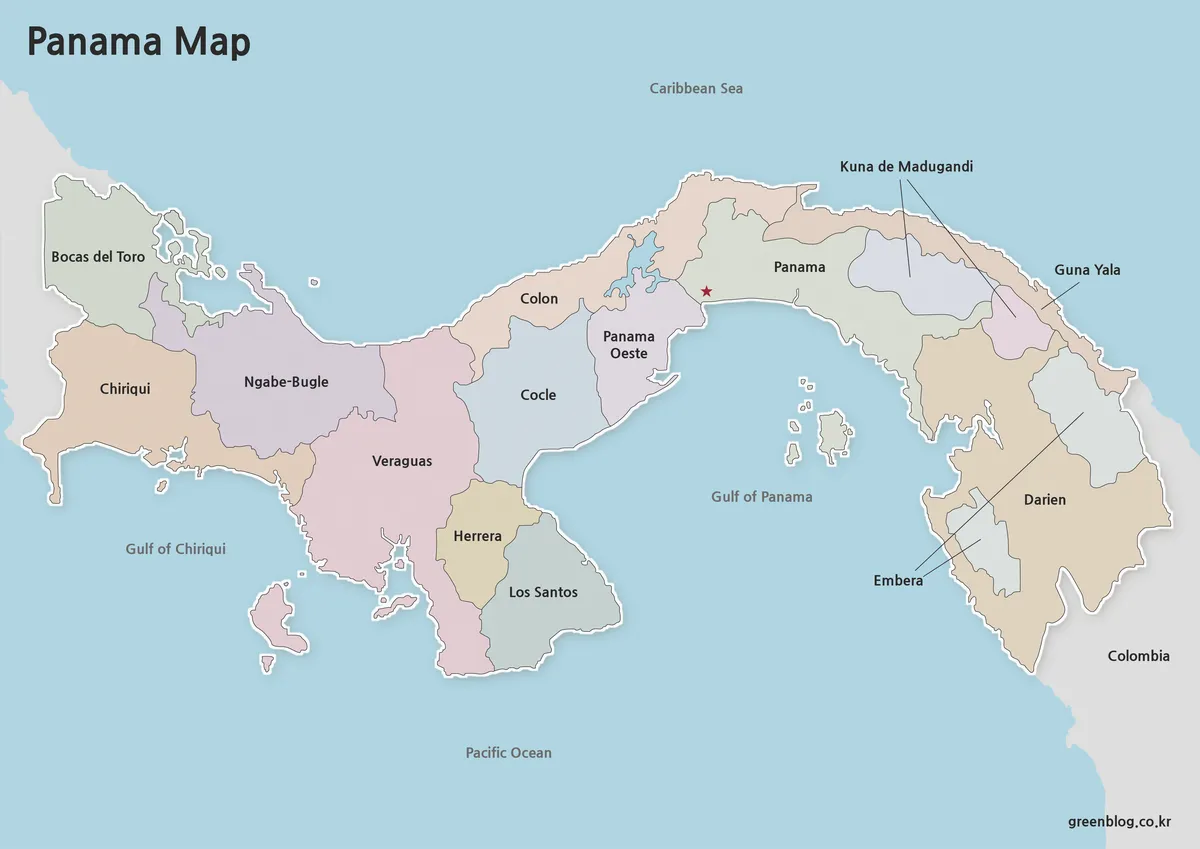
The color Panama Map uses muted fills to separate adjoining areas along the narrow isthmus. Contrast is particularly valuable around Coclé, Colón, Panamá Oeste, and Panamá, where compact boundaries meet near the capital. In the east, separate fills help distinguish Darién, Guna Yala, Emberá, and Kuna de Madugandí despite their irregular forms.
Light blue water turns the two coasts and two labeled gulfs into clear orientation features. The western and eastern neighboring land is gray, keeping attention on Panama, although only Colombia is named in the image. The red capital star adds a single urban reference without converting the map into a city or transport diagram.
The palette is categorical only. It does not encode population, elevation, land use, politics, language, or legal status. Use this edition when an audience must distinguish displayed regions quickly, and provide a new legend if sourced numerical information is added later.
Black-and-White Labeled Edition
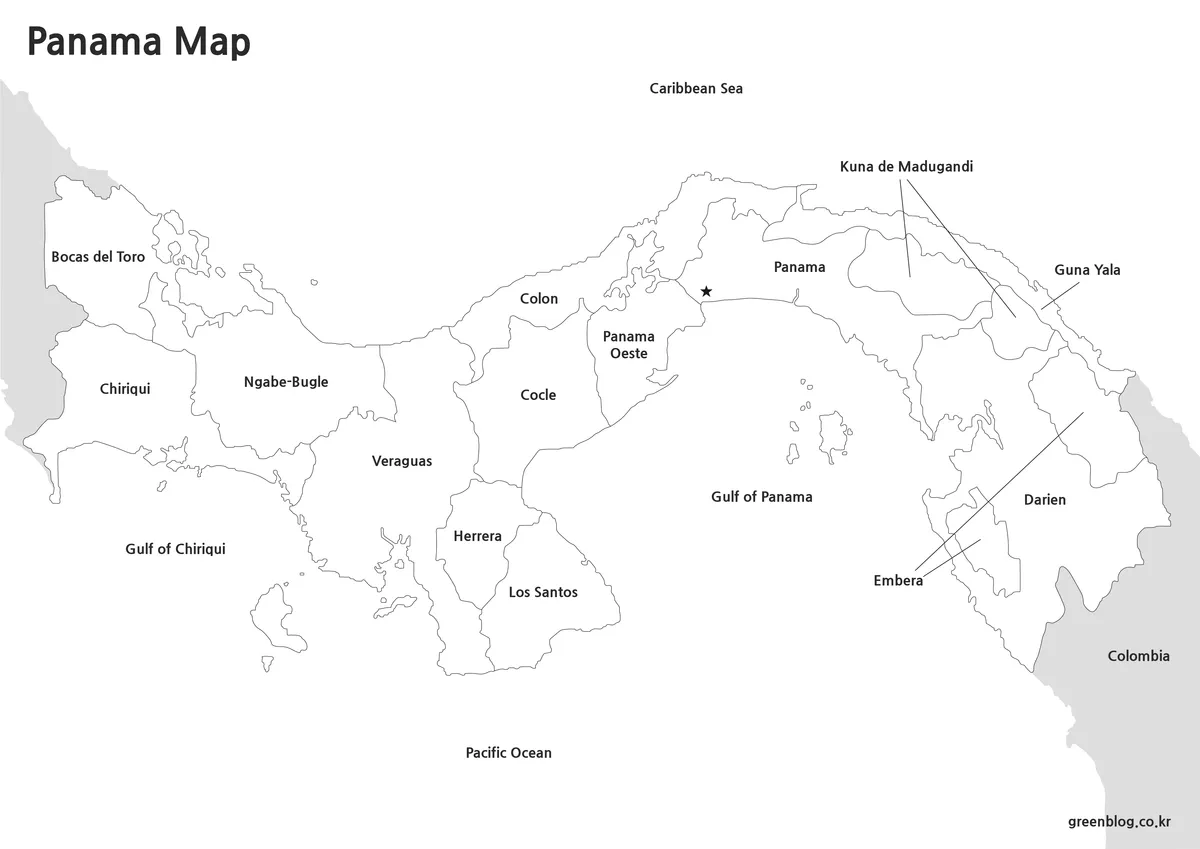
The monochrome edition retains province and comarca names, the capital star, Colombia, sea and gulf labels, internal lines, and leader lines. White administrative interiors reduce visual competition and leave space for limited highlighting or handwritten notes. The gray neighboring land still separates Panama from the outer context.
This version suits photocopied handouts, restrained reports, and reference sheets placed beside a blank exercise. Students can identify Caribbean and Pacific areas, locate the Azuero Peninsula, or compare the western provinces with the eastern Darién region. Because every displayed unit is named, it works as a guide or answer sheet rather than a recall-only worksheet.
At reduced sizes, the eastern labels and their leader lines determine practical legibility. Print one proof before producing many copies, preserve the original landscape ratio, and avoid cropping the wide margins that keep Bocas del Toro and Colombia from touching the page edge.
Blank Outline Edition
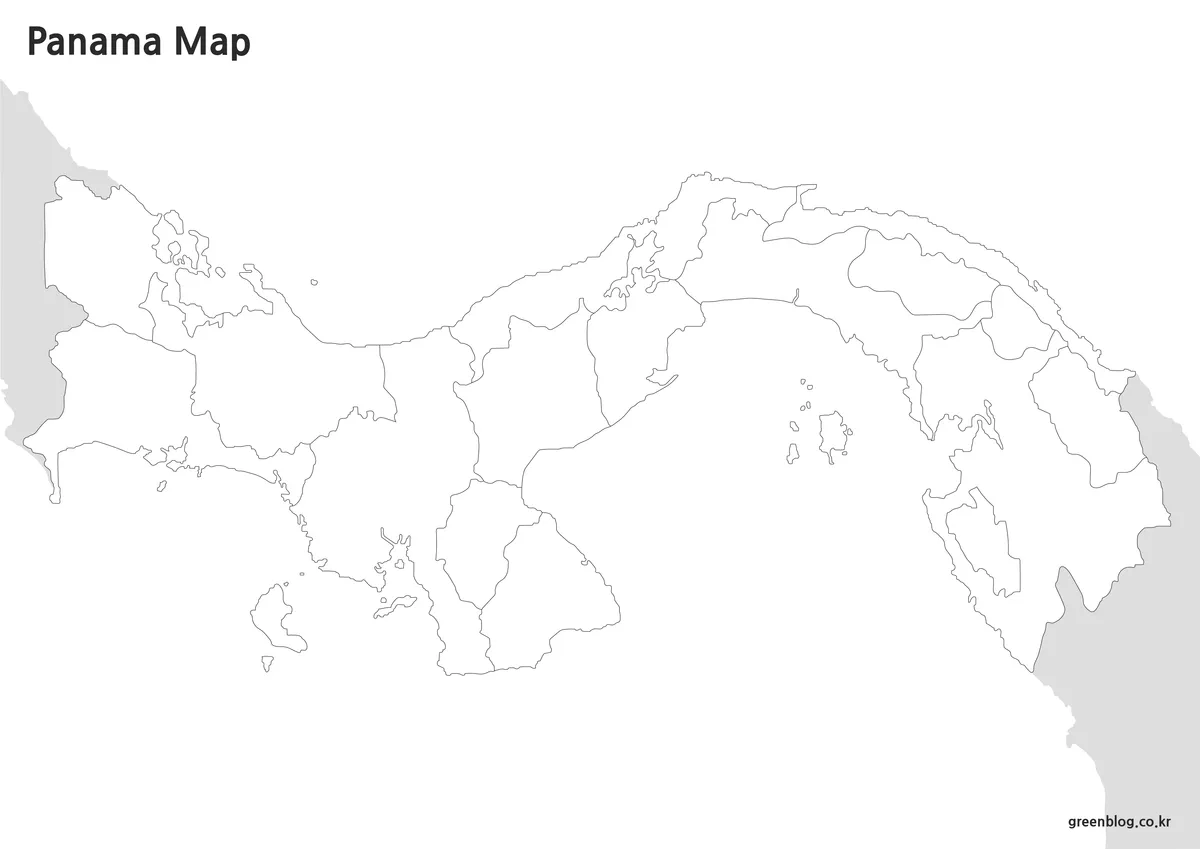
The outline removes names, the capital star, blue water, and region fills while retaining the outer coast, islands, internal divisions, and gray neighboring land. The graphic title and small site mark remain part of the raster image. Readers therefore receive an unlabeled geographic field, not a transparent or vector boundary file.
Students can label the ten provinces, mark selected comarcas, identify both oceans, or place Panama City. Designers can add a simplified route, location points, service areas, or a sourced statistical layer. A date, units, source, and legend should accompany any thematic values so additions are not confused with the original boundaries.
Keep an untouched master and make additions on separate layers in image-editing or presentation software. The outline can support broad annotation, but its raster format and simplified scale are unsuitable for cadastral work, surveying, exact area measurement, or legally authoritative boundary publication.
Selecting the Best Version for Your Project
The best Panama Map depends on the reader’s task. Choose color for immediate administrative separation, monochrome when labels must remain visible in a text-heavy or low-color document, and outline when learners or designers will supply names, symbols, or data. Each edition should be introduced as a map of the areas actually displayed, not as a complete inventory of every current unit.
Printing, Presentation, and Annotation Ideas
The protected collection information identifies the files as high-resolution A3 maps. Preserve their wide proportions when fitting the page so Panama does not become vertically stretched. On a landscape slide, leave enough height for the Gulf of Panama and enough width for the western islands and Colombia label.
A Panama Map can support lessons about the Central American land bridge, Caribbean and Pacific orientation, province placement, and the difference between provinces and indigenous comarcas. It can also accompany a regional table or serve as a locator graphic. Dense route symbols should be avoided because the country’s narrow axis leaves limited space between the two coasts.
Administrative Coverage and Date-Sensitive Use
Administrative names and boundaries should be checked against a current Panamanian authority whenever the output will support legal, electoral, statistical, or government decisions. The map’s absence of Naso Tjër Di and its simplified spellings are visible limitations, not details to conceal. The safer description is “ten provinces and selected indigenous comarcas.”
For classroom orientation, general presentation, and design work, that stated scope remains useful. Readers can compare the areas that are present and understand Panama’s overall shape without assuming that the graphic contains every modern administrative category. Specialized work should use an official dataset created for the required date and level.
Frequently Asked Questions
What administrative areas appear on the Panama Map?
The labeled editions show the country’s provinces and several indigenous comarcas, including Ngäbe-Buglé, Guna Yala, Emberá, and an area labeled Kuna de Madugandí. Because not every current indigenous territory is visibly named, use the collection as a broad regional reference rather than a complete legal administrative register.
Which version is most suitable for a geography worksheet?
The blank outline is best for student labeling, coloring, and orientation exercises. The black-and-white map can serve as a separate reference or answer sheet, while the color edition helps explain how adjacent regions fit along Panama’s narrow land corridor and around the Gulf of Panama.
Can the Panama Map files be printed at A3 size?
Yes. The supplied collection information identifies the maps as high-resolution A3 files. Preserve the original landscape proportions when placing them on the page, and check small labels and leader lines in a print preview before producing a large classroom or presentation set.
Does the map show the Panama Canal or transportation routes?
No. The images focus on administrative boundaries, regional labels, coastlines, major surrounding waters, and a Panama City marker. They do not display the canal route, highways, local roads, airports, or public transportation. A specialized transportation or canal map is necessary for those subjects.
Can I edit the blank outline map?
Yes, as a raster image. You can add colors, text, symbols, routes, or broad regional data in image-editing or presentation software. The download is not identified as a vector source, so it should not be presented as an SVG or infinitely scalable boundary file.
Map File Information
The ZIP archive contains three coordinated administrative map images for reference, printing, and annotation.
- Included Versions: Color administrative, black-and-white labeled, and blank outline maps
- Printable Size: High-resolution A3 layout
- File Type: Image files supplied in a ZIP archive
- Intended Use: Lessons, presentations, regional reference, printing, and custom graphics
Related Maps
Additional Resources
- Indigenous Communities of Panamá — Learn about Panama’s recognized Indigenous peoples and communities, including Naso Tjër Di, which is not labeled in the supplied maps.
Green Map creates custom-edited map images using open geographic data sources such as geoBoundaries, Natural Earth, OpenStreetMap, and government open data.
These maps are edited visual materials, not raw data files, and are provided for education, documents, presentations, and graphic reference.