An Estonia Map must balance a compact mainland with a highly broken western archipelago, small northern islands, and 15 county areas that vary greatly in shape. Saare and Hiiu counties occupy the two largest western islands, while several mainland counties meet around the center and southeast. Lake Peipus forms a broad eastern edge beside Russia, giving the country a distinctive combination of sea coast, islands, and inland water.
The supplied collection includes a labeled color map, a labeled black-and-white map, and an unlabeled outline. The first two identify all 15 counties, mark Tallinn with a star, and label Latvia, Russia, the Baltic Sea, Gulf of Finland, Gulf of Riga, and Lake Peipus. The outline retains the same county geometry and water shapes but removes geographic names and the capital marker.
All three published previews measure 1,200 × 849 pixels and use a landscape canvas. Their shared geometry makes it possible to move from visual reference to monochrome printing or custom annotation without changing the location of a boundary. The maps are county-level diagrams rather than road, terrain, population, municipal, or navigation maps.
Table of Contents
Map Collection Overview
The collection presents the same administrative framework in three visual treatments. The color edition separates neighboring counties immediately, the monochrome edition preserves every label on a quieter page, and the outline leaves open space for names, symbols, routes, or sourced data. The protected FAQ confirms that the downloadable maps were prepared for A3-size printing.
- Color map: pastel county fills, geographic labels, a Tallinn star, blue water, and gray neighboring land
- Black-and-white map: the same labels and boundaries with white county interiors
- Outline map: unlabeled county divisions, islands, coastlines, lake shapes, and surrounding land context
The images use simplified Latin spellings where Estonian names contain diacritics. For formal material, readers may wish to restore Jõgeva, Järva, Lääne, Lääne-Viru, Põlva, Pärnu, and Võru instead of the unaccented forms visible in the artwork. The maps label Tallinn but do not mark other county seats or cities with point symbols.
Why an Estonia Map Is Useful
Estonia is the northernmost of the three Baltic states. Latvia meets it along the south, Russia along the east, the Gulf of Finland lies to the north, and the Baltic Sea and Gulf of Riga frame the west and southwest. Finland is across the Gulf of Finland, although the supplied images label the gulf rather than the country itself.
The 15 counties are Harju, Hiiu, Ida-Viru, Jõgeva, Järva, Lääne, Lääne-Viru, Põlva, Pärnu, Rapla, Saare, Tartu, Valga, Viljandi, and Võru. Statistics Estonia confirms that the country retained 15 counties after the 2017 administrative reform, although many county boundaries and populations changed. This collection represents counties, not the more numerous municipalities beneath them.
A county map makes several relationships easier to see. Harju contains the capital on the north coast; Ida-Viru reaches the Russian border in the northeast; Tartu, Põlva, and Võru face the Lake Peipus and southeastern border area; and Pärnu extends to the Gulf of Riga. Saare and Hiiu counties are separated from the mainland by water, while Lääne occupies the indented western mainland opposite the islands.
The coastline is not a simple outer ring. Peninsulas, narrow channels, offshore fragments, and the large western islands create far more edge detail than the inland county boundaries. That complexity is why a broad landscape layout is helpful: it leaves room for Saare, Hiiu, the northern islands, Lake Peipus, and surrounding labels without shrinking the mainland county names excessively.
Color Estonia Map for Regional Reference
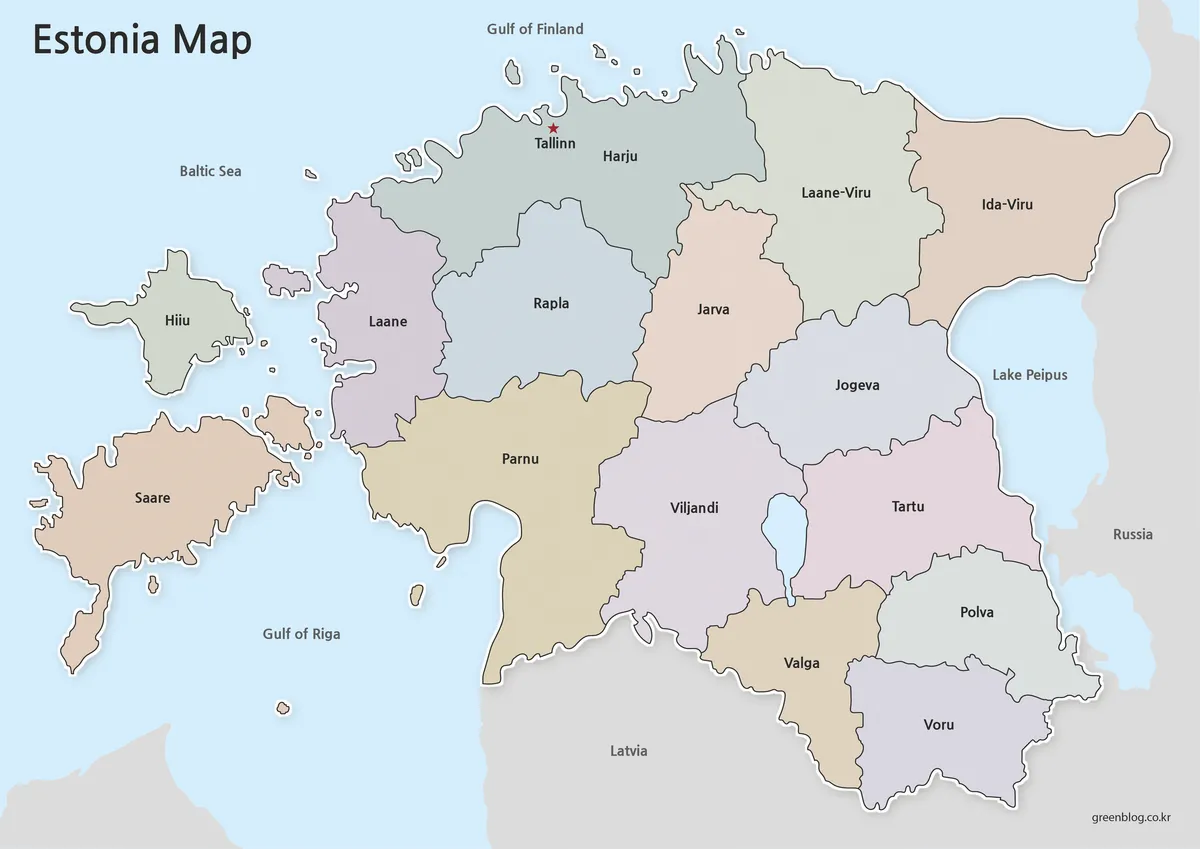
Muted county fills allow the viewer to distinguish adjoining areas without obscuring text. This is especially useful around Rapla, Järva, Viljandi, Jõgeva, and Tartu, where several interior boundaries sit close together. Water is pale blue, while Latvia and Russia are gray, so Estonia remains the visual focus even where the eastern outline follows Lake Peipus.
The color treatment does not represent population, language, land use, elevation, or political affiliation. It is a categorical aid for separating the 15 counties. Use this edition for an introductory regional slide, a labeled classroom reference, or a report that needs county positions to be understood quickly before another dataset is discussed.
Tallinn’s star provides a single capital reference near the Gulf of Finland. No equivalent symbols identify Tartu, Pärnu, Narva, or other cities, so the image should not be read as a city-distribution map. When adding locations, use separate point symbols and a legend so county names are not mistaken for settlement markers.
Black and White Estonia Map for Printing
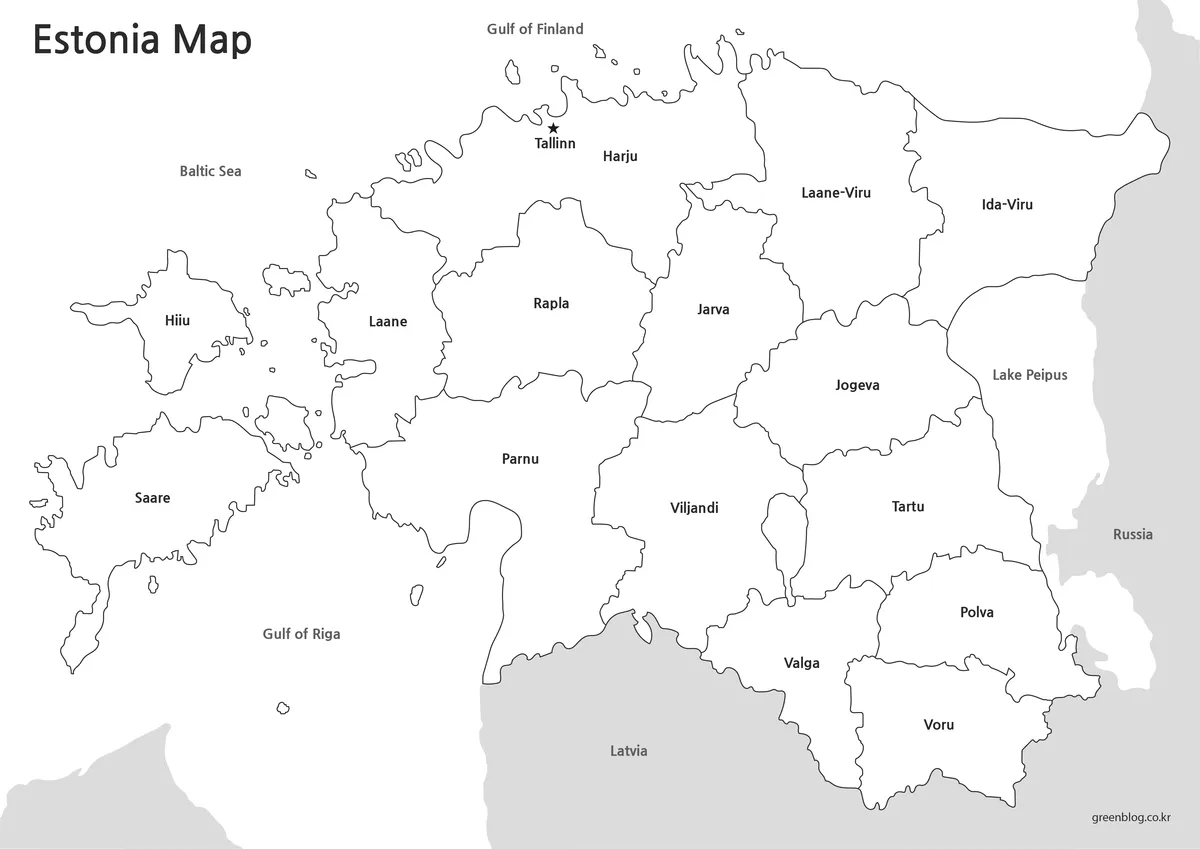
The monochrome edition preserves the county names, Tallinn star, water labels, neighboring-country labels, coastline, islands, and internal borders while removing pastel fills. White county interiors provide space for a learner to shade selected areas or for an editor to add a limited highlight without covering the original geographic references.
This version fits photocopied handouts, restrained reports, and exercises that require readers to locate named counties without relying on color. A lesson might compare the island counties, identify areas bordering Latvia or Russia, or follow the counties beside Lake Peipus. Because names are already present, it functions as a reference or guided worksheet rather than a blank memory test.
Before producing many copies, inspect the smaller central labels at the intended scale. Preserve the original aspect ratio and use fit-to-page scaling so the western islands and eastern border are not clipped. If handwritten annotation is planned, leave additional margin around the map rather than enlarging it beyond the printable area.
Blank Estonia Outline Map for Editing
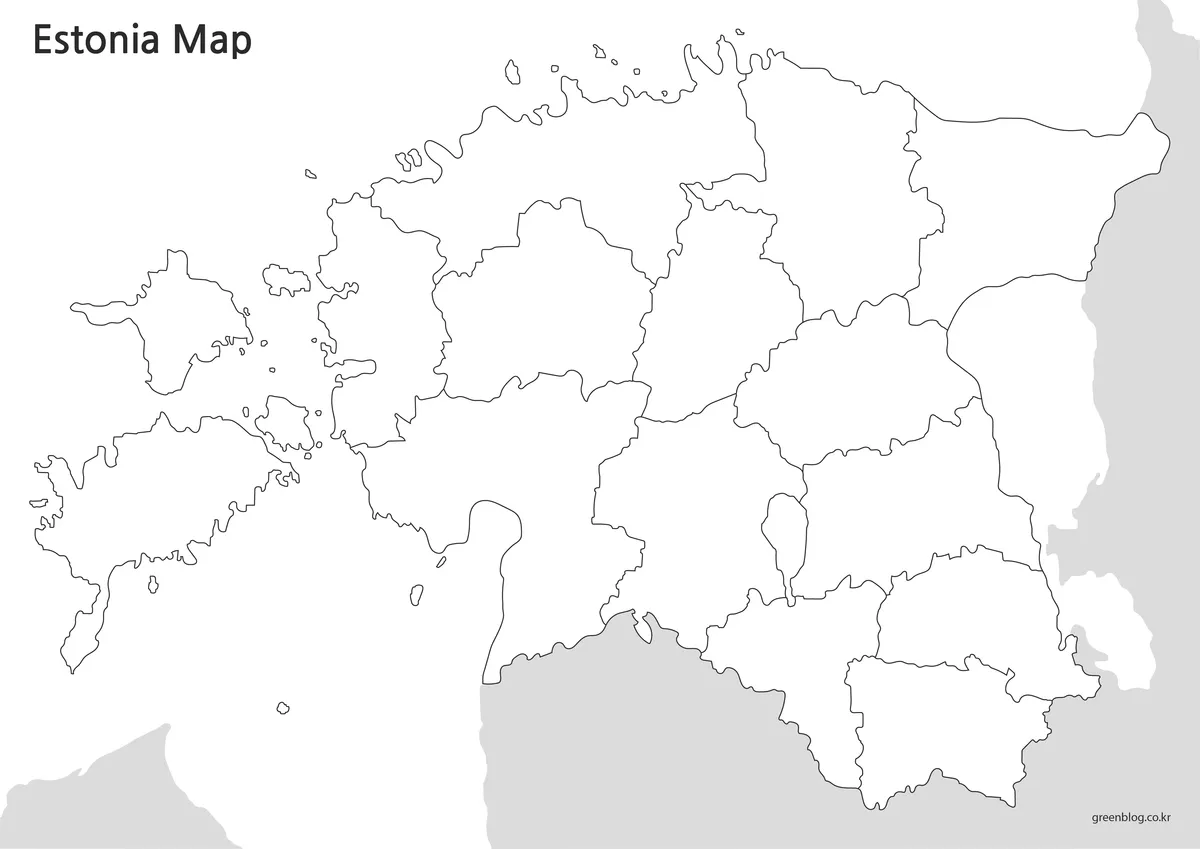
The outline edition removes all geographic labels, the Tallinn star, and water color. County divisions, the outer coastline, Lake Peipus, smaller inland water shapes, Saare, Hiiu, northern islands, and gray neighboring land remain visible. The printed map title and small site mark are still part of the raster image.
Students can label all 15 counties, color counties that touch an international border, or distinguish island and mainland areas. Designers can add a sourced statistical variable, simplified travel path, location points, or regional groupings. Any added data should include a date, units, source, and legend rather than borrowing meaning from the original color palette.
The supplied asset is a raster image, not a vector or GIS boundary file. Keep a clean master and add text, fills, and symbols on separate layers. The outline is appropriate for visual annotation and classroom graphics, but it should not be used for surveying, precise boundary measurement, or turn-by-turn navigation.
Practical Uses for These Maps
Version choice should follow the reader’s task. Use color when fast county separation matters, monochrome when labels must remain present in a restrained document, and outline when the reader will supply names or thematic information. The Estonia Map collection is most effective when its county-level scope is stated clearly.
- County reference: choose either labeled edition.
- Blank county quiz: use the outline with an accurate list of names.
- Baltic orientation: use the color map’s seas, lake, and neighboring labels.
- Thematic graphic: add sourced values and a purpose-built legend.
None of the three versions includes municipal boundaries, road networks, terrain relief, or comprehensive city locations. Pair the files with a transport map for routes, a physical map for elevation, or official regional data for current statistical analysis. Within those limits, the consistent three-version set provides a clear way to compare Estonia’s mainland, islands, counties, and bordering waters.
FAQ
These answers cover A3 printing, classroom selection, annotation, and the surrounding references shown in the Estonia Map files.
Can I print the Estonia map in A3 size?
Yes. The map was prepared as a high-resolution file for A3-size printing.
Which version is best for classroom use?
The black and white map is usually best for handouts, while the color map works well for slides and visual explanations.
Is the outline map useful for editing?
Yes. The blank outline version is designed for adding custom colors, labels, routes, or infographic elements.
Does the map show nearby countries and sea areas?
The labeled versions include nearby geographic references such as Latvia, Russia, the Baltic Sea, the Gulf of Finland, and the Gulf of Riga.
Map File Information
The ZIP archive contains three coordinated county map images for labeled reference, monochrome printing, and annotation.
- Included Versions: Labeled color, labeled black and white, and unlabeled outline maps
- Printable Size: Prepared for A3 output
- File Type: Image files supplied in a ZIP archive
- Intended Use: Lessons, presentations, regional reference, printing, and custom graphics
Related Maps
Additional Resources
- Statistics Estonia: Statistics by Region — Explore current regional indicators and official statistical resources for counties, cities, and rural municipalities.
Green Map creates custom-edited map images using open geographic data sources such as geoBoundaries, Natural Earth, OpenStreetMap, and government open data. These maps are edited visual materials, not raw data files, and are provided for education, documents, presentations, and graphic reference.