A Greece Map has to make sense of a country whose mainland, peninsulas, and island groups stretch across several seas. This collection approaches that challenge with three coordinated views: a color regional map, a labeled black-and-white map, and an unlabeled outline. All three retain the same national shape and regional divisions, so readers can switch from reference to printing or annotation without learning a new layout.
The set is intended for teachers, students, editors, presentation designers, travel writers, and anyone preparing a clear geographic overview. The labeled editions identify 13 administrative regions, mark Athens, and provide border and sea context. The blank edition removes the place names while keeping internal boundaries and the island pattern. Each Greece Map file is supplied as a 4961 × 3507 JPG in CMYK color mode, a high-resolution canvas proportioned for A3 output.
These are reference graphics rather than navigation maps. They do not show roads, railways, ferry routes, terrain, or attractions, and Athens is the only city marker visible in the labeled versions. That controlled level of detail is useful when the task is to compare regions, introduce the country’s overall form, build a worksheet, or add a custom layer without competing with transport data.
Table of Contents
Map Collection Overview
The Greece Map set covers the mainland from Macedonia and Thrace in the north to the Peloponnese in the south, then extends across the Ionian and Aegean island groups to Crete. Albania, North Macedonia, Bulgaria, and Turkey frame the landward side of the labeled maps. The Ionian Sea appears to the west; the Aegean Sea fills the broad space between the mainland and Turkey; and the Mediterranean Sea and Sea of Crete provide southern context.
The regional divisions make several geographic relationships easy to read. Attica forms the compact capital region around Athens. Central Greece and Thessaly connect the southern and northern mainland, while Epirus occupies the mountainous western edge. Macedonia and Thrace span the north. The Peloponnese projects southwest as a large peninsula, and Crete sits separately along the southern margin. The Ionian Islands, North Aegean, and South Aegean regions show why a mainland-only silhouette would give an incomplete picture.
Across the three files, the coastlines, islands, and internal borders remain aligned. That consistency supports a simple teaching sequence: introduce the colored regions, review them on the monochrome sheet, and test recall or add project data on the blank version. It also lets a designer use one Greece Map as a visual key while placing another beside it for notes, statistics, or thematic coloring.
The collection includes:
- A color reference map with region names, Athens, neighboring countries, and sea labels
- A labeled black-and-white edition for economical printing and hand annotation
- A blank outline with regional boundaries, coastlines, and islands
File Information
- Resolution: 4961 × 3507 pixels
- Format: JPG
- Color mode: CMYK
- Print layout: A3 proportion, landscape orientation
- Best suited to: regional reference, lessons, reports, slides, posters, and custom annotations
Regional Color Greece Map
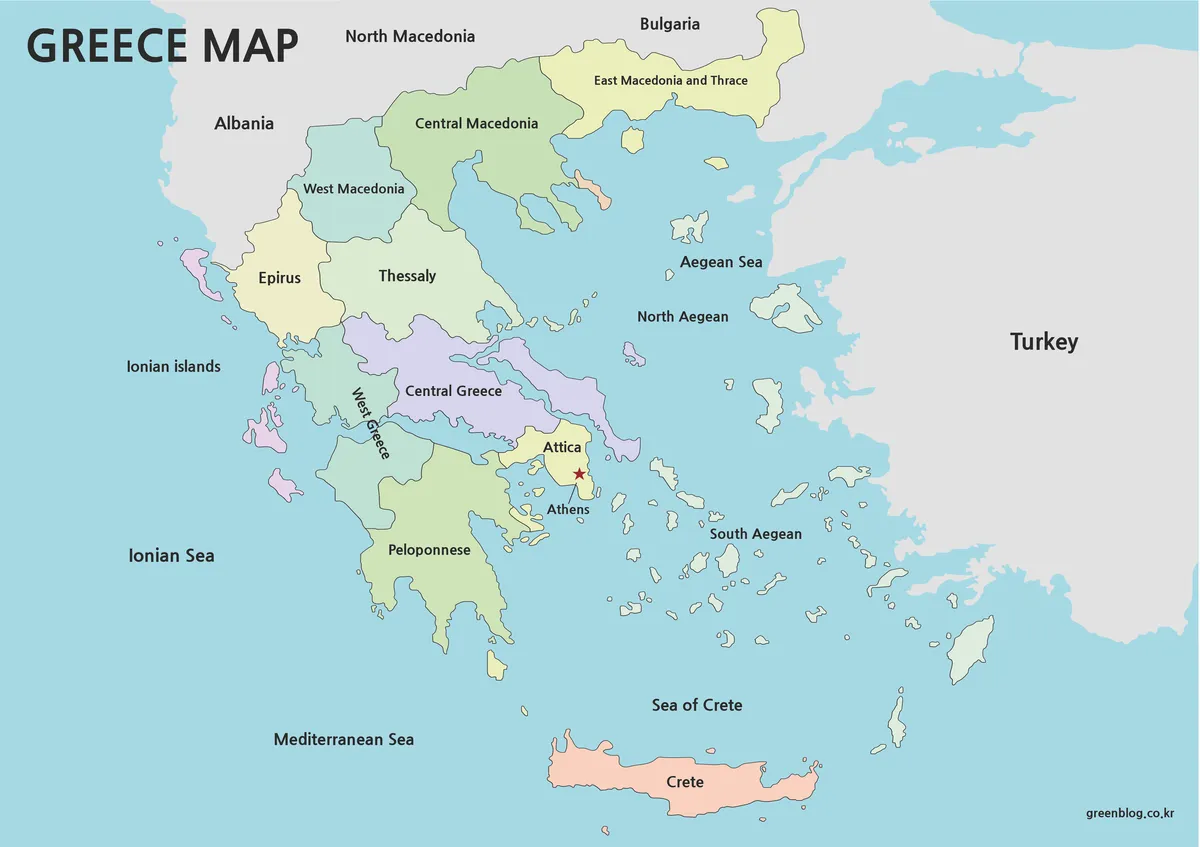
The color edition gives every region a distinct fill while reserving pale neutral tones for nearby countries and blue for the surrounding water. This hierarchy makes the national territory stand out without losing the border context. The Greece Map labels East Macedonia and Thrace, Central Macedonia, West Macedonia, Epirus, Thessaly, Ionian Islands, West Greece, Central Greece, Attica, Peloponnese, North Aegean, South Aegean, and Crete. Athens is marked with a star inside Attica.
Choose this version when viewers need to distinguish adjacent areas quickly. It is the strongest option for an introductory slide, a wall reference, a regional comparison, or a graphic in which the administrative pattern must remain legible at a glance. The colors also help separate island regions that are composed of many small pieces rather than one continuous landmass.
For a presentation, introduce the full map before cropping or enlarging a particular region; the wider frame explains where each island group sits in relation to the mainland. For print, run a small proof first because CMYK output and paper stock can change how similar neighboring tones appear. Keep the original aspect ratio during resizing so coastlines and label spacing are not distorted.
Black and White Printable Version
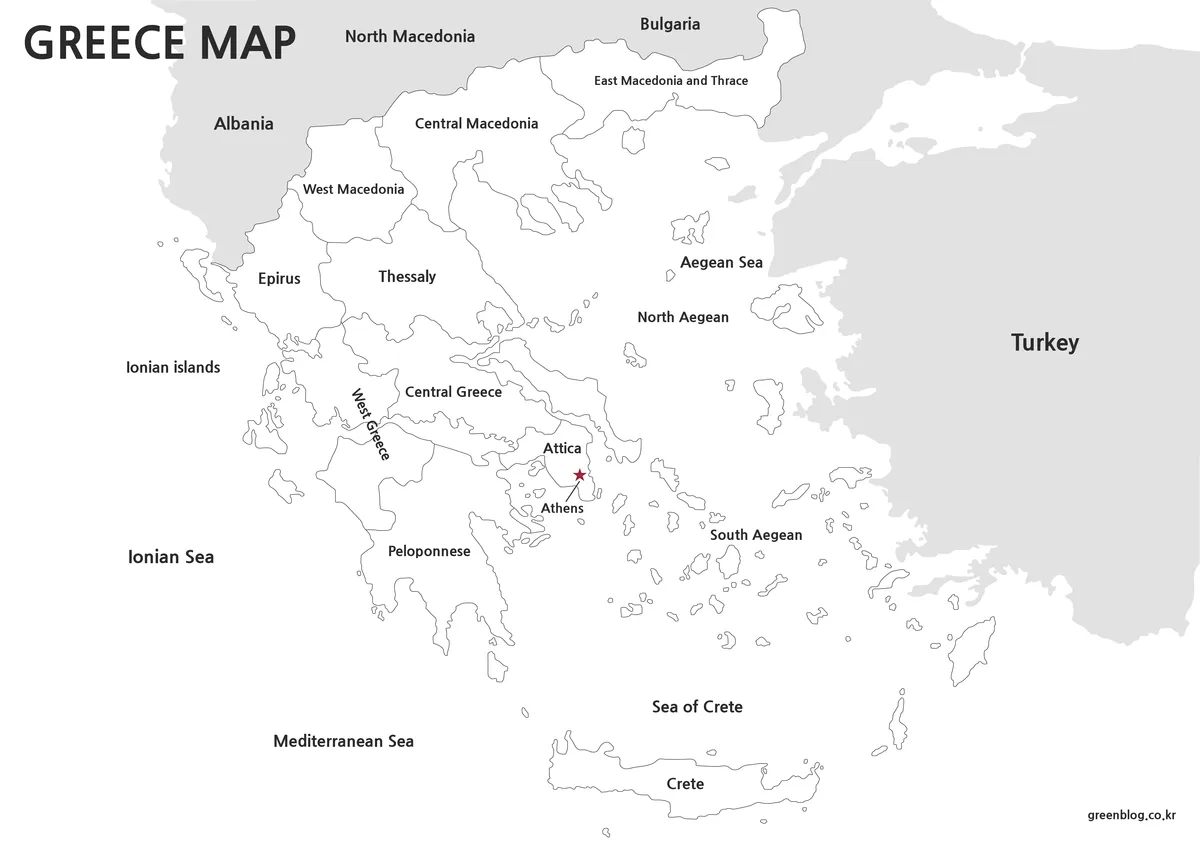
The monochrome Greece Map preserves the names and spatial context of the color edition but uses white land areas, gray neighboring countries, and crisp boundary lines. It therefore remains informative without relying on hue. That makes it suitable for office printers, photocopies, grayscale reports, and classroom packets where every learner needs a labeled reference.
This version is also helpful when users need to add a limited amount of information by hand. A teacher can circle a region, a student can underline a sea, and an editor can place numbered callouts without covering a colored fill. Since the labels are already present, it works better as a study guide or answer sheet than as a recall exercise.
When reducing the page below A3, check the smallest island and sea labels in a print preview rather than judging only from the screen. If a worksheet needs generous writing space, place the map on one half of a landscape page and reserve the other half for questions. Avoid heavy image compression, which can blur thin coastlines and make clusters of small islands harder to distinguish.
Blank Outline Map for Editing
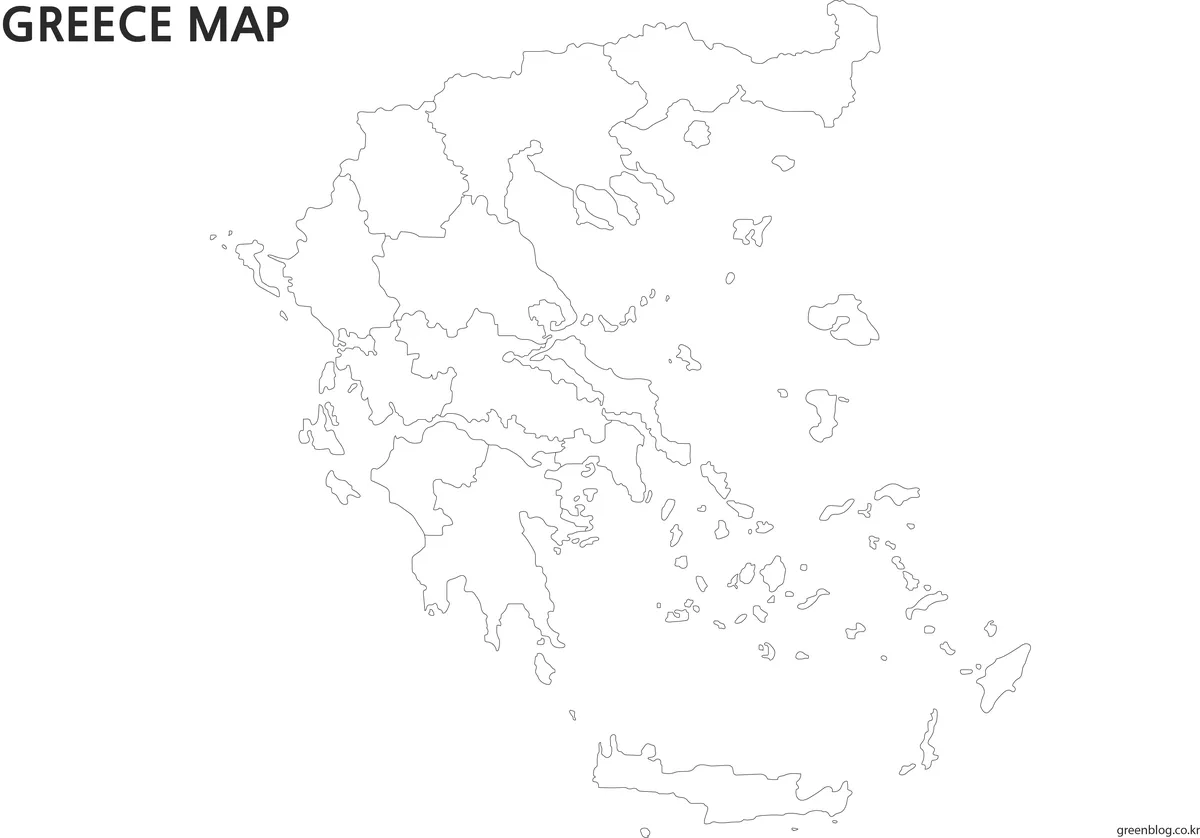
The outline file removes region names, country labels, sea names, the Athens marker, and all color fills. It keeps the Greek coastline, the island pattern, and the 13 internal regional boundaries. The result is a neutral base for labeling exercises, language-localized materials, thematic shading, quiz sheets, and custom infographic work.
Because the source is a JPG rather than a vector file, it should be treated as a high-resolution raster image. You can place text, arrows, symbols, or transparent color layers above it in common page-layout or image-editing software, but individual boundaries are not supplied as separately editable vector paths.
For classroom use, ask learners to locate the capital region, label the three island regions, or group northern and southern regions with a color key. For data graphics, define the legend before adding fills and use a consistent opacity so the boundary lines stay visible. At national scale, very small islands may be visually simplified, so the outline should not be used for surveying, marine navigation, or parcel-level measurement.
Designed for Printing and Visual Projects
Select the color version for immediate recognition, the monochrome version for a labeled low-ink reference, and the outline when the reader must supply information. If a project uses more than one edition, keep them at matching dimensions. Their shared geometry makes side-by-side comparisons feel deliberate and helps viewers transfer what they learned from the labeled sheet to the blank one.
For A3 printing, choose landscape orientation, preserve the image proportions, and use the printer’s fit-to-page option only if it does not crop the outer islands. A modest white margin is safer than borderless enlargement when the device cannot print to the edge. For smaller paper, test whether the island clusters and labels remain readable.
In slides and web graphics, add a short legend only for information that you introduce yourself; the original regional colors are categorical and do not represent a measured scale. Provide descriptive alternative text when publishing online, and do not place essential instructions inside the image alone. These practices keep the map useful for readers who view a reduced image, use assistive technology, or receive a grayscale copy.
Frequently Asked Questions
The Greece Map questions below cover print size, editing, transport detail, and the geographic labels visible in the supplied versions.
Can I print the maps in large size?
Yes. The files were designed for high-resolution A3 printing.
Is the outline map editable?
Yes. The blank version works well for graphic editing, annotations, and custom labeling.
Are roads and transportation details included?
No. The collection focuses on regional readability rather than navigation details.
Are neighboring countries labeled?
Yes. Several surrounding countries and sea regions are included in the main versions.
Map File Information
The three high-resolution JPG maps are grouped in one ZIP package for convenient download.
- Included Files: Three high-resolution JPG maps
- File Type: ZIP archive containing JPG images
- Intended Use: Printing, education, presentations, and map-based projects
Related Maps
Additional Resources
- Visit Greece — Official destination information for the mainland, islands, culture, and trip planning.
Green Map creates custom-edited map images using open geographic data sources such as geoBoundaries, Natural Earth, OpenStreetMap, and government open data. These maps are edited visual materials, not raw data files, and are provided for education, documents, presentations, and graphic reference.