A Seoul Map becomes much easier to read when the Han River is treated as the city’s main visual axis. The river crosses the capital from west to east, separating a broad northern group of districts from the districts to the south while bending around Yongsan, Seongdong, Gwangjin, Yeongdeungpo, Dongjak, Gangnam, and Songpa. Seeing that relationship on one page gives more context than a list of Seoul’s 25 autonomous districts.
This download collection provides three JPG maps at 4961 × 3508 pixels: a color district map, a labeled black-and-white version, and an unlabeled outline version. The files are arranged in an A3 landscape layout and use CMYK color mode. They are intended for district reference, classroom activities, presentation graphics, document inserts, and image-based editing rather than street navigation.
All three versions retain the municipal boundary, the 25 district divisions, and the course of the Han River. The labeled files use English district names without the “-gu” suffix, while the outline removes every district name so users can add their own language, categories, or symbols. Roads, subway lines, station names, landmarks, and neighboring Gyeonggi municipalities are not included.
Table of Contents
Map Overview
The Seoul Map shows the city at the autonomous-district level. Officially, Seoul has 25 autonomous “gu” districts; each contains smaller administrative neighborhoods, or “dong,” that are beyond the scale of this collection. Focusing on gu boundaries keeps the page readable and makes it possible to compare large outer districts with the compact central districts near Jongno, Jung, Yongsan, Mapo, and Seongdong.
Fourteen districts lie broadly north of the Han River and eleven lie broadly south, although the river’s curves prevent a perfectly straight division. The northern half extends from Eunpyeong and Mapo in the west through Jongno and Jung to Gwangjin and Gangdong in the east. The southern half runs from Gangseo, Yangcheon, Guro, and Geumcheon toward Seocho, Gangnam, and Songpa.
The map also makes the city’s uneven district shapes visible. Nowon and Dobong reach northward, Gangseo projects far to the west, and Seocho has a long southern extension. By contrast, Jung and Dongdaemun occupy smaller central spaces where label placement is tighter. These differences explain why a large A3 canvas is helpful even though the collection does not include neighborhood-level detail.
Included Map Types
Each Seoul Map version answers a different practical need. Color provides the fastest district separation, monochrome preserves every name in a restrained format, and outline creates an empty base for new information. Because the geographic extent and boundary arrangement remain consistent, the versions can be used as a sequence in one lesson or design project.
The downloadable files are raster JPG images rather than layered vectors. They can be placed in common word-processing, presentation, and image-editing software, but individual districts are not separately selectable paths. Users planning complex recoloring or scalable vector output would need to trace or rebuild the boundaries in a vector application.
Regional Color Seoul Map
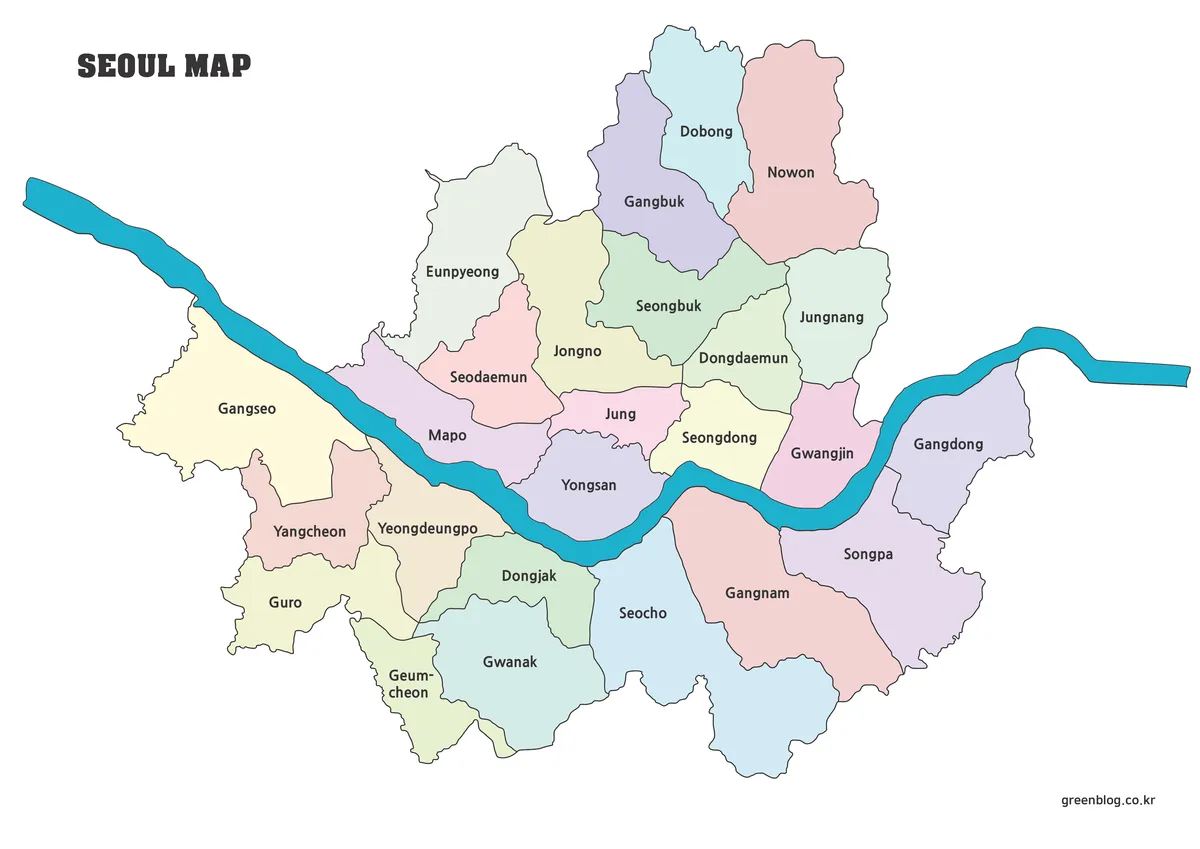
The color Seoul Map uses a separate pastel fill for each autonomous district and a strong blue band for the Han River. This treatment helps neighboring areas such as Gangnam, Seocho, Songpa, and Dongjak remain distinct even where several boundaries meet near the river. In the center, the color changes make the smaller Jung, Yongsan, Mapo, and Seongdong shapes easier to separate.
District names are placed directly inside their areas. Long names such as Yeongdeungpo and Dongdaemun fit horizontally, while Geumcheon is divided across two lines because of its narrow southern shape. The map title and large white margins keep the page uncluttered, but they also make clear that this is a district reference graphic rather than a complete urban atlas.
This version is the strongest choice for a presentation opening, a city overview, or a comparison of river-north and river-south districts. A teacher can ask students to identify the districts touching the river, while an editor can use the pastel separation as a visual index for a Seoul article. The blue river remains immediately recognizable even when the image is viewed at reduced screen size.
Black and White Printable Version
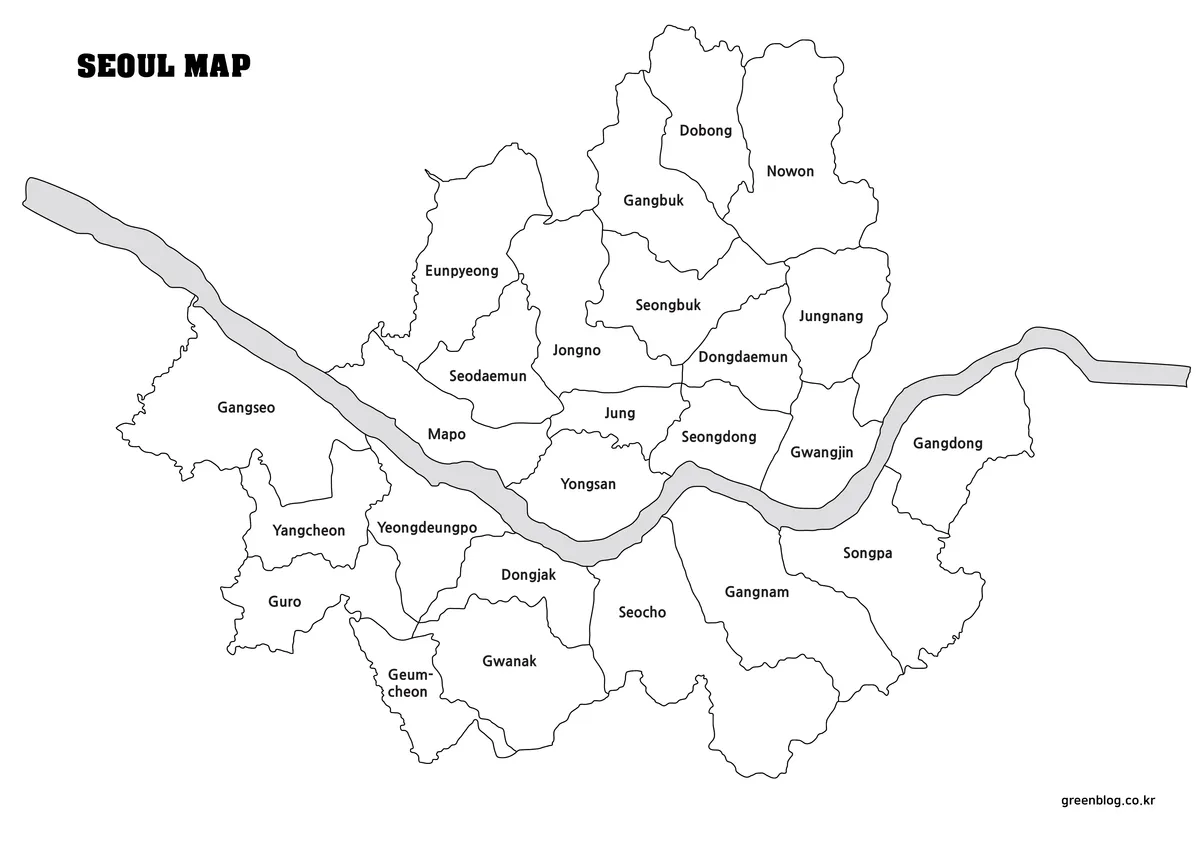
The black-and-white Seoul Map replaces the colored districts with open white areas and outlines the river in pale gray. Every district name remains visible, allowing readers to locate all 25 gu without referring to a second page. The reduced palette is useful when the map must sit beside charts, colored headings, or handwritten notes in the same document.
Line clarity matters most around the compact central districts and along the river bends. When reducing the A3 file to A4 or placing it in a narrow report column, check Jung, Seongdong, Gwangjin, Yongsan, and Mapo at the final size before printing a full set. The names are readable in the supplied layout, but heavy printer scaling can weaken the finer boundary lines.
For classroom review, this version can follow the color map: students first learn the district positions through color, then use the monochrome sheet to identify them by shape and location. It is also suitable for marking river-adjacent districts or grouping areas into northwest, northeast, southwest, southeast, and central sectors with pencil or highlighter.
Blank Outline Map for Editing
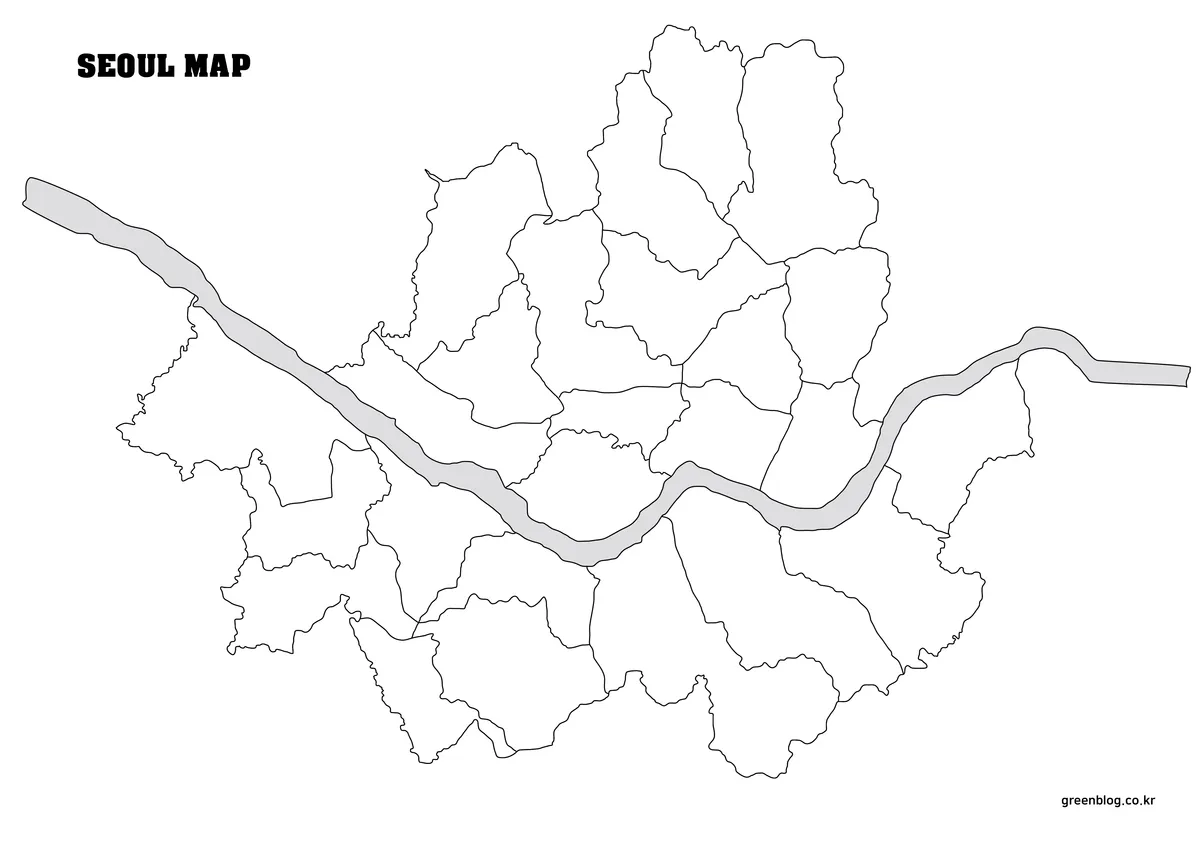
The blank Seoul Map removes all district labels and color fills while preserving the full gu boundary network and the river corridor. This creates space for custom English or Korean names, numbers, thematic colors, and short annotations. The underlying shapes remain recognizable, including Gangseo’s western reach, the northern Dobong–Nowon pair, and the southeastern Gangnam–Songpa area.
One classroom exercise is to label the 14 districts north of the river and the 11 districts south of it, then identify which districts meet the water. Another is to color the five broad planning sectors while retaining the official gu boundaries. Designers can add project locations or statistical categories, provided the final graphic explains that roads and precise point locations are not part of the base image.
The river is filled light gray rather than left transparent, giving it a stable visual role in an otherwise empty page. That makes the outline especially useful for route concepts or district comparisons that depend on crossing the Han. Since the file is raster-based, it should be treated as an annotation background rather than an editable source with independent district objects.
Designed for Printing and Presentation Use
The 4961 × 3508 Seoul Map files match an A3 landscape proportion and provide enough room for the longer district names. Keep the original aspect ratio when inserting an image into a slide or document; stretching it horizontally can distort district shapes and the river course. For printing, use fit-to-page settings and inspect the title, western river edge, and eastern river edge for clipping.
Choose color when rapid visual separation is the priority, monochrome when the labels must remain but the surrounding document needs a restrained appearance, and outline when the audience will add information. The three versions can share the same captioning system because their district arrangement is identical. They should not be presented as street, subway, terrain, tourism, or neighborhood maps.
For projected use, check that small central names remain legible from the back of the room. For worksheets, leave enough margin for notes and avoid shrinking the outline so far that the narrow boundaries around Jung and nearby districts merge. These simple output checks preserve the value of the clean district layout.
Frequently Asked Questions
Can I print the maps in large size?
Yes. The files were designed for high-resolution A3 printing.
Is the outline map editable?
Yes. The blank version works well for editing, annotations, and graphic design projects.
Are district names included?
The color and black and white versions include district labels. The outline version removes them for easier editing.
Download Information
Map File Information
The archive contains three district maps of Seoul for labeled reference, monochrome printing, and custom annotation.
- Included Versions: Color labeled, black and white labeled, blank outline
- Printable Size: A3 landscape
- File Type: JPG
- Intended Use: Lessons, presentations, reports, district reference, and image-based editing
Related Maps
Additional Resources
- Seoul Location Information — Review the city’s official explanation of the Han River, 25 autonomous districts, and overall geographic extent.
Green Map creates custom-edited map images using open geographic data sources such as geoBoundaries, Natural Earth, OpenStreetMap, and government open data. These maps are edited visual materials, not raw data files, and are provided for education, documents, presentations, and graphic reference.