A Denmark Map has to explain a country built around a peninsula, large islands, narrow straits, and many smaller pieces of land. Jutland forms the western core, Funen occupies a central position, and Zealand extends east toward Copenhagen. Bornholm sits much farther away in the Baltic Sea. A wide landscape frame is therefore essential if the central island network and the separated eastern island are both to remain readable.
The three supplied images share one geometry and one historical administrative layer. The color version labels older county-era areas and surrounding waters, the black-and-white version keeps those labels with no green or blue fill, and the outline removes the names and capital symbol. Each preview measures 1200×849 pixels, allowing readers to move from reference to annotation without changing the coastline or the position of Bornholm.
These boundaries are not current. Labels such as Viborg, Ringkjøbing, Ribe, West Zealand, Roskilde, Frederiksborg, and Storstrøm belong to the county structure that ended when Denmark’s municipal reform took effect on January 1, 2007. As of 2026, Denmark is organized into five regions and 98 municipalities. A Denmark Map based on the older scheme is consequently best used for historical comparison, island geography, print activities, and general orientation rather than present-day administrative reference.
Table of Contents
Denmark Map Overview
Denmark proper lies between the North Sea and Baltic Sea, north of Germany and southwest of Sweden. Neighboring land is not drawn on these sheets, so the water labels provide much of the orientation. The North Sea appears west of Jutland, Skagerrak lies above the peninsula, Kattegat occupies the passage toward Zealand, and the Baltic Sea is labeled below Bornholm.
The national shape reads naturally from west to east. Jutland carries most of the mapped county-era divisions and includes the country’s only land connection to continental Europe. Funen forms a bridge through the central island zone, and Zealand contains the Copenhagen area near its eastern side. On the Denmark Map, a star and leader lines help separate Copenhagen, Frederiksberg, Roskilde, and Frederiksborg in a compact part of the page.
Coastline complexity is more important here than one simple outer border. Fjords and inlets cut into northern and western Jutland, while islands and channels divide the space around Funen and southern Zealand. Bornholm appears to the far right without an inset frame, preserving its geographic separation within the composition. Greenland and the Faroe Islands are not included, so the graphics cover Denmark proper rather than the entire Danish Realm.
The eastern placement of Copenhagen also matters for map reading. The capital is not near the center of the country’s landmass; it faces the Øresund side of Zealand close to Sweden, although Sweden is outside the displayed frame. The map can introduce that position, but it contains no bridges, ferry routes, roads, railways, or travel distances.
Included Map Files
File Information
The set contains three coordinated WebP previews. All preserve the main islands, Bornholm, and the old internal boundary framework; only the amount of labeling and color changes. This consistency lets one Denmark Map serve as a reference, a second as a low-ink handout, and the third as an open base for student or designer input.
- Color reference: green land, blue water, older county labels, water names, and a Copenhagen marker
- Black-and-white reference: the same historical labels and capital marker on a white background
- Outline base: coastlines and old internal divisions without geographic names or water fills
- Published size: 1200×849 pixels in each supplied preview
The visible files are raster images, not confirmed vector artwork or GIS layers. Internal areas should not be assumed to function as independently selectable polygons. Preserve an untouched original before painting regions, erasing lines, or adding a new legend. No terrain, road, facility, population, municipal, or transport layer is included.
A date note should accompany every version. Simply replacing an old county name with a modern regional name would not correct the geography, because the 2007 reform changed the underlying divisions. For a present-day task, use current official boundaries rather than relabeling the historical lines. For a comparison exercise, retain both systems and explain what changed.
Regional Color Map
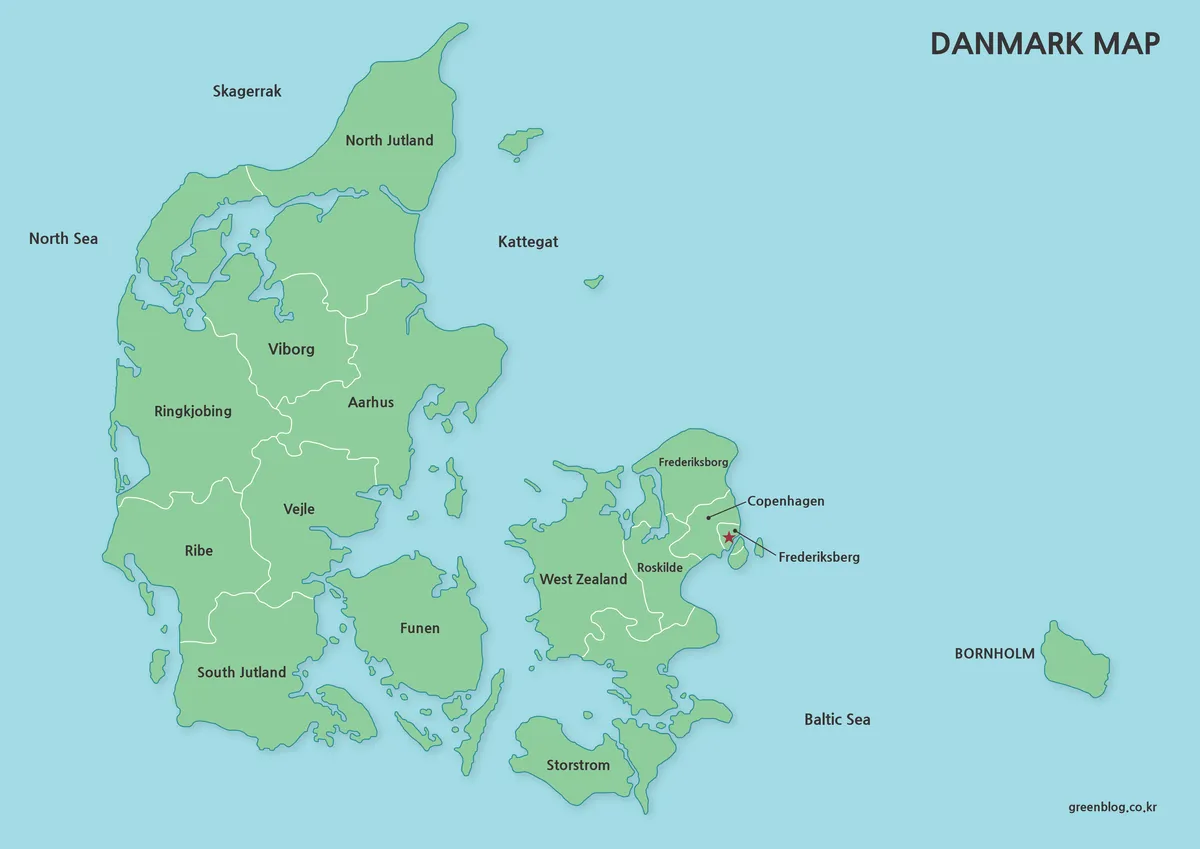
The color Denmark Map uses green land, pale blue water, white internal lines, and dark labels. The palette makes the channels around Funen, Zealand, and the smaller islands easier to distinguish on screen. It does not assign a different fill to every division, so green has no statistical meaning and should not be read as a category, elevation, or land-cover value.
Historical labels visible across Jutland include North Jutland, Viborg, Ringkjøbing, Aarhus, Vejle, Ribe, and South Jutland. Funen is labeled on the central island, while West Zealand, Storstrøm, Roskilde, Frederiksborg, Copenhagen, and Frederiksberg appear farther east. Bornholm remains isolated beside the Baltic label. These names make the file useful for pre-2007 comparison when the date is stated clearly.
Use the color version for an introductory geography slide, a historical county overview, or a lesson about Denmark’s surrounding seas. Any added route should be visually distinct from the white boundaries, and new markers should not compete with the Copenhagen star. A present-day administrative graphic requires a different base rather than a new legend placed over these lines.
Black and White Printable Version
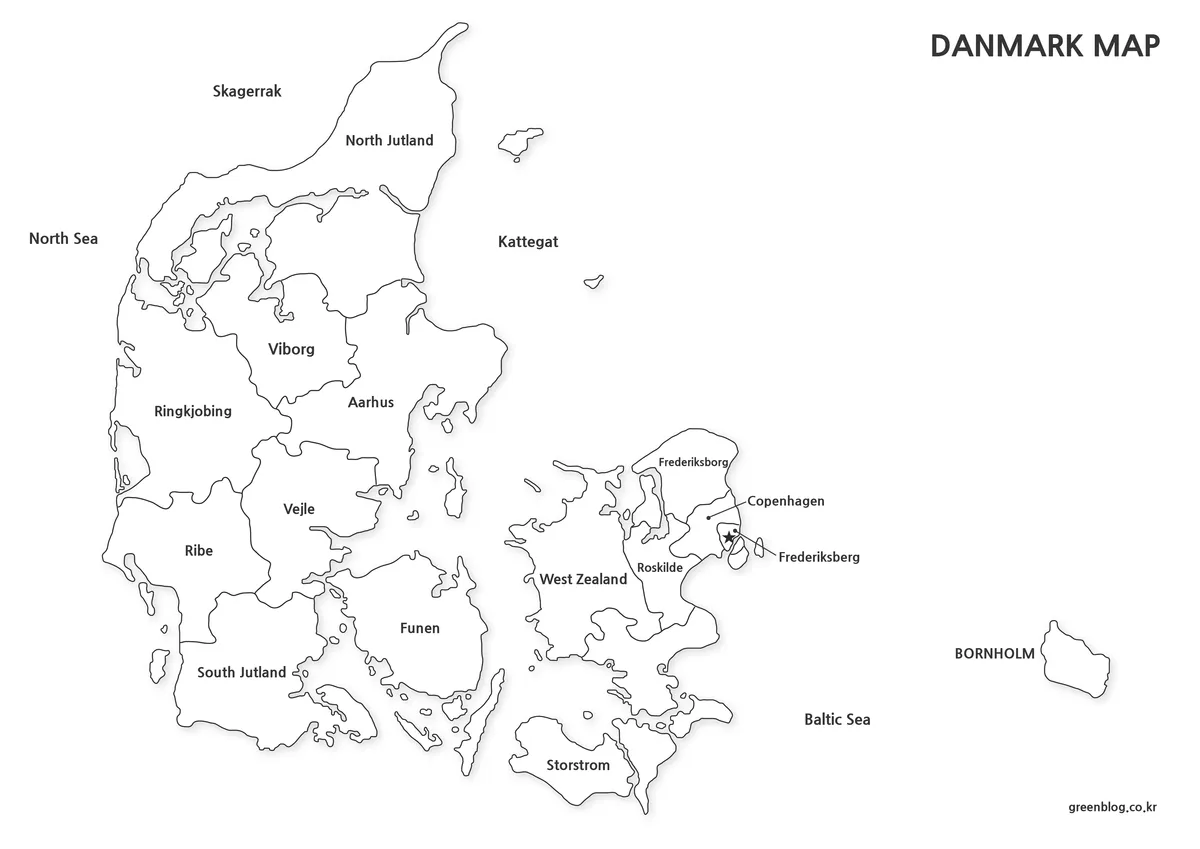
The black-and-white Denmark Map retains the historical area names, sea labels, Copenhagen marker, coastlines, and old internal divisions while removing the green and blue fields. Strong outer coastlines remain distinguishable from thinner inner lines. This difference is particularly helpful around small islands and eastern Zealand, where too many equally dark strokes would make the geography difficult to follow.
This version suits labeled worksheets, report figures, photocopies, and guided notes. Students can underline Jutland, circle Funen, trace Zealand, and locate Bornholm without first supplying every name. Use the outline when recall is the goal. Print a proof before making a class set because small labels around Copenhagen and the island channels can lose clarity after heavy reduction.
Several labels use simplified English forms or spellings without Danish characters, including Ringkjobing and Storstrom in some contexts. Treat the embedded words as source-image labels rather than a formal naming guide. If precise Danish orthography is required, provide a verified list next to the protected image instead of altering its media block.
Blank Outline Map for Editing
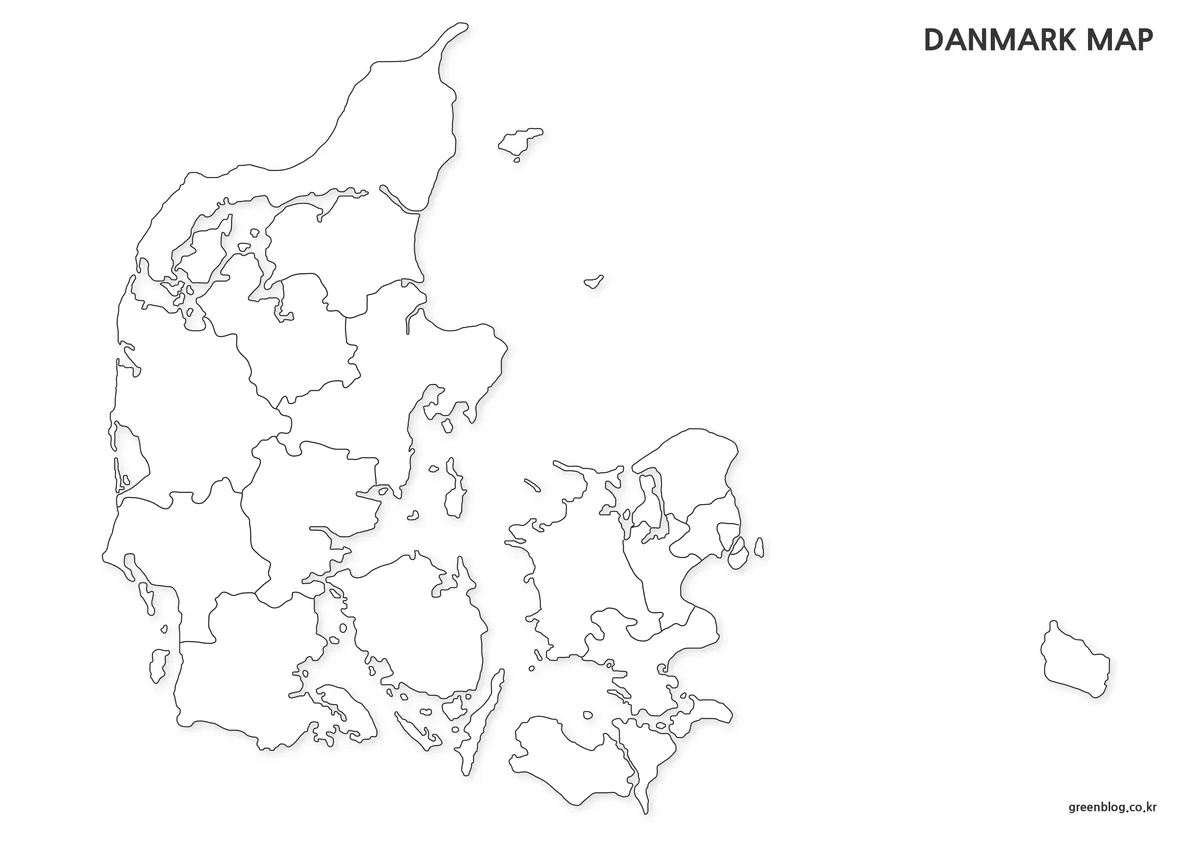
The outline Denmark Map removes all place names, water labels, color fills, and the Copenhagen star. It preserves the complex coast, smaller islands, Bornholm, and the county-era internal lines. Open white space makes it the most flexible option for labeling, color keys, route sketches, and historical exercises, but it is not a blank current-region map.
A strong activity can use two layers of information: one color for the former county areas and a separate overlay or reference for the regions established in 2007. This turns the old boundaries into a teaching advantage. Writing modern region names directly over the historical geometry without explanation would instead produce a misleading administrative graphic.
Small islands are the main editing challenge. Thick symbols can close narrow channels around Funen and southern Zealand, while long labels can obscure compact eastern shapes. Add text at the final output size and use short leader lines when necessary. Bornholm has more surrounding space, so a nearby label or statistic can be placed without covering its coastline.
The outline is unsuitable for legal boundaries, cadastral decisions, navigation, or precise spatial analysis. It has no scale, coordinates, projection information, or current municipality layer. For thematic work, add a dated legend, units, and source, and describe the base as a historical illustrative map.
Practical Uses
For teaching, display the color Denmark Map while introducing Jutland, Funen, Zealand, Bornholm, and the four labeled water bodies. Move to monochrome for guided notes and use the outline for recall. A visible “pre-2007 county boundaries” caption should remain with every version so learners do not confuse the historic scheme with current administration.
For presentations, choose color when the sea passages and fragmented coastline must read immediately. Choose black and white when annotations or charts need to dominate the palette. Choose the outline only when the audience will add information or compare boundary systems. The shared landscape geometry keeps Bornholm visible and supports direct version-to-version comparison.
- Island geography: compare Jutland, Funen, Zealand, smaller islands, and Bornholm.
- Water context: label the North Sea, Skagerrak, Kattegat, and Baltic Sea.
- Historical study: contrast county-era boundaries with the post-2007 system.
- Print work: use monochrome for notes and outline for independent labeling.
Frequently Asked Questions
The preserved FAQ covers roads, printing, and editing. Before applying those answers, remember that this Denmark Map collection shows county-era boundaries that ended in 2007; current regional or municipal work requires a separate official reference.
Does the map include detailed roads and facilities?
No. The collection focuses on regional structure and readability rather than transportation details.
Can the maps be printed clearly?
Yes. All files were created in high resolution for A3 printing.
Is the outline version editable?
Yes. The blank version works well for graphic editing and annotations.
Map File Information
This archive contains three coordinated maps using Denmark’s pre-2007 county-era boundary framework.
- Included Versions: Labeled color, labeled black-and-white, and unlabeled outline
- Intended Use: Geographic study, historical comparison, printing, notes, and design
Related Maps
Additional Resources
- Official Website of Denmark — Explore an official introduction to Denmark’s islands, society, culture, and national setting.
Green Map creates custom-edited map images using open geographic data sources such as geoBoundaries, Natural Earth, OpenStreetMap, and government open data. These maps are edited visual materials, not raw data files, and are provided for education, documents, presentations, and graphic reference.