An Albania Map is most useful when it distinguishes the country’s 12 counties from the smaller municipalities below them. The three supplied images use one portrait layout and the same county geometry: a pastel color version, a labeled black-and-white version, and an unlabeled outline. Together they support regional orientation, economical printing, and independent labeling without presenting the artwork as a detailed road or terrain map.
The labeled editions place Montenegro to the northwest, Kosovo to the northeast, North Macedonia to the east, and Greece to the southeast. The Adriatic Sea is named along the western coast. The southwestern water label reads “Lonian Sea” in the artwork, but the correct geographic name is Ionian Sea. This spelling issue should be corrected in any derivative worksheet or presentation.
This Albania Map shows county boundaries, surrounding-country context, several lake shapes, and a star for Tirana. It does not show the 61 municipality boundaries, roads, other city points, rivers, mountain relief, elevation, distances, or a scale bar. Each supplied preview measures 1,200 × 1,697 pixels, giving the long north-to-south country enough room on a portrait page.
Table of Contents
Albania Map Collection Overview
Albania’s official statistical classification identifies 12 counties and 61 municipalities. The county-level framework displayed here consists of Berat, Dibër, Durrës, Elbasan, Fier, Gjirokastër, Korçë, Kukës, Lezhë, Shkodër, Tiranë, and Vlorë. These are first-level administrative areas; the map does not subdivide them into the municipality layer.
The labels printed on the Albania Map omit several Albanian diacritics: Shkoder, Kukes, Lezhe, Diber, Durres, Tirana, Korce, Vlore, and Gjirokaster appear instead of Shkodër, Kukës, Lezhë, Dibër, Durrës, Tiranë, Korçë, Vlorë, and Gjirokastër. Fier, Berat, and Elbasan do not change. Use the official spellings when preparing a formal geographic reference.
Spatially, Shkodër and Kukës occupy the north, with Lezhë and Dibër below them. Durrës and Tiranë create the compact central-western pair, while Elbasan extends eastward. Fier, Berat, and Korçë form much of the middle-south, and Vlorë and Gjirokastër reach toward the southern border. The shapes also reveal why a simple national silhouette cannot teach county adjacency.
Color Administrative Map
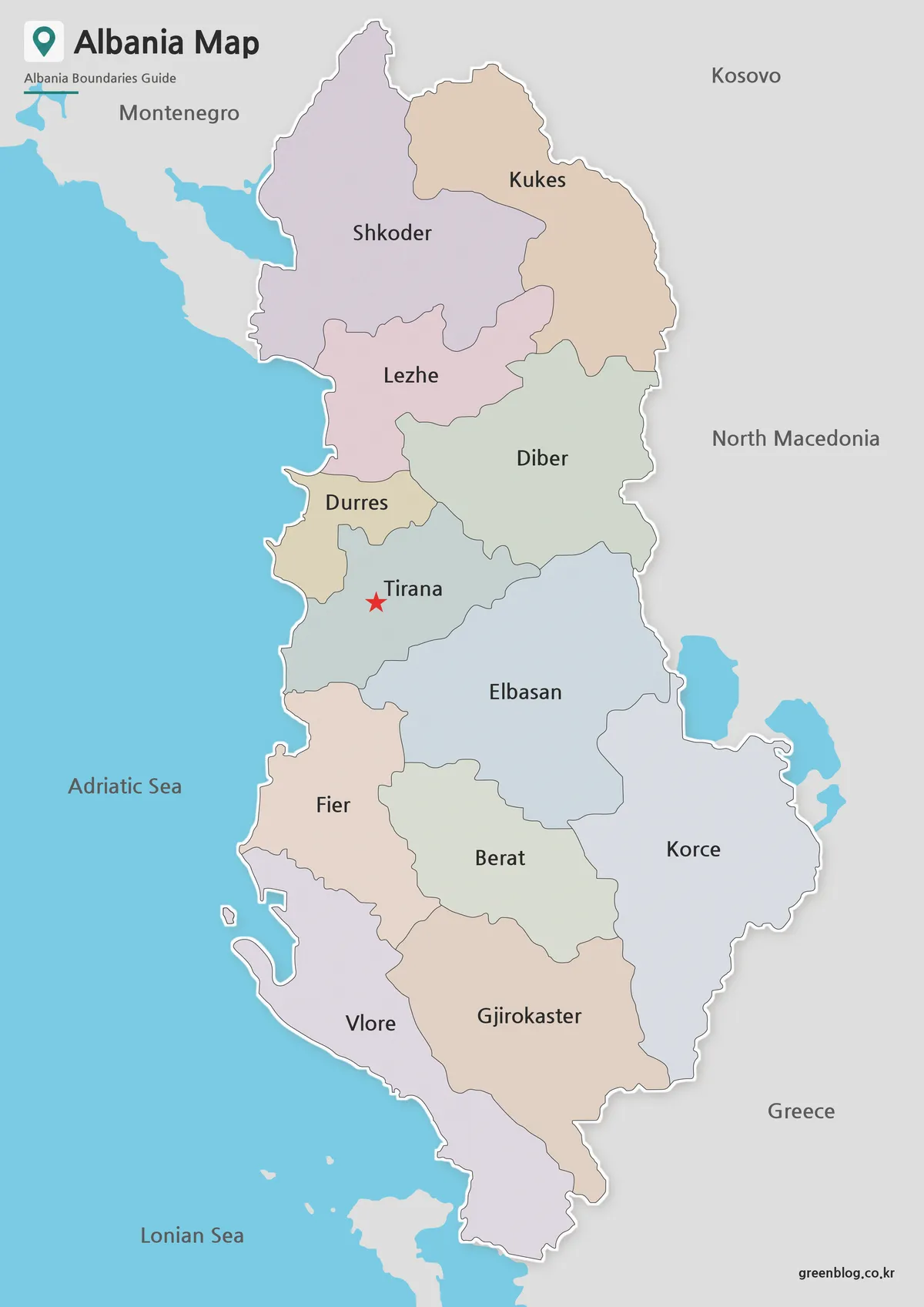
The color Albania Map gives each county a muted fill so adjoining areas can be separated quickly. Tirana receives a red star inside Tiranë County, making the national capital easy to locate. Neighboring countries remain gray and the western water is blue, producing a clear hierarchy between the target country, its internal divisions, and the broader Balkan context.
The palette is categorical rather than statistical. It does not encode population, elevation, economic output, climate, or any other measured value. If the image is adapted for data work, replace the decorative colors with a documented scale and add a legend. Otherwise, readers may incorrectly interpret neighboring pastel shades as higher or lower values.
The map also includes recognizable lake shapes near Montenegro and along the North Macedonia and Greece side, but those waters are not named. It does not plot Durrës, Shkodër, Vlorë, or other cities as point locations merely because counties carry similar names. Only Tirana is explicitly marked with a city symbol.
Useful For
- Introducing all 12 counties in a geography lesson
- Comparing Albania with its four land neighbors
- Locating Tirana within the county framework
- Explaining Albania’s Adriatic and Ionian coastal position
- Providing a county reference beside a data table
Black and White Printable Version
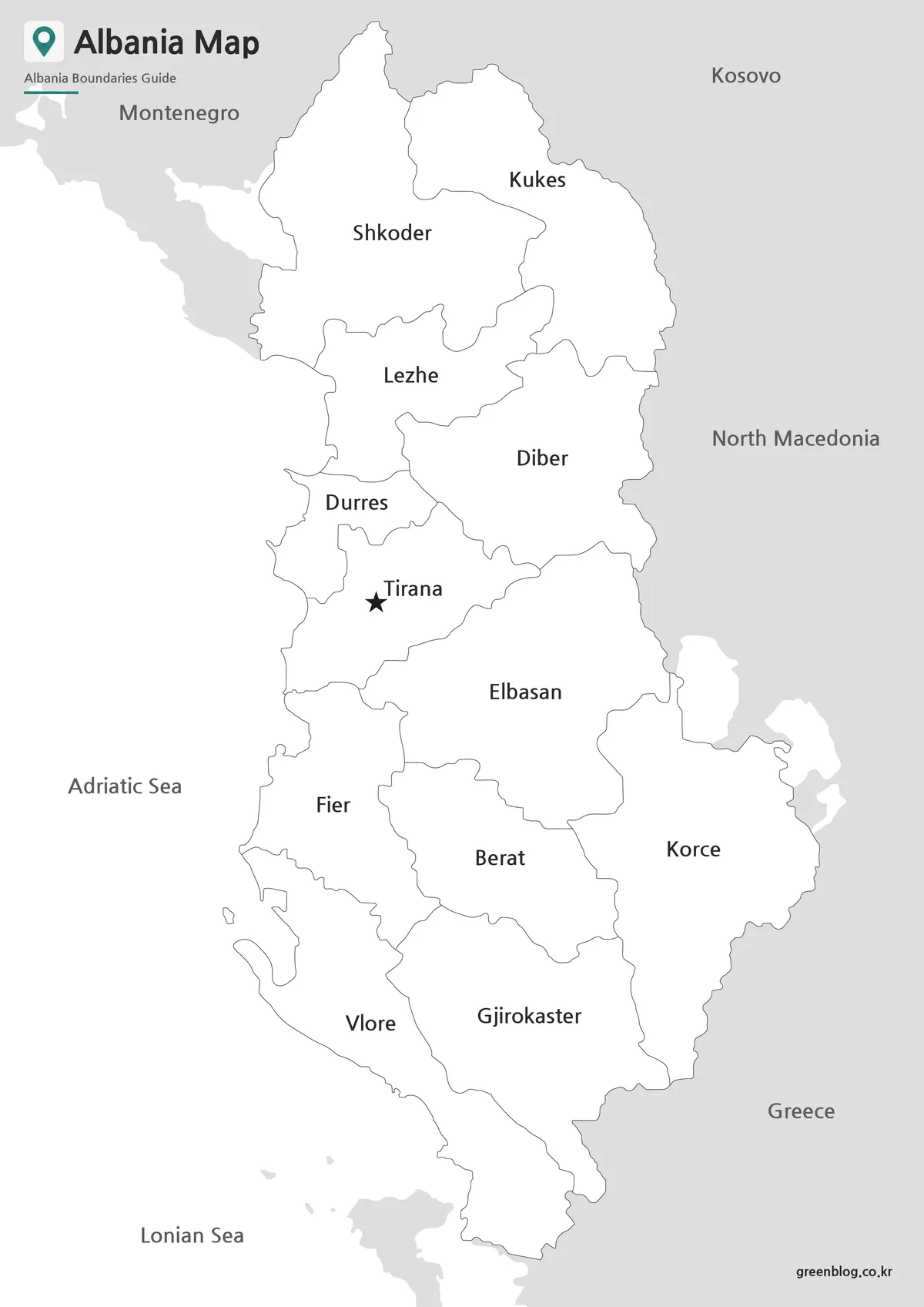
The black-and-white Albania Map keeps the 12 county names, boundary lines, Tirana star, four neighboring-country labels, and both sea labels while removing the pastel fills. This makes it the strongest choice for low-ink printing, photocopies, reference sheets, or pages that need handwritten annotations beside the map.
Print one test copy before producing a large set. Names such as Durrës and Lezhë occupy relatively small western counties, so excessive reduction can make the labels uncomfortable to read. Preserve the portrait aspect ratio, leave white page margins, and avoid stretching the map to fit a landscape box. The misspelled southwestern sea label remains present in this edition and needs the same correction noted above.
Common Uses
- County-name review and answer keys
- Monochrome report or workbook pages
- Handwritten regional notes and symbols
- Border-country and coastline exercises
- Accessible layouts that do not depend on color
Blank Outline Map for Editing
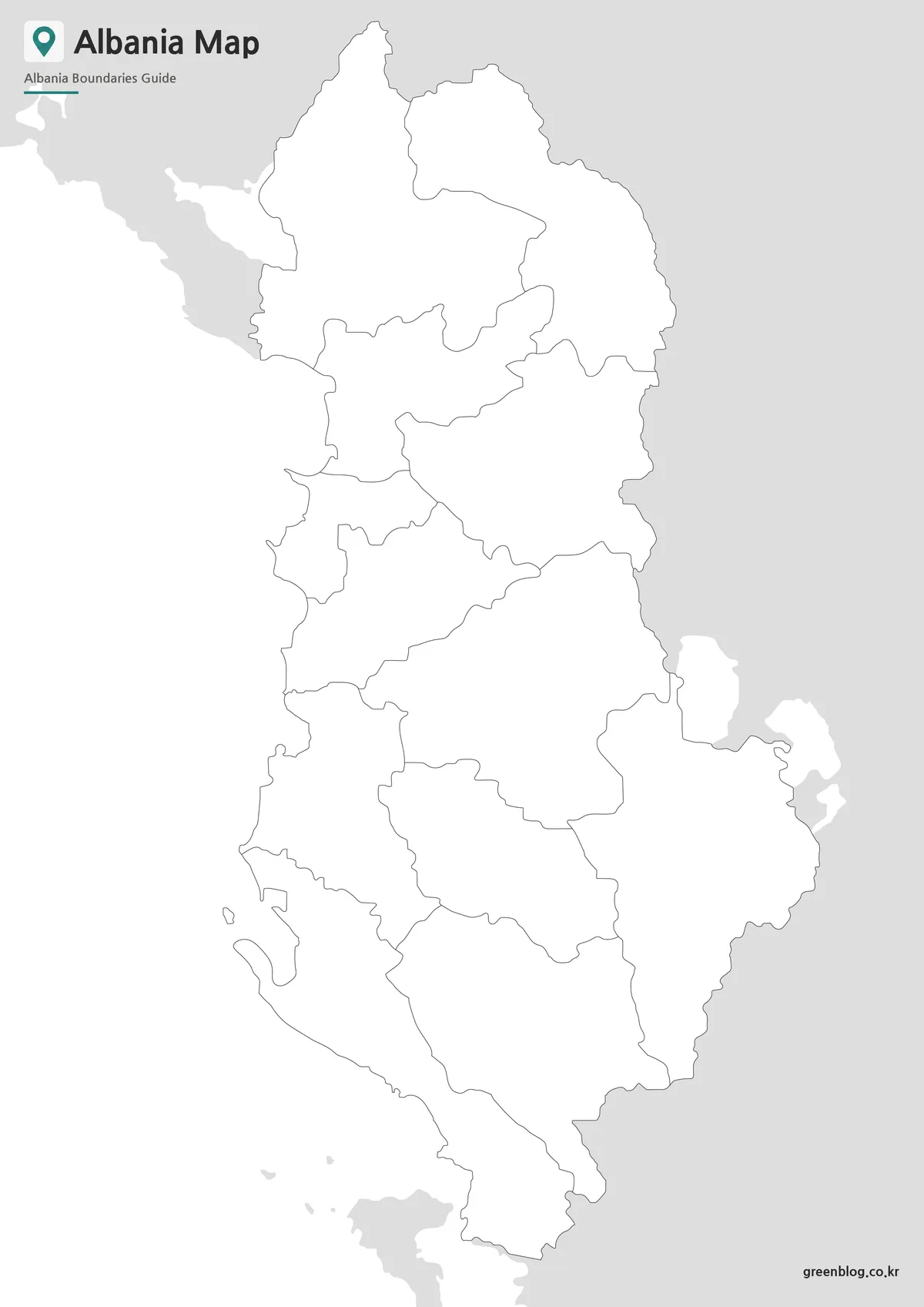
The outline Albania Map removes county names, neighbor labels, sea text, Tirana’s star, and all internal color. It preserves the national coastline, 12 county shapes, and simplified surrounding land-and-water context. Students can supply the names from memory, while designers can add a purpose-built legend without first deleting the original text.
Keep an untouched reference copy and edit a duplicate. Add labels outside narrow areas with short leader lines, state what every symbol means, and cite the date and source of any overlaid data. When exact roads, municipalities, elevation, or legal boundaries are required, obtain an authoritative spatial layer rather than tracing them from this simplified illustration.
Works Well For
- A 12-county labeling quiz
- Custom regional groupings and legends
- Sourced county-level statistics
- Capital and city-marker exercises
- Balkan border and coastline comparisons
Designed for Printing and Visual Projects
Choose the version according to what the reader must do. The color image supports rapid visual separation, monochrome supports reading and annotation, and the outline supports recall or original thematic design. Using all three in sequence can turn one Albania Map collection into an introduction, study sheet, and assessment.
For a county lesson, begin with the northern pair of Shkodër and Kukës, then move down the west and east sides toward Vlorë and Gjirokastër. For a border exercise, identify the four neighboring countries and ask which counties meet each frontier. For a coastal exercise, correct Ionian Sea before publication and explain how the Adriatic and Ionian sections relate to the western shoreline.
Do not use these images to calculate distance or navigate. They have no scale bar, projection note, route network, or coordinate grid. Their value lies in a clean county-level hierarchy and consistent versions. Any added population, transport, tourism, or physical-geography information should be visibly separated from the original layer and supported by a cited source.
Frequently Asked Questions
Can I print the Albania Map in A3 size?
Yes. The collection was prepared for high-resolution A3 printing.
Which version is best for classroom activities?
The black and white map is usually the easiest for students to annotate and study.
Is the outline map editable?
Yes. The outline version was created specifically for editing and custom graphic projects.
Why does the map focus on major administrative regions?
Displaying larger regions improves readability and makes the overall structure easier to understand.
Does the map label the Ionian Sea correctly?
No. The color and black-and-white images print “Lonian Sea” with an initial L. Replace it with “Ionian Sea” in any derivative graphic. The blank outline avoids the error because it contains no sea labels.
Map File Information
The package contains matching color, monochrome, and blank county maps for printing, reference, and customization.
- Included Versions: Color labeled, black-and-white labeled, and blank outline
Related Maps
Additional Resources
- INSTAT Administrative Divisions: official confirmation of Albania’s 12 counties and 61 municipalities.
Green Map creates custom-edited map images using open geographic data sources such as geoBoundaries, Natural Earth, OpenStreetMap, and government open data.
These maps are edited visual materials, not raw data files, and are provided for education, documents, presentations, and graphic reference.