This Nigeria Map fits a broad northern interior, a narrow southern coast, 36 states, and the Federal Capital Territory into one landscape frame. Large northern states leave generous label space, while Lagos and several southeastern states require compact or rotated text.
Nigeria borders Benin, Niger, Chad, and Cameroon and opens southward to the Gulf of Guinea. The supplied labeled artwork names Benin, Niger, and Cameroon but omits Chad. It also labels the water as “Gulf of guinea,” with a lowercase “g,” so accompanying prose should use the standard capitalization even when the image itself is unchanged.
The collection contains a pastel state reference, a black-and-white labeled sheet, and an unlabeled administrative outline. All three Nigeria Map previews measure 1200 × 849 pixels and share the same boundaries. They pair as a completed reference, neutral print sheet, and blank activity without shifting the geometry.
Table of Contents
Printable Nigeria Map Overview
Nigeria’s federal structure consists of 36 states and the Federal Capital Territory. The completed maps label every state and use the abbreviation “FCT” for the central capital territory. They do not print the word “Abuja” or add a star, dot, or other capital symbol, so the FCT label is the only capital-area cue within the supplied artwork.
Across the upper edge, Sokoto, Katsina, Jigawa, Yobe, and Borno meet the northern border, while Kebbi and Zamfara fill the northwest below Sokoto. Kano sits inside the northern interior rather than on the international boundary. Kaduna, Bauchi, and Gombe lead toward the center and northeast, with Adamawa and Taraba extending down the long eastern side toward Cameroon.
The label “Niger” appears twice and has two different meanings. The word above Nigeria identifies the neighboring country; the one inside the large west-central unit identifies Niger State. This Nigeria Map relies on position rather than different typography to distinguish them, so a classroom caption should explain the difference before students begin labeling.
Central Nigeria contains a tight relationship among Niger State, Kaduna, the FCT, Nasarawa, Plateau, Kogi, and Benue. The map spells Nasarawa as “Nassarawa” in both labeled versions; official Nigerian sources use one “s” after the first “a.” The artwork’s spelling should therefore be corrected in answer keys, overlays, and accompanying text.
The southwest brings together Kwara, Oyo, Osun, Ekiti, Ogun, Ondo, Lagos, Edo, and Kogi. Lagos is too small for a comfortable internal label, so a leader line points from the state to its name near the coast. That solution keeps the boundary visible while preventing the label from covering the narrow coastal shape.
Labels become especially dense southeast of Edo and Kogi. Delta, Bayelsa, Rivers, Imo, Abia, Anambra, Enugu, Ebonyi, Akwa Ibom, and Cross River are fitted into a compact coastal and inland cluster. Anambra is written vertically, while Cross River and Akwa Ibom use stacked words. These placements are useful checkpoints when judging whether a reduced print remains readable.
Color Nigeria State Map
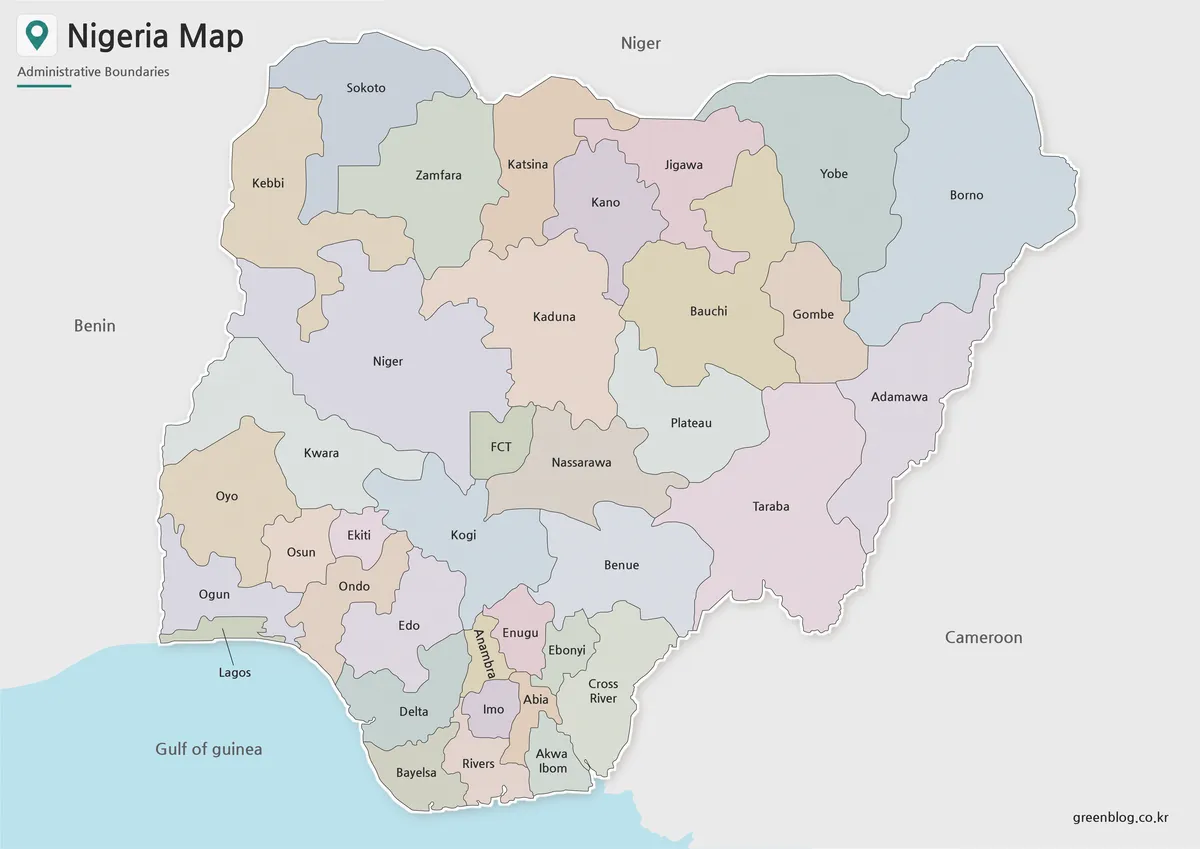
The color Nigeria Map uses alternating pastel fills to separate adjacent states. The treatment clarifies the broad northern blocks around Sokoto, Zamfara, Kaduna, Bauchi, Yobe, and Borno, then becomes more valuable in the crowded southern group where several short borders meet. Blue water also gives the Gulf of Guinea a clear visual separation from the coast.
The palette is categorical only. It does not encode population, geopolitical zone, language, vegetation, resources, elections, or economic data, and no statistical legend is provided. A presenter can use the colors to follow state boundaries, but any thematic interpretation needs a new legend, a cited dataset, and a reference date.
This edition is best suited to a screen presentation or completed classroom reference where rapid state separation matters. A useful reading sequence begins along the northern border, moves through the FCT and neighboring central states, and ends with the compact southern coast. That order follows the visual density of the map instead of treating every label as equally difficult.
Black and White Printable Nigeria Map
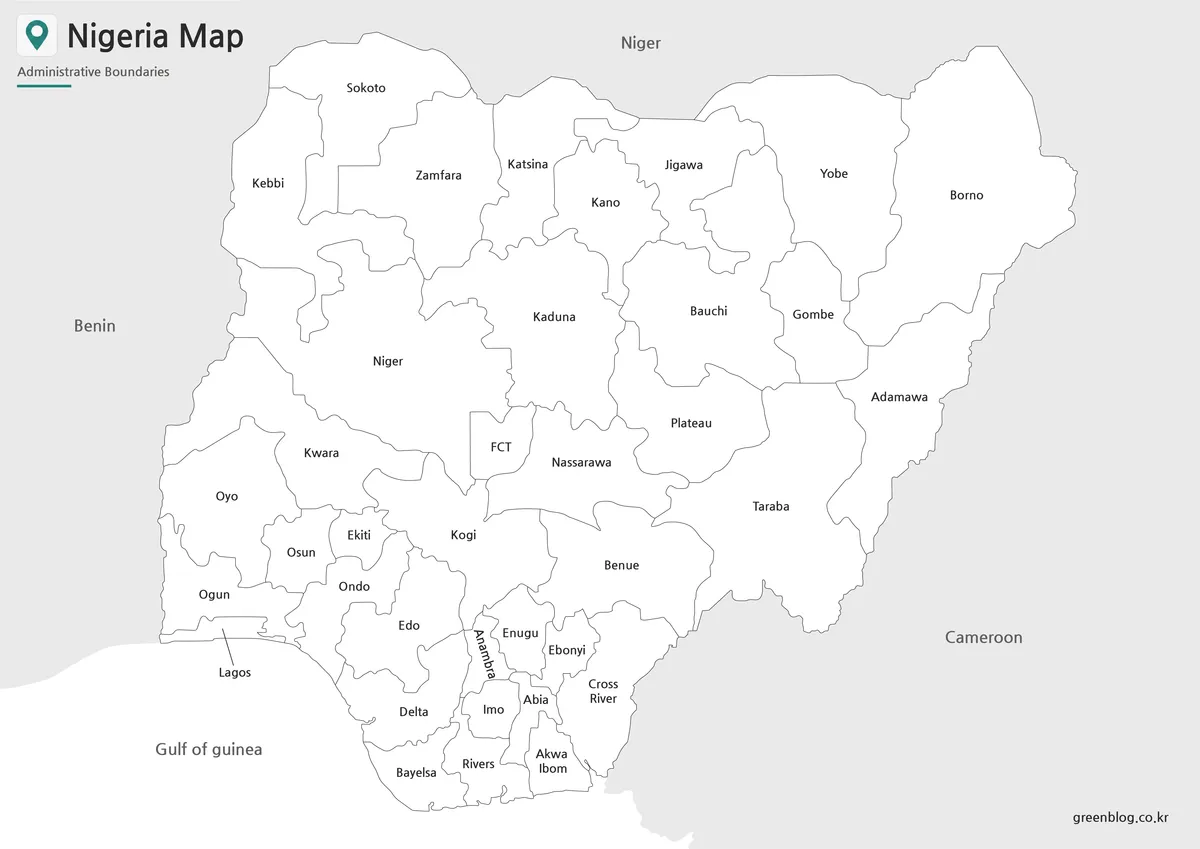
Monochrome removes the pastel categories while preserving every state name, the FCT label, the three neighboring-country names, and the Gulf label. White interiors place more emphasis on spelling and shared boundaries. The leader line for Lagos and the rotated Anambra text remain, which helps the version function as an answer key rather than a blank exercise.
This view suits documents where a neutral administrative figure is preferable to a colored illustration. Readers can circle one state, shade a study group by hand, or compare names without interpreting decorative colors. Before printing at a reduced size, check Lagos, FCT, Anambra, Abia, Ebonyi, Akwa Ibom, and Cross River because those labels have the least spare space.
Blank Nigeria Outline Map for Editing
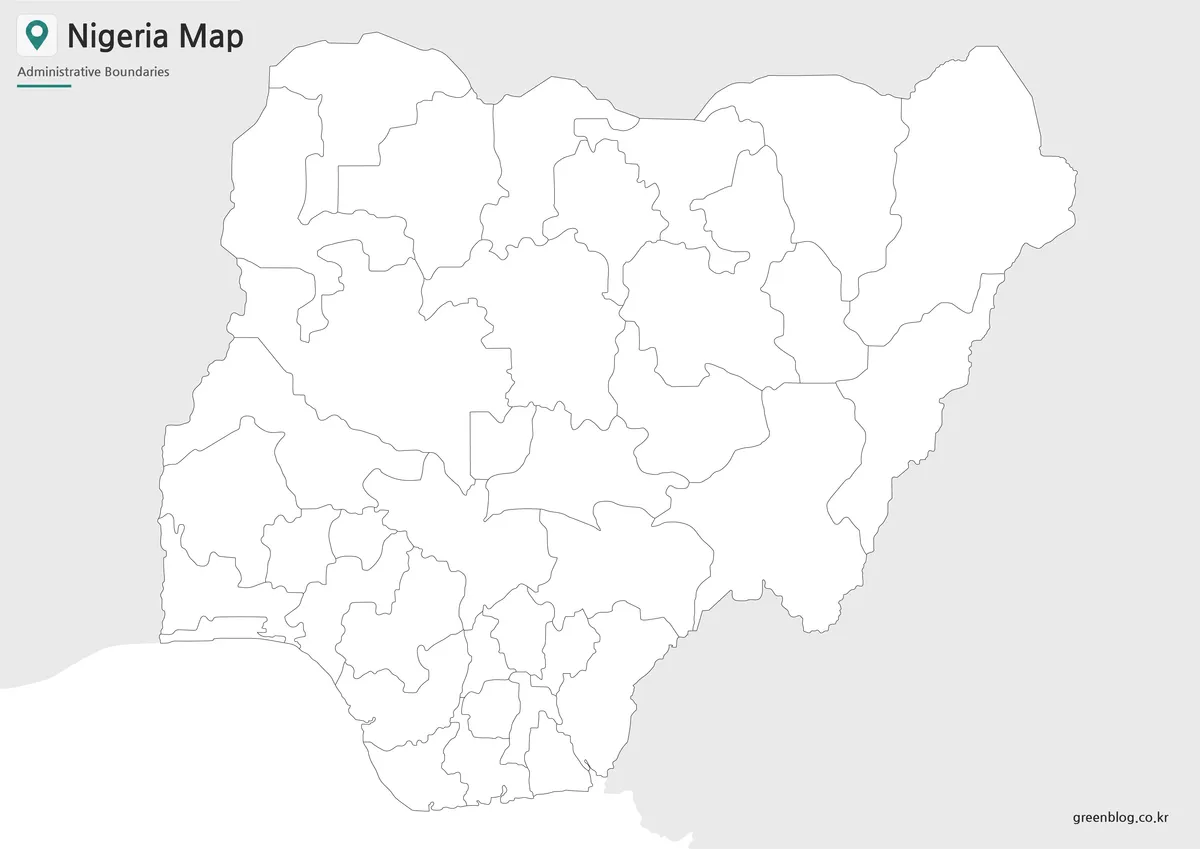
The outline removes state names, “FCT,” neighboring-country labels, the Gulf label, and every pastel fill. It retains the national silhouette, all internal administrative lines, the page title, “Administrative Boundaries” subtitle, gray surrounding land, and site mark. It is therefore blank for study purposes rather than a border-only country outline.
Students can identify the five states along the northern edge, distinguish Niger State from the country to the north, or rebuild the dense southeastern cluster using the labeled version as a key. Designers may add verified capital or city markers, regional categories, or data values. The supplied WebP is a raster image, however, and should not be described as a vector, GIS, or editable source file.
Why This Nigeria Map Is Useful
The map makes several distinctions that a national locator cannot show. It separates 36 states from the FCT, reveals the very different label density of northern and southern Nigeria, and shows how the Gulf of Guinea shapes the coastline. It also exposes where readers need clarification: the duplicated Niger name, missing Chad label, misspelled Nasarawa, and absent Abuja marker.
Use the color edition when neighboring states must be recognized quickly, the monochrome edition when names belong in a low-color document, and the outline when learners or designers should supply information. None of the three includes roads, rivers, terrain, local government areas, state capitals, a scale, or a north arrow. Those layers require a different map or a separately verified overlay.
The archive was prepared for high-resolution A3 use, and the previews share a 1200 × 849 landscape ratio. Preserve that proportion when placing the image so the coastal states are not stretched or compressed. A test print should focus on the small southern labels rather than the much larger and easier northern areas.
Practical Uses for Students, Teachers, and Designers
A teacher can pair the labeled Nigeria Map with the outline and organize the assignment into northern border states, central states around the FCT, southwest states around Lagos, and the southeast coastal cluster. Students can correct “Nassarawa” in their answer key and add Chad to the northeast margin. These tasks turn visible artwork limitations into specific geography checks.
For presentation work, the color map provides immediate administrative separation without implying a data classification. The monochrome sheet can support a written country profile, while the outline can carry a custom legend based on verified statistics. If Abuja, Lagos, state capitals, roads, or routes are added, identify them as new overlay content rather than features supplied by the original map.
For classroom printing, keep the map in landscape orientation and leave room around the western Lagos leader line and the Gulf label. Avoid cropping the gray margin too tightly, because it contains the neighboring-country context. On smaller sheets, a separate numbered key may be clearer than forcing every southeastern name into its state.
Frequently Asked Questions
Does the Printable Nigeria Map include all states?
Yes. The map is designed to show Nigeria’s 36 states and the Federal Capital Territory, Abuja, in a clear visual layout.
Is Abuja shown on the map?
Yes. Abuja is marked so users can identify the capital area more easily.
Which version is best for printing?
The black and white version is usually best for printing because it keeps the layout clean and avoids heavy color use.
Can I use the outline map for editing?
Yes. The outline version is useful for adding custom labels, colors, routes, data points, or classroom worksheet elements.
Is this map suitable for classroom use?
Yes. The map collection works well for geography lessons, student handouts, printable assignments, and regional comparison activities.
Image clarification: In the supplied files, Abuja is not written or marked with a capital symbol. The central territory is identified only by the abbreviation “FCT.”
Map File Information
The archive contains the three Nigerian administrative views displayed above for printing, reference, labeling, and custom graphics.
- Included Versions: Color labeled, black-and-white labeled, and blank outline maps
- Printable Size: A3 high resolution
- File Type: Image files in a ZIP archive
- Intended Use: Lessons, answer keys, reports, slides, annotations, and design projects
Related Maps
Additional Resources
The Nigerian National Bureau of Statistics’ agency overview explains the country’s federal statistical structure across 36 states, the FCT, and local government areas.
Green Map creates custom-edited map images using open geographic data sources such as geoBoundaries, Natural Earth, OpenStreetMap, and government open data. These maps are edited visual materials, not raw data files, and are provided for education, documents, presentations, and graphic reference.