This Tanzania Map records an earlier administrative picture of the country rather than its current 31-region framework. The labeled artwork shows 21 mainland regions and five Zanzibar regions—the 26-region arrangement used in 2010-era national statistics. It does not separate the later mainland regions of Geita, Katavi, Njombe, Simiyu, and Songwe, so the date context matters before the map is used in a current administrative lesson.
Within that historical scope, the set gives readers three coordinated views: a pastel regional map, a labeled black-and-white map, and an unlabeled outline. A fourth image presents Tanzania’s flag. The map sheets share a 1200-by-849-pixel landscape canvas arranged for A3 use, while the flag uses a separate 900-by-600-pixel format.
The maps connect mainland Tanzania with the islands of Zanzibar and its East African surroundings. Dodoma is identified with a star near the center, Dar es Salaam appears on the coast, and leader lines keep the small island labels readable. Neighboring-country names and the Indian Ocean provide orientation, while the internal boundary pattern remains the main subject.
Table of Contents
Printable Tanzania Map Collection
Tanzania stretches from the Great Lakes region to the Indian Ocean. It borders Kenya and Uganda in the north; Rwanda, Burundi, and the Democratic Republic of the Congo in the west; Zambia, Malawi, and Mozambique toward the south. The mainland outline therefore combines lake-edge borders, a long coast, and several international boundaries in one broad landscape composition.
The offshore area is not treated as a decorative inset. Pemba and Zanzibar are drawn east of the mainland and connected to five labeled island regions: Pemba North, Pemba South, Zanzibar North, Zanzibar Urban, and Zanzibar Central. Their small scale requires callout lines, especially around Zanzibar, where several labels would otherwise overlap.
A current comparison is essential. Tanzania now has 31 regions in national statistical reporting: 26 on the mainland and five in Zanzibar. The supplied Tanzania Map retains the earlier total of 26, and its mainland shapes predate the separate presentation of five newer regions. This makes the collection appropriate for historical comparison, map-reading practice, and projects that clearly state the boundary period—not as an unlabeled claim about today’s complete regional system.
- Color map with earlier regional names, neighboring countries, islands, and a Dodoma star
- Black-and-white map preserving the same labels and boundary geometry
- Blank outline with mainland and island regional divisions
- Tanzania flag with its diagonal green, black, yellow, and blue design
Regional Color Tanzania Map
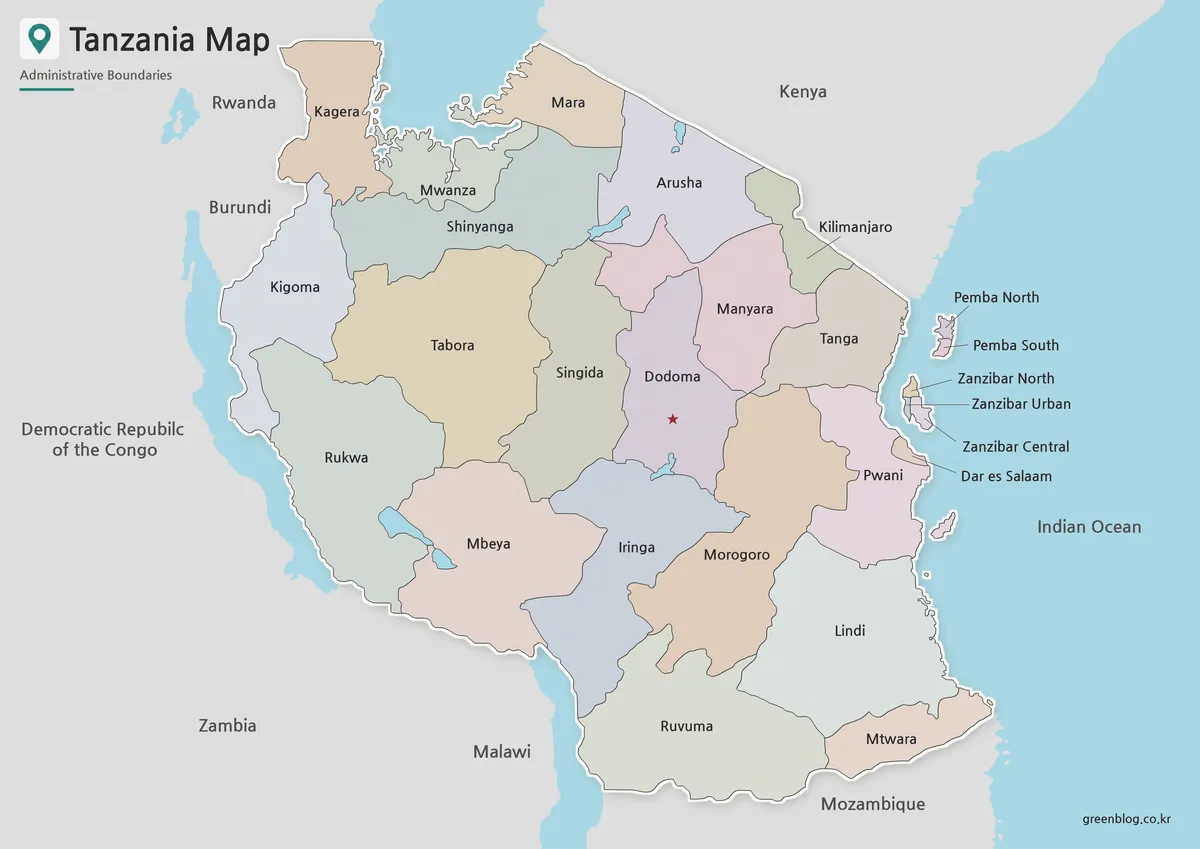
Muted fills separate adjacent regions without suggesting a data scale. Kagera, Mwanza, Shinyanga, Mara, and Arusha can be followed across the north, while Kigoma, Tabora, Rukwa, Mbeya, and Ruvuma help define the western and southwestern sequence. Along the coast, Tanga, Pwani, Dar es Salaam, Lindi, and Mtwara form a clear north-to-south progression.
The star inside Dodoma gives the map a national reference point distinct from the regional labels. It also helps readers compare the inland capital with Dar es Salaam on the coast. Small blue lake shapes and a pale-blue ocean add geographic context, but the image does not label physical features or present itself as a terrain, road, or hydrographic map.
Color is most valuable where boundary shapes meet around the center. Singida, Dodoma, Manyara, Iringa, and Morogoro are easier to distinguish when each receives a different fill. Use this Tanzania Map for a slide explaining the earlier arrangement, a historical worksheet answer key, or a comparison in which the later five mainland regions will be added separately.
Black and White Printable Tanzania Map
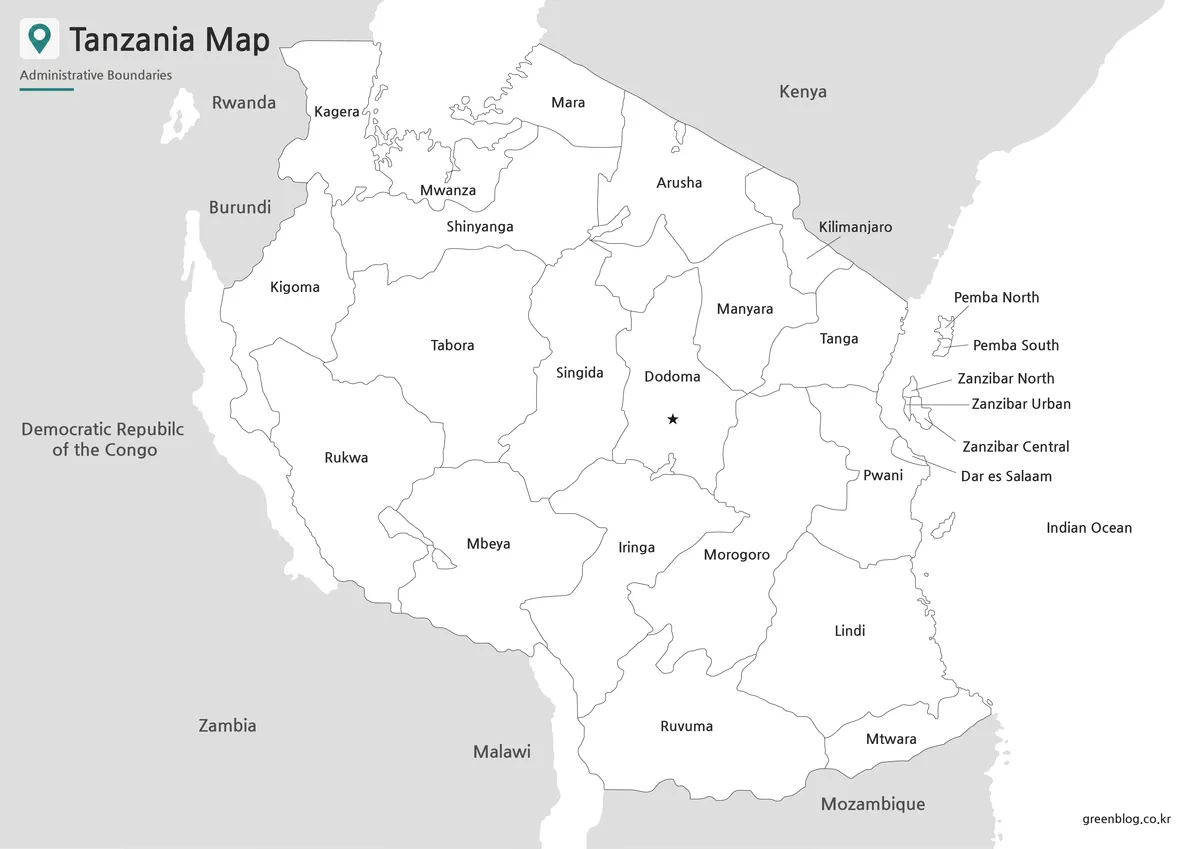
The monochrome edition removes the regional fills but keeps the names, boundary lines, capital star, islands, surrounding countries, and ocean label. Its neutral appearance is suited to reports or handouts that already contain color elsewhere. Readers can also shade chosen areas by hand without competing with an existing palette.
Label density is uneven across the sheet. Mainland names generally fit inside their regions, while Kilimanjaro uses a leader line and the small island regions depend on several callouts. When printing, preserve the landscape ratio and check that those fine lines remain visible. A3 placement provides more room, but final legibility still depends on printer margins, scaling, and image compression.
A useful classroom sequence is to ask learners to locate the capital, identify the coast, and trace the border countries before discussing the administrative date. The labeled Tanzania Map can then be compared with a current 31-region source to identify where Geita, Katavi, Njombe, Simiyu, and Songwe are missing as separate regions.
Blank Tanzania Outline Map for Editing
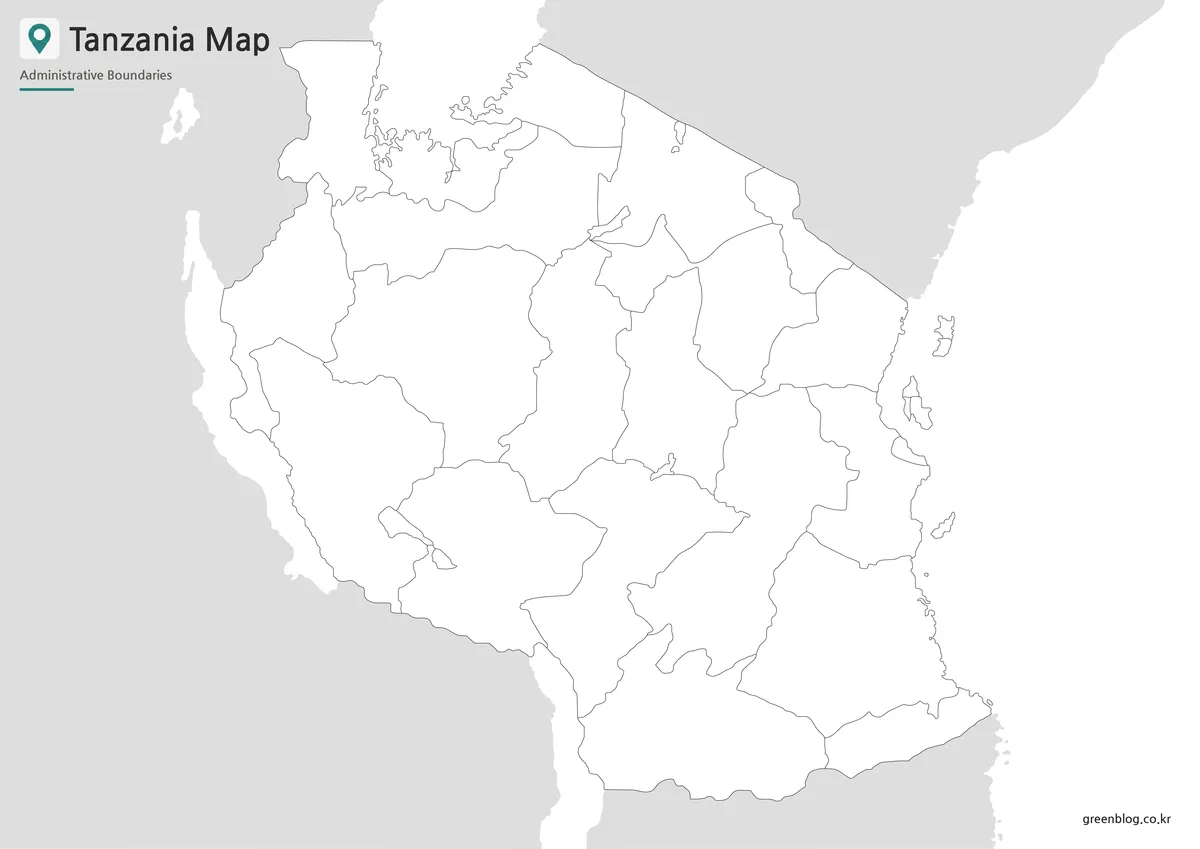
The outline removes every place name, country label, color fill, and capital marker while preserving the same mainland and island boundaries. That makes it a blank activity surface, but it does not convert the historical geometry into a current map. Any worksheet should name the period or ask students specifically to compare the earlier and present-day systems.
Teachers can use the sheet for label recall, coastline identification, or a before-and-after regional exercise. Designers can add a custom legend, arrows between inland and coastal regions, or markers tied to a project dataset. Because the supplied image is a raster graphic rather than a confirmed vector source, annotations should be added on a duplicate so the original remains available.
The blank Tanzania Map also retains the small island shapes, which can easily disappear if the page is cropped too tightly. Leave space to the east of the mainland for Zanzibar and Pemba, and keep sufficient contrast between white land areas and the gray background when exporting a modified version.
Tanzania Flag for Country Resources
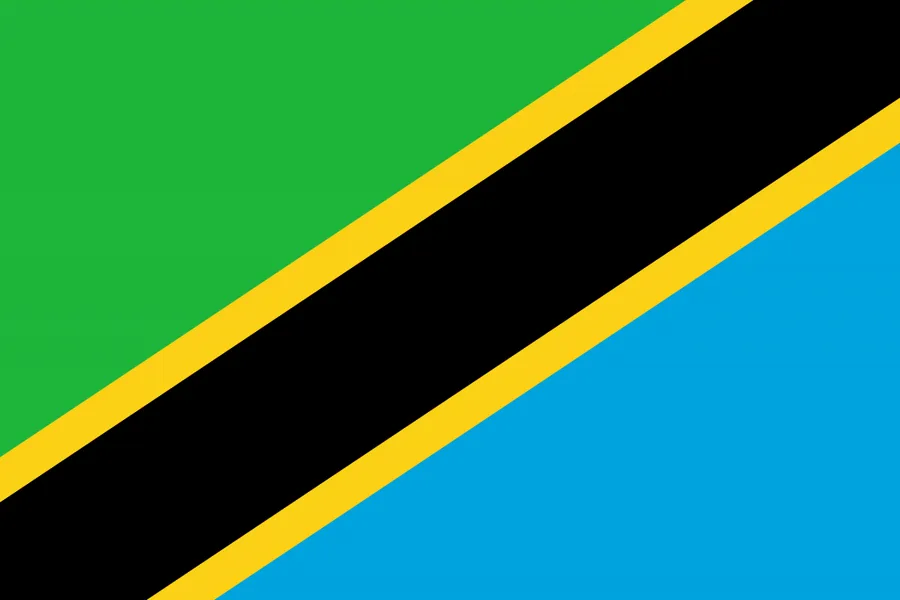
The flag image uses a black diagonal band edged in yellow between green and blue fields. Its 3:2 landscape proportion differs from the wider map sheets, so it is better placed as a separate identification panel than stretched to match the maps. Keeping the full diagonal composition intact prevents the yellow borders from being clipped.
Pair the flag with a labeled map when a country profile needs both national identity and geographic structure. The flag does not add administrative information, and the map colors do not correspond to the flag colors, so the two visuals should retain distinct roles in a lesson or presentation.
Practical Uses for the Tanzania Map
The strongest use for this set is an explicitly dated comparison. Show the color version as the earlier 26-region arrangement, then place a current 31-region reference beside it. Students can identify the five additional mainland regions and discuss why an undated administrative map may become misleading even when its coastline and country borders still look familiar.
For general East African orientation, the labeled maps show Tanzania between the Great Lakes side and the Indian Ocean, with seven neighboring-country names visible around the frame. Uganda is a national neighbor but is not labeled in the supplied artwork. That distinction is worth stating so readers do not mistake the visible labels for a complete border-country list.
Choose color for rapid regional separation, monochrome for name-based reference and hand marking, or the outline for a custom exercise. In every case, keep the earlier-boundary notice near the image. This Tanzania Map is valuable when its limitation becomes part of the lesson; it should not be presented as the current official regional arrangement.
FAQ
The questions below explain how to select and print the supplied files. Remember that the Tanzania Map shown here uses an earlier 26-region framework rather than today’s 31-region structure.
What is included in this Tanzania map collection?
The collection includes a color Tanzania map, a black and white Tanzania map, and a blank outline map. Each version is prepared for a different use, including printing, presentations, classroom materials, and editing projects.
Can I print the Tanzania map in A3 size?
Yes. The map files are prepared in an A3 layout, which makes them suitable for larger printed materials, worksheets, and classroom reference pages.
Which version is best for classroom use?
The black and white map is usually best for worksheets and printed handouts. The color map is better for visual explanation, while the outline map is useful for coloring activities and custom labels.
Is the outline map editable?
The outline version is designed as a blank base map. It can be used for adding colors, markers, routes, regional data, or infographic notes in graphic editing software.
Does the Tanzania map show neighboring countries?
The color version includes simplified neighboring country labels to help users understand Tanzania’s position in East Africa without making the map too crowded.
Map File Information
The download contains three maps based on the earlier 26-region framework plus the Tanzania flag image shown on this page.
- Included Versions: Color labeled map, black-and-white labeled map, blank outline map, and flag
- Printable Size: Maps arranged for A3 landscape use
- File Type: Image files
- Intended Use: Historical comparison, classroom reference, presentations, and annotation projects
Related Maps
Additional Resources
- Tanzania National Bureau of Statistics: 2022 Survey: Review the official 31-region statistical framework, including 26 mainland regions and five in Zanzibar.
Green Map creates custom-edited map images using open geographic data sources such as geoBoundaries, Natural Earth, OpenStreetMap, and government open data. These maps are edited visual materials, not raw data files, and are provided for education, documents, presentations, and graphic reference.