A Sierra Leone Map should make the country’s Atlantic coast, Freetown peninsula, and borders with Guinea and Liberia easy to recognize. The supplied files do that in three coordinated styles: a pastel regional view, a black-and-white labeled map, and an unlabeled boundary outline. Their wide layout leaves room for the coast and neighboring-country labels without reducing Sierra Leone to a small locator shape.
These images require an important boundary note before they are used. They show Northern, Eastern, Southern, and Western as four large internal areas. Current Sierra Leone government sources instead describe five administrative regions—Eastern, North Western, Northern, Southern, and Western Area—and 16 districts. The map set therefore represents a legacy four-region framework, not the current national administrative structure.
There is also visible text that should not be copied into a report title: all three previews print “Sierran Leone Map” rather than “Sierra Leone Map.” The body labels for Guinea, Liberia, Freetown, the North Atlantic Ocean, and the four depicted regions remain readable. Teachers, designers, and presentation authors can still use the files for historical comparison or basic location work when the outdated division and title error are disclosed.
Table of Contents
Sierra Leone Map Overview
Sierra Leone lies on the coast of West Africa. Guinea surrounds much of its north and northeast, Liberia borders the southeast, and the Atlantic forms the western and southwestern edge. Freetown is marked by a star beside the Western coastal area, close to a deeply indented shoreline that makes the capital’s position distinct from the broad inland regions.
The depicted Northern area occupies most of the upper half. Eastern fills the inland southeast, Southern reaches across the lower center and much of the southern coast, and Western appears as a small section around the Freetown peninsula. This division is visually simple enough for a first regional comparison, but it omits the North Western region recognized in current official material.
The Sierra Leone Map does not show districts, chiefdoms, roads, rivers, relief, or population. Its four internal areas should not be mistaken for the country’s 16 present-day districts. A reader researching current administration should consult a recent government map, while anyone using these images should label the framework as historical or legacy rather than current.
Coastal details are another reason the map is more informative than a plain national silhouette. Islands, estuaries, and narrow inlets appear along the west and south, while the inland eastern projection creates a different border profile. These outlines support orientation, but no scale bar is provided, so the artwork should not be used to measure distance or plan a route.
Map Versions Included
The archive provides three JPG images arranged for A3 use. All share the same national outline and four-region boundary base. The color and black-and-white maps retain regional names, neighboring-country labels, the ocean label, and the Freetown marker; the outline removes those labels and the star while leaving the internal divisions visible.
- Pastel map labeling four legacy regions, Freetown, Guinea, Liberia, and the North Atlantic Ocean
- Black-and-white map with the same labels and boundary geometry
- Blank outline retaining the national shape and four internal boundaries
- Landscape JPG images for printing, slides, and annotation
Consistency between the versions makes comparison straightforward. A learner can study the labeled image, complete an activity on the outline, and return to the monochrome view for checking. That workflow does not correct the administrative age of the base map, so the same four-region limitation applies to every file.
Color Sierra Leone Map for Regional Comparison
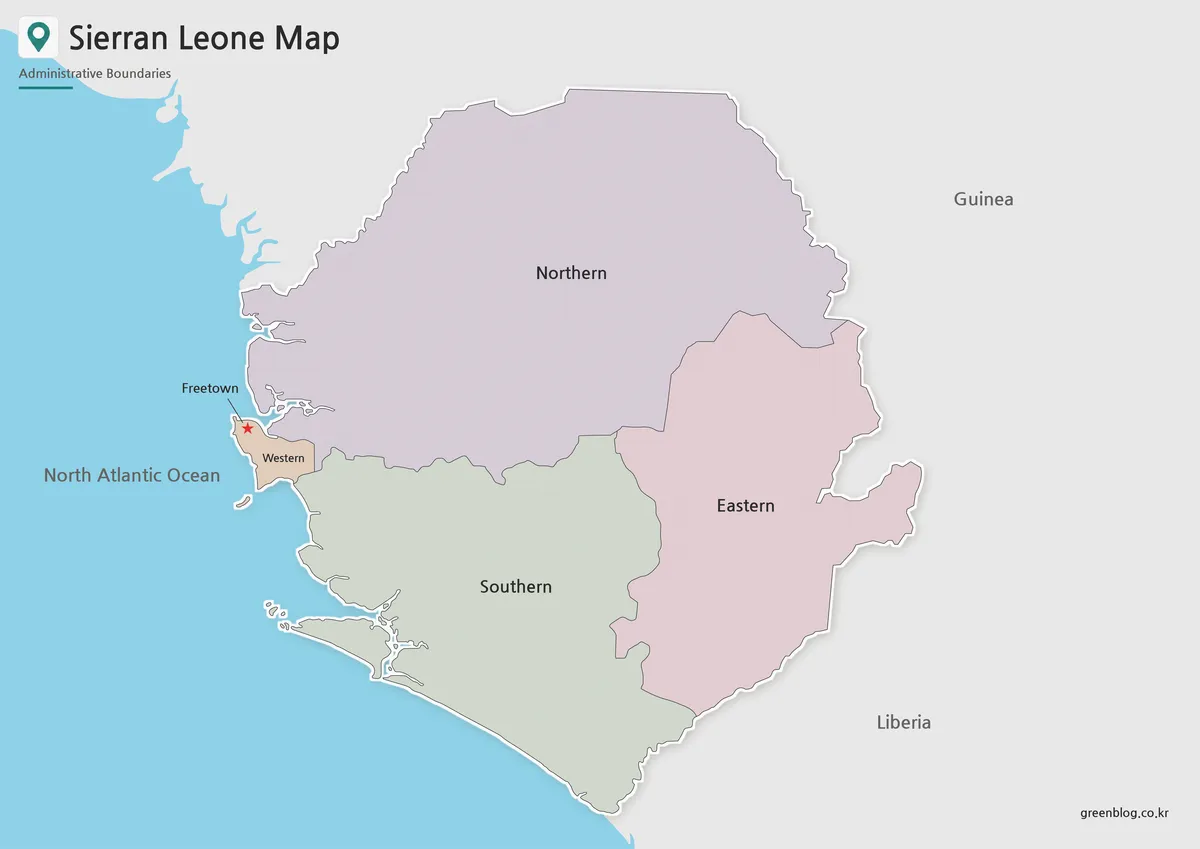
The color view uses separate muted fills for Northern, Eastern, Southern, and Western. Blue water distinguishes the Atlantic side, a red star identifies Freetown, and gray space holds the Guinea and Liberia labels. The large color fields make the older regional arrangement easy to explain in a slide or historical comparison.
Those colors are decorative categories rather than data. They do not encode population, language, land cover, election results, or economic activity. If the color Sierra Leone Map is reused for a thematic project, apply a sourced legend and state that the underlying boundaries predate the current five-region system.
Freetown’s coastal marker provides a useful orientation point, but no other city is plotted. A presentation about current districts or regional government should not fill the missing detail with guesses. Pair the image with a current official reference, or reserve it for tasks focused on national location, coastline recognition, and comparison between historical and current administrative frameworks.
Black and White Printable Sierra Leone Map
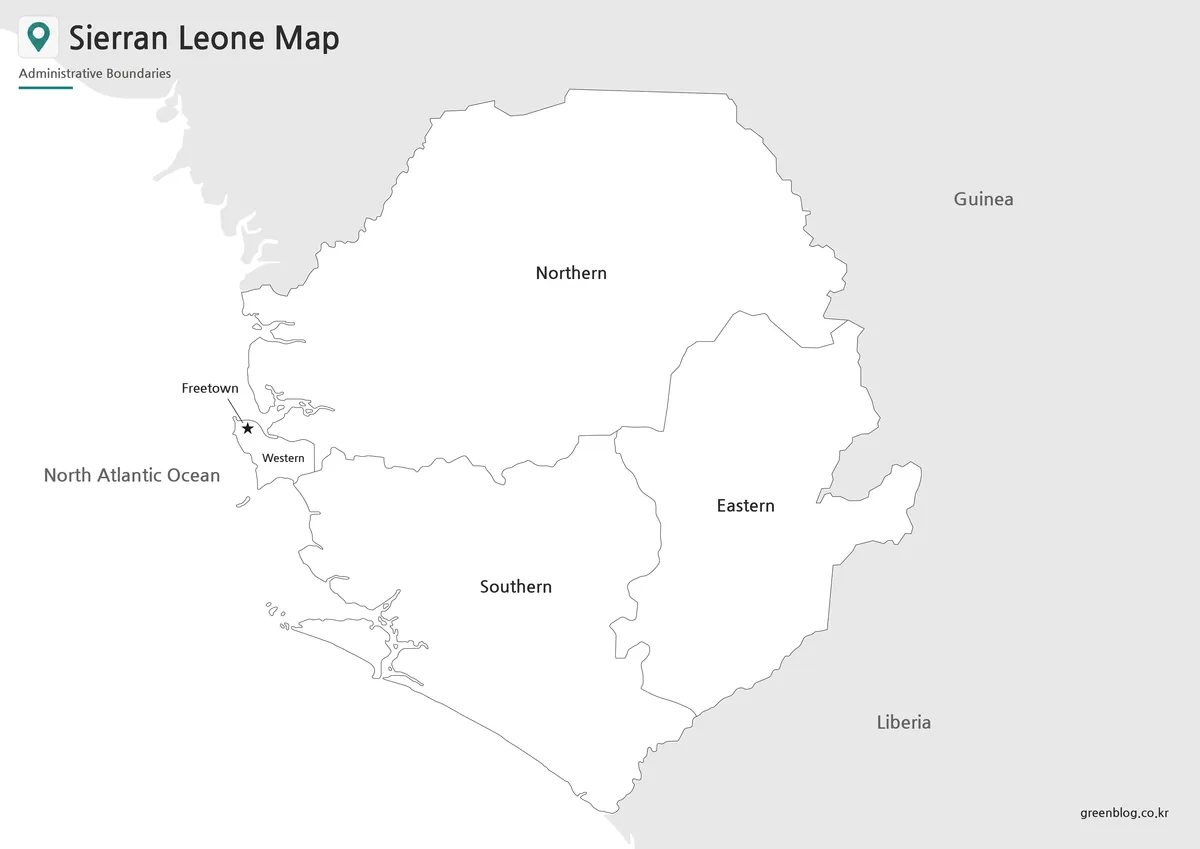
The monochrome version replaces colored regions with white interiors while preserving the four names, country context, ocean label, and Freetown star. It fits a report appendix or reference handout where the boundary lines must remain visible without large pastel areas. Because the labels are already printed, it is an answer reference rather than a blank worksheet.
Students can add light notes beside the regions, mark the two international borders, or trace the Atlantic-facing edge. The black-and-white Sierra Leone Map still carries the misspelled title and legacy divisions, so a teacher should explain both points before distributing it. A small correction note on the page prevents learners from reproducing “Sierran Leone” as the country name.
Blank Sierra Leone Outline Map for Editing
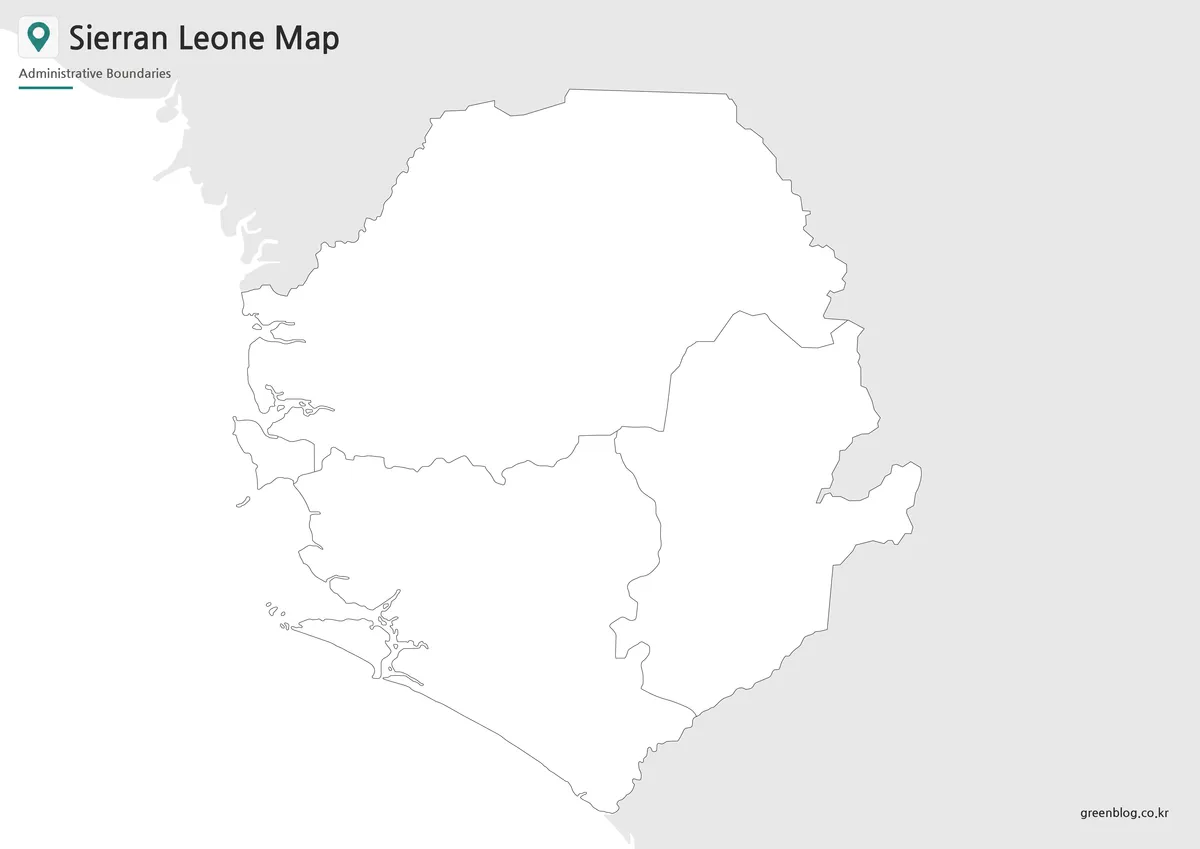
The outline removes region names, neighboring-country names, the ocean label, and the Freetown marker. It retains the coast, national border, and the same four internal areas. This creates room for custom labels or pale shading, but it should not be presented as a blank map of the current five administrative regions.
A productive exercise is to label Guinea, Liberia, the Atlantic Ocean, and Freetown first, then compare the legacy regions with a current official map. The blank Sierra Leone Map can also support a lesson about boundary change: learners can identify where a separate North Western region would need to be considered without pretending the supplied lines already show it.
The file is a raster JPG rather than an editable vector source. Text, arrows, and fills can be added in common document or graphics software, but the regional polygons are not supplied as independently selectable objects. Keep an untouched copy and perform edits at the largest practical size so the thin coastal and internal lines remain clear.
Practical Uses for the Sierra Leone Map
The strongest use is a clearly qualified historical or visual reference. A geography class can locate Sierra Leone between Guinea, Liberia, and the Atlantic, identify Freetown on the coast, and then discuss why administrative maps require dates. A presentation can place the four-region image beside a current five-region source to show how a map’s usefulness depends on its boundary framework.
For a country report, use the labeled color file as a visual overview only after adding a boundary note. For a worksheet, use the outline for neighboring-country and capital placement rather than testing current regional names. For an infographic, keep statistics separate unless their geographic units match the four areas actually drawn.
The coastline deserves careful handling when the image is resized. Preserve the landscape proportions and avoid cropping the western inlets, offshore shapes, or southern coastal edge. The title area may be cropped only if the project permits it and the national outline remains intact; otherwise, add a visible correction rather than silently repeating the misspelling.
Choosing the Best Version
Select the color file when an audience needs immediate separation among the four depicted regions. Use the monochrome file when printed names and boundaries are the main reference. Begin with the outline when the task calls for custom labels, a coastline exercise, or comparison with a current administrative source.
None of the versions is appropriate for current district administration, navigation, or detailed city study. The best choice depends not only on color and labels but also on whether the legacy framework fits the assignment. When present-day accuracy is essential, use a current map from Statistics Sierra Leone or another official government source instead.
Frequently Asked Questions
What is included in this Sierra Leone Map collection?
The collection includes a color map, a black and white map, and an outline map. Each version is prepared for a different use, such as printing, presentations, classroom materials, or editing.
Is this Sierra Leone Map useful for classroom projects?
Yes. The black and white and outline versions are especially useful for worksheets, geography activities, country reports, and regional comparison assignments.
Can I edit the outline map?
Yes. The outline version is a blank base map, so users can add labels, colors, routes, city markers, or regional data.
Why is Sierra Leone’s coastal location important on a map?
Sierra Leone borders the Atlantic Ocean and sits between Guinea and Liberia. A map helps users understand that coastal and regional position much faster than text alone.
Map File Information
Download three matching Sierra Leone image maps showing a legacy four-region framework for qualified reference and annotation.
- Included Versions: Labeled color / Labeled black and white / Blank outline
- Printable Size: A3
- File Type: JPG
- Intended Use: Historical comparison · Location study · Presentations · Annotation
Additional Resources
- Electoral Commission for Sierra Leone Regions — This official page describes the present regional and district framework for comparison with the legacy map.
Related Maps
Green Map creates custom-edited map images using open geographic data sources such as geoBoundaries, Natural Earth, OpenStreetMap, and government open data. These maps are edited visual materials, not raw data files, and are provided for education, documents, presentations, and graphic reference.