A Serbia Map becomes much easier to read when its district framework is separated into three visual zones: the seven districts of Vojvodina in the north, Belgrade and the central districts through the middle, and the southern district pattern extending toward Kosovo. The supplied artwork makes those changes in scale visible on a tall portrait page rather than reducing Serbia to a simple country silhouette.
The package contains a labeled color administrative map, a labeled black-and-white version, and an unlabeled outline. All three published previews measure 1200 × 1697 pixels and follow an A3 portrait layout. They can support geography lessons, district-reference sheets, presentation graphics, labeling exercises, print handouts, and custom visual projects without changing the underlying geometry from one version to another.
The map uses the Serbian statistical and administrative framework of 29 administrative districts plus the separately listed Belgrade area. Five Kosovo-related districts appear inside the same outer country outline, and the labeled editions use a dotted line across the northern edge of that group. Kosovo’s status is disputed internationally, so the artwork should be described as one administrative representation rather than as a neutral settlement of status or sovereignty.
Table of Contents
Serbia Map Overview
The northern section is Vojvodina, where the map labels West Backa, North Backa, South Backa, North Banat, Central Banat, South Banat, and Syrmia. Their broad, comparatively regular shapes create a clear upper block. Belgrade lies immediately south of that pattern and is marked with a star inside its own small area, making the capital easier to distinguish from the surrounding districts.
West and southwest of Belgrade, Macva, Kolubara, Zlatibor, Moravica, and Raska form a descending chain toward Montenegro and the Kosovo boundary. Sumadija occupies the interior, while Podunavlje, Branicevo, and Bor extend east toward Romania. Pomoravlje, Zajecar, Rasina, Nisava, Toplica, Jablanica, Pirot, and Pcinja create the denser central, eastern, and southern sequence.
The five labels shown in the Kosovo area are Kosovska Mitrovica, Pec, Prizren, Kosovo, and Kosovo-Pomoravlje. These names correspond to the district arrangement used in Serbian official statistics; they are not the same as the contemporary district system used by Kosovo institutions. That distinction matters for classroom, policy, and reference use, especially when two maps from different publishers appear to divide the same area differently.
Six surrounding names are visible: Croatia, Bosnia and Herzegovina, Montenegro, Albania, Bulgaria, and Romania. Hungary and North Macedonia are not named at the cropped top and lower edges. The surrounding gray land gives directional context, but the page is not a complete Balkan border map. It also contains no road network, city network, railway layer, terrain, or labeled rivers despite the more detailed administrative divisions.
Included Map Versions
The three images share the same portrait extent and district framework, allowing readers to move from recognition to annotation without relearning the shapes. Color provides the fastest separation, monochrome retains every printed answer with less visual weight, and the outline removes names and fills. The best choice therefore depends on whether the user needs identification, economical printing, or a blank working surface.
- Color administrative map: district names, alternating pastel fills, surrounding-country labels, and a Belgrade star
- Black-and-white map: the same names and boundaries on white interiors
- Blank outline: national and district lines without labels, fills, or the capital symbol
- Download format: image files grouped in one ZIP archive
- Print layout: A3 portrait
These are raster resources rather than GIS datasets or vector artwork with independently selectable district polygons. Users can add text, transparent fills, markers, or arrows in common image and page-layout software, but exact district selection may require manual tracing or a fill tool. Keep an untouched original before making project-specific changes.
Color Serbia Map for Regional Comparison
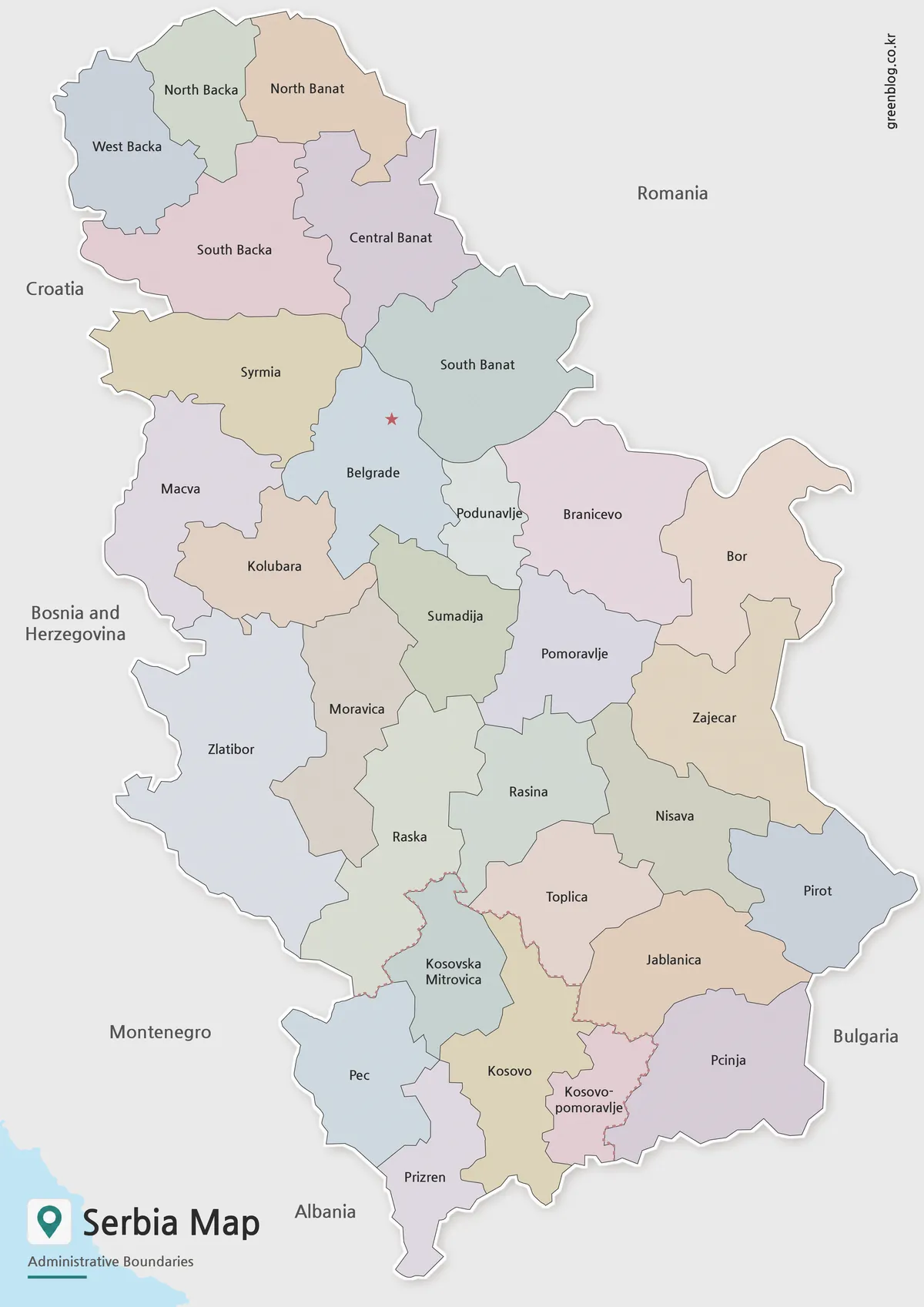
The color Serbia Map assigns muted blue, green, tan, pink, and violet fills to adjoining areas. The palette makes the seven Vojvodina districts easy to compare and helps separate the compact central districts around Belgrade, Sumadija, Podunavlje, Pomoravlje, and Moravica. In the south, color also clarifies the small Kosovo and Kosovo-Pomoravlje shapes.
These colors are categorical only. They do not represent population, ethnicity, language, election results, economic activity, elevation, or land cover. A user adding new data should supply a dated source and a separate legend. Transparent symbols or patterns are preferable when the original district separation needs to remain visible underneath the new information.
The red star identifies Belgrade, while the dotted southern line signals that the Kosovo-related boundary is not drawn like an ordinary solid district boundary. This version works well for an opening slide or labeled reference because those two cues remain immediately visible. Any discussion of political status should still be handled in accompanying text rather than inferred from color alone.
Black and White Printable Serbia Map
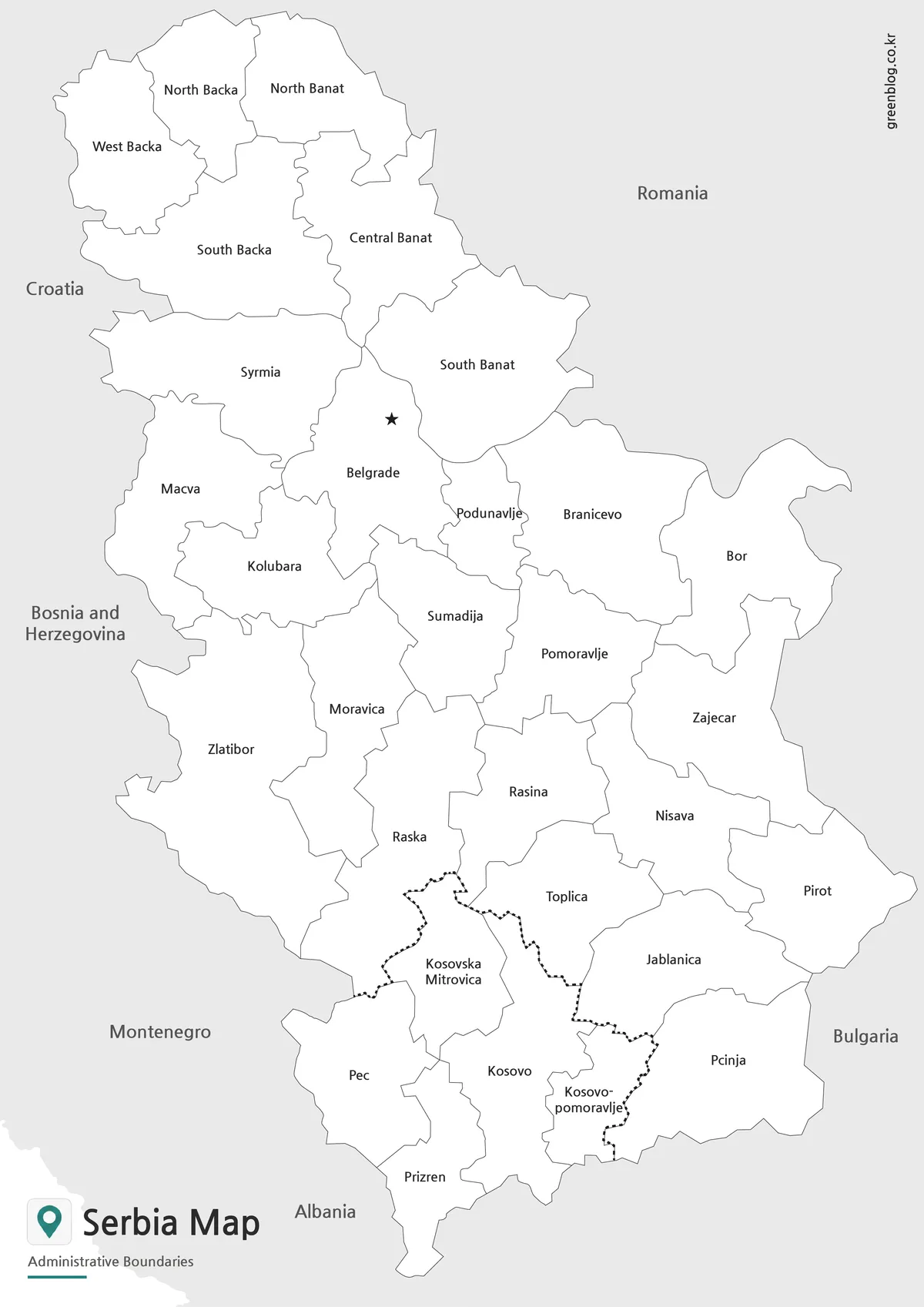
The monochrome edition preserves the district names, surrounding-country labels, Belgrade star, and dotted line while changing all administrative interiors to white. That restrained treatment suits reports and handouts that already contain colored charts, logos, or annotations. It also leaves enough open space for circles, arrows, short notes, and a limited highlight color.
Because every district name remains printed, this edition is best for guided identification rather than a closed-book labeling test. Teachers can place it beside the blank outline as an answer key. Report authors can emphasize one corridor—for example, Belgrade toward Nisava and Pcinja—without the base colors competing with the new mark.
Before printing a class set, test the small central and southern names. Podunavlje, Sumadija, Moravica, Kosovo-Pomoravlje, and Kosovska Mitrovica occupy narrow or irregular areas. Preserve the original portrait ratio, keep a margin at both ends, and avoid enlarging only one portion of the country unless the crop is clearly identified.
Blank Serbia Outline Map for Editing
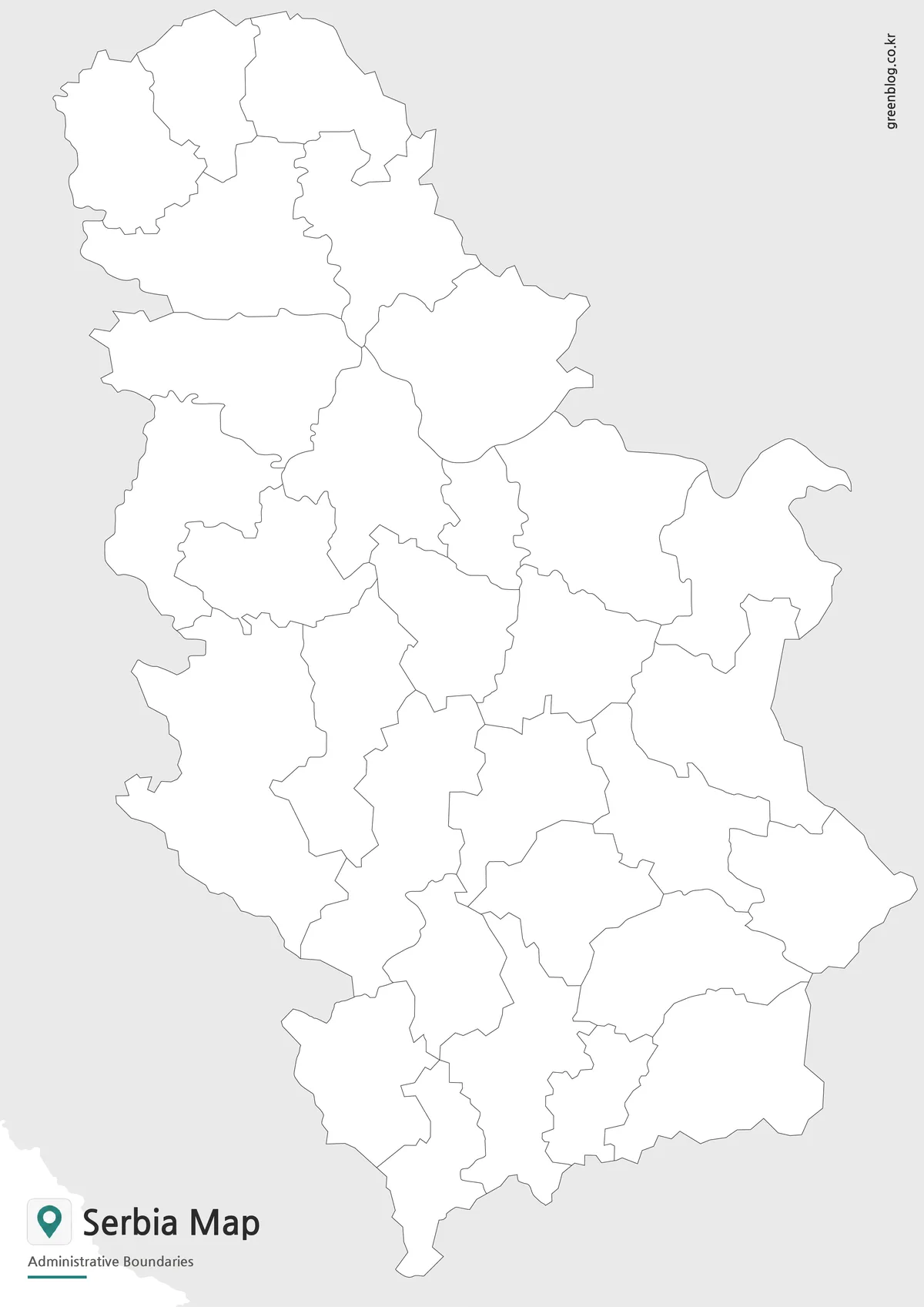
The outline edition removes district names, neighboring-country labels, the Belgrade star, and all color fills. It retains the outer silhouette and internal divisions, including the five shapes used for the Kosovo-related districts in the source framework. Without labels or the emphasized dotted line, viewers should not be expected to infer the political meaning of those shapes from the blank image alone.
A classroom sequence can begin with the color map, continue with monochrome identification, and finish with the outline. Learners might label the Vojvodina districts, locate Belgrade, distinguish broad western areas from the tighter southeast, or compare two administrative frameworks. In a presentation, the blank base can reveal groups progressively without concealing the district boundaries.
Designers can add localized names, project categories, route arrows, or simple statistics, provided the added layer has a clear legend and date. The map is not suitable for cadastral work, legal boundary interpretation, navigation, or operational planning. Where Kosovo’s status or contemporary institutions are central to the topic, use status-neutral wording and compare sources from more than one framework.
Practical Uses for the Serbia Map
The collection is most useful when readers need district-level orientation rather than roads, terrain, or individual municipalities. A geography lesson can contrast Vojvodina with central and southern areas; a country profile can use Belgrade as an anchor; and a Balkan comparison can show how Serbia sits among the six neighboring names printed around the artwork.
For A3 printing, use portrait orientation, preserve the source proportions, and check the fine lines at the northern and southern ends. On a slide, keep the labeled map large enough for the compact central districts to remain readable. If the available space is landscape, place explanatory text beside the map instead of rotating or widening the country.
Online pages should pair each image with descriptive alternative text and visible context for the district count and dotted line. If population, transport, heritage, tourism, or election information is added, identify the source date. This helps readers distinguish the supplied administrative base from a new thematic overlay and prevents pastel colors from being interpreted as data.
Choosing the Best Version
Use color when the audience needs rapid separation of adjacent districts and the boundary cues must be obvious. Use black and white when names are required but the surrounding document has its own color system. Use the outline when the task is to supply names, add categories, or build an uncluttered custom graphic.
For a classroom set, the strongest combination is color for introduction, monochrome for review, and outline for independent work. For publication, select only the view that supports the immediate point and explain the Kosovo-related representation wherever it could affect interpretation. None of the three editions replaces a current legal, statistical, or navigation source.
Frequently Asked Questions
What is included in this Serbia Map collection?
The collection includes a color map, a black and white map, and an outline map. Each version is prepared for a different use, such as printing, presentations, classroom materials, or editing.
Is this Serbia Map useful for classroom projects?
Yes. The black and white and outline versions are especially useful for worksheets, geography activities, and country comparison assignments.
Can I edit the outline map?
Yes. The outline version is designed as a blank base map, so users can add labels, colors, routes, city markers, or regional data.
Why is Serbia’s regional context important on a map?
Serbia is located in the central Balkan region and connects with several neighboring countries. A map helps users understand those relationships much faster than text alone.
Map File Information
The ZIP package groups color, labeled monochrome, and blank outline images using the same Serbian district framework.
- Included Versions: Color, labeled black and white, and blank outline
- Printable Size: A3 portrait layout
- File Type: Image files in one ZIP archive
- Intended Use: Lessons, reports, presentations, labeling, coloring, and annotations
Related Maps
Additional Resources
- Statistical Office of the Republic of Serbia — Review the official Serbian statistical classification of Belgrade, administrative districts, regions, cities, and municipalities.
Green Map creates custom-edited map images using open geographic data sources such as geoBoundaries, Natural Earth, OpenStreetMap, and government open data. These maps are edited visual materials, not raw data files, and are provided for education, documents, presentations, and graphic reference.