A Mozambique Map is especially helpful for understanding a country whose territory runs in a long arc along southeastern Africa and the Indian Ocean. This collection provides three complementary views: a labeled color administrative map, a labeled black-and-white map, and a blank outline map. Together, they give teachers, students, editors, and designers a clear way to introduce the country’s provincial pattern without relying on a crowded road or terrain map.
Mozambique’s coastline lies to the east, while its inland side connects with Tanzania, Malawi, Zambia, Zimbabwe, South Africa, and Eswatini. The supplied map places the Indian Ocean beside the country and identifies Tanzania, Malawi, Zambia, Zimbabwe, and South Africa around the national outline. That surrounding context matters because the country’s northern, central, and southern areas do not read as a compact block on the page; they form a tall, uneven shape with a wide western reach around Tete and a narrow southern end near Maputo.
The files are arranged as an A3-oriented reference set. They focus on national shape, provincial boundaries, and legible regional labels rather than streets, turn-by-turn routes, or topographic detail. Use the color version when the relationship between adjoining provinces needs to be immediately visible, select the monochrome version for documents and handouts, or start with the blank outline when your project requires original labels, symbols, or data.
Each layout leaves enough open space around the outline to keep the country recognizable at print size. Neighbor labels are restrained, the ocean is clearly placed on the east, and the internal divisions are given priority over decorative details. That balance makes the set appropriate for a country report, an African regional comparison, a classroom worksheet, or a presentation slide where the map must be read quickly.
Table of Contents
Mozambique Map Overview
The Mozambique Map emphasizes the country’s administrative geography in a vertical composition. The labeled artwork shows Cabo Delgado, Niassa, Nampula, Zambézia, Tete, Sofala, Manica, Inhambane, Gaza, and Maputo, making the north-to-south progression easier to follow than it would be in a compressed horizontal layout. Tete stands out as the broad western extension, while the long coastal side joins the northern provinces to Sofala, Inhambane, Gaza, and the Maputo area in the south.
For regional orientation, start with the northern edge near Tanzania, then follow the border-facing areas beside Malawi and Zambia toward the central and western provinces. Zimbabwe appears west of Manica and Sofala, and South Africa is shown beyond the southern end of the country. This arrangement explains why an administrative image can be more informative than a simple location pin: it connects province names with the border and coastline relationships that shape the country’s visual geography.
Included Map Versions
The download contains three map treatments built from the same clear national and provincial framework. The color administrative version uses separate fills to distinguish adjoining areas; the black-and-white version retains labels and boundary lines while removing the color coding; and the outline version removes both labels and fills. Because the three images share the same general composition, they can also be used together in a lesson or design workflow without forcing readers to reorient themselves.
- Color administrative map
- Black and white labeled map
- Blank provincial outline map
Color Mozambique Administrative Map
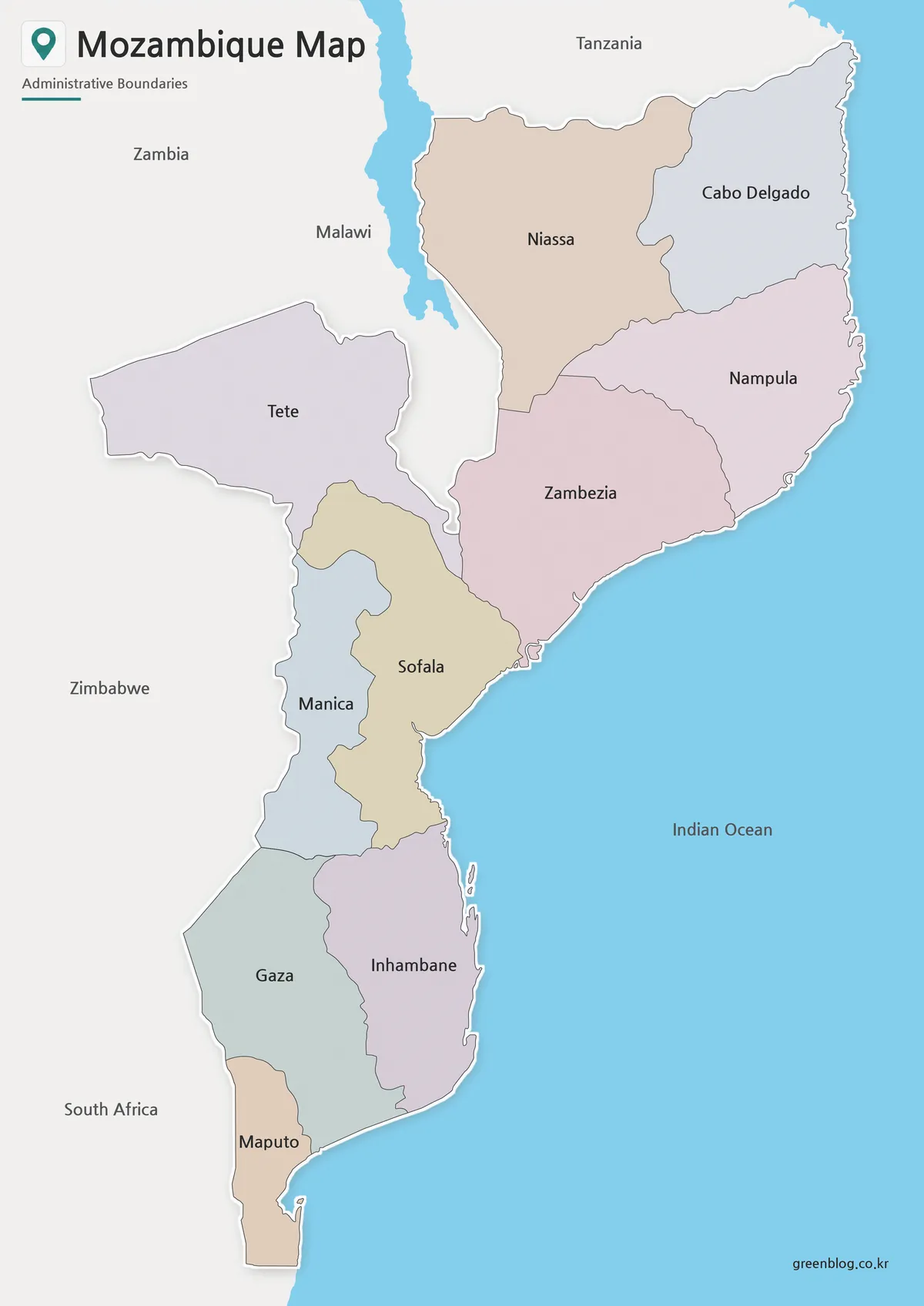
Color is most valuable here because several provinces meet along the central coast and inland border corridors. On the Mozambique Map, contrasting fills help separate Niassa from Cabo Delgado and Nampula in the north, distinguish Zambézia from Sofala below it, and clarify the adjoining southern areas of Gaza, Inhambane, and Maputo. The visual grouping makes it easier to discuss provincial position before introducing any city-level or thematic information.
This is the strongest choice for a slide, poster, or reference page where viewers need to compare regions at a glance. A teacher can point out the Indian Ocean side and trace the country from Cabo Delgado to Maputo; a writer can use it beside an overview of southeastern Africa; and a presenter can assign a color-based key to regional topics without redrawing the national outline. The map’s simple neighbor labels provide orientation while keeping attention on Mozambique.
The gentle color separation is paired with a restrained border treatment, so provincial names remain readable rather than competing with intense fills. Tete’s westward projection, the inland position of Manica, and the long coastal edge of Inhambane remain visually distinct. Those features make the image more than a decorative country silhouette: it is a practical reference for explaining how the provinces relate to one another.
Black and White Printable Version
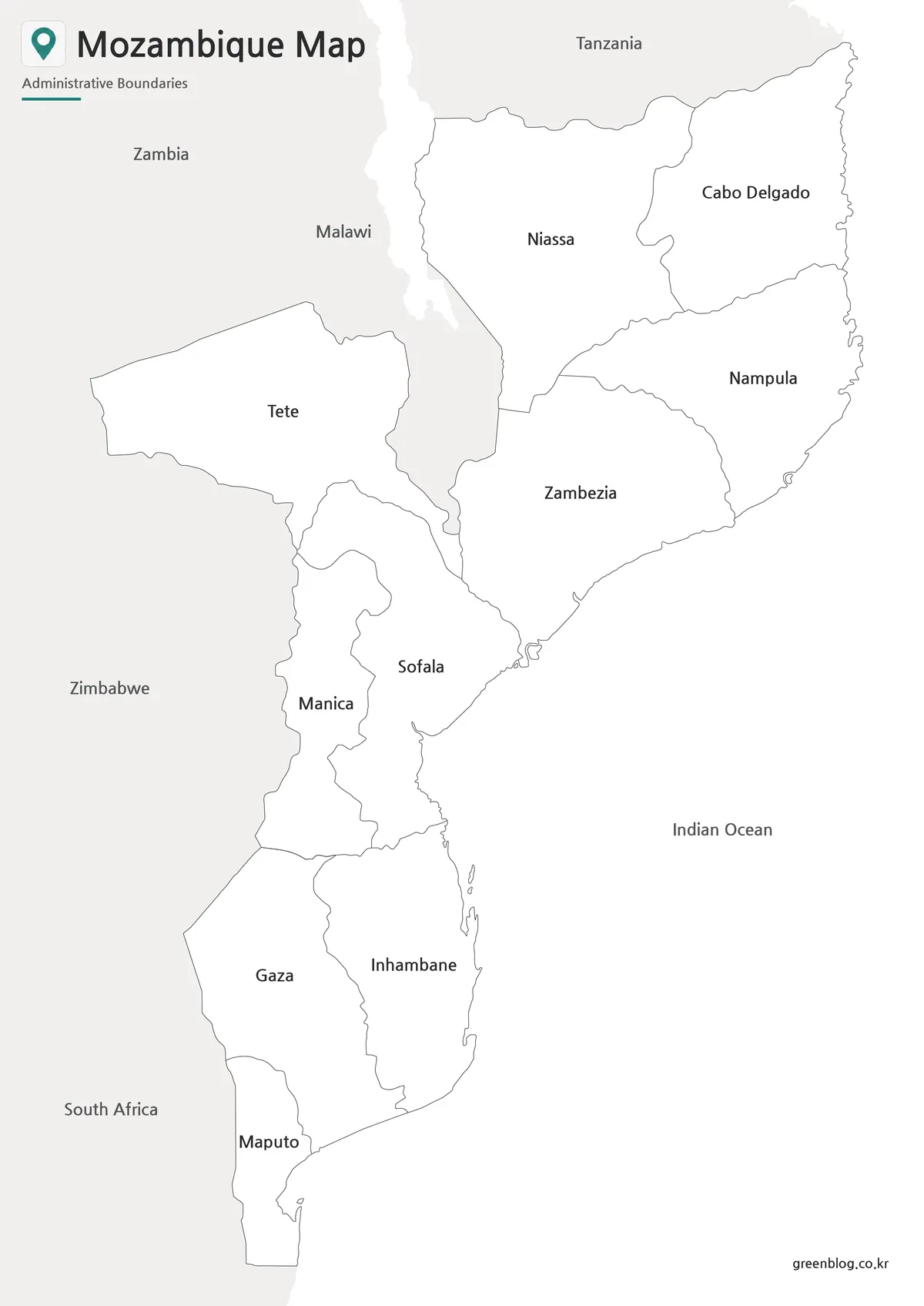
The black-and-white edition keeps the provincial labels, outlines, ocean label, and neighboring-country context but removes the color fills. It is better suited to reports, worksheets, and printed packets where a quiet image needs to sit beside written material. The lack of colored regions also gives instructors room to add a legend or ask students to shade selected areas themselves.
Its value is not simply that it is monochrome. Mozambique’s narrow coastal profile and irregular internal boundaries require clear lines and carefully spaced names, particularly around the central provinces and the southern approach to Maputo. The simplified treatment keeps those divisions visible when the map is reproduced as part of a larger document or displayed with other charts.
Choose this version when color would distract from surrounding text, when the map is part of a formal handout, or when labels need to remain the main point of reference. It also offers a neutral baseline for comparing Mozambique with neighboring countries in a country-study binder or regional presentation.
Blank Mozambique Outline Map for Editing
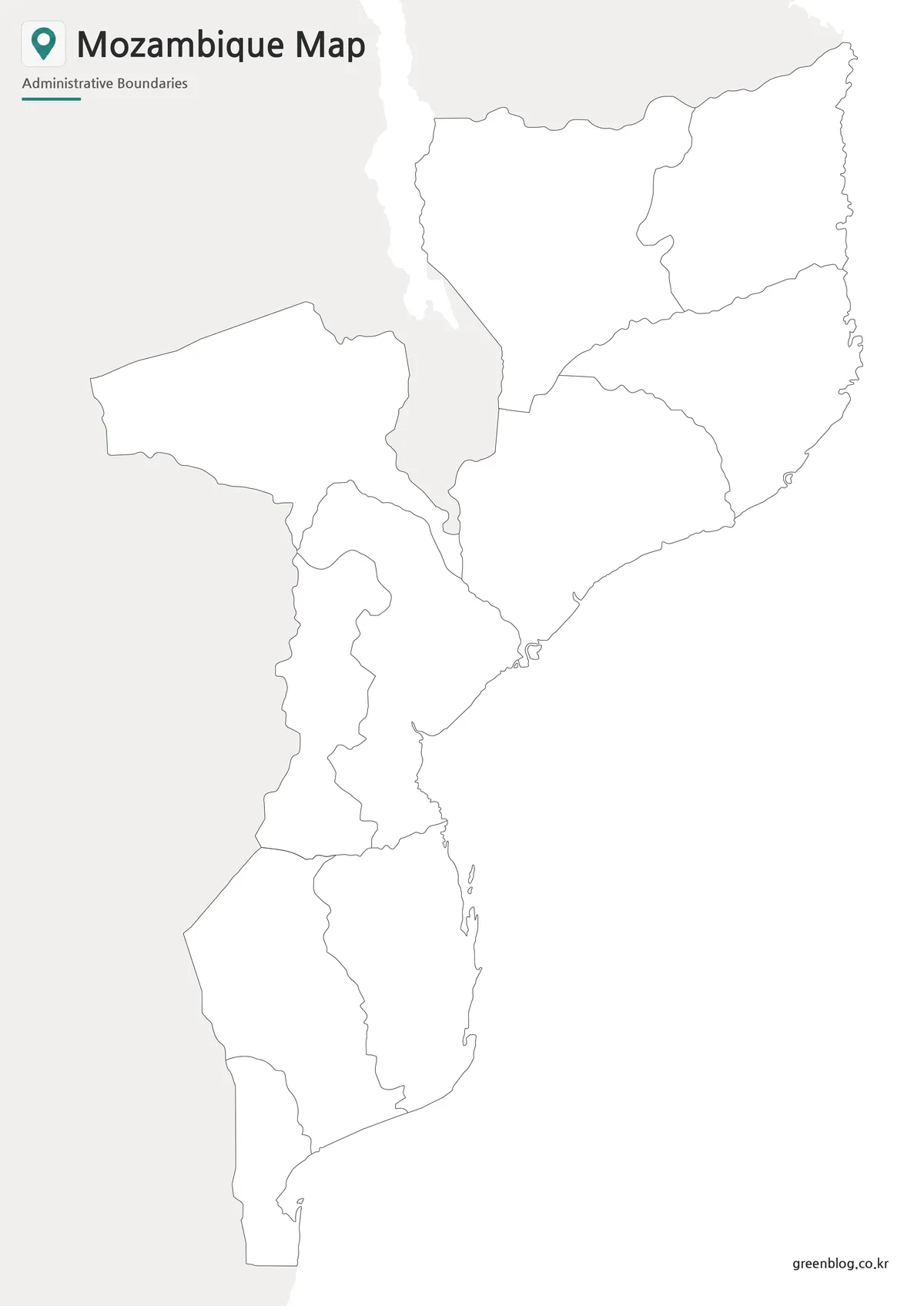
The blank outline image retains the national border and provincial divisions while removing labels, color fills, and surrounding geographic text. This creates a clean base for annotation tasks. Students can label Cabo Delgado, Niassa, Zambézia, or the southern provinces from memory, while editors can add markers, callouts, or a custom legend without needing to erase preexisting text.
For place-specific exercises, use the outline to trace a north-to-south route along the coast, highlight the western reach of Tete, show provinces that meet Malawi or Zimbabwe, or compare coastal and inland areas. It also works for thematic projects in which each province receives a category, statistic, or research note. The visible internal boundaries provide structure without deciding what the final graphic must communicate.
This file is an image-based annotation surface, not a claim of editable vector source artwork. It is best treated as a clean visual starting point for coloring, labeling, overlays, and presentation layouts. Keeping the linework sparse is particularly useful for Mozambique because the country’s distinctive long outline remains recognizable even after users add their own information.
Mozambique Flag
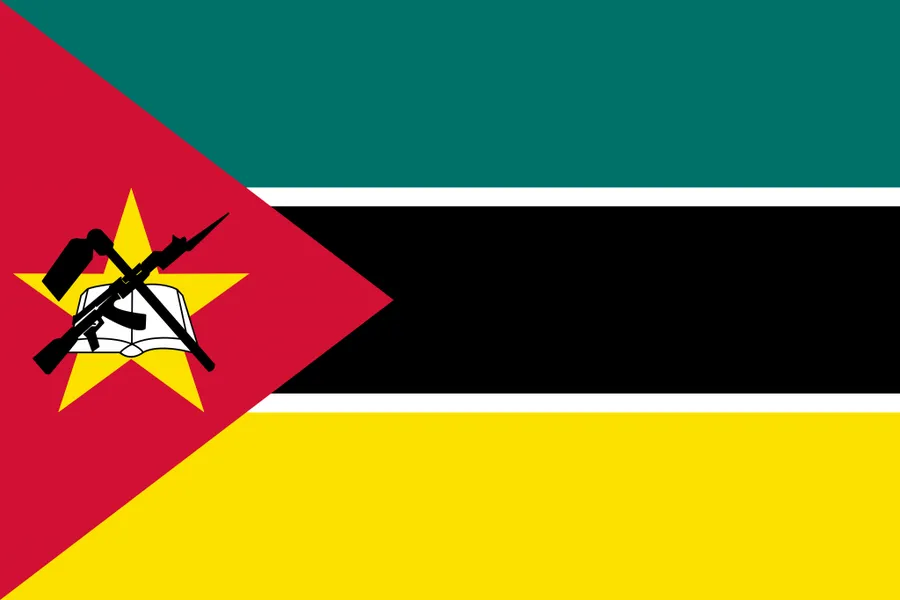
The flag image is included as a supporting country-reference visual. Pair it with the labeled map on a classroom slide, country profile, or display sheet to connect the national symbol with the provincial layout. It is particularly effective when Mozambique is presented alongside other southeastern African countries, since the map supplies the spatial context and the flag provides a quick visual identifier.
For a cleaner composition, place the flag near a title or introductory text rather than over the outline map itself. That preserves the visibility of the provincial boundaries and avoids covering the narrow coastal form that makes Mozambique immediately recognizable.
Practical Uses for This Mozambique Map
A Mozambique Map can support several kinds of work when the goal is regional explanation rather than navigation. In a geography lesson, use the labeled editions to identify the Indian Ocean, compare northern and southern provincial placement, and locate the neighboring countries visible around the outline. For a written country report, the black-and-white image gives readers an uncluttered reference before they encounter detailed text.
For design and communication projects, begin with the blank version and add only the information your audience needs: a travel path, a province-by-province comparison, coastal study sites, or a set of location markers. The color image is preferable when province separation is central to the message; the monochrome image is preferable when labels and boundaries must coexist with dense copy. None of the supplied files is intended for detailed route planning, so use a dedicated navigation service when street-level directions are required.
Frequently Asked Questions
Is this Mozambique Map suitable for A3 printing?
Yes. This Mozambique Map was prepared with A3 printing in mind, so it works well for classroom materials, presentation boards, and printed reference sheets.
Does the map include neighboring countries?
Yes. Neighboring country names are included in a simplified way to help users understand Mozambique’s regional position without crowding the map.
What is the difference between the color and black and white versions?
The color version helps separate provinces quickly, while the black and white version is cleaner for printing, reports, and handouts.
Can I edit the outline map?
Yes. The blank outline version is suitable for adding colors, labels, travel routes, city markers, or infographic data.
Does the map show roads or detailed terrain?
No. The map focuses on province boundaries and overall country structure, keeping the layout clean for educational and presentation use.
Map File Information
Download the labeled color, labeled black-and-white, and blank outline images for A3-oriented reference, classroom, document, and annotation projects.
- Included Versions: Color administrative map, black and white labeled map, blank outline map
- Printable Size: A3 layout
- File Type: Image files
- Intended Use: Reference sheets, classroom activities, presentations, document layouts, and custom annotations
Related Maps
Additional Resources
- Visit Mozambique country map — An official visitor map that provides additional national orientation, including provinces and major places.
Green Map creates custom-edited map images using open geographic data sources such as geoBoundaries, Natural Earth, OpenStreetMap, and government open data. These maps are edited visual materials, not raw data files, and are provided for education, documents, presentations, and graphic reference.