A Turkmenistan map becomes much easier to read when the Caspian coast, five broad regions, four land neighbors, and Ashgabat marker appear in one frame. The country extends from the Caspian Sea in the west toward Uzbekistan and Afghanistan in the east, with Kazakhstan along the north and Iran along the south. This landscape composition keeps that regional setting visible without adding roads, terrain, or numerous city names.
The supplied resource contains three matching 1,200 × 849-pixel WebP map previews: a pastel color version, a labeled black-and-white version, and an unlabeled administrative outline. A separate 900 × 600-pixel WebP image shows the national flag. The protected download is described as an A3 JPG map package containing the color, monochrome, and outline versions; the flag should be treated as a separate page resource unless the downloaded archive confirms otherwise.
Five regional names appear on both labeled maps: Balkan, Dasoguz, Ahal, Mary, and Lebap. Standard English references may render Dasoguz as Daşoguz, but the artwork omits the diacritic. Ashgabat is marked by a star within the Ahal-colored area rather than outlined as another region, so the map communicates a capital location but not a separate capital boundary.
The color artwork also includes several blue inland water shapes, yet none is named. Only the Caspian Sea receives a water label. Readers should not identify the unlabeled features, estimate their size, or infer roads, elevation, desert extent, settlement density, or border crossings from this administrative base.
Table of Contents
Printable Turkmenistan map collection
Turkmenistan lies on the western side of Central Asia. Its Caspian coastline gives the national outline an irregular western edge, while long land boundaries connect the rest of the country to Kazakhstan, Uzbekistan, Afghanistan, and Iran. The labeled maps place all four country names outside the national shape, allowing readers to orient the border without confusing neighboring territory with an internal region.
Balkan occupies the west and contains the entire Caspian-facing portion shown here. Daşoguz spans the north-central area along Uzbekistan, while Ahal reaches across the central-southwestern part above Iran. Mary fills much of the south-central and southeastern section, and Lebap forms the elongated eastern region beside Uzbekistan and Afghanistan.
This Turkmenistan map is valuable because the five region shapes are highly unequal and directional. Balkan is broad and coastal, Lebap follows a long eastern border, and Mary projects southward before meeting Afghanistan. Ahal sits between the western and eastern halves, while Daşoguz forms the northern bridge toward Uzbekistan.
Ashgabat’s red star appears near the Iranian border in southern Ahal. The small “Ashgabat” label and marker are the only city-level information on the artwork. Because no scale bar, coordinates, streets, or municipal boundary accompany the star, it should be used for national orientation rather than precise measurement or navigation.
The three map versions share the same outer silhouette and five internal divisions. That consistency supports a study sequence in which readers first compare colors, then review names in monochrome, and finally reconstruct the geography on the outline. The flag image adds a separate national symbol for covers, country cards, or presentation introductions without changing the administrative content of the maps.
Color Turkmenistan Map with Regional Labels
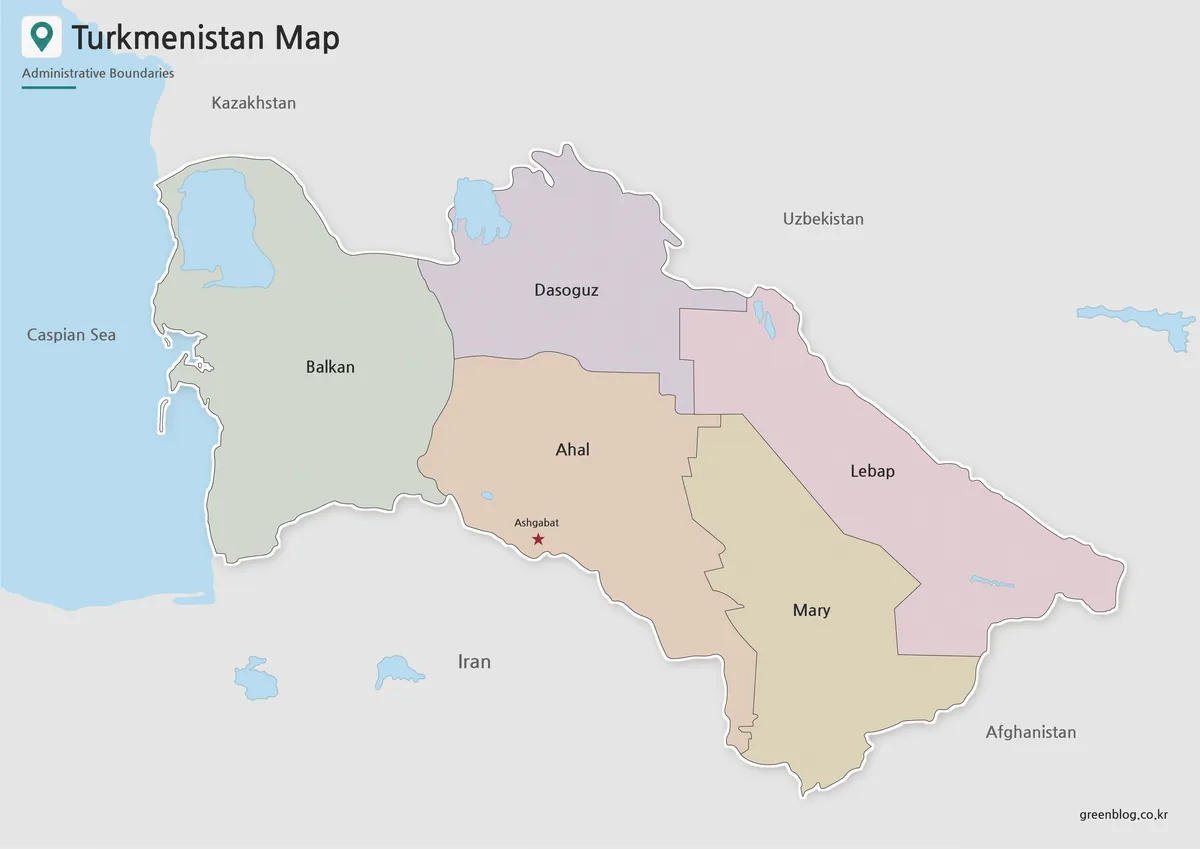
Muted fills give Balkan, Daşoguz, Ahal, Mary, and Lebap separate visual identities without suggesting a numeric scale. The contrast is especially useful where Ahal, Mary, Lebap, and Daşoguz meet near the center. A red star isolates Ashgabat from the region label, while blue distinguishes the Caspian Sea and the unnamed inland water features.
The color Turkmenistan map is the strongest first reference for an answer key, Central Asia slide, or country overview graphic. It shows that the nation is not divided into five similar rectangles: Balkan wraps around the western coastline, Lebap narrows along the east, and Mary has an angular boundary with Ahal and Lebap. The pastel categories encode administrative separation only.
The gray exterior helps the four neighboring-country labels remain legible, but it does not show their internal divisions. Likewise, the blue water features do not carry a legend or individual names beyond the Caspian Sea. Any lesson about reservoirs, rivers, desert geography, energy infrastructure, or transport corridors requires a different authoritative source.
Black and White Printable Turkmenistan Map
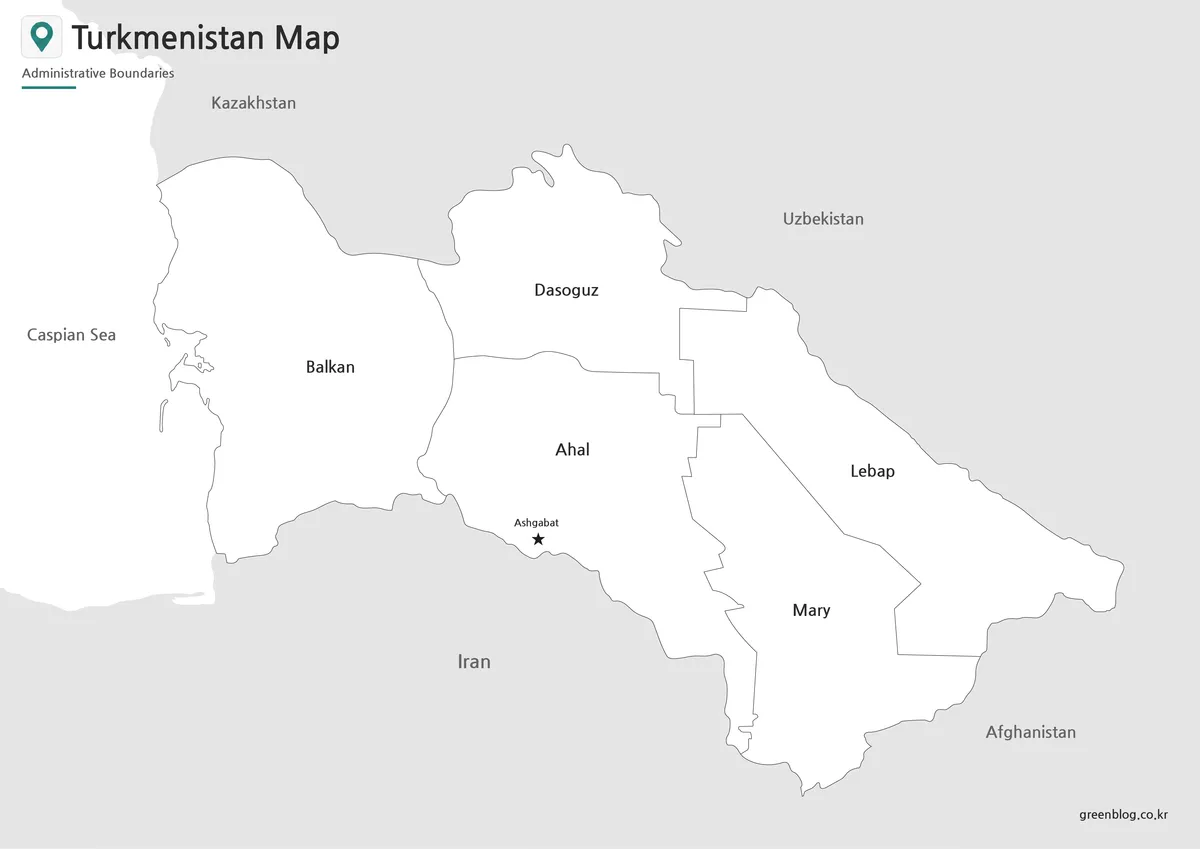
The black-and-white Turkmenistan map keeps all five region names, the Ashgabat star, the four neighboring-country labels, and the Caspian Sea label while removing the pastel and blue fills. Regional boundaries become the main visual cue. This restrained treatment suits reports, guided worksheets, and pages where readers will add their own highlights.
Monochrome does not turn the image into a blank exercise: every answer remains visible. Students can trace which regions touch Iran, compare Balkan with Lebap, or identify the region containing the capital marker. For unaided recall, the outline is the better choice because it removes both labels and the star.
Before printing multiple sheets, check the Ashgabat text and the thin central boundaries on the intended paper size. Automatic cropping can remove parts of the Kazakhstan, Uzbekistan, Iran, or Afghanistan labels, while disproportionate resizing will distort the wide national silhouette. Preserve the original 1,200 × 849 preview ratio when placing the image in another document.
Blank Turkmenistan Outline Map for Editing
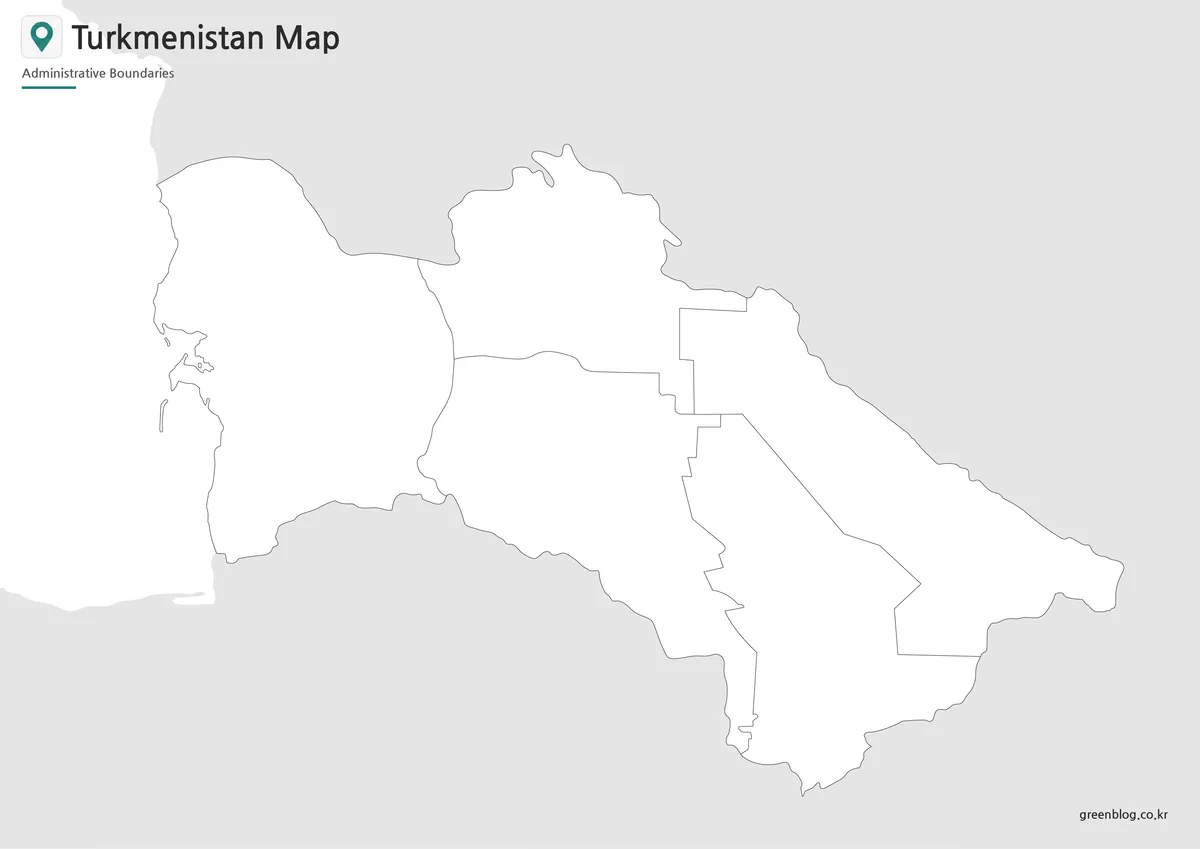
The outline removes region names, neighboring-country labels, the Ashgabat marker, and all water coloring while retaining the country boundary and five internal divisions. The page title and administrative-boundary subtitle remain. It is therefore an unlabeled regional outline rather than a completely empty canvas or an editable vector file.
A blank Turkmenistan map supports tasks tied directly to the country’s shape. Learners can label the five regions, place Ashgabat in southern Ahal, identify the Caspian side, or write the four neighbors in the surrounding space. The labeled monochrome version can serve as an answer key using exactly the same geometry.
Designers may overlay a carefully sourced category, route, or statistic, but each added symbol and color needs a legend. The raster image does not supply roads, coordinates, terrain, or data values. Use a current specialist source whenever accuracy below the regional level matters.
Turkmenistan Flag for Country Resources
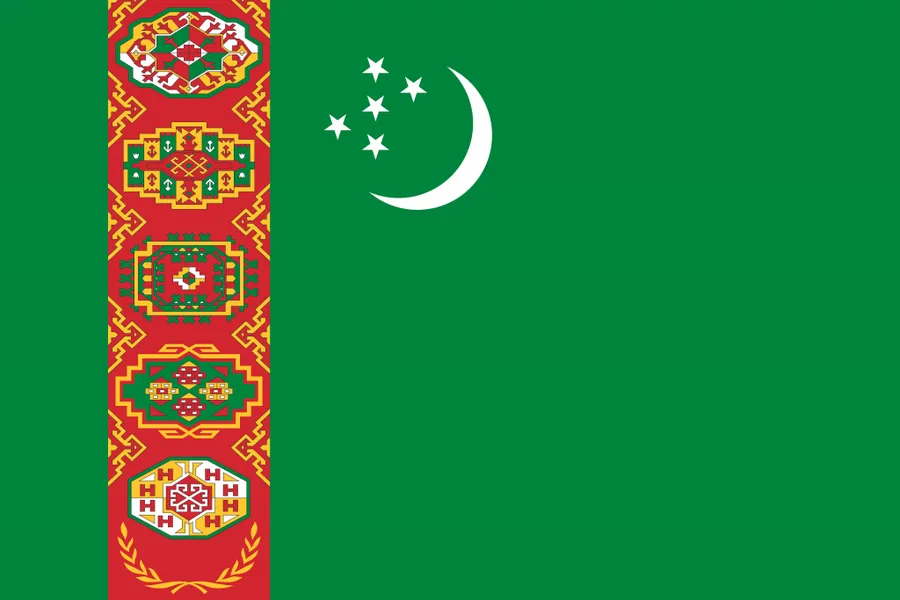
The flag preview is a 900 × 600 image, giving it a 3:2 ratio distinct from the landscape maps. A vertical red band carries five detailed carpet designs and olive branches, while a white crescent and five stars appear on the green field. These visible elements make the image suitable for a country profile header or comparison card.
Keep the flag separate from the administrative legend. Its five stars and five carpet designs should not be used as substitutes for the five regional boundaries on the maps. When both assets appear in one presentation, captions can explain that one is a national symbol and the other is a geographic reference.
Practical Uses for the Turkmenistan Map
A classroom sequence can begin with color for regional separation, continue with monochrome for guided comparison, and finish with the outline for recall. Students can name the Caspian-facing region, identify the long eastern region, locate Ashgabat, or match each international border to the adjacent country. Every task uses information visible in the supplied set.
For presentations, the color map communicates structure fastest; for reports, monochrome reduces competition with surrounding text; for custom categories, outline supplies the cleanest base. A Turkmenistan map should be supplemented when a project needs district-level boundaries, multiple cities, roads, physical relief, current transport, or named inland waters.
Selecting the right version is mainly a question of whether labels should remain visible. Preserve the full landscape frame when neighboring-country context matters, and crop more tightly only when the five regions are the sole subject. Test print legibility before relying on A3 placement in a particular page layout.
Frequently Asked Questions
What is included in this Turkmenistan map collection?
The collection includes a color Turkmenistan map, a black and white map, and a blank outline map. Each version is prepared for a different use, including printing, presentations, classroom materials, and graphic editing.
Can I print the Turkmenistan map in A3 size?
Yes. The original map was prepared in an A3 layout, making it suitable for larger printed reference sheets, worksheets, and presentation materials.
Does the map show neighboring countries?
Yes. The labeled version includes nearby country names such as Iran, Afghanistan, Uzbekistan, and Kazakhstan to help users understand Turkmenistan’s location in Central Asia.
Which version is best for editing?
The outline map is the best option for editing. It works well as a blank base for adding colors, routes, markers, regional data, or infographic annotations.
Why is the Caspian Sea shown separately?
The Caspian Sea is an important geographic feature on the western side of Turkmenistan. Showing it separately helps readers understand the country’s coastline and regional position more clearly.
Map File Information
The protected package contains three matching administrative views for regional reference, monochrome printing, recall practice, and custom annotation.
- Included Versions: Color map · Black and white map · Outline map
- File Type: JPG map files
Related Maps
Additional Resources
- Turkmenistan Ministry of Foreign Affairs: General Information — The official overview lists the country’s five welaýat and explains their division into districts.
Green Map creates custom-edited map images using open geographic data sources such as geoBoundaries, Natural Earth, OpenStreetMap, and government open data. These maps are edited visual materials, not raw data files, and are provided for education, documents, presentations, and graphic reference.