A Nagano Prefecture Map must fit a long inland prefecture and many differently sized municipalities into one readable page. Nagano stretches through central Honshu, with broad municipal areas around the mountains and smaller shapes clustered in several valleys and basins. The supplied portrait layout follows that north-to-south form instead of compressing the prefecture into a landscape sheet.
The download contains three matching administrative views: a color map with English municipality names, a black-and-white labeled version, and an unlabeled outline. Their geometry is the same, which makes it possible to use one file as a reference and another as a worksheet or annotation base. The JPG images are arranged for A3 use, where narrow municipalities and rotated labels have enough room to remain distinguishable.
This Nagano Prefecture Map collection is suited to prefecture study, regional comparison, presentations, reports, and custom graphics. It shows municipal boundaries and neighboring-prefecture context, but it does not contain roads, railways, elevation shading, or tourist sites. Those layers should come from a separate specialized source when a project requires route planning or physical geography.
Table of Contents
How to Read the Nagano Prefecture Map
Nagano is landlocked and touches eight prefectures: Niigata, Toyama, Gifu, Aichi, Shizuoka, Yamanashi, Gunma, and Saitama. Most of those names appear around the map as gray reference areas, helping readers orient the long western and eastern edges. The prefectural capital, Nagano City, occupies a large northern-central area, while Matsumoto, Ueda, Saku, Ina, and Iida anchor other parts of the sheet.
Mountain systems explain why the municipal pattern is not a simple grid, although the maps themselves do not depict terrain. The Northern, Central, and Southern Japanese Alps divide travel corridors and settlement basins. The official tourism framework groups Nagano into six broad travel regions—Northern, Central, Eastern, Suwa, Kiso Valley, and Southern—but these are interpretive regions rather than an additional administrative layer drawn on the map.
Reading the Nagano Prefecture Map from top to bottom reveals several distinct clusters. Iiyama, Nozawa Onsen, Sakae, and Yamanouchi sit in the far north and northeast. Ueda, Tomi, Komoro, Saku, and Karuizawa form an eastern group; Matsumoto and Azumino occupy the central-western area; Suwa, Chino, Shimosuwa, and Okaya gather around the central-southeast. Farther south, the Kiso municipalities follow the western side while Ina, Komagane, and Iida extend down the central and southern valleys.
Map Collection Overview
The three versions answer different questions while preserving identical boundaries. Use color when the main task is distinguishing adjacent municipalities, use the monochrome sheet when names and linework are more important than fills, and use the outline when the reader will add information. The surrounding prefecture labels remain visible on the two labeled maps, while the blank version removes all place names.
- Color administrative map with English municipality labels
- Black-and-white map with the same labels and boundaries
- Blank municipal outline for labeling and thematic shading
- Portrait JPG files arranged for A3 page use
The Nagano Prefecture Map uses varied label sizes and orientations to fit a complex municipal pattern. Large places such as Nagano, Matsumoto, Ueda, Saku, Ina, and Iida can carry horizontal names inside their shapes. Narrower municipalities such as Tatsuno, Minamiminowa, Shimosuwa, and several southern villages require rotated text or compact placement. That contrast is why the portrait proportions and full-page viewing size matter.
Color Administrative Map
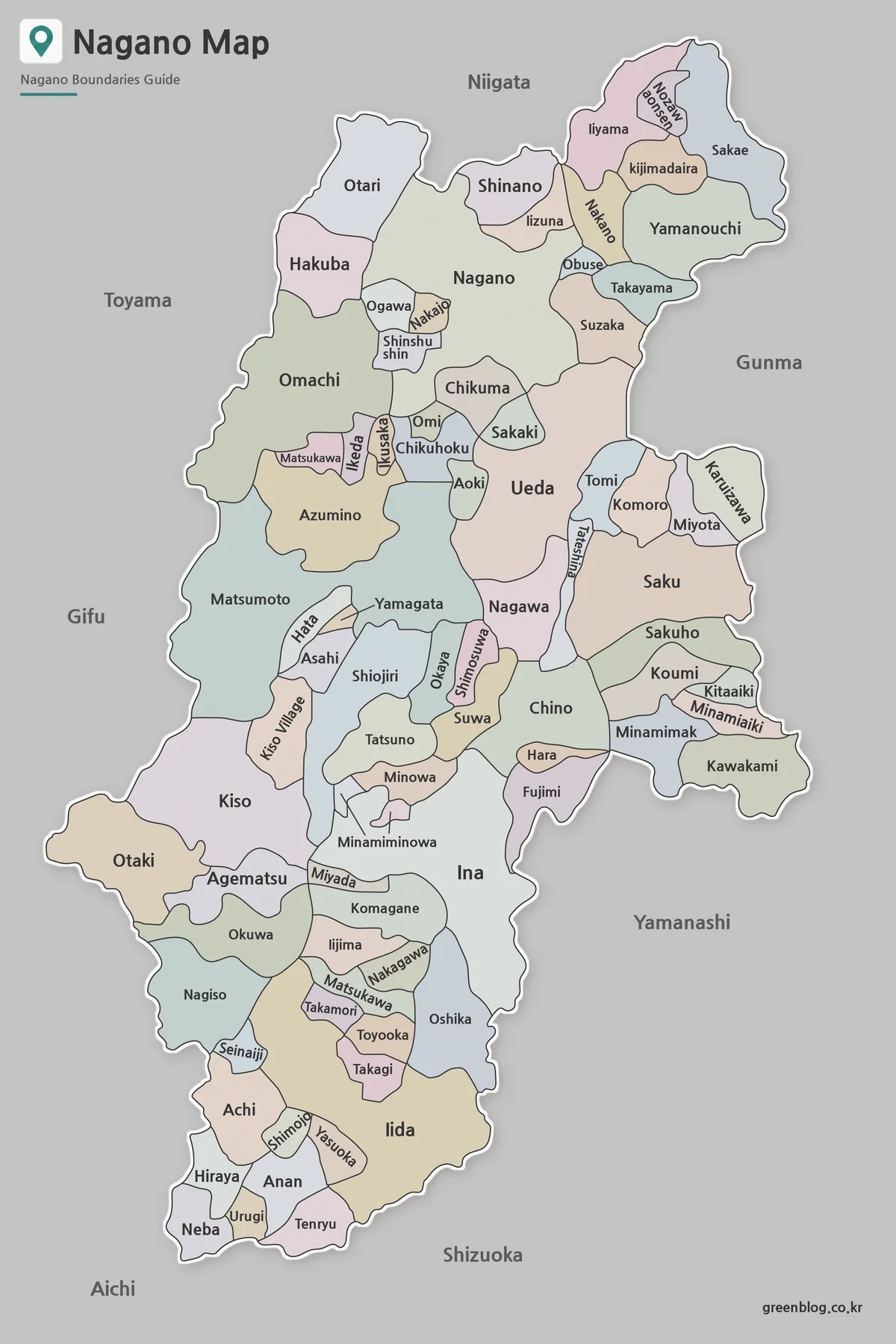
The color version assigns muted contrasting fills to neighboring municipalities and places the prefecture against a gray surrounding area. This makes boundaries easier to follow where several small towns and villages meet, especially west of Ueda, around the Suwa area, and along the southern section between Komagane and Iida. It also helps separate large neighboring shapes that would otherwise depend entirely on thin boundary lines.
For a presentation, the color Nagano Prefecture Map lets a speaker point to one municipality without losing its relationship to the rest of the prefecture. A classroom comparison can group the northern municipalities, the Matsumoto–Azumino area, the eastern Saku area, and the two southern corridors. The fills are categorical only; they do not represent elevation, population, land use, or political affiliation.
Labeled Black and White Version
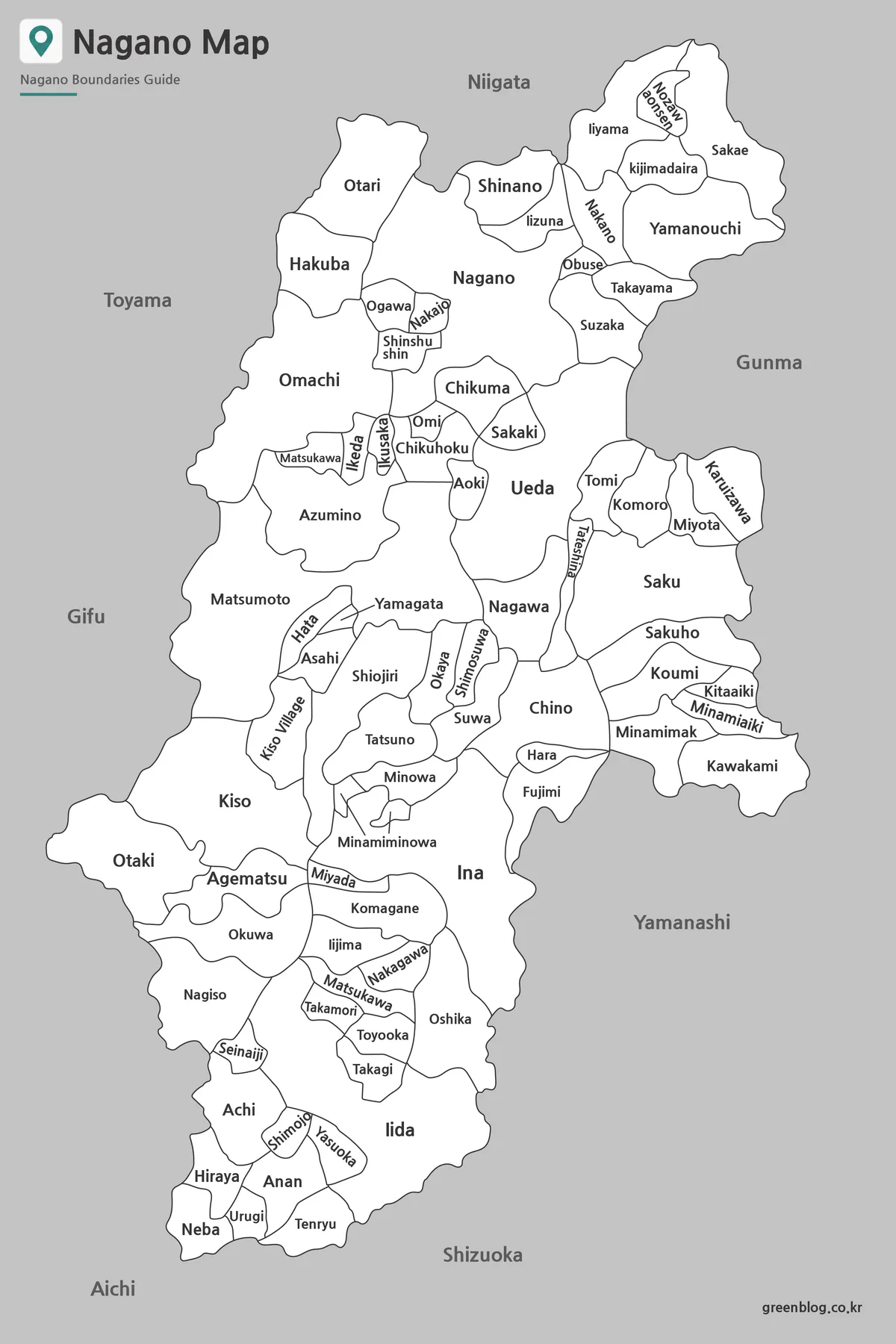
Removing the pastel fills turns attention to names, municipal edges, and the overall silhouette. The gray exterior still separates Nagano from adjacent prefectures, so the white internal shapes do not blend into the page. This treatment fits research notes, monochrome reports, and handouts in which users need a labeled reference beside other charts or text.
The labeled Nagano Prefecture Map is densest in the central band and the lower half, where compact municipalities require vertical or angled text. Keep the original proportions when placing it in a document, and check names such as Ikeda, Ikusaka, Hata, Minamiminowa, and the villages south of Iida before reducing the image. If those labels are essential, a full A3 page or a large on-screen view is the safer choice.
Blank Outline Map for Editing
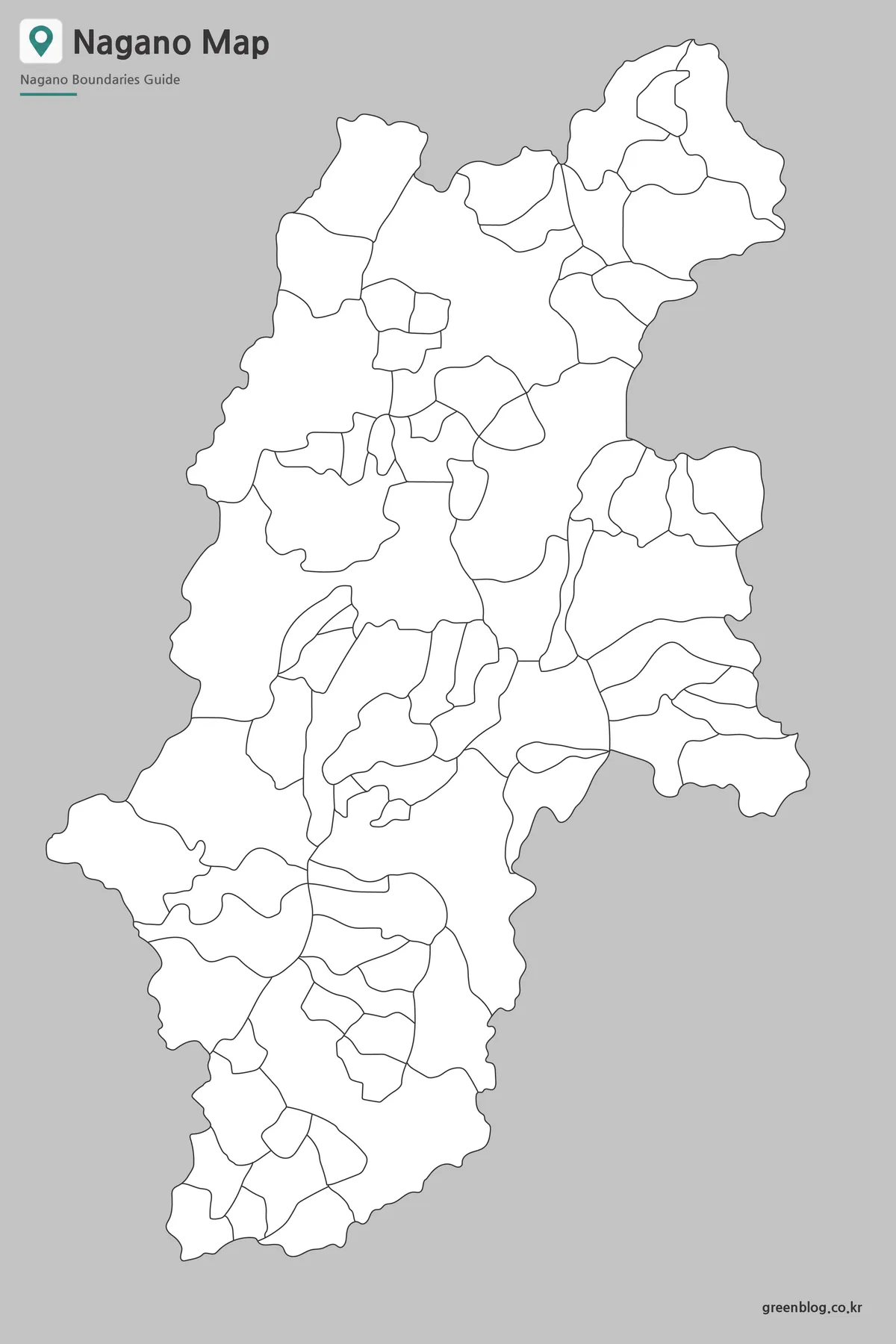
The outline file removes municipality names and surrounding prefecture labels but retains the outer silhouette and every internal division shown in the other versions. It can serve as a labeling exercise, a coloring sheet, or a neutral base for project data. Students might identify the prefectural capital first, then add Matsumoto, Ueda, Saku, Suwa, Ina, Iida, and selected towns or villages.
For thematic work, the blank Nagano Prefecture Map can be shaded by a statistic supplied by the creator, grouped into the six broad travel regions, or marked with selected study locations. Because the download is a raster JPG rather than a vector source, make edits on a duplicate at the largest available size. Added labels should also be checked against the labeled reference so that small central and southern polygons are not assigned incorrectly.
Built for Printing and Presentation Use
Choose the file according to the reader’s task rather than treating the three designs as interchangeable. The color map supports quick comparison on a projected slide. The black-and-white version is better when a labeled reference must sit inside a monochrome document. The outline is the starting point when learners or designers need to supply labels, categories, or highlights themselves.
Practical assignments can make use of Nagano’s distinctive form. Ask students to trace the chain from the Niigata border to the Aichi and Shizuoka edges, compare the broad Nagano City and Matsumoto shapes with smaller nearby municipalities, or separate the Kiso side from the Ina–Iida corridor. A presentation can reveal the labeled version after an outline-based question, while an infographic can use color to distinguish a limited set of selected municipalities.
When printing, avoid stretching the image horizontally; doing so makes the long prefectural outline inaccurate and reduces room for narrow labels. A3 placement preserves the intended balance between the northern, central, and southern sections. For small-page use, the outline version tolerates reduction better than the labeled files, but it should still be checked to ensure that the finest municipal lines remain visible.
Frequently Asked Questions
Can I print the Nagano Prefecture Map in large format?
Yes. The maps were prepared in high resolution and are suitable for large-format printing.
Which version is best for editing?
The outline map is the most flexible choice for editing, annotations, and custom graphic work.
Does the map include municipal boundaries?
Yes. Municipal boundaries are included across all versions of the collection.
Map File Information
Download three matching Nagano municipal map images for labeled reference, monochrome printing, or custom annotation.
- Included Versions: Color map / Black and white labeled map / Blank outline map
- Printable Size: A3
- File Type: JPG
- Intended Use: Printing · Study · Presentations · Annotation
Related Maps
- How a Japan Map
- Why a Nara Prefecture map
- High-Resolution Aomori Prefecture Map
- Japan Fukushima Prefecture Map
Additional Resources
- The Six Regions of Nagano — The official prefectural tourism guide explains the northern, central, eastern, Suwa, Kiso Valley, and southern regional framework.
Green Map creates custom-edited map images using open geographic data sources such as geoBoundaries, Natural Earth, OpenStreetMap, and government open data.
These maps are edited visual materials, not raw data files, and are provided for education, documents, presentations, and graphic reference.