A Shimane Prefecture map has to balance a long mainland corridor with four municipalities in the Oki Islands. The current prefectural structure contains 19 municipalities: eight cities, ten towns, and one village. Fifteen occupy the mainland portion of western Honshu, while Okinoshima, Nishinoshima, Ama, and Chibu are shown north of the coast as separate island jurisdictions.
The supplied artwork follows that administrative pattern rather than presenting a road or physical map. Municipal names sit directly on their areas, and Matsue is printed more prominently near the eastern end. It has no star, dot, or other prefectural-capital symbol. Roads, railways, terrain, scale, north arrow, and statistical legend are also absent.
Each Shimane Prefecture map preview measures 1200 × 1350 pixels in portrait orientation. The color sheet uses pastel municipality fills and blue water, the monochrome sheet retains the names on white interiors, and the outline sheet removes all labels. Tottori, Hiroshima, and Yamaguchi appear in gray around the mainland in the completed versions, while Ulleungdo is labeled across the sea at the far left.
The map does not label the Sea of Japan or identify a national boundary around Ulleungdo. That island is contextual geography, not part of Shimane’s municipal count. The Oki group, by contrast, is part of the prefecture and must remain on the page. Keeping those roles separate prevents the detached island shapes from being interpreted as decorative insets or additional municipalities.
Table of Contents
Map Collection Overview
The three versions use identical municipal geometry and differ only in the amount of visual guidance they provide. This makes them suitable as a completed reference, a low-color handout, and an unlabeled exercise without changing the location or shape of any boundary.
- Color reference: 19 labeled municipalities, pastel fills, blue water, gray neighboring land, and the Ulleungdo label.
- Black-and-white reference: all municipality and surrounding labels with white Shimane interiors.
- Blank outline: the mainland and island boundary network without place names or categorical color.
The eight city labels are Matsue, Izumo, Oda, Gotsu, Hamada, Masuda, Yasugi, and Unnan. The mainland towns are Okuizumo, Iinan, Kawamoto, Misato, Onan, Tsuwano, and Yoshika. Combined with the four Oki municipalities, these labels account for every one of the 19 current municipal units shown in the official prefectural count.
The artwork uses simplified Latin spellings without macrons. For example, it prints Oda, Gotsu, and Onan, whereas other English references may write Ōda, Gōtsu, and Ōnan. Users who add bilingual captions should choose one romanization convention and apply it consistently rather than mixing the two styles on a single page.
Reading from east to west, Yasugi touches the Tottori side, Matsue occupies the northeastern coast and peninsula, and Izumo lies west of it. Unnan connects the eastern urban area to the interior, with Okuizumo and Iinan along the Hiroshima side. Oda, Gotsu, Hamada, and Masuda continue down the coast toward Yamaguchi, while the smaller inland towns fill the southern border corridor.
Above the mainland, Okinoshima occupies the large isolated island shape. Nishinoshima, Ama, and Chibu form the compact group below and to its left. Their labels are placed outside the small polygons so the coastlines remain visible. This layout is particularly helpful for distinguishing the single large Oki municipality from the three closely grouped island municipalities.
Regional Color Map for Administrative Comparison
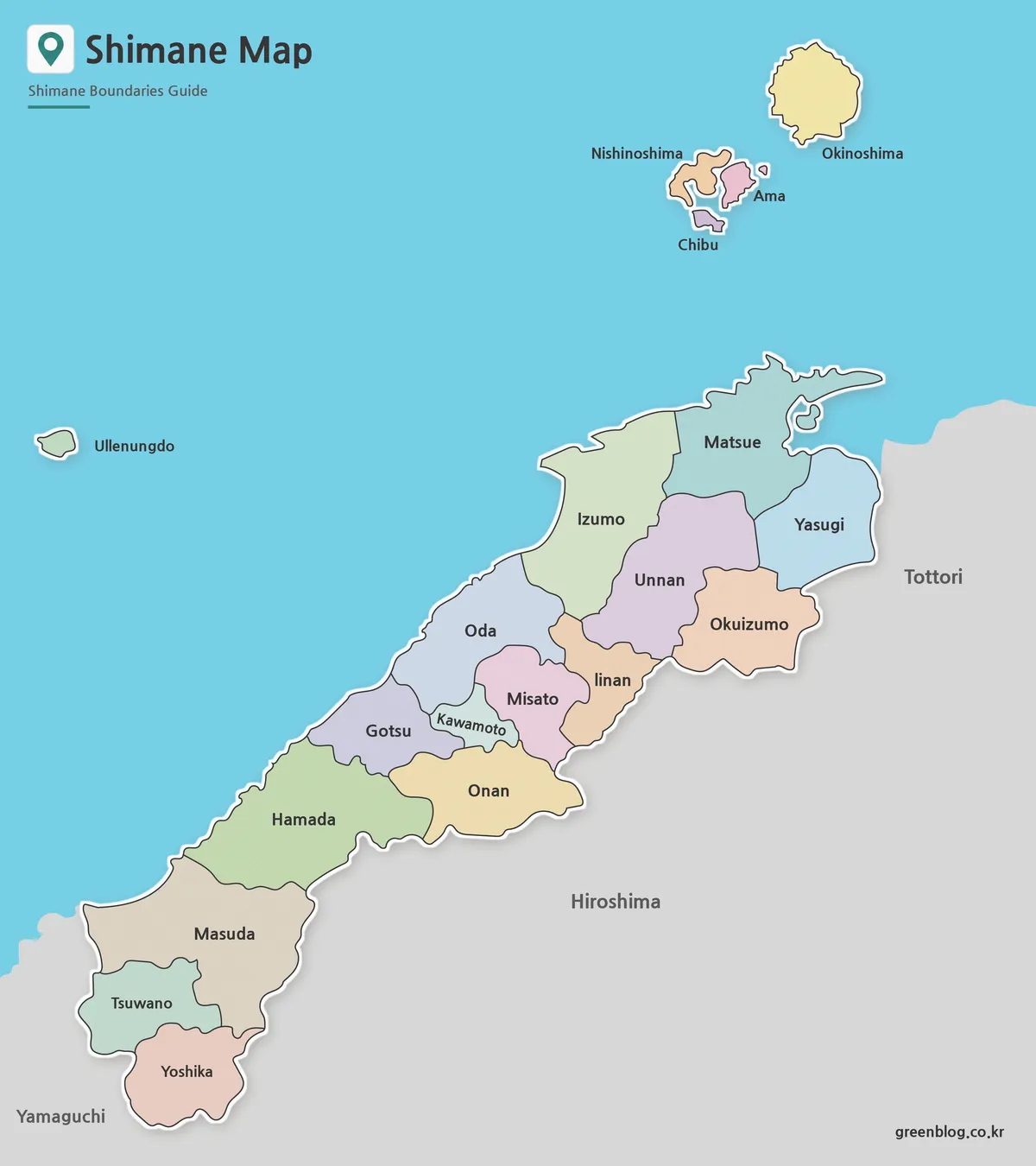
The color Shimane Prefecture map uses alternating pastel blue, green, yellow, pink, purple, and tan to keep neighboring municipalities distinct. The palette is categorical only. It does not represent population, land use, elevation, tourism zones, political results, or municipality type, and no numeric legend accompanies the fills.
Blue water creates clear separation between the mainland, the four Oki jurisdictions, and Ulleungdo. Gray land outside Shimane makes the Tottori, Hiroshima, and Yamaguchi edges legible without competing with the target prefecture. Matsue’s bold label draws attention, but the fill beneath it has no special administrative meaning.
This version works best as a completed regional overview. A presenter can trace the long mainland sequence, compare large coastal cities with narrow inland towns, and then move to the Oki group. If new data are added, the original pastel colors should be replaced or explained by a separate legend so they are not confused with measured categories.
Clean Labeled Version for Documents and Reports
The monochrome edition keeps all 19 municipality labels and the same surrounding context while removing blue water and pastel interiors. Shimane remains white against gray neighboring prefectures. Oki and Ulleungdo are outlined on the white background, so their separation depends on line work and label placement rather than color contrast.
This is the most practical answer key for a worksheet or a neutral figure in a report. The narrow Kawamoto label is angled to fit its small inland shape, while the Oki names sit beside their islands. At reduced size, inspect Kawamoto, Iinan, and the Nishinoshima–Ama–Chibu cluster before printing a full set.
Because the neighboring labels remain, the sheet can support a simple border exercise: Tottori lies to the east, Hiroshima along much of the southern edge, and Yamaguchi at the southwestern end. It should not be used to infer routes or distances, however, because it has no scale and does not display the transport network.
Outline Map Designed for Editing Projects
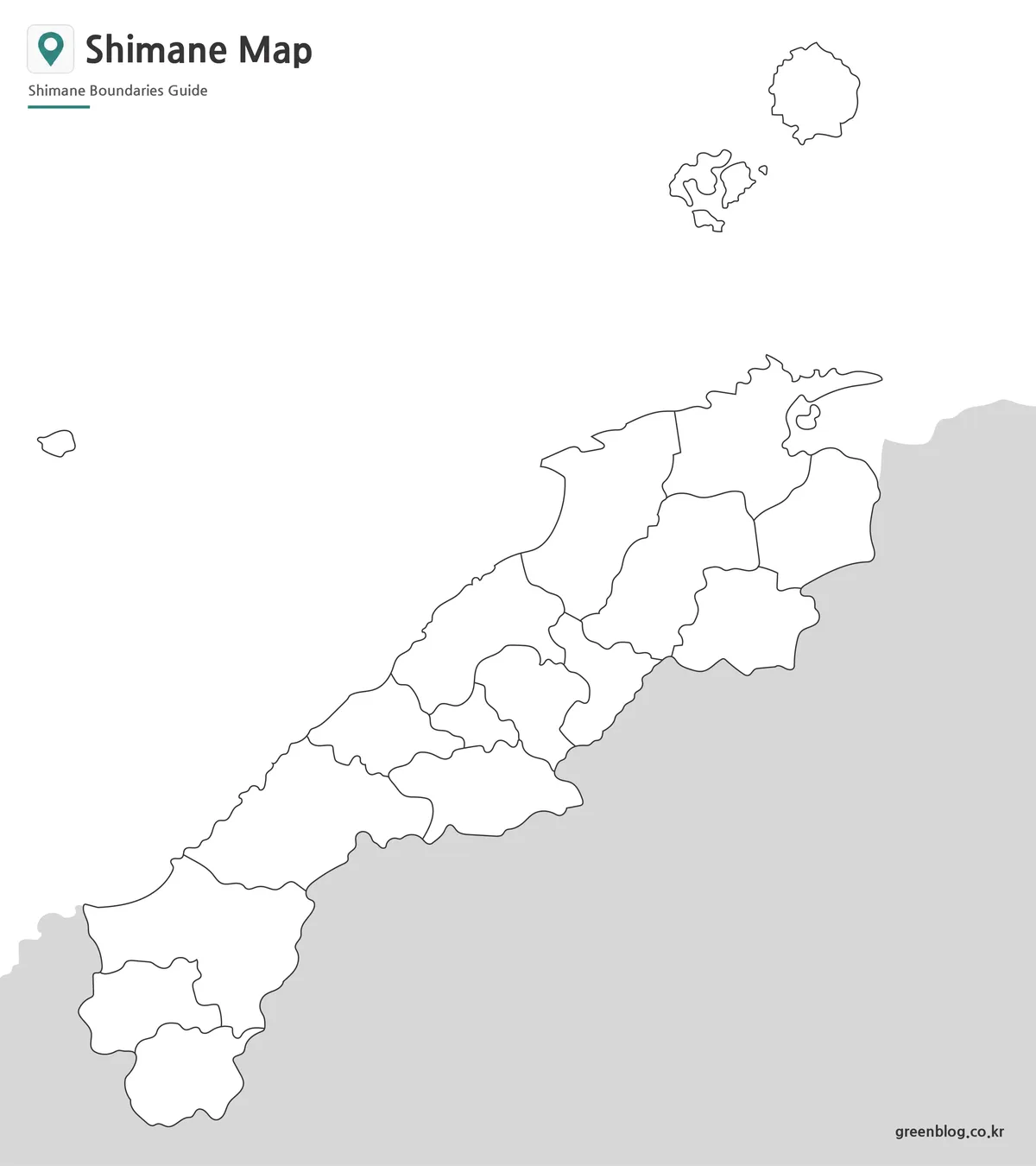
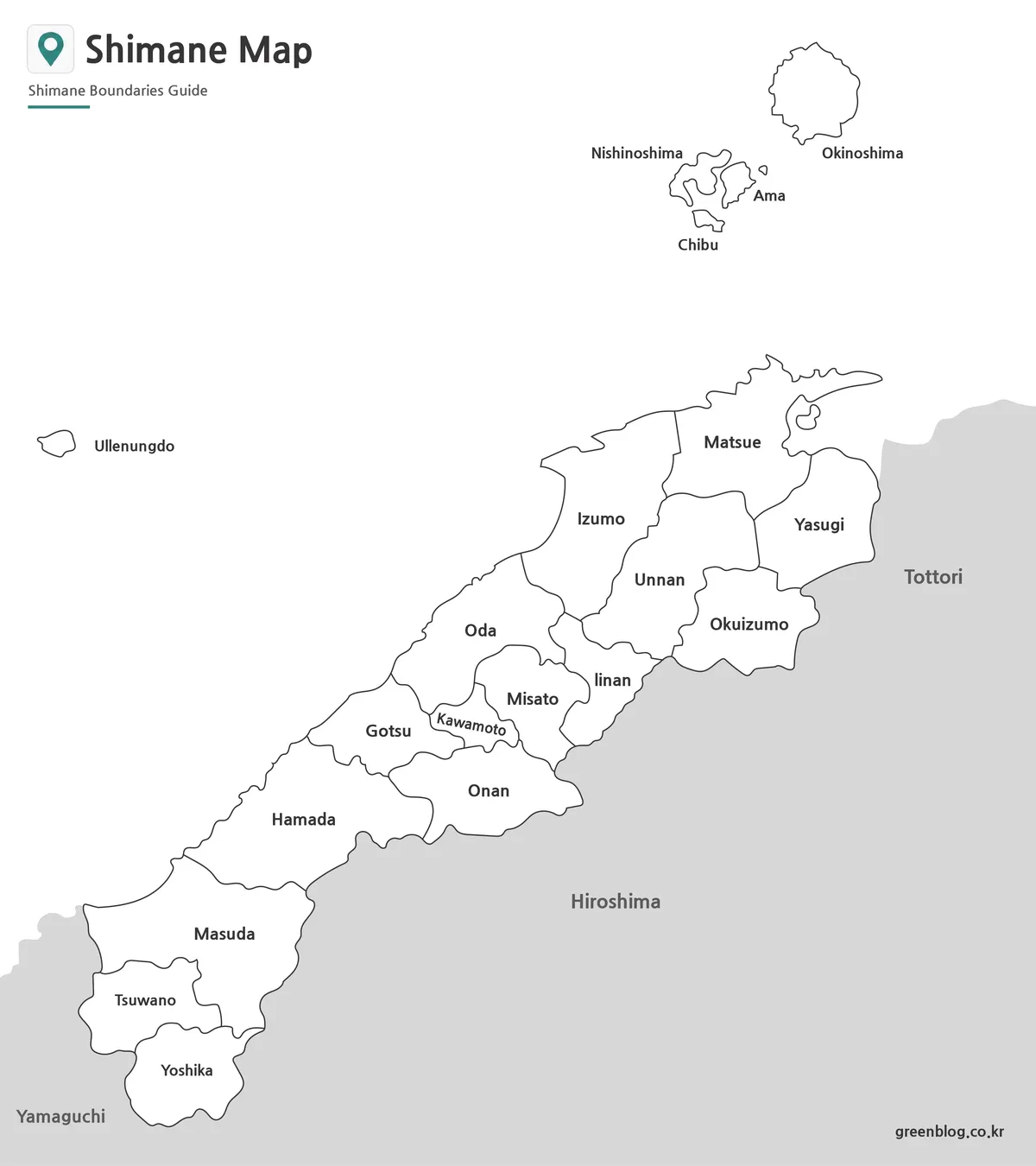
The outline Shimane Prefecture map removes municipality names, the Tottori–Hiroshima–Yamaguchi labels, the Ulleungdo label, and all pastel or blue fill. It retains the title, mainland perimeter, 19-unit boundary structure, Oki coastlines, Ulleungdo outline, gray surrounding land, and the site mark.
Learners can label the eastern cities first, follow the coast through Izumo, Oda, Gotsu, Hamada, and Masuda, then complete the southern towns and four Oki municipalities. Designers can add verified statistics, routes, or thematic categories, but any new symbols or fills need a source and legend.
The supplied preview is a WebP raster image rather than an SVG, GIS layer, or editable vector file. It can be annotated in an image editor, but the municipal polygons are not promised as independently selectable objects. Retaining the 1200 × 1350 proportions prevents the island spacing and elongated mainland from being distorted.
Why a Shimane Prefecture map Can Be Useful
The collection supports several levels of study without pretending to be a detailed atlas. The color sheet is suited to a first explanation, the monochrome sheet keeps all answers visible, and the outline creates a clean assessment or design base. Together they allow the same geometry to move from instruction to practice and then to custom presentation work.
For a municipal lesson, separate the eight cities from the ten towns and one village, then compare the 15 mainland areas with the four Oki areas. For a regional lesson, identify the three neighboring prefectures and explain why Ulleungdo is visible but excluded from the Shimane count. That distinction is more informative than treating every detached shape alike.
The archive description identifies the downloadable files as high-resolution JPG images prepared for A3 output, while the three web previews inspected here are WebP. Before large-format printing, preserve the aspect ratio, leave adequate margins around Okinoshima and Ulleungdo, and test the smallest labels. A sample page is safer than assuming a particular printer will scale the portrait layout identically.
Frequently Asked Questions
Can I print the Shimane Prefecture map in A3 size?
Yes. The files were prepared in high resolution for A3 printing.
Does the Shimane Prefecture map include the Oki Islands?
Yes. Okinoshima, Nishinoshima, Ama, and Chibu are included.
Which version is best for editing?
The outline map is the best choice for graphic editing, annotations, and custom projects.
Is the labeled version suitable for classroom use?
Yes. The black and white map was designed with educational printing and document use in mind.
Is Matsue marked with a prefectural-capital symbol?
No. Matsue is shown as a bold municipality label inside its boundary, but there is no star, dot, or capital icon. Add a separate symbol and legend if a project needs to identify the prefectural capital, and state clearly that the marker was added after the original map was created.
Map File Information
The archive groups the color, labeled monochrome, and blank municipal views displayed above.
- Included Versions: Color, black and white, and outline
- Intended Use: Lessons, reports, reference sheets, presentations, and annotations
Related Maps
- Okinawa Prefecture Map
- Why a Nara Prefecture map
- High-Resolution Aomori Prefecture Map
- Nagano Prefecture Map
Additional Resources
The official Shimane Prefecture location and municipality guide confirms the 19-municipality structure and explains the mainland–Oki relationship.
Green Map creates custom-edited map images using open geographic data sources such as geoBoundaries, Natural Earth, OpenStreetMap, and government open data.
These maps are edited visual materials, not raw data files, and are provided for education, documents, presentations, and graphic reference.