A Hsinchu County Map reveals a long northwest-to-southeast layout that a small Taiwan locator cannot explain. Compact coastal and foothill divisions cluster around Zhubei, Zhudong, and Hsinchu City, while Jianshi and Wufeng occupy much larger mountain areas in the east and south. The supplied portrait set keeps all 13 county divisions visible in three matching treatments: labeled color, labeled black and white, and an unlabeled outline.
Each published preview measures 1,200 × 1,697 pixels and is arranged for an A3 portrait page. The tall frame gives the extended Jianshi shape room without shrinking the smaller western units beyond recognition. Teachers can use the maps for administrative lessons, editors can place the monochrome version in reports, and designers can annotate a blank base without first removing labels.
Hsinchu County and Hsinchu City are separate local governments. The county map wraps around an unlabeled gray space on the west that corresponds to Hsinchu City, but it does not mark the city by name. It does label Taoyuan, Miaoli, Yilan, and Taichung around the county. That combination makes the artwork valuable for boundary reading, provided viewers are told that the western gap is not missing county data.
Table of Contents
Hsinchu County Map Overview
The county’s 13 first-level local divisions consist of one county-administered city, three towns, seven ordinary townships, and two mountain indigenous townships. Zhubei City is the county seat. Guanxi, Xinpu, and Zhudong are towns; Baoshan, Beipu, Emei, Hengshan, Hukou, Qionglin, and Xinfeng are townships; Jianshi and Wufeng are mountain indigenous townships.
The labeled Hsinchu County Map prints only the romanized place names, without “City,” “Town,” or “Township” suffixes. This keeps the artwork uncluttered but hides the differences in administrative type. A formal lesson or report should pair the image with a categorized list so readers do not assume that every colored area has the same status.
Spatially, Xinfeng and Hukou form the northern end beside the Taoyuan label. Zhubei reaches the western edge, with Xinpu immediately inland. Guanxi stretches eastward above Hengshan, while the narrow Zhudong and Qionglin areas occupy the center. Baoshan, Emei, and Beipu sit to the southwest of that central corridor. Wufeng and Jianshi dominate the mountainous lower half of the page.
The illustration contains administrative outlines rather than a complete geographic reference. It does not plot roads, railways, rivers, reservoirs, elevation, terrain shading, settlement points, coordinates, or a scale bar. Zhubei is named but not marked with a county-seat symbol. Use the image to compare division shapes and adjacency, not to calculate distance or plan travel.
Included Map Versions
The Hsinchu County Map package keeps the same boundary geometry and portrait extent across all three previews. Only the fills and labels change, so users can move from reference to practice without introducing a different shape or scale.
- Color labeled map: separates the 13 divisions with muted categorical fills.
- Black-and-white labeled map: preserves names and borders for monochrome pages.
- Blank outline map: removes all place labels and internal color for custom work.
Choose color for quick recognition, monochrome when text and handwritten notes should dominate, and outline when the reader must supply the information. None of the versions adds physical geography or transport detail, and the raster images should not be described as vector source files.
Color Map for Regional Comparison
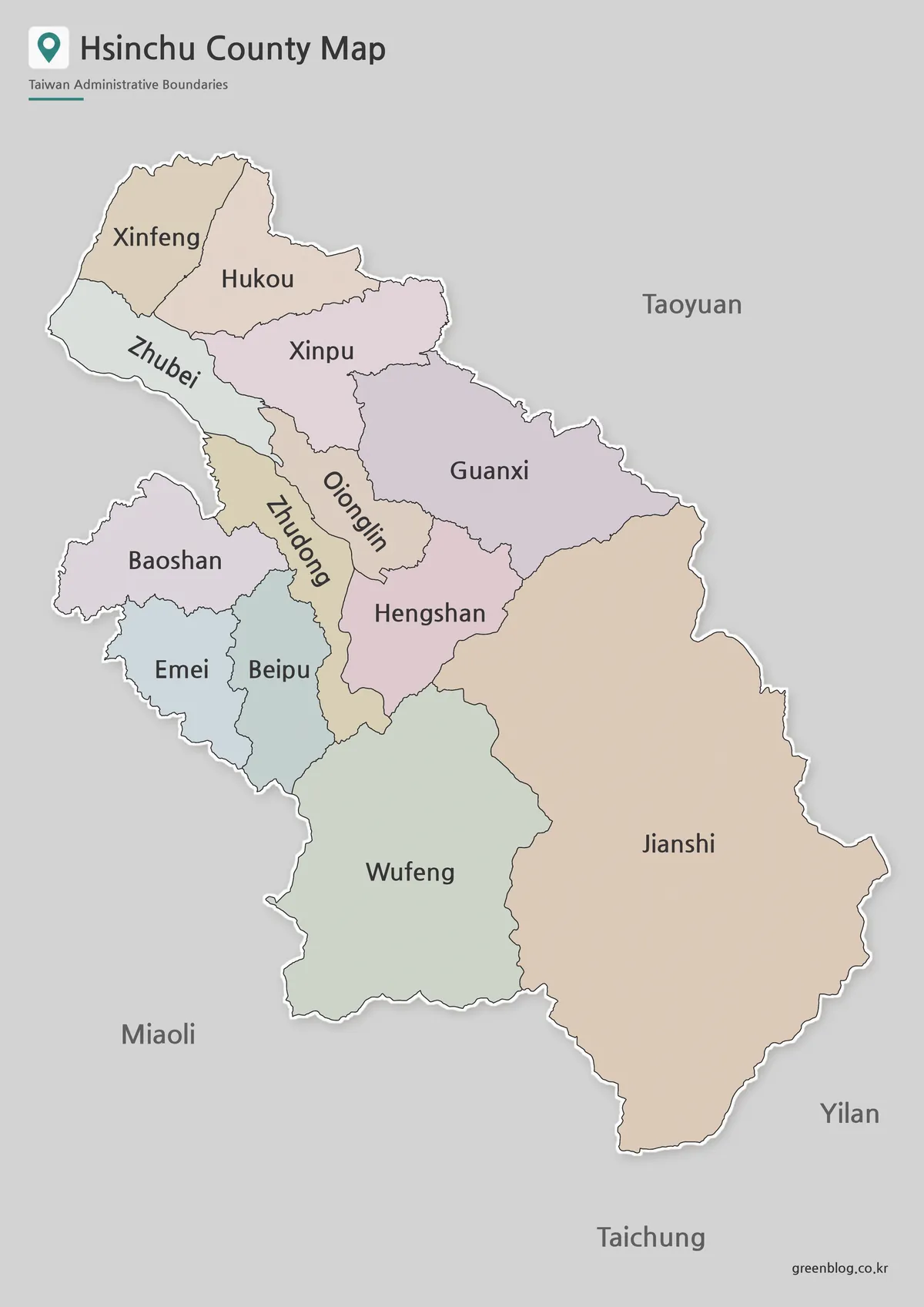
On the color Hsinchu County Map, pastel fills make neighboring units easier to separate where the layout is most crowded. Zhubei, Zhudong, Qionglin, and the small connecting shapes in the central-western corridor would be harder to distinguish using outlines alone. Farther east, Guanxi, Jianshi, and Wufeng are large enough to read clearly even without strong color contrast.
The colors are categorical rather than statistical. They do not encode population, elevation, land use, rainfall, ethnicity, or economic activity. If this edition becomes the background for a data graphic, replace or mute the decorative fills and add a documented legend. Otherwise, readers may mistake unrelated pastel differences for measured values.
The surrounding gray field gives four neighboring jurisdictions visual context, but the map does not label the Taiwan Strait or Hsinchu City. A presentation about location should add those two references outside the county boundary. Keep the labels away from Xinfeng and Zhubei so the already compact northwest remains readable.
Black and White Printable Version
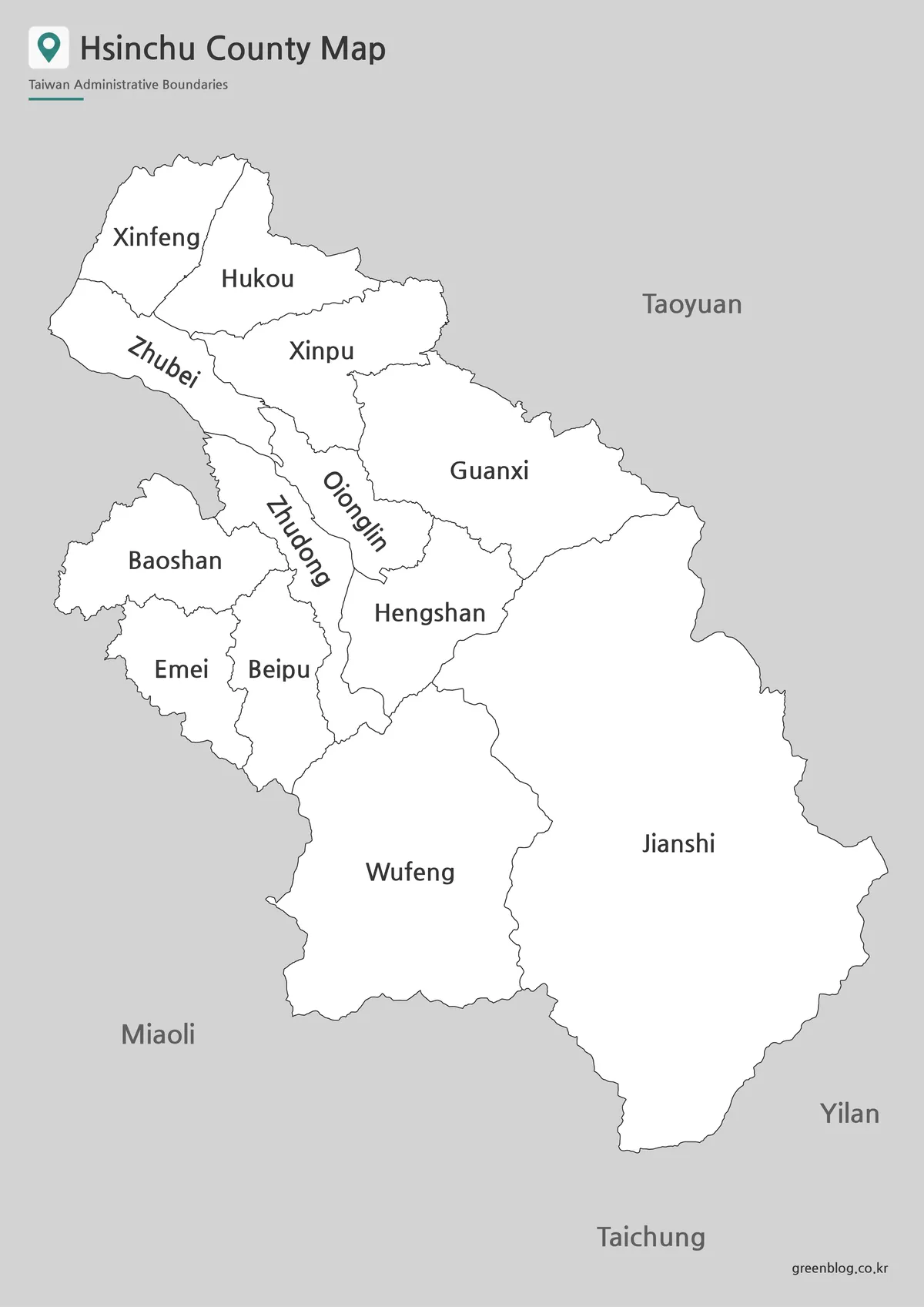
The black-and-white Hsinchu County Map retains every internal name and neighboring-jurisdiction label while removing the pastel palette. It fits monochrome handouts, report inserts, answer sheets, and documents where color would compete with surrounding content. Because boundaries remain thin, users can add arrows, numbers, or notes without obscuring the original structure.
Several labels are angled to follow narrow shapes, especially Zhubei, Zhudong, and Qionglin. Preserve the portrait aspect ratio and test one print before producing a class set. Excessive reduction can make those rotated names less comfortable to scan even though Jianshi, Wufeng, and Guanxi remain spacious.
This is the best reference partner for the blank worksheet because it uses identical geometry. Students can complete the outline first and check their results against the labeled edition. A separate key can identify which names are a city, towns, ordinary townships, or mountain indigenous townships.
Blank Outline Map for Editing
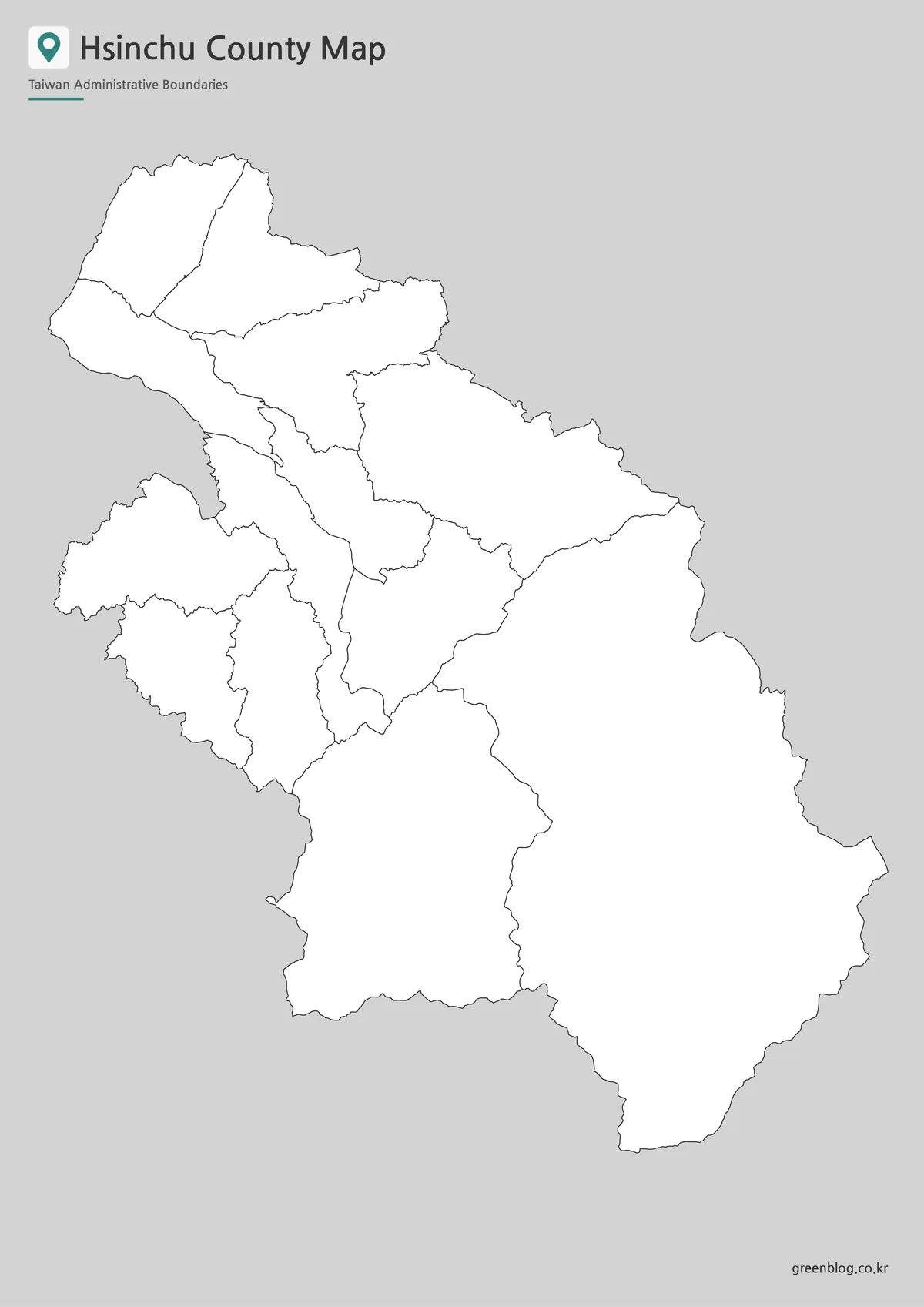
The blank Hsinchu County Map removes the 13 local names, all surrounding labels, and every internal fill. What remains is the county silhouette, division lines, and the gray outside context. This clean base is suited to a labeling quiz because no printed answer hints remain inside or around the county.
For a progressive exercise, begin with Zhubei at the northwest edge, then identify the northern pair of Xinfeng and Hukou. Continue through Xinpu, Guanxi, Qionglin, Zhudong, and Hengshan before moving to Baoshan, Emei, Beipu, Wufeng, and Jianshi. The pronounced size difference between compact western areas and the two southern-eastern mountain townships gives learners useful shape cues.
Designers can add a custom color scale, location markers, or sourced values, but should work on a duplicate and provide a legend, date, and source. The outline has no projection or surveyed precision statement. Use an authoritative spatial dataset when exact boundaries, coordinates, or measurements are required.
Administrative Areas Included
The Hsinchu County Map labels all 13 divisions represented by the boundary layer. Grouping them by status makes the list more informative than a single undifferentiated sequence.
- County-administered city: Zhubei
- Towns: Guanxi, Xinpu, and Zhudong
- Townships: Baoshan, Beipu, Emei, Hengshan, Hukou, Qionglin, and Xinfeng
- Mountain indigenous townships: Jianshi and Wufeng
Romanization systems have varied across official English materials, so older sources may show forms such as Jhubei, Sinpu, Guansi, Cyonglin, Jhudong, or Wufong. The supplied artwork consistently uses Zhubei, Xinpu, Guanxi, Qionglin, Zhudong, and Wufeng. Retain one naming system throughout a project and record alternatives only when they help readers match another official source.
Hsinchu City is not a fourteenth county division. It is a separate city-level jurisdiction enclosed by the county on multiple sides and open to the western coast. This distinction explains the irregular indentation between Zhubei, Baoshan, and nearby county areas.
Practical Uses for This Map
A geography lesson can use the Hsinchu County Map to compare administrative type and physical scale. Ask learners why one city and three towns are concentrated toward the more compact northwest and center, while Jianshi and Wufeng occupy broad mountain territory. The map itself does not show elevation, so the answer should be supported with a separate physical reference rather than inferred from color.
For a regional-boundary activity, students can place Taoyuan to the north and northeast, Miaoli to the southwest, Yilan to the southeast, and Taichung to the south. They can then add the unlabeled Hsinchu City and Taiwan Strait. This makes the blank outline useful for both internal and external orientation.
- Create a 13-division name-recall worksheet.
- Separate city, town, township, and mountain-indigenous status.
- Compare compact western units with Jianshi and Wufeng.
- Add Hsinchu City and the Taiwan Strait to the context.
- Build a sourced thematic overlay with a custom legend.
For publication, state exactly what the image contains. It is an administrative boundary illustration with selected surrounding labels, not a road, terrain, tourism, or navigation map. That concise qualification keeps the resource useful without encouraging readers to infer features that are absent.
Frequently Asked Questions
Is Hsinchu County the same as Hsinchu City?
No. Hsinchu County and Hsinchu City are separate administrative areas in Taiwan, so a Hsinchu County map should not be treated as a Hsinchu City map. Hsinchu County includes Zhubei City and several towns and townships, while Hsinchu City is managed separately.
What versions are included in this Hsinchu County map collection?
The collection includes a color map, a black and white map, and an outline map. Each version is designed for a different use case, such as presentation design, classroom printing, or custom editing.
Can I use the outline map for coloring or labeling?
Yes. The outline version is suitable for coloring activities, labeling exercises, infographic editing, and custom map projects.
Is the map useful for classroom materials?
Yes. The map can be used for Taiwan geography lessons, worksheets, regional comparison projects, and printable study resources.
Does the Hsinchu County Map label Hsinchu City?
No. The labeled maps show a gray western indentation where the separate city jurisdiction sits, but they do not print “Hsinchu City.” Add that name when the lesson or graphic needs complete local context.
Map File Information
The ZIP package contains matching color, black-and-white, and blank administrative images of Hsinchu County.
- Included Versions: Color labeled, black-and-white labeled, and blank outline
- Printable Size: Prepared for an A3 portrait layout
- File Type: Image files in a ZIP archive
Additional Resources
- Hsinchu County Government: official county information, local-government pages, and current public resources.
Related Maps
Green Map creates custom-edited map images using open geographic data sources such as geoBoundaries, Natural Earth, OpenStreetMap, and government open data. These maps are edited visual materials, not raw data files, and are provided for education, documents, presentations, and graphic reference.