An Iraq Map is easiest to understand when its broad western desert, compact northern governorates, central capital district, and southeastern approach to the Gulf are viewed together. In this collection, Al-Anbar fills most of the west, the northern tier narrows around Duhok, Nineveh, Arbil, Kirkuk, and Al-Sulaimaniyah, and a chain of smaller governorates follows the Tigris–Euphrates heartland toward Al-Basrah.
The package supplies three coordinated images: a labeled color administrative map, a labeled black-and-white map, and an unlabeled outline. They were prepared around an A3 landscape layout for classroom handouts, country-reference sheets, presentation graphics, labeling activities, and custom visual projects. The published WEBP previews measure 1200 × 849 pixels; the download box identifies the packaged resources more generally as image files rather than promising editable vector source files.
This Iraq Map requires an important date note. The artwork labels 18 governorates and does not separate or name Halabja. Iraq’s parliament approved Halabja as the country’s 19th governorate in April 2025, so the supplied boundary framework represents the earlier 18-governorate arrangement. It remains useful for studying the exact images provided, but it should not be described as a complete current 19-governorate map.
Table of Contents
Map Collection Overview
The labeled maps name Duhok, Arbil, Nineveh, Kirkuk, Al-Sulaimaniyah, Salah al-Din, Diyala, Baghdad, Al-Anbar, Karbala, Babil, Wasit, Misan, Al-Qadisiyah, Dhi Qar, Al-Najaf, Al-muthanna, and Al-Basrah. Some English references use alternative transliterations such as Erbil, Sulaymaniyah, Anbar, Najaf, Muthanna, Basra, and Qadisiyyah. The Iraq Map images retain their printed spellings, so those labels should not be silently treated as errors.
Baghdad appears as a small, separately outlined central governorate with its name printed inside. It is not shown with a star or pin. Karbala and Babil sit immediately to the south, Diyala extends eastward toward Iran, and Salah al-Din reaches north between Nineveh, Kirkuk, and Diyala. This dense center contrasts sharply with the single large Al-Anbar polygon stretching to the Syrian and Saudi borders.
Farther south, Al-Najaf and Al-muthanna occupy broad areas along the Saudi Arabian border. Al-Qadisiyah, Dhi Qar, Wasit, and Misan form the interior and eastern sequence, while Al-Basrah reaches Iraq’s short Gulf coastline. Small blue water features and river segments are visible in the color edition, but they are not labeled and do not form a complete hydrographic reference.
Turkey, Syria, Iran, and Saudi Arabia are labeled outside the country. Iraq also borders Jordan and Kuwait, but their names do not appear in the supplied artwork. When using this Iraq Map for a border lesson, explain that the surrounding labels are selective context rather than a full list of neighboring states.
- Color version: 18 labeled governorates with alternating muted fills
- Monochrome version: the same labels and boundaries on white interiors
- Outline version: national and internal boundaries without place names or fills
- Administrative date caution: Halabja is not shown as a separate 19th governorate
Regional Color Map
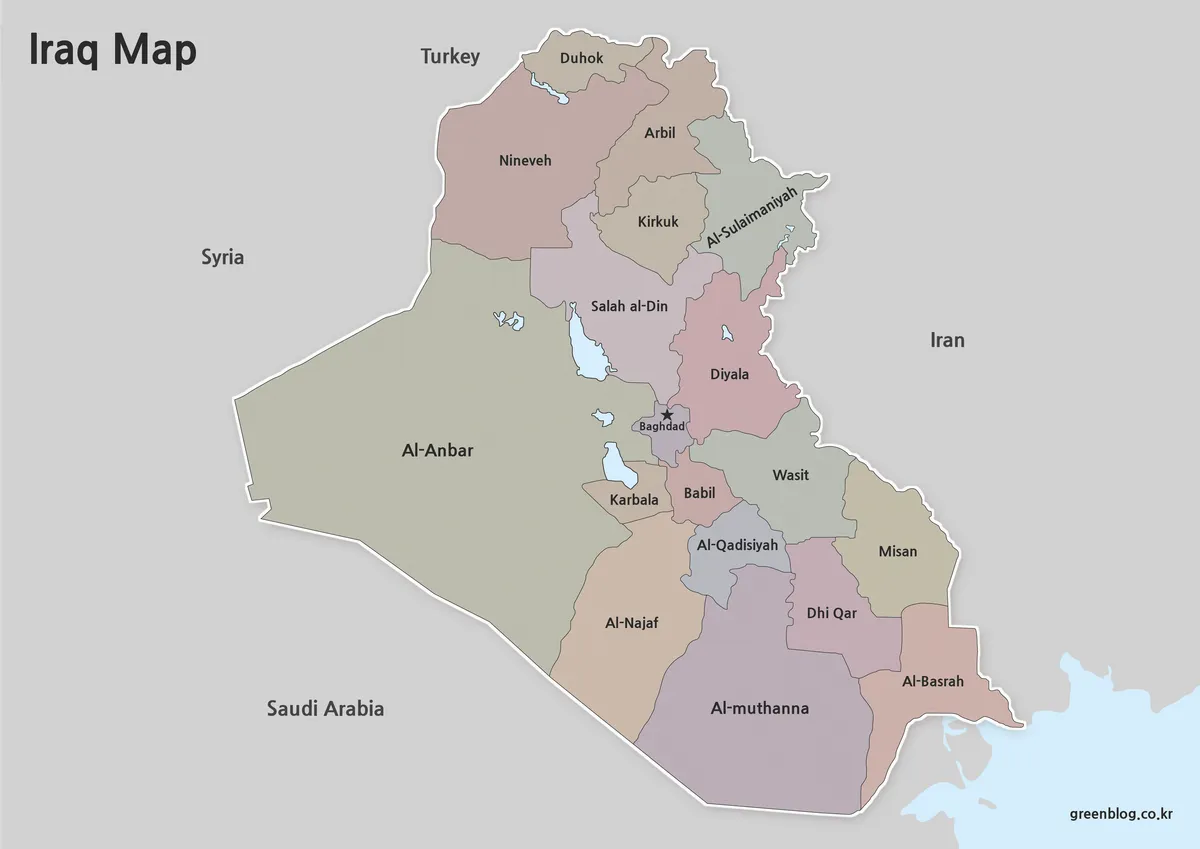
The color Iraq Map uses restrained pink, tan, green, blue, and violet fills to distinguish adjoining governorates. Color is particularly helpful around Baghdad, where several small units meet, and in the north, where Kirkuk, Arbil, Duhok, Nineveh, and Al-Sulaimaniyah create an irregular pattern. Al-Anbar’s large western area and Al-muthanna’s broad southern shape are immediately recognizable.
The fills have no statistical meaning. They do not represent population, ethnicity, language, religion, political affiliation, elevation, land cover, or security conditions. If a user adds thematic information, it needs a separate legend and a dated source. Transparent symbols or hatching are safer than replacing every fill when the original purpose—separating boundaries—must remain clear.
This version works best as an introductory slide, a wall reference, or a visual index beside a written governorate list. It also helps readers follow the sequence from the Kurdistan Region area in the north toward Baghdad and the southern governorates. Because Halabja is absent, presentations discussing the post-April-2025 system should add a visible note rather than implying that the map shows all current units.
Black and White Printable Version
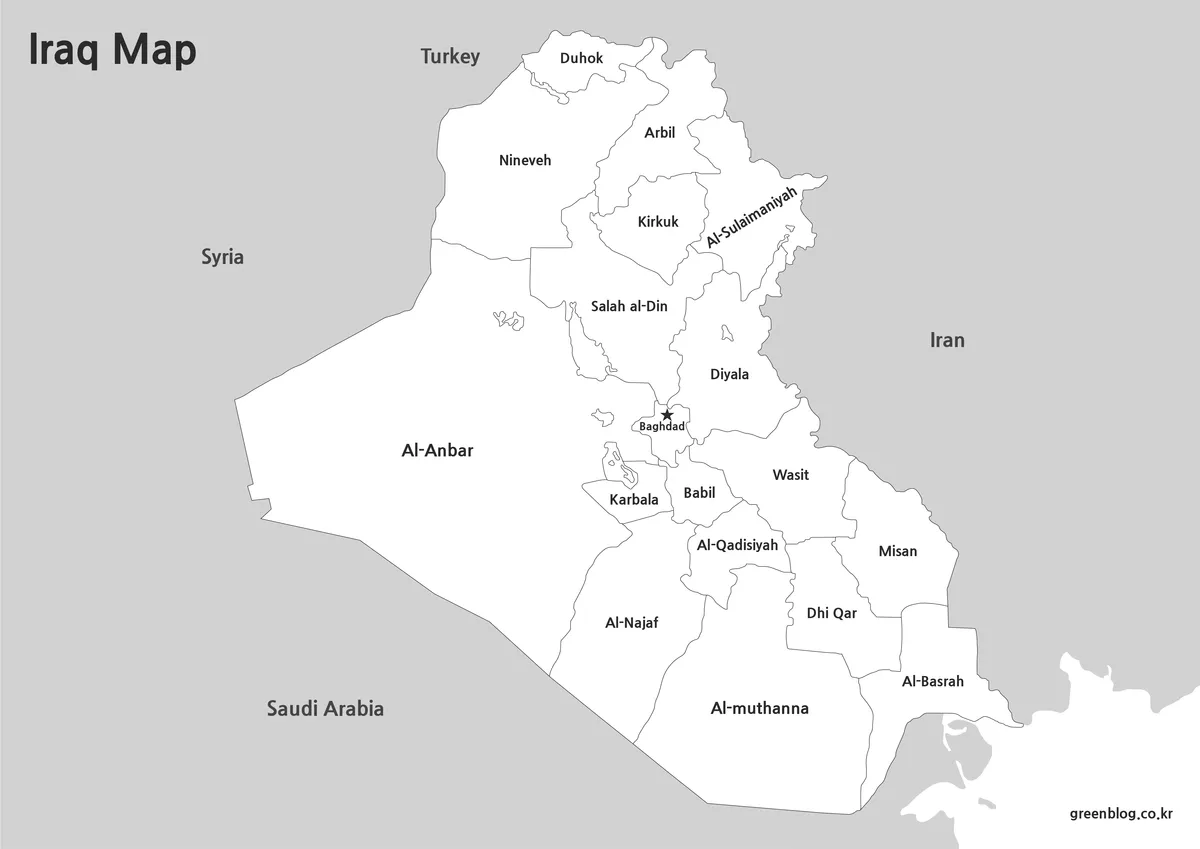
The black-and-white Iraq Map removes the pastel fills but preserves the internal lines, governorate names, selected neighboring-country labels, and small blue-gray water shapes. White interiors reduce competition with surrounding text and leave room for circles, arrows, short notes, or a limited highlight color.
Choose this edition when names must remain visible in a worksheet, report, or presentation handout. It supports guided identification better than a recall test because the answers are already printed. A teacher can pair it with the blank outline, using the monochrome version as a reference and the outline as the activity page.
Test the smallest labels before producing multiple A3 copies. Baghdad, Karbala, Babil, and several northern names occupy constrained spaces, while Al-Sulaimaniyah is angled along a narrow eastern shape. Preserve the landscape proportions, keep a margin around the Gulf coast, and avoid stretching the map horizontally merely to fill a slide.
Blank Outline Map for Editing
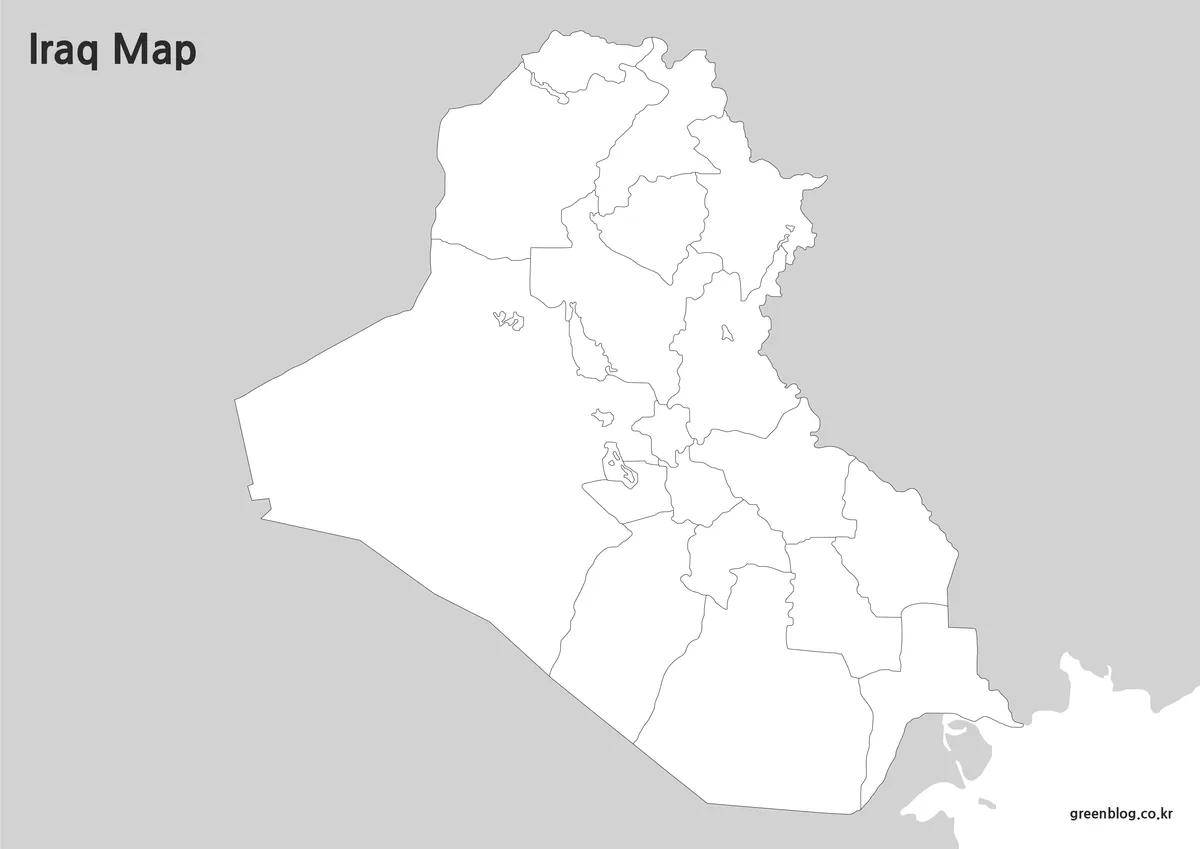
The outline Iraq Map removes governorate names, neighboring-country labels, and color fills while retaining the country silhouette and internal boundary framework. This creates a neutral base for labeling exercises, regional grouping, localized text, simple data displays, and project-specific annotations.
A classroom task might ask learners to locate Baghdad, identify the large western governorate, label the three northern governorates of the Kurdistan Region shown here, or trace the route from Nineveh toward Al-Basrah through the central and southern sequence. Any exercise requiring Halabja as a separate unit needs an updated source map rather than an improvised line.
The resource is a raster image, not a GIS layer or a vector file with independently selectable polygons. Users can add text, arrows, transparent fills, and markers in common image or page-layout software, but a region may need to be selected manually. Keep an untouched copy and do not use the generalized boundaries for surveying, legal interpretation, routing, or operational planning.
Designed for Printing and Presentation Use
An Iraq Map used at A3 size should retain its original landscape ratio. The broad Al-Anbar area gives the page horizontal balance, while the northern and southeastern ends need enough margin to keep Duhok and the Al-Basrah coastline intact. Print one test sheet to check the thin internal lines and the compact labels around Baghdad before making a class set.
For presentations, color is useful when the audience must distinguish adjacent governorates quickly; monochrome is better when the map accompanies charts or colored callouts; and the outline works when information will be revealed step by step. On a small slide, explain the north, center, west, and south in separate passes instead of expecting every label to be read at once.
For online publication, add descriptive alternative text and repeat the administrative date note in nearby visible copy. If the Iraq Map is combined with population, transport, water, heritage, or security information, identify the source and date of the added layer. This separates the supplied 18-governorate artwork from newer facts and prevents decorative color from being mistaken for data.
FAQ
What map versions are included?
The collection includes color, black and white, and outline versions.
Can the maps be printed in A3 size?
Yes. The files were prepared with A3 printing in mind and remain readable when enlarged.
Is Baghdad marked on the map?
Yes. Baghdad is highlighted separately for easier identification.
When should I use the outline version?
The outline map works best for editing, annotations, educational exercises, and infographic creation.
Map File Information
The ZIP package groups color, labeled monochrome, and blank outline images based on the displayed 18-governorate framework.
- Included Versions: Color, labeled black and white, and blank outline
- Printable Size: A3 landscape layout
- File Type: Image files in one ZIP archive
- Intended Use: Lessons, reports, presentations, labeling, coloring, and annotations
Related Maps
Additional Resources
- UNESCO Iraq — Explore Iraq’s World Heritage sites, living heritage, educational work, and country-level UNESCO programs.
Green Map creates custom-edited map images using open geographic data sources such as geoBoundaries, Natural Earth, OpenStreetMap, and government open data.
These maps are edited visual materials, not raw data files, and are provided for education, documents, presentations, and graphic reference.