A Kaohsiung City Map has to show two very different spatial patterns at once: a tight group of coastal and urban districts in the southwest and a much larger chain of inland districts reaching northeast into Taiwan’s mountains. The supplied portrait layout keeps both patterns on one page without enlarging the downtown cluster so much that Taoyuan, Namasia, Jiasian, Liouguei, and Maolin lose their geographic relationship.
This collection provides three matching views of Kaohsiung’s 38 districts. The color map separates neighboring districts with muted fills, the black-and-white map retains names and boundaries for a quieter reference sheet, and the outline map removes the labels to create space for exercises or annotations. Each map measures 1200 by 1468 pixels and uses the same A3-oriented composition.
The district arrangement is more complex than a simple city-center map suggests. Cijin forms a narrow offshore strip beside the port, the older central districts are too small for full names inside their shapes, and the eastern half contains broad mountain districts that dominate the page by area. Those contrasts make the set practical for Taiwan geography lessons, reports, presentation graphics, district comparison, and project-specific marking.
Table of Contents
Kaohsiung City Map Overview
Kaohsiung occupies a long section of southwestern Taiwan. Its developed coastal plain faces the Taiwan Strait, while the municipal boundary extends far inland toward higher terrain. Tainan lies to the north and northwest, and Pingtung County borders much of the east and south. The downloadable maps focus on Kaohsiung itself rather than drawing those neighbors, roads, railways, or terrain.
The 38-district structure becomes easiest to read in bands. Taoyuan and Namasia fill much of the far northeast; Jiasian, Liouguei, Shanlin, Neimen, Meinong, and Maolin form a broad interior transition; and Cishan, Tianliao, Yanchao, Dashu, and nearby districts lead toward the densely divided southwest. The outlines make this change in scale visible even before the labels are read.
Near the coast, several district shapes are narrow, irregular, or packed around the harbor. The Kaohsiung City Map uses numbers 1 through 4 for YanCheng, Cianjin, Sinsing, and Lingya, then identifies them in a boxed key. This prevents four names from colliding inside the smallest central areas while preserving their positions in the boundary network.
Readers should use the spellings printed on the Kaohsiung City Map when matching the three versions. The artwork includes forms such as Namasia, Liouguei, Cishan, Cianjhen, Siaogang, and Cijin. Romanization can vary between English-language sources, so an official city reference is the better companion when a project requires a particular administrative spelling.
Color-Coded District Map
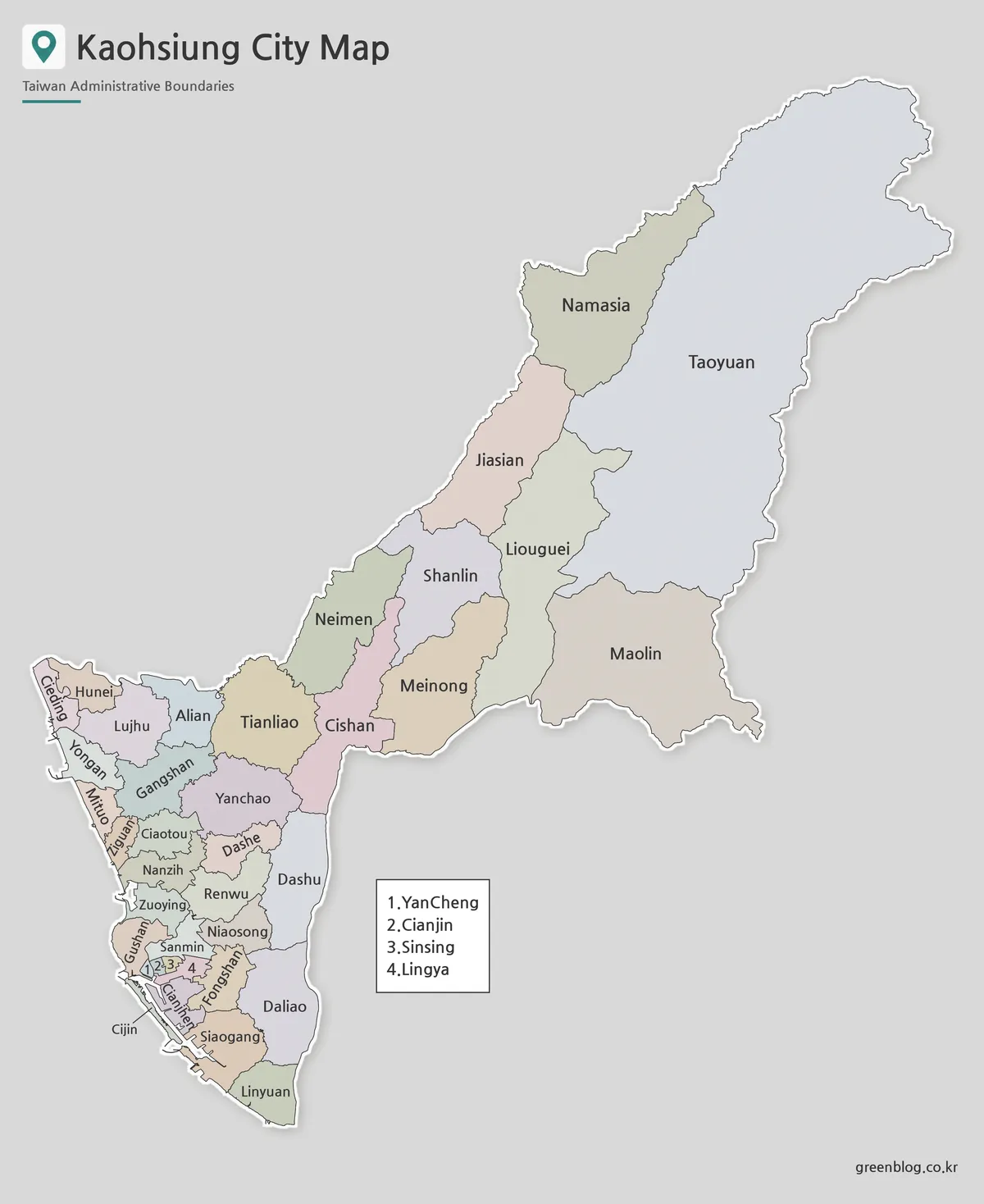
Pastel fills give each adjacent district a separate visual field. The effect is strongest around Gangshan, Ciaotou, Yanchao, Dashe, Renwu, Nanzih, and Zuoying, where many boundaries meet within a small portion of the page. In the east, the larger colored areas make the scale of Taoyuan and Maolin immediately apparent.
The port-side geometry also benefits from color. Cijin can be followed as a long coastal strip, while Cianjhen and Siaogang remain distinct beside the harbor lines. The four-number key isolates the smallest central districts without introducing large callout boxes across nearby shapes. As a result, the Kaohsiung City Map can support a spoken presentation while the audience tracks district locations visually.
Color on this sheet is categorical, not statistical. It does not represent population, elevation, land use, or political preference. Choose this edition when the task is to compare adjacent districts, introduce the city’s unusual municipal extent, or create a slide where rapid recognition matters more than monochrome consistency.
Black and White Printable Version
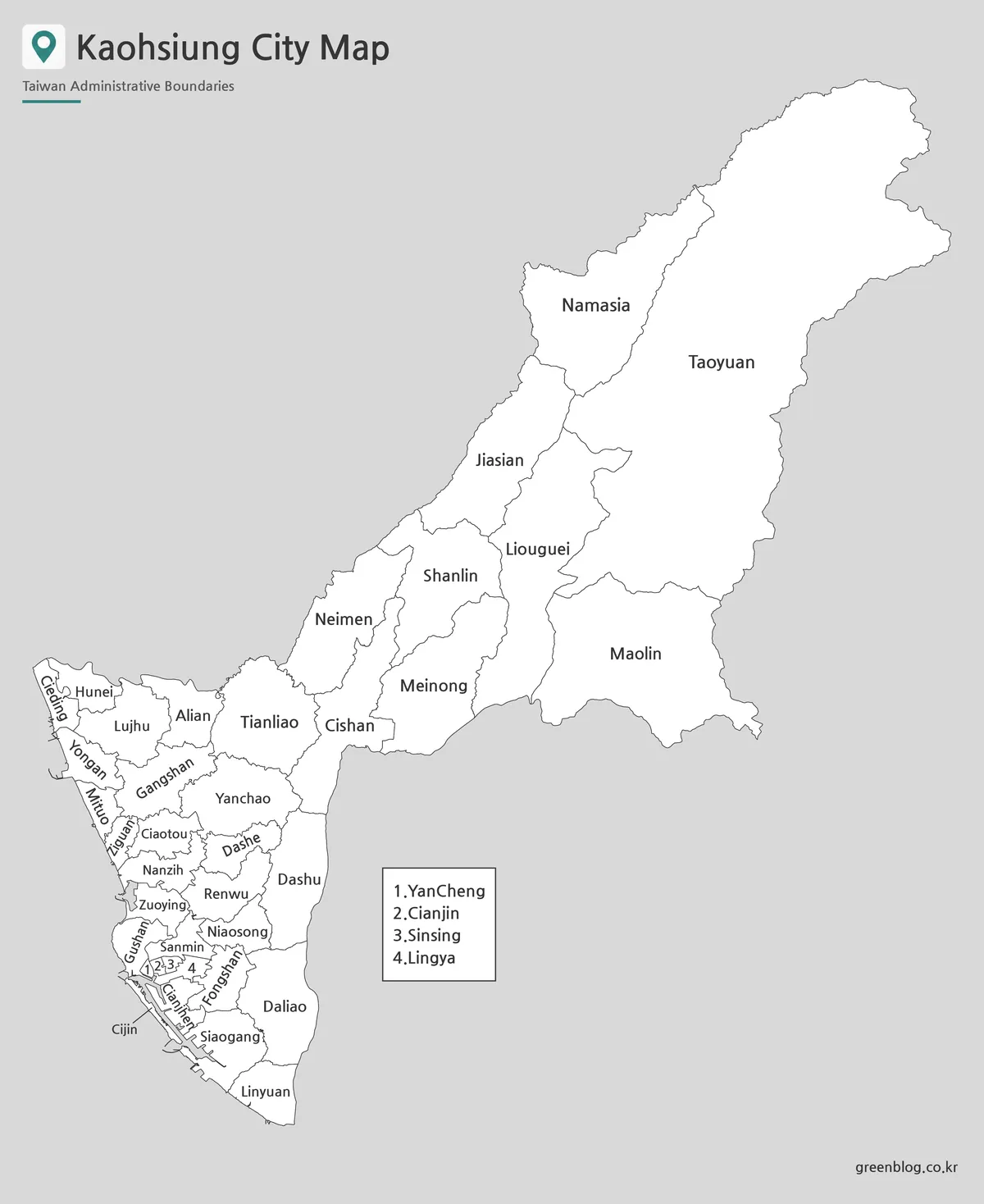
The monochrome version preserves the full label system but removes the pastel fills. This puts more attention on the district names, coastline, harbor edges, and boundary lines. It is a better fit for documents that already use a strong color palette or for classroom sheets that ask readers to underline, circle, or shade selected places.
Scale deserves attention when printing. Large names such as Taoyuan, Maolin, and Meinong remain comfortable at smaller sizes, but the western cluster contains angled labels and the four numbered districts. Keeping the portrait ratio and avoiding aggressive page reduction will make the key and thin coastal shapes easier to read.
A practical lesson can begin with this labeled Kaohsiung City Map and ask students to trace a sequence from the coast toward the mountains. Another activity might compare the size of Cijin with Taoyuan or locate Fengshan in relation to Sanmin, Lingya, Daliao, and Siaogang. The printed names provide an answer source without adding unrelated transport or tourist information.
Blank Outline Map for Editing
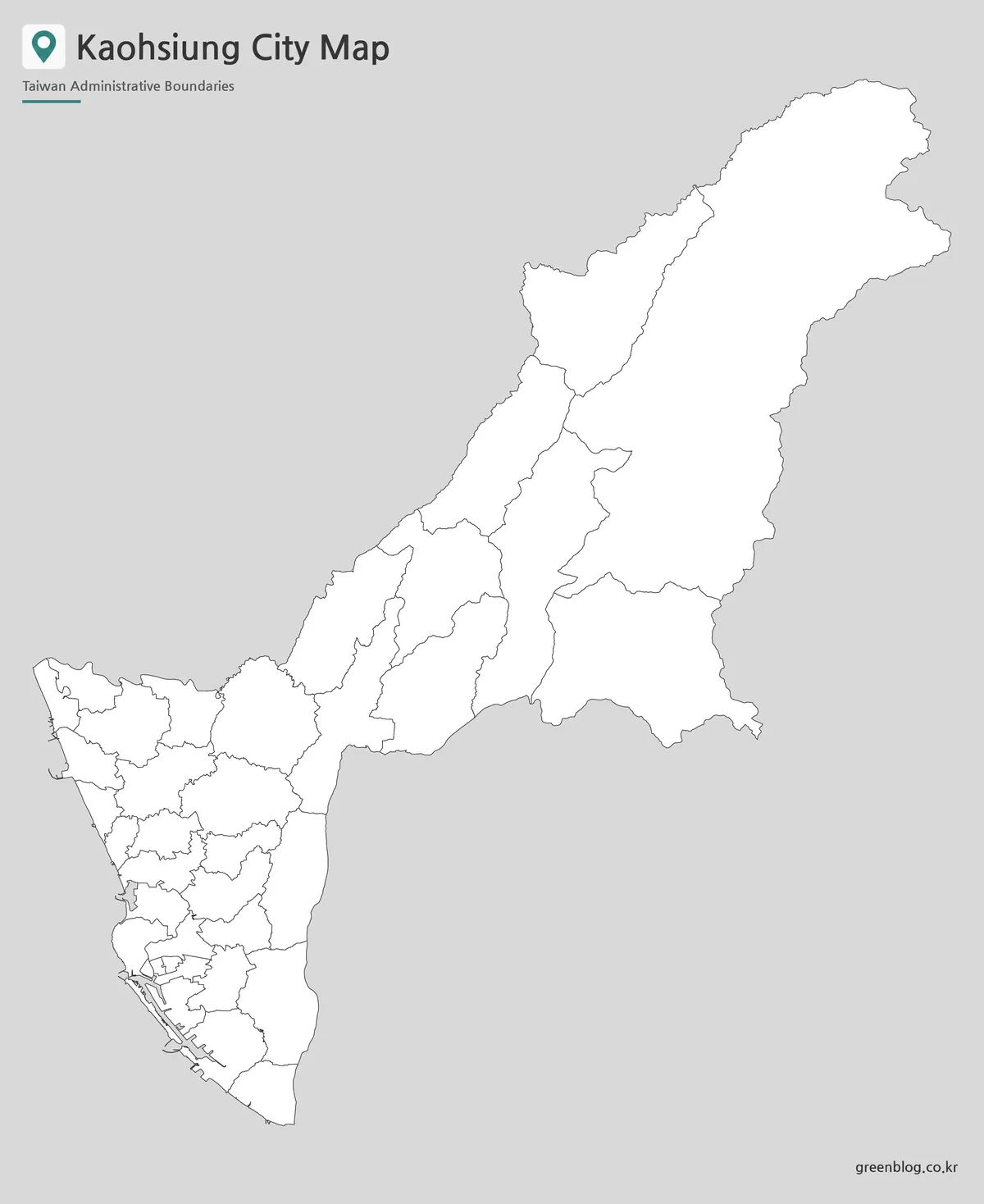
The outline edition keeps the identical city silhouette, internal divisions, and harbor geometry while removing every district name, number, key, and color fill. It therefore tests spatial recognition rather than reading. Learners can label the broad northeastern districts first, then work into the more demanding southwestern cluster with the labeled map beside them as a reference.
Project creators can build a custom layer of information without erasing existing text. Possible additions include a coast-to-interior route, a selected group of port districts, markers for a field-study itinerary, or colors representing categories defined in the project itself. Those marks are user annotations; the supplied image does not claim to include roads, attractions, terrain, or live navigation data.
Because the smallest central areas are unlabeled and unnumbered here, save an untouched copy before adding text digitally. If the Kaohsiung City Map is printed as a worksheet, provide a separate key or the monochrome version so students can distinguish the four tiny central districts from the surrounding port-side shapes.
Built for Printing, Teaching, and Visual Projects
The three versions form a useful progression rather than three interchangeable decorations. Start with the color view when explaining the complete municipal footprint, switch to black and white when names are the main reference, and use the outline after readers understand the structure. Sharing one geometry across all three makes it easy to compare an answer sheet with an activity page.
For A3 printing, use portrait orientation and scale the image proportionally. Check a preview before printing to confirm that the central numbered areas and thin coastal boundaries remain visible within the printer’s margins. The source canvas supports a large page arrangement, but clarity will still depend on the printer, application, compression, and chosen scaling.
In presentations, avoid cropping away the northeastern districts merely to enlarge downtown Kaohsiung. That would hide the central geographic lesson of the set: the municipality combines a compact metropolitan and port zone with an extensive inland reach. If a close-up is needed, show it beside the complete Kaohsiung City Map so the audience retains orientation.
These files are administrative-boundary references, not route planners or legal boundary records. Use the color and labeled versions for general comparison, then consult an up-to-date city source when accuracy depends on official names or administrative status. The outline remains best suited to learning tasks and custom visual communication built from that checked reference.
Frequently Asked Questions
How many districts are shown on the Kaohsiung City Map?
The map shows Kaohsiung City’s 38 districts, including central urban districts, coastal districts, port-side areas, and eastern mountain-side districts.
Which version is best for travel planning?
The color map is usually the easiest choice for travel planning because it separates districts quickly. It works well for explaining central Kaohsiung, the port area, Cijin, and outer districts.
Can I print the black and white version?
Yes. The black and white map is designed for clean printing, classroom handouts, worksheets, reports, and document layouts.
What is the outline map best for?
The outline map is best for editing, coloring, labeling, and adding custom information. It can be used for route marking, infographic projects, classroom exercises, or district comparison work.
Is this map useful for classroom projects?
Yes. The collection works well for Taiwan geography lessons, city comparison materials, printable worksheets, and student assignments.
Map File Information
The download contains the three Kaohsiung district-map views displayed on this page, with matching color, labeled monochrome, and blank boundary layouts.
- Included Versions: Color map, black-and-white map, and outline map
- Printable Size: A3-oriented layout
- File Type: Image files
- Intended Use: Lessons, worksheets, reports, presentations, and custom annotations
Related Maps
Additional Resources
- Kaohsiung City Government Administrative Districts: Check the city’s official district directory and administrative overview.
Green Map creates custom-edited map images using open geographic data sources such as geoBoundaries, Natural Earth, OpenStreetMap, and government open data. These maps are edited visual materials, not raw data files, and are provided for education, documents, presentations, and graphic reference.