A Bolivia Map makes the country’s contrasting regional pattern easier to understand at a glance. Bolivia sits near the center of South America, yet its outline joins environments that look very different on the ground: the high Andes and Altiplano in the west, intermediate valleys through the center, and broad tropical lowlands toward the north and east. The supplied maps focus on the departmental structure that connects these areas rather than on roads, terrain, or tourist routes.
This collection contains three confirmed versions: a color administrative map, a labeled black-and-white map, and a blank outline map. Each is prepared as a high-resolution A3 JPG image. Together, they give teachers, students, presentation creators, bloggers, and designers a choice between immediate regional identification, clear monochrome reference, and a clean base for adding original information.
Bolivia’s landlocked position also makes border context important. Peru and Chile frame the western side, Argentina and Paraguay meet the south and southeast, and Brazil follows the long northern and eastern frontier. Lake Titicaca is visible near the Peru–Bolivia border, while the Pacific Ocean appears farther west as geographic context rather than as Bolivian territory. Reading these relationships prevents a common mistake: Bolivia has no coastline even though the ocean is shown on the page.
Table of Contents
Why Bolivia’s Shape and Departments Matter
The country is divided into nine departments: Pando, Beni, La Paz, Cochabamba, Oruro, Santa Cruz, Potosí, Chuquisaca, and Tarija. Their shapes are far from uniform. Pando occupies the far northwestern corner, Beni spreads across much of the north, and Santa Cruz forms the large eastern section. The western and south-central departments create a tighter chain where labels and borders sit much closer together.
That contrast gives a Bolivia Map more value than a simple national silhouette. A reader can compare the large lowland departments with the narrower Andean and valley departments, follow which areas meet international borders, and see how Cochabamba occupies a central position between western and eastern Bolivia. The map does not depict provinces or municipalities, so its lines should be read specifically as first-level departmental boundaries.
The star identifies Sucre, located in Chuquisaca. Sucre is Bolivia’s constitutional capital, while La Paz is the seat of government. Because the image labels the La Paz department but does not use a second city symbol for the government seat, the star should not be interpreted as marking every nationally important administrative center.
Three Bolivia Map Files in the Collection
The three files share the same landscape composition, allowing users to switch styles without relearning the geography. Bolivia is enlarged on the page, surrounding countries remain visible as orientation cues, and the western edge includes Lake Titicaca and the distant Pacific coast. This consistent framing is helpful when a lesson or presentation moves from a labeled reference to a blank exercise.
The set does not include roads, elevation shading, population data, or an editable vector source. Its purpose is narrower and clearer: showing the national outline, the nine departmental divisions, selected neighboring geography, and—in the two labeled versions—the department names and Sucre marker.
Color Administrative Map
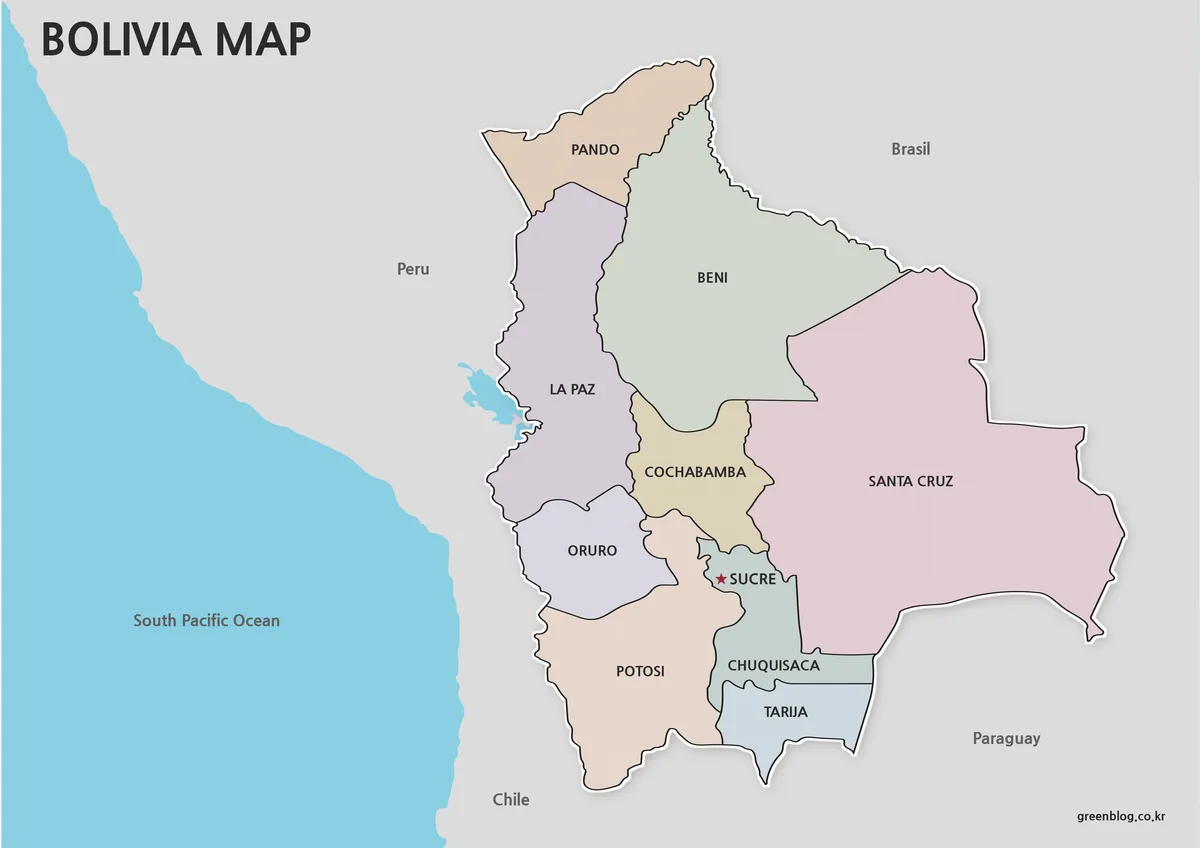
Soft color separation makes departments with shared borders easier to distinguish without relying only on thin linework. This is especially helpful around Cochabamba, Chuquisaca, Oruro, and Potosí, where several boundaries and labels occupy the central and southern portion of the country. The large areas of Beni and Santa Cruz remain visually balanced rather than dominating the smaller western departments.
Use the color Bolivia Map when viewers need to identify regional units quickly on a screen, poster, or presentation slide. Neighboring countries stay gray, the Pacific is blue, and Lake Titicaca uses the same water color, so Bolivia remains the visual focus. The restrained palette also leaves enough contrast for the black department labels and red Sucre star.
Labeled Black-and-White Map
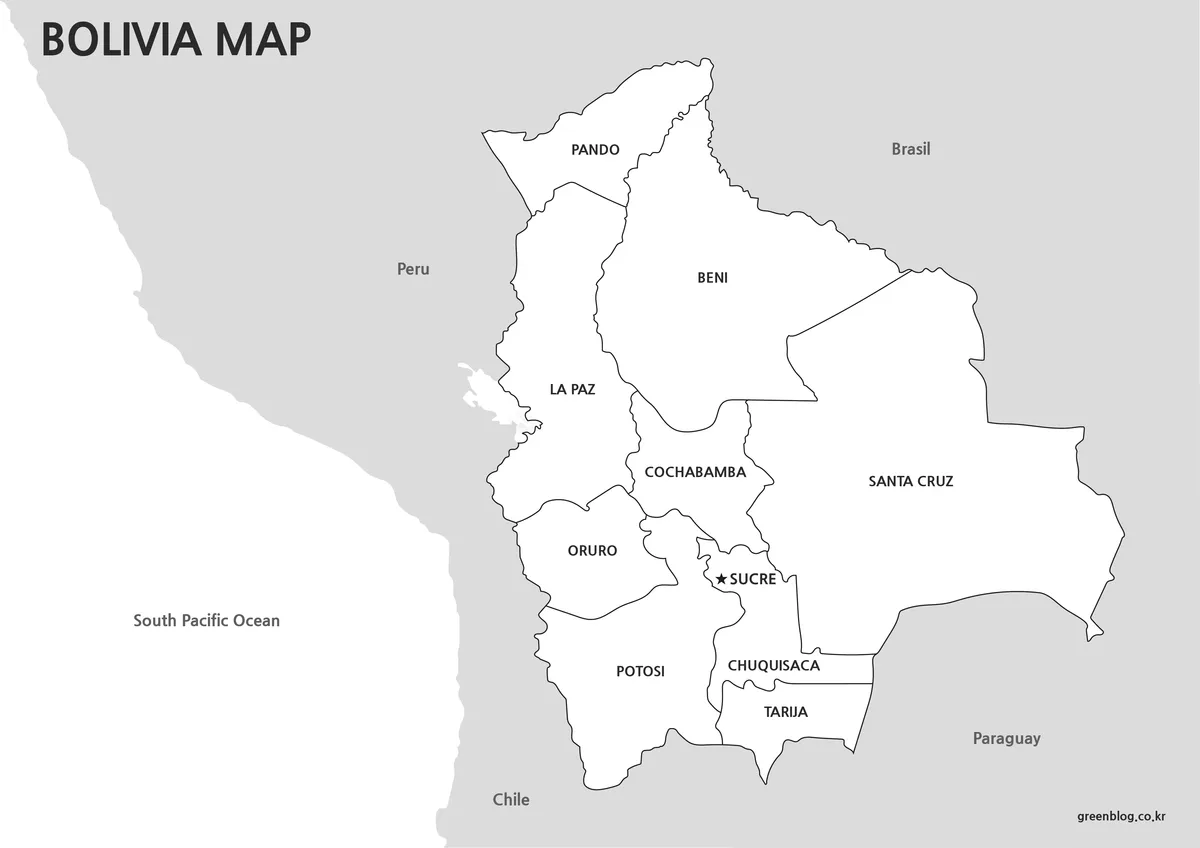
The monochrome version removes departmental colors but preserves the same nine names, international context, boundary lines, and capital marker. It fits reports, worksheets, and documents where color would compete with surrounding text or where the page will be reproduced on a standard monochrome printer. White departmental interiors also provide room for handwritten numbers, notes, or small symbols.
On this Bolivia Map, line clarity does more of the work. Students can trace the border between Beni and Santa Cruz, locate landlocked Bolivia relative to five neighboring countries, or identify which departments form the southern edge. The South Pacific Ocean label is included for orientation, but the gray separation between Bolivia and the coast keeps the country’s lack of direct ocean access visually clear.
Blank Department Outline
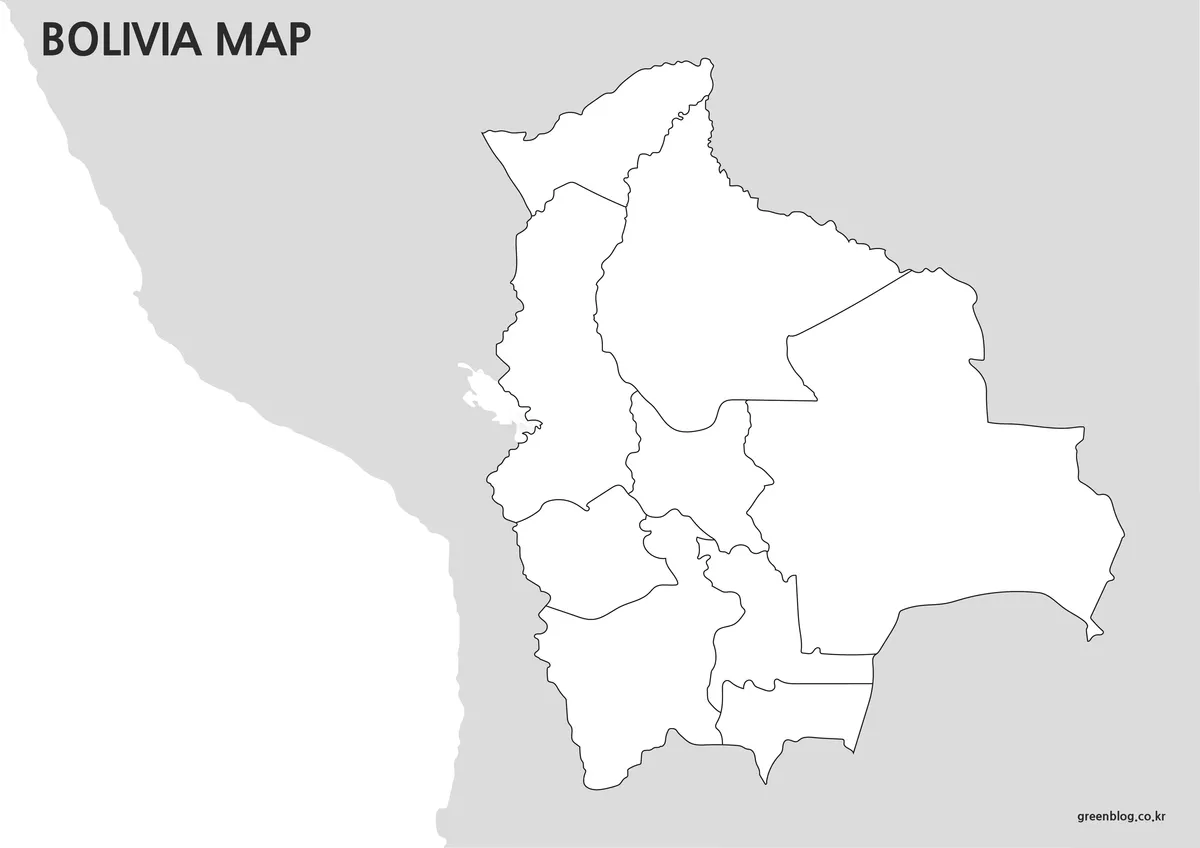
The outline file removes department names, country labels, the capital star, and color fills while retaining Bolivia’s external boundary and its nine internal departmental divisions. It is a raster JPG rather than a vector source, but it still works as a practical annotation base in slide software, image editors, and digital classroom tools.
A blank Bolivia Map supports tasks that would be crowded on the labeled versions. Learners can write all nine department names from memory, shade the Andean west and lowland east, mark Sucre and La Paz with different symbols, or draw arrows toward Brazil, Peru, Chile, Argentina, and Paraguay. Designers can also place departmental statistics or category colors over the open areas, provided they keep the original proportions and boundary positions intact.
Choosing the Right Version
Choose the color file when rapid comparison matters most. It is the strongest option for a projected lesson, blog illustration, country profile, or slide in which an audience must separate the departments immediately. Choose the black-and-white file when labels must remain available but the page needs a quieter visual style or will be printed without color.
The outline version is better when the reader is expected to supply the information. It can become a geography quiz, a coloring activity, an itinerary sketch, or a base for departmental data. If a project needs roads, exact distances, municipal boundaries, or topographic detail, none of these three maps should be treated as a substitute for a specialized reference map.
Practical Ways to Use a Bolivia Map
In a classroom, the labeled map can serve as the answer key while students complete the blank outline. A second activity can ask learners to group La Paz, Oruro, and Potosí as part of a western comparison, then contrast their position with Beni and Santa Cruz in the north and east. The exercise links administrative geography with Bolivia’s broad physical regions without pretending that departmental borders are physical boundaries.
For presentations, the color map provides a readable opening reference before more detailed charts appear. A presenter can duplicate the outline image, tint one department at a time, and add a short label or statistic beside it. Bloggers and infographic designers can use the same method to discuss border relationships, regional travel planning, or departmental comparisons while keeping the base map visually consistent.
At A3 size, the horizontal layout leaves space for the western coastline context and the large eastern extent of Santa Cruz. When reducing the image for A4 or letter-size printing, check the smallest central labels before final output. Avoid aggressive cropping on the left, because removing Peru, Lake Titicaca, Chile, and the Pacific context would make the country’s western position harder to interpret.
Reading the Map Accurately
The departmental borders are the central subject, not the full administrative hierarchy. Bolivia also has smaller administrative units, but they are not drawn here. Likewise, the surrounding gray regions are simplified context and should not be used to study their internal divisions.
The Bolivia Map collection is most reliable as a visual reference and project base at the level shown. Users adding current statistics should date and source their own data, because a blank or labeled boundary map does not indicate the year of an added dataset. Keeping boundary information separate from later annotations makes a classroom worksheet or infographic easier to review and update.
Frequently Asked Questions
How many departments are shown?
All nine first-level departments are represented: Pando, Beni, La Paz, Cochabamba, Oruro, Santa Cruz, Potosí, Chuquisaca, and Tarija. The internal lines do not show provinces or municipalities. This makes the collection suitable for national departmental comparisons but not for tasks that require finer local boundaries.
Why does the map mark Sucre rather than La Paz with a star?
Sucre is the constitutional capital of Bolivia, and the supplied labeled maps place the capital star there in Chuquisaca. La Paz is the country’s seat of government and is also the name of a department. Readers discussing national institutions may wish to add a separate city marker for La Paz on the outline version.
Does the blue Pacific area mean Bolivia has a coastline?
No. Bolivia is landlocked. The South Pacific Ocean is shown west of Peru and Chile to provide continental context, while Bolivia remains separated from it. Lake Titicaca appears closer to the western border and is a different geographic feature shared by Bolivia and Peru.
Can I edit these files for a presentation or infographic?
The JPG images can be placed in presentation or image-editing software and annotated with text, arrows, markers, or transparent color overlays. They are not confirmed vector files, so individual boundaries may not behave as independently editable paths. The blank Bolivia Map offers the cleanest base for raster editing.
Map File Information
This download contains three high-resolution Bolivia department maps for reference, printing, classroom activities, presentations, and raster-based design work.
- Included Versions: Color administrative, labeled black-and-white, and blank departmental outline maps
- Printable Size: A3 high-resolution layout
- File Type: JPG images grouped in a ZIP archive
- Intended Use: Education, printing, presentations, annotation, blog graphics, and infographic projects
Related Maps
- Printable Paraguay Map Collection for Education and Design Projects
- Argentina Map Pack – Color, Blank and Printable A3 Maps
- Printable Colombia Map Set – Regional, Blank, and Black & White Versions
- Mexico Maps Download Collection: Three Regional Reference Files
Additional Resources
- Geographic Information from Bolivia’s National Institute of Statistics: Review official information about Bolivia’s location, international borders, major physical regions, mountain systems, and drainage basins.
Green Map creates custom-edited map images using open geographic data sources such as geoBoundaries, Natural Earth, OpenStreetMap, and government open data. These maps are edited visual materials, not raw data files, and are provided for education, documents, presentations, and graphic reference.