A Wyoming map is particularly valuable when a project needs to show the scale of the interior West without reducing the state to a single rectangular shape. Wyoming sits between Montana, Idaho, South Dakota, Nebraska, Colorado, and Utah, so it provides a useful geographic bridge between the northern Rockies, the Great Plains, and the Colorado Plateau region. The surrounding-state labels in this collection make that setting immediately readable.
This page provides three printable county-boundary views: a color reference map, a black-and-white labeled map, and a blank outline map. They are arranged for A3 layout use and are supplied as image files in the downloadable collection. Whether the goal is a classroom worksheet, a regional presentation, a report illustration, or an annotated travel graphic, the three views offer different starting points without changing the underlying Wyoming outline.
Wyoming’s borders are mostly straight, yet the county pattern inside them is far from uniform. Large western counties such as Sweetwater, Fremont, and Sublette contrast with the more compact counties in the southeast and northeast. The state’s northwestern edge also bends around the Yellowstone area, making a focused map more informative than a small state shape on a national map.
The layouts emphasize county names, county lines, and the names of adjacent states rather than roads, terrain, or destination details. That focus keeps the resource clear for readers comparing administrative areas or preparing their own labels and notes. It also helps the map remain legible when placed on a printed page or used as a supporting visual in a slide.
Table of Contents
Wyoming Map Download Overview
The downloadable Wyoming map collection presents the same county framework in three distinct visual treatments. The color version separates adjacent counties for rapid comparison; the monochrome version keeps names and borders prominent in text-heavy documents; and the outline version removes labels so users can build their own activity, graphic, or reference layer.
All three views show Wyoming in relation to Montana at the top, Idaho along the west, South Dakota on the northeast side, Nebraska to the east, Colorado below, and Utah to the southwest. This edge labeling is helpful when explaining why Wyoming often appears in discussions of Yellowstone access, Rocky Mountain geography, western interstate travel, or multistate environmental and land-use topics. The maps are administrative references, not road, topographic, or park-navigation maps.
Included Wyoming Map Files
The collection contains three county-boundary map styles. County names are visible on the color and black-and-white editions, while the outline edition retains the state and county shapes without text. The county arrangement is worth studying on its own: Park and Teton occupy the northwest, Hot Springs forms a narrow central-northern county, and Platte, Goshen, and Laramie create a tighter group toward the southeastern corner.
- Color Wyoming county map
- Black-and-white Wyoming county map
- Blank Wyoming county outline map
Use the labeled editions when county identification matters, and select the blank edition when labels will be added later. The state outline is intentionally given generous space within the page, allowing the county shapes to remain readable instead of appearing as a small insert surrounded by unused margins.
Color Wyoming Map for Regional Reference
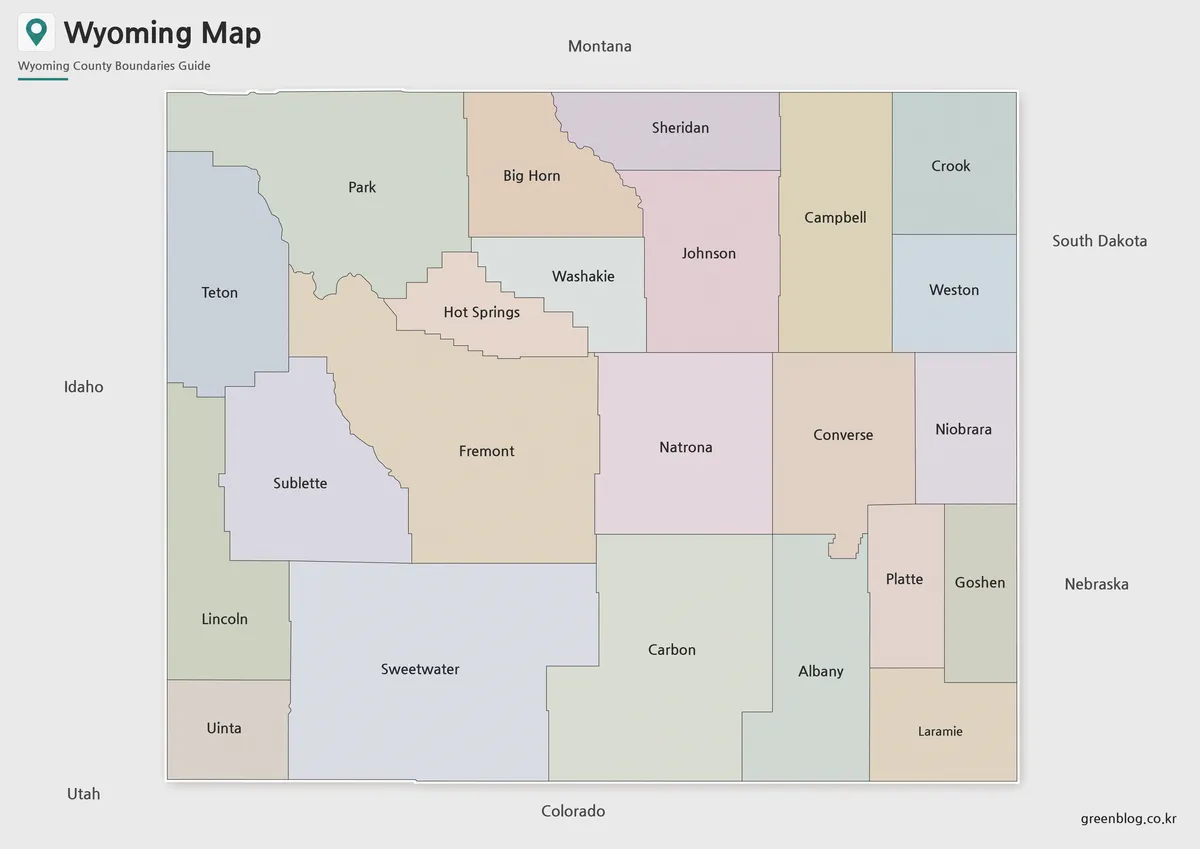
The color Wyoming map makes the state’s uneven county sizes easier to scan. Alternating fills distinguish the broad central and western areas from the smaller units near the eastern and southeastern borders, so a viewer can follow boundaries without relying only on fine lines. This is especially helpful around the center of the state, where Fremont, Natrona, Carbon, and Sweetwater meet or lie close together.
For a presentation about the western United States, the color treatment can quickly establish where Wyoming lies relative to Colorado and Utah below it, Montana above it, and Nebraska and South Dakota on the eastern side. It is also a clear choice for a report that needs a county reference image beside text, tables, or a legend. County labels remain the main content, so the image should be treated as an administrative orientation map rather than a detailed destination guide.
The northwestern portion is a useful example of why color separation matters: Teton, Park, and Sublette form a visibly different pattern from the nearly grid-like counties across much of the east. Readers preparing Yellowstone-related context can use this view to locate the northwest corner within Wyoming while still seeing the statewide county structure.
Black and White Wyoming Map for Printing
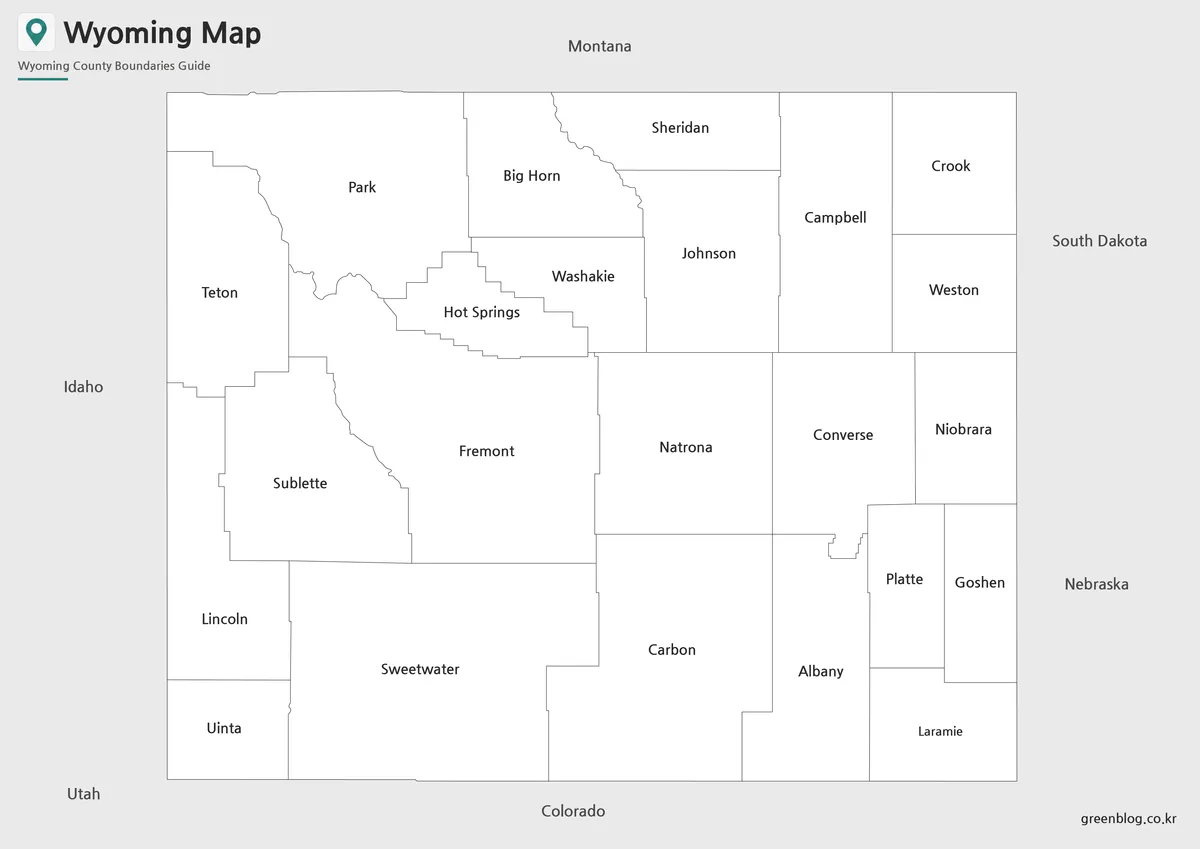
Choose the black-and-white edition when the map needs to sit comfortably in a worksheet, packet, report, or other document where color is not essential. The white background and restrained boundary lines keep attention on county names such as Sheridan, Campbell, Converse, Albany, and Laramie. This makes the design suitable for readers who need to identify places while leaving room for handwritten notes nearby.
Monochrome presentation is also useful when a document already contains charts, photographs, or colored data markers. Rather than competing with those elements, this labeled Wyoming map provides a calm reference layer. The fine county lines still show the distinctive edges of Teton, Hot Springs, and the narrow southeastern counties, while the surrounding-state names preserve broad regional orientation.
For printing, keep the page at its intended A3 layout when possible so the county labels remain comfortable to read. If the image is reduced for a smaller handout, review the printed result before distributing it, particularly where several small southeastern county shapes sit together. The map is designed around administrative clarity, so it is most effective when names and borders are allowed adequate space.
Blank Wyoming Outline Map for Editing
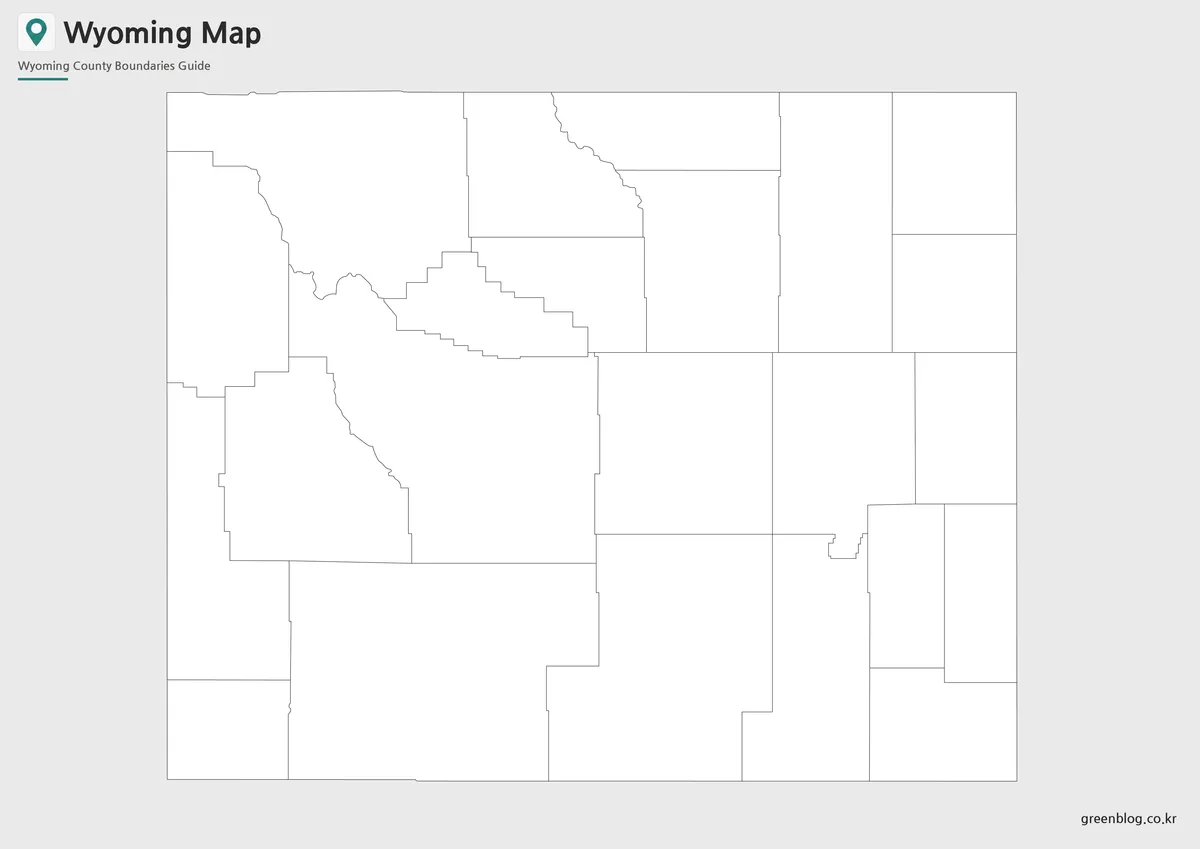
The blank outline version keeps Wyoming’s external border and internal county divisions but omits county and neighboring-state text. That makes it a flexible annotation base for a geography lesson, a county-labeling exercise, or a custom infographic. Students can write county names, shade regions, mark the capital at Cheyenne, or identify the northwest area associated with Yellowstone and Grand Teton.
For project work, this Wyoming map can support a wide range of overlays: route arrows between cities, county-level research notes, land-use categories, or a simple comparison of eastern and western Wyoming. Because the supplied file is an image map, it should be used as a visual base for annotation rather than described as an editable vector source. Add text boxes, symbols, or coloring in the software appropriate to your workflow.
The outline is also useful for showing how a regular-looking state boundary contains markedly different county forms. A class can compare the broad outlines of Sweetwater and Fremont with the compact blocks around Platte, Goshen, and Laramie, then discuss how administrative units are distributed across a large state. That task uses the actual linework on the image instead of asking students to infer county geography from a general U.S. map.
Why Wyoming Is Easier to Understand with a Map
Wyoming can look simple at national scale because much of its boundary follows straight state lines. A closer county view reveals a more varied interior: the northwest border shifts around Park and Teton counties, Hot Springs has a narrow irregular footprint, and the eastern half combines large blocks with several smaller counties near Nebraska. Those differences are difficult to communicate through a short written description alone.
The state’s position also gives the Wyoming map a clear regional role. It can introduce the relationship between the northern Rockies and the High Plains, or show why Wyoming is adjacent to both Montana and Colorado despite being less densely populated than many states on either side. Cheyenne lies in the southeast near the Colorado and Nebraska connections, while the Yellowstone area is in the far northwest, making statewide distance and direction important parts of the map-reading experience.
Practical Uses for the Wyoming Map Collection
Start with the color map when readers need to compare counties on screen or recognize Wyoming’s position among neighboring states. Select the black-and-white map for a printed study sheet, a report appendix, or a document that needs an unobtrusive administrative reference. Use the outline image when the project requires original labels, category shading, arrows, symbols, or handwritten responses.
Teachers can turn the blank Wyoming map into a county-labeling activity or ask students to distinguish the northwest park region from the southeastern capital area. Designers can place a small number of custom data points over the outlines without obscuring a dense basemap. Writers and presenters can use a labeled version to give audiences regional context before discussing Yellowstone, Grand Teton, Cheyenne, Casper, or Wyoming’s connections to surrounding states.
When preparing a graphic, avoid adding so many labels that the county boundaries disappear. The original layouts are most readable because they give county names room to breathe, especially across the larger central counties. A focused set of annotations will usually communicate more clearly than attempting to turn this administrative reference into a road atlas or a complete travel guide.
Basic Wyoming Information for Map Users
Wyoming is a western U.S. state bordered by six states: Montana, Idaho, South Dakota, Nebraska, Colorado, and Utah. Its capital is Cheyenne in the southeast, while Casper is centrally located and commonly used as a statewide reference point. The county map identifies 23 counties, from Teton and Park in the northwest to Laramie, Goshen, and Platte in the southeast.
- Administrative focus: County boundaries and county names
- Regional context: Northern Rockies, High Plains, and the interior West
- Capital: Cheyenne
- County count shown: 23
- Map versions: Color, black and white, and blank outline
- Best use: County reference, printing, study, and custom annotation
Frequently Asked Questions
What is included in this Wyoming map download?
The download includes color, black and white, and outline versions of the Wyoming map. Each version is designed for a different use, such as visual reference, printing, or editing.
Can I use the map for classroom materials?
Yes. The printable Wyoming map versions work well for classroom handouts, geography worksheets, student reports, and presentation slides.
Which version is best for travel presentations?
The color map is usually the easiest option for travel presentations because it makes Wyoming and nearby states easier to compare visually.
Is the outline map useful for editing?
Yes. The blank outline version can be used to add travel routes, city markers, national park notes, infographic labels, or classroom activity details.
Is this Wyoming map download suitable for A3 printing?
Yes. The map files are prepared for an A3 layout, making them suitable for larger printed reference materials and presentation graphics.
Map File Information
This download contains three printable Wyoming county-boundary map images for reference, study, presentation layouts, and custom annotation.
- Included Versions: Color map, black and white map, outline map
- Printable Size: A3 layout
- File Type: JPG / PNG / ZIP
- Intended Use: County reference, classroom activities, reports, presentations, and annotated graphics
Additional Resources
- Wyoming GIS Maps – State of Wyoming: Explore the state government’s public map and GIS resources for additional Wyoming geographic information.
Related Maps
Green Map creates custom-edited map images using open geographic data sources such as geoBoundaries, Natural Earth, OpenStreetMap, and government open data. These maps are edited visual materials, not raw data files, and are provided for education, documents, presentations, and graphic reference.