An Idaho County Map works best in a vertical format because the state extends from the Canadian border through a narrow northern panhandle before widening across the south. That shape places Boundary and Bonner counties far above the broad southern tier containing Owyhee, Twin Falls, Cassia, Oneida, Franklin, and Bear Lake. A conventional horizontal page would either shrink the panhandle or waste much of the available height.
This set presents Idaho’s 44 counties in three coordinated versions: a labeled color map, a labeled black-and-white map, and an unlabeled outline. The downloadable maps are high-resolution JPG images arranged for A3 portrait printing. They can support county-reference sheets, classroom activities, presentation graphics, reports, and user-created thematic layers without changing the underlying county geometry.
The artwork is administrative rather than navigational or physical. It does not mark Boise or other cities, highways, rivers, mountain ranges, parks, or elevation. Four surrounding states—Washington, Oregon, Montana, and Wyoming—are named for orientation, but Canada, Nevada, and Utah are not labeled. Readers should therefore treat the outside context as selective rather than as a complete border guide.
Table of Contents
Idaho County Map Overview
Idaho contains 44 counties, and the map makes their change in scale visible from north to south. Boundary occupies the northern tip above Bonner. Kootenai, Benewah, and Latah form a western stack beside Washington, while Shoshone and Clearwater extend eastward toward Montana. Lewis is compact, and Nez Perce sits along the western side below Latah.
The labeled artwork prints “Nezperce” as one word, but the official county name is Nez Perce County. That distinction should be corrected or noted in formal classroom and reference projects. Idaho County, whose name matches the state, dominates the north-central portion of the map and creates the long transition between the panhandle and the wider southern half.
Across the mountainous center, Adams, Valley, Lemhi, Custer, and Boise counties cover large, irregular shapes. Southwest Idaho includes Washington, Payette, Gem, Canyon, Ada, Elmore, and Owyhee. The map does not identify Boise as a city; “Boise” and “Ada” are county labels, so users should not interpret either name as a point marker.
The south-central band contains Camas, Blaine, Gooding, Lincoln, Jerome, Minidoka, Twin Falls, and Cassia. Farther east, Butte, Clark, Fremont, Jefferson, Madison, Teton, Bonneville, Bingham, Power, Bannock, Caribou, Oneida, Franklin, and Bear Lake create a denser boundary pattern. Narrow counties and stepped borders in this area require more attention when the page is reduced.
- Color reference: All county names with alternating pastel fills
- Monochrome reference: The same names and county borders on white interiors
- Blank outline: State and county boundaries without labels or fills
- Download format: High-resolution JPG files in one ZIP archive
- Print layout: A3 portrait
Color-Coded County Map
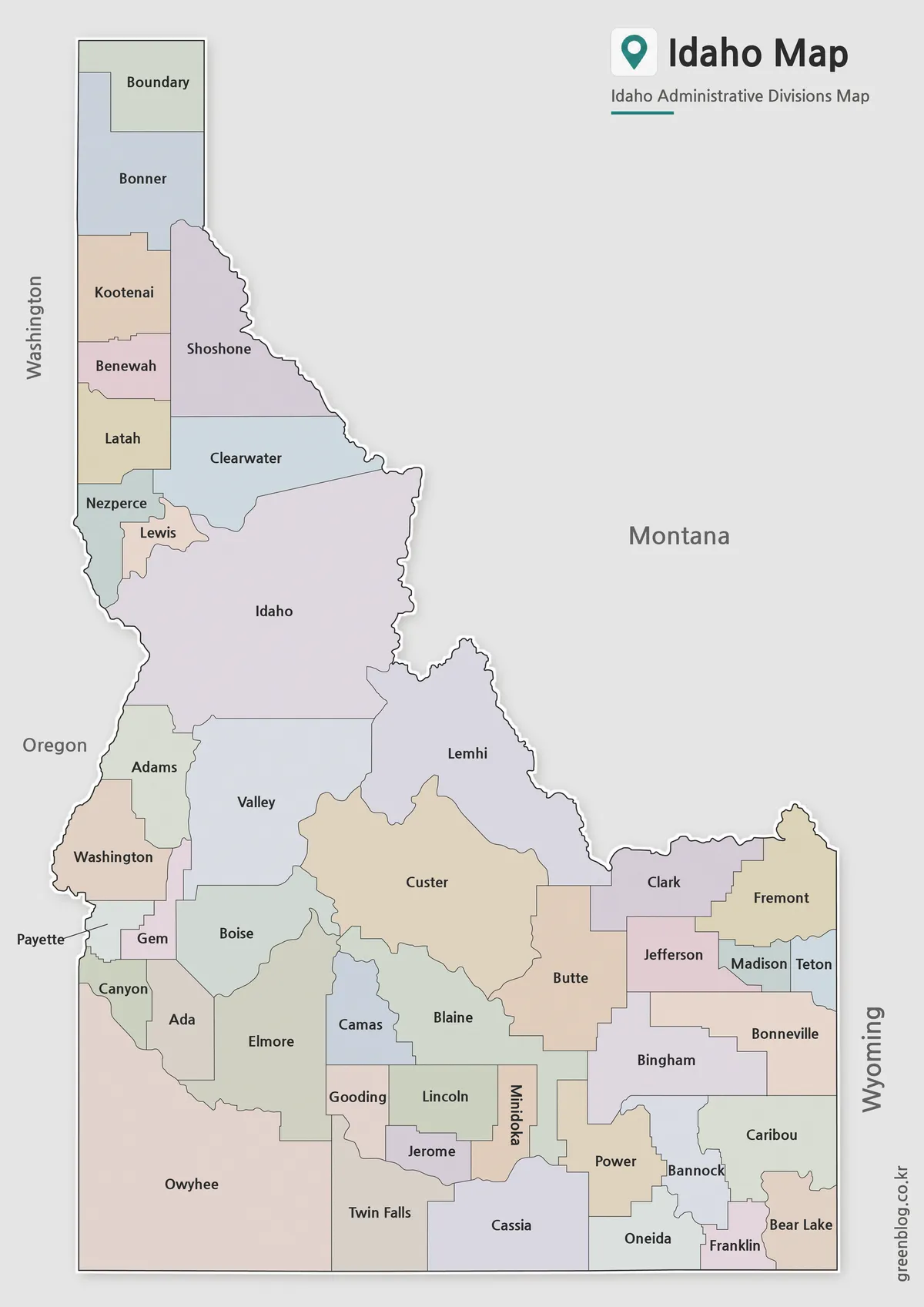
The color edition uses a separate muted fill for neighboring counties while keeping every name in dark text. This treatment makes the narrow panhandle sequence easier to follow and separates the small southwestern counties around Payette, Gem, Canyon, and Ada. It also helps viewers trace the tightly fitted southeastern group without relying on boundary direction alone.
Idaho County’s large central shape is especially prominent because its fill contrasts with Clearwater, Lemhi, Adams, Valley, and the surrounding gray background. Custer and Owyhee also occupy broad areas, while counties such as Camas, Gooding, Jerome, Minidoka, Madison, Teton, and Franklin appear comparatively compact. Color gives these size differences immediate visual structure.
Choose this version for an introductory slide, a wall reference, or a comparison in which several adjacent counties must be recognized quickly. The pastel fills are categorical only; they do not show population, land use, political results, elevation, or transportation districts. Any thematic symbols added by the user need a dated source and a separate legend.
Black and White Idaho County Map
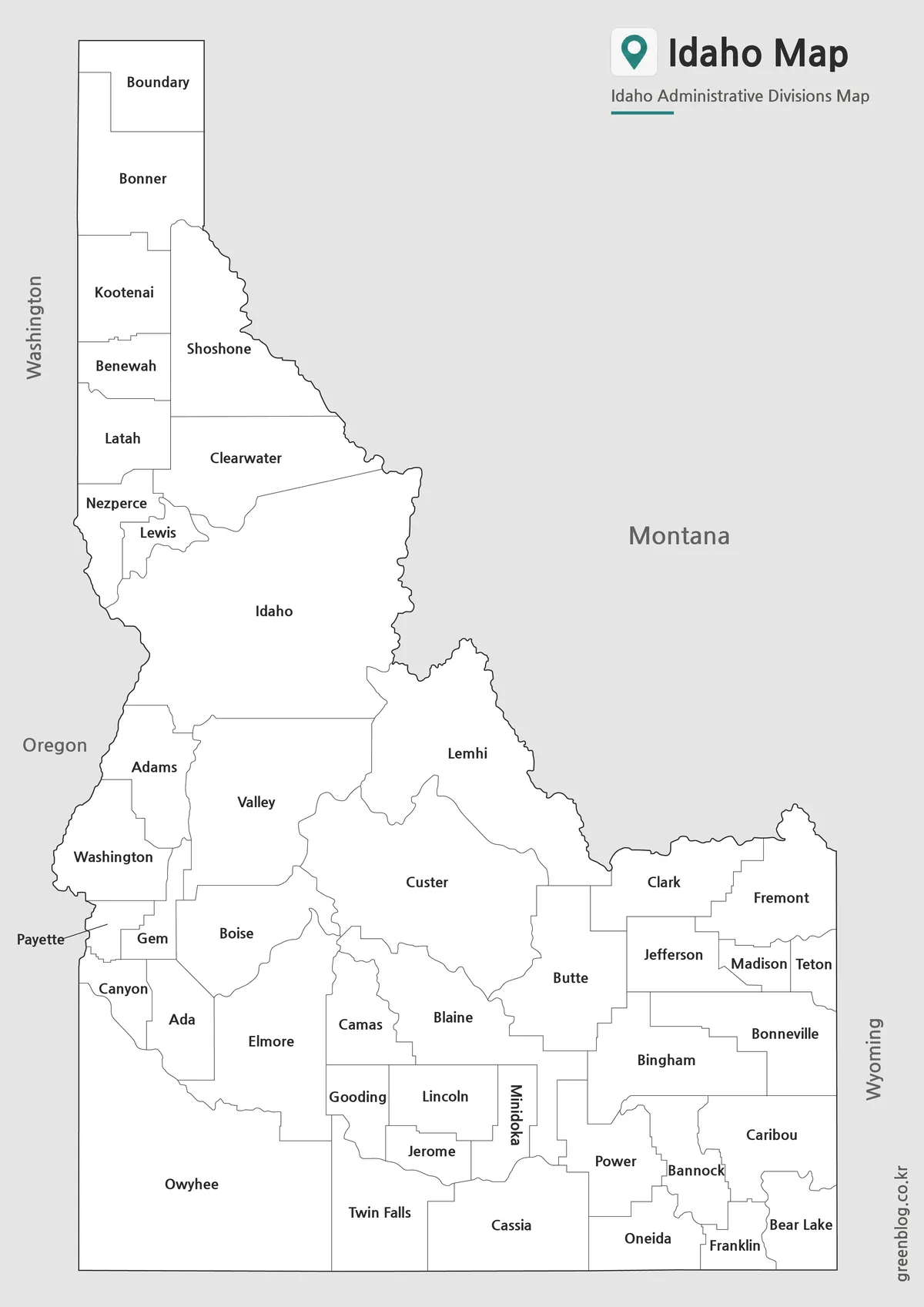
The monochrome edition keeps the 44 county names and all internal lines but replaces the pastel regions with white. Washington, Oregon, Montana, and Wyoming remain in gray outside the state, creating a clear edge without adding more geographic layers. The result suits documents where county identification matters but color would compete with other charts or text.
White county interiors leave space for circles, short notes, and a limited number of symbols. Teachers can use the file as a labeled reference beside a blank exercise, and report authors can highlight one county with a single accent color. Since every name is embedded, it is more appropriate for orientation and review than for an unlabeled recall test.
When reducing the map, inspect the label spacing around Payette, Gem, Canyon, Ada, Gooding, Jerome, Minidoka, Bannock, Franklin, Madison, and Teton. The northern counties remain relatively easy to read because they are stacked vertically, while small southern shapes can become crowded. Preserve the portrait proportions instead of widening the state to fill a landscape page.
Blank Outline Map for Editing
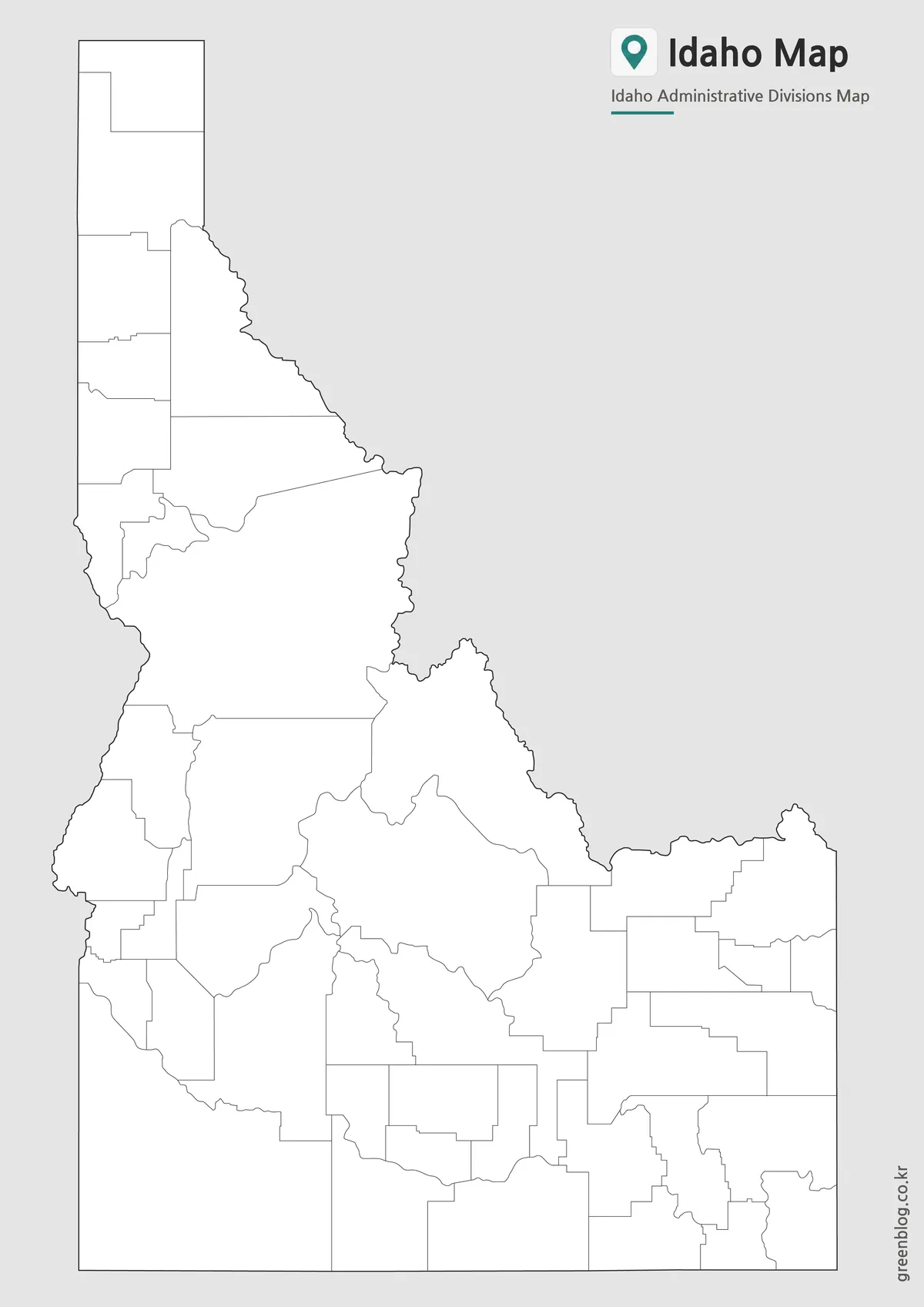
The outline version removes county names, surrounding-state labels, and every color fill. Only the Idaho silhouette and the 44 internal county divisions remain. This creates a neutral base for language-localized labels, county quizzes, project-specific symbols, regional grouping, and data graphics that would be difficult to place over the labeled editions.
A classroom activity might ask students to label the panhandle counties, find the large central county that shares the state’s name, or identify the southern counties bordering Nevada and Utah. A designer could shade ITD districts or compare a documented statistic across counties, provided the new categories are clearly explained. The original outline does not supply those groupings or values.
The download is a raster JPG rather than a vector source with independently selectable county paths. Users can place text, arrows, transparent fills, or markers on layers in common image and page-layout software, but individual boundary objects are not included. Keep a clean copy before editing and do not use the generalized outline for survey, parcel, or navigation work.
Common Uses for an Idaho County Map
Select color when the audience needs rapid separation, monochrome when names must remain visible in a restrained document, and outline when readers will add labels or categories. Because all three maps share the same geometry, they can form a useful sequence for reference, guided review, and independent work.
For A3 printing, use portrait orientation, retain the source proportions, and leave a small margin around the state. Test the compact southern labels before producing multiple copies. If the map is inserted into a landscape slide, reserve the empty side area for notes or a legend rather than cropping Boundary County or the southeastern corner.
For online publication, provide descriptive alternative text and repeat the main conclusion in nearby text instead of depending only on color. Correct the Nez Perce spelling when adding replacement labels. When introducing statistics, routes, or regional divisions, include a source date so readers can distinguish the original county framework from the added information.
Frequently Asked Questions
What does the Idaho County Map include?
The Idaho County Map collection includes color, labeled, and outline versions showing county boundaries across the state.
Can I print the maps in A3 size?
Yes. The files were prepared as high-resolution resources and reviewed for large-format printing.
Is the outline version editable?
Yes. The outline version is designed for annotations, custom coloring, infographic work, and educational activities.
Why was the map designed in a vertical layout?
Idaho has a long north-to-south shape, and a vertical layout provides a more accurate and readable representation of the state.
Map File Information
The ZIP package groups three high-resolution county-map JPG files for color reference, monochrome printing, and custom annotation.
- Included Versions: Color, labeled black and white, and blank outline
- Printable Size: A3 portrait
- File Type: JPG files in one ZIP archive
- Intended Use: Lessons, reports, presentations, coloring, and annotations
Related Maps
Additional Resources
- Explore Idaho’s Counties — The State Controller’s office provides profiles for all 44 counties.
Green Map creates custom-edited map images using open geographic data sources such as geoBoundaries, Natural Earth, OpenStreetMap, and government open data. These maps are edited visual materials, not raw data files, and are provided for education, documents, presentations, and graphic reference.