A Tennessee Map has to place 95 county shapes inside a state that is much wider than it is tall. The western counties occupy broad blocks, the middle of the state introduces a tighter mixture of shapes, and the eastern end narrows into compact, irregular areas. A landscape page is therefore essential for keeping the complete county framework visible without squeezing the two ends together.
This collection presents that framework in three forms: a labeled black-and-white reference, a labeled pastel edition, and an unlabeled outline. The online previews are 1200 × 454 WebP images with matching geometry. The protected ZIP contains the printable JPG files described in the original package, prepared for A3 landscape output. Each version serves a different reading or annotation task rather than simply changing the decoration.
These are county maps, not city, road, terrain, or river maps. Nashville, Memphis, Knoxville, and Chattanooga do not appear as point symbols. Instead, the labeled sheets show Davidson, Shelby, Knox, and Hamilton counties. Neighboring states and Tennessee’s three Grand Divisions are also absent from the artwork, leaving the county boundaries and names as the main information layer.
Table of Contents
Map Collection Overview
Tennessee borders Kentucky and Virginia to the north, North Carolina at the eastern end, Georgia, Alabama, and Mississippi along the south, and Arkansas and Missouri across the Mississippi River on the west. Those neighboring names are not printed in the supplied images, but they help readers orient the long state shape. Lake County occupies the northwestern edge, Shelby anchors the southwest, Johnson reaches the northeast, and Polk sits at the southeastern end.
The county pattern changes noticeably from one end to the other. Obion, Weakley, Gibson, Carroll, Madison, Haywood, Fayette, and Hardeman are among the comparatively broad western areas. Around the center, Davidson, Williamson, Rutherford, Wilson, Maury, Bedford, Coffee, and Warren create a more varied network. The names remain readable because the artwork rotates or stacks text where a horizontal label would not fit.
Eastern Tennessee demands the closest inspection. Campbell, Claiborne, Grainger, Hamblen, Hancock, Hawkins, Washington, Unicoi, Carter, and Sullivan share the narrowing northeastern section. South of that band, Knox, Blount, Sevier, Loudon, Monroe, McMinn, Meigs, Bradley, Hamilton, and Polk form another compact group. At reduced size, several boundaries can remain visible even after their embedded names become too small to identify confidently.
Small and narrow counties provide useful print checkpoints. Trousdale fits between Macon, Smith, Sumner, and Wilson; Moore lies among Bedford, Lincoln, Franklin, and Coffee; and Sequatchie follows a slim form beside Bledsoe, Hamilton, Marion, and Van Buren. If these names are readable in a test print, the broader counties will usually present fewer problems. A full-width Tennessee Map is much easier to scan than the same artwork placed in a narrow page column.
- Labeled monochrome: County names, white interiors, and dark boundaries
- Pastel color: The same labels with contrasting county fills
- Blank outline: All county divisions without names or color
- Package: Three printable JPG files in one protected ZIP
- Intended layout: A3 landscape
Tennessee Map for Printing and Reference
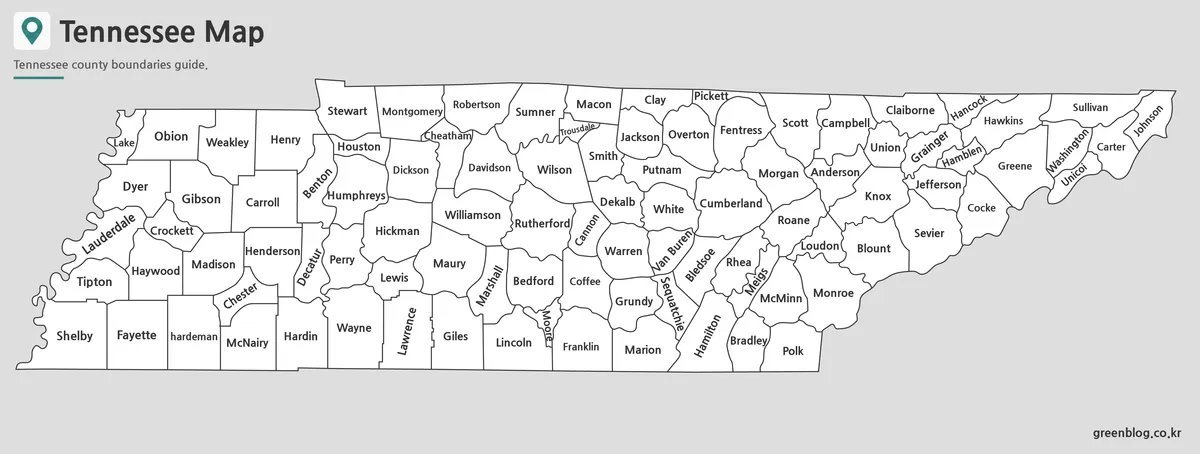
The monochrome edition gives the names and boundary lines priority. White county interiors reduce visual competition, making this the most direct version for locating a county, tracing its neighbors, or following written instructions. It works well in a report appendix, a grayscale handout, or an answer sheet paired with the blank version. Pencil circles, arrows, and short notes remain visible over the unfilled areas.
Label direction responds to available space. Shelby, Fayette, Wayne, Lawrence, Giles, and Lincoln can hold horizontal names, while Benton, Decatur, Marshall, Moore, Van Buren, Bledsoe, Sequatchie, Meigs, Unicoi, and Washington use angled or vertical placement. The variation is functional, but it means readers should trace the surrounding border before assigning a tight label to a county.
Use the black-and-white Tennessee Map when the names themselves are the subject. It is less suitable for a closed-book recall activity because every answer is already printed. Before publication, inspect the smallest text and visible typography at full size; the source image contains minor capitalization styling differences, so a formal reference should be compared with the official county list linked below.
Easy-to-Read County Color Map
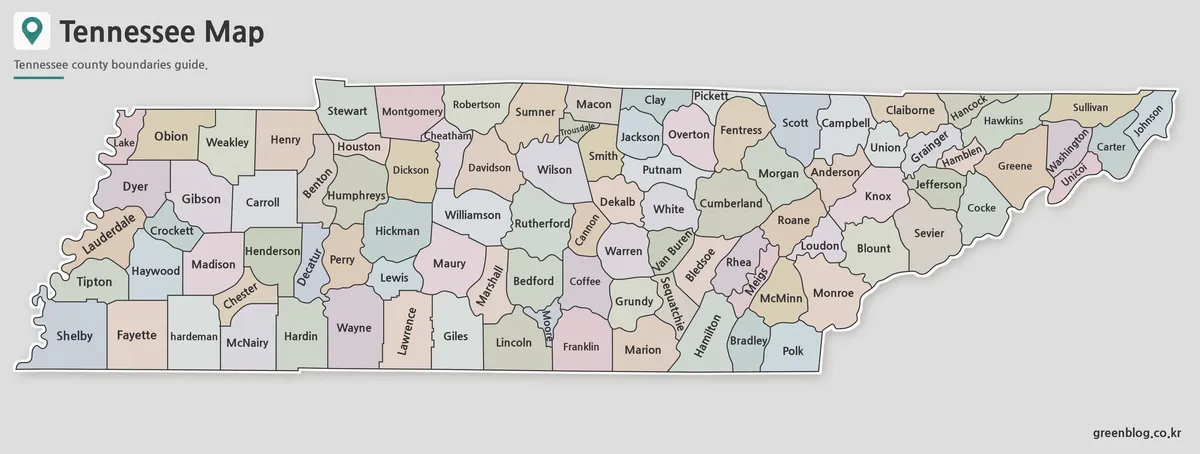
The color edition keeps the complete label set and assigns soft contrasting fills to adjacent counties. This makes short boundary segments easier to follow through the center and northeast. A viewer can separate Smith from Trousdale, Wilson, Putnam, and Jackson more quickly, or work through the small counties around Knox without relying on outlines alone. The black lettering remains the dominant detail.
The colors are visual separators, not data. They do not encode the state’s Grand Divisions, transportation regions, population, election results, elevation, or land cover. If statistics or categories are added, use a new scale and a clear legend rather than assigning an unexplained meaning to the existing pastels. The color Tennessee Map is strongest as an orientation graphic or a presentation reference.
Slides should give the map most of the horizontal canvas. Placing it in a narrow column may leave western county names readable while making the more crowded eastern section difficult to scan. When projecting the file, check contrast on the actual display and repeat important conclusions in nearby text so the presentation does not depend on color perception alone.
Blank Outline Version for Editing
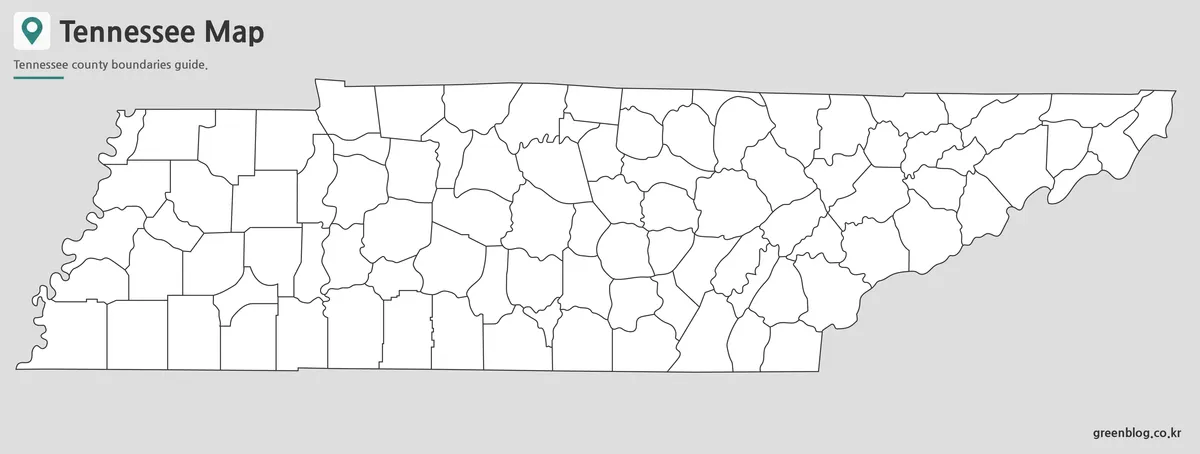
The outline edition removes all county names and pastel fills while retaining the state silhouette and internal network. It supplies no answers, so it is the best base for county-labeling exercises, regional coloring, selected coverage areas, and user-created thematic graphics. Broad western spaces accept larger notes, whereas central and eastern annotations may need numbered markers and a separate key.
A lesson can ask students to find the four corner counties, label Davidson, Shelby, Knox, and Hamilton, or apply a supplied key for West, Middle, and East Tennessee. Editors can highlight a limited group of counties for a report or infographic. In either case, the blank Tennessee Map should be accompanied by a legend and source date whenever the added information represents real data.
The package provides raster artwork rather than a vector file with separately selectable county paths. Image and layout software can place text, arrows, transparent fills, or symbols above it, but the county shapes are not delivered as editable GIS objects. Keep an untouched copy before adding layers, and use authoritative spatial data for surveying, parcel work, navigation, or calculations that depend on coordinates and measured geometry.
Designed for Multiple Uses
Choose the edition according to the reader’s role. Monochrome is most efficient for named reference, color improves fast separation, and outline invites the reader to supply information. Because the three images use the same county geometry, they can form a coherent sequence: introduce locations with color, review names in monochrome, and test recall or build a custom layer on the blank sheet.
For A3 printing, select landscape orientation, preserve the original proportions, and leave enough margin to protect both narrow ends. Do not stretch the image to fill a page, because distortion changes the apparent county shapes and weakens label placement. A single proof copy should be checked at Trousdale, Moore, Sequatchie, Meigs, Unicoi, and the northeastern cluster before producing a larger batch.
For digital use, supply descriptive alternative text and explain any color-dependent result in the surrounding copy. New statistics need a source, date, unit, and legend. The base Tennessee Map contains none of those thematic claims; it contributes only the statewide county framework. Keeping that distinction clear makes the files useful across worksheets, reports, slides, and carefully documented graphics.
Frequently Asked Questions
Can I print the Tennessee Map in A3 size?
Yes. The files were prepared at high resolution and reviewed for A3 printing.
Which version is best for presentations?
The color county map is usually the easiest version to read on presentation slides.
Is the outline version editable?
Yes. The outline map works well for graphic editing, annotations, and custom regional projects.
Does the Tennessee Map include county boundaries?
Yes. All versions include Tennessee county boundaries.
Map File Information
The ZIP package groups three county-map JPG files for labeled reference, color comparison, and custom annotation.
- Included Versions: Labeled black and white, color, and blank outline
- Printable Size: A3 landscape
- File Type: JPG files in one ZIP archive
- Intended Use: Worksheets, reports, slides, coloring, and annotations
Related Maps
- Following 82 Counties Down a Mississippi Map
- Why a Virginia Map
- Why a West Virginia Map
- A Georgia State Map
Additional Resources
- Tennessee County Outline Map — TDOT provides an official statewide county reference and an alphabetical list of all 95 counties.
Green Map creates custom-edited map images using open geographic data sources such as geoBoundaries, Natural Earth, OpenStreetMap, and government open data.
These maps are edited visual materials, not raw data files, and are provided for education, documents, presentations, and graphic reference.