This Zambia map collection presents the country in three deliberately different ways: a color province map, a monochrome labeled map, and a blank national outline. Each image is 1200 × 849 pixels and uses a wide, A3-oriented canvas. Together, the files support province recognition, economical printing, and custom annotation without pretending to be road, terrain, or navigation maps.
The most important reading detail is easy to miss. Zambia has 10 provinces and borders eight countries, but the two labeled versions display only six neighboring-country names. Namibia and Botswana are not labeled around the southern edge. That is a limitation of this artwork, not a statement about the national border. This guide identifies what appears in each file, what is absent, and how to select the right version for a lesson, report, or presentation.
Table of Contents
Zambia Map Download Overview
The collection focuses on Zambia’s first-level administrative pattern. On the labeled maps, the names Luapula, Northern, Muchinga, Eastern, Lusaka, Central, Copperbelt, North-Western, Western, and Southern appear inside their respective province areas. The color file separates those areas with contrasting fills, while the black and white file preserves the same names and internal lines without relying on hue.
Six surrounding labels are visible: Democratic Republic of the Congo, Tanzania, Malawi, Mozambique, Zimbabwe, and Angola. Zambia also meets Namibia and Botswana, so a complete border lesson should add those two names separately. This distinction matters most near the south and southwest, where a learner could otherwise infer that an unlabeled edge has no neighboring state. The files are strongest as clean regional reference graphics, not as exhaustive border atlases.
No version marks cities with points, plots highways, traces rivers, shows relief, or includes a scale bar, north arrow, coordinates, legend, or source note. Although “Lusaka” appears on the two labeled maps, it identifies Lusaka Province; it should not be read as a marker for the capital city. Users who need the city location must add or verify a separate point.
Included Map Versions
The download contains three WEBP images with the same 1200 × 849 dimensions. Their shared proportions make it easy to switch versions in a slide or document without rebuilding the surrounding layout.
- Color province map: ten named provinces in contrasting colors, plus six surrounding country labels.
- Black and white province map: the province divisions and labels retained in a grayscale-friendly treatment.
- Blank outline map: the national silhouette without province divisions, province names, or neighboring-country names.
Choose by task rather than appearance alone. The color Zambia map is the quickest reference for comparing province shapes. Monochrome is more dependable for photocopies and low-ink handouts. The outline is the flexible choice for quizzes, thematic diagrams, and exercises in which learners supply the information themselves.
Color Zambia Province Map
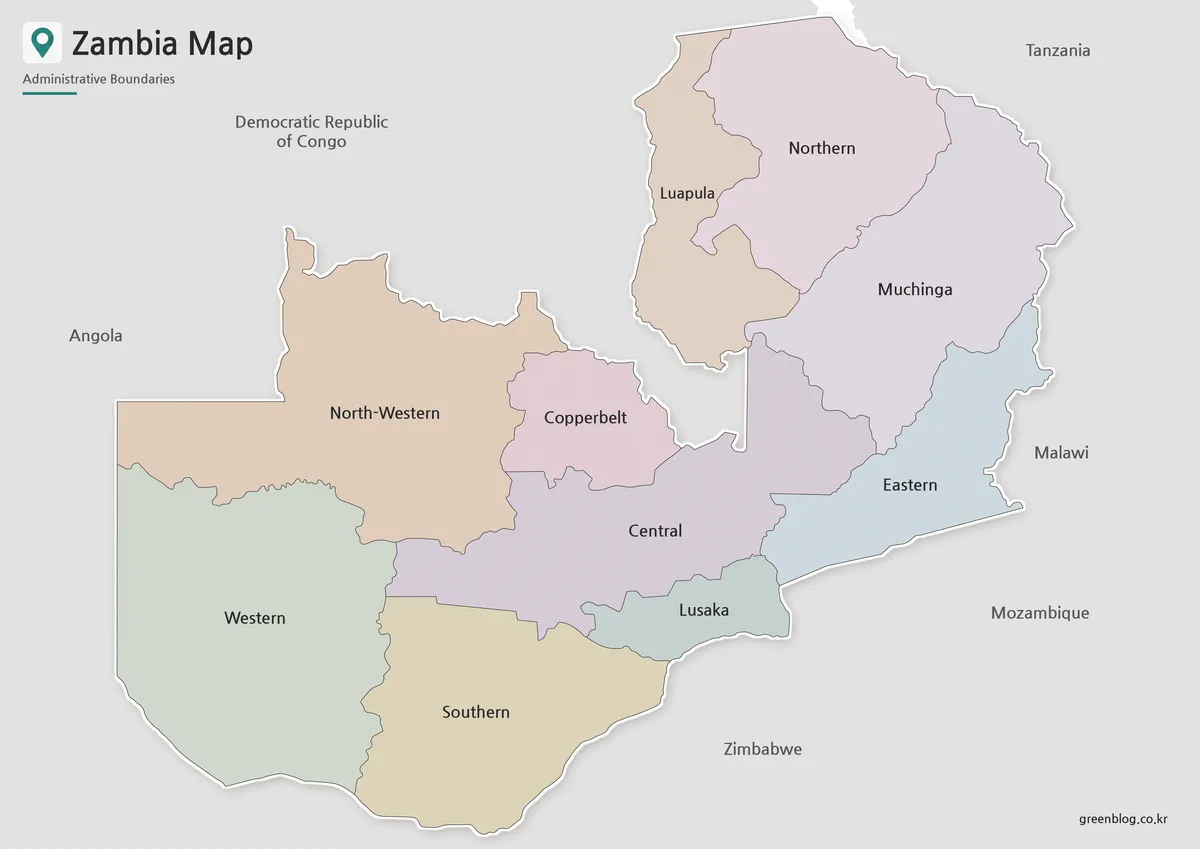
The first image assigns a different fill to each of the 10 provinces. These colors are categorical: they help the eye separate adjacent areas but do not represent population, elevation, climate, election results, or any numerical ranking. A reader should use the printed province names and boundary lines as the geographic information, not infer meaning from a particular color.
The map makes several broad spatial relationships easy to see. Western and North-Western occupy much of the west; Copperbelt sits toward the north-central border; Central forms a long interior area; Southern extends across the lower part of the country; and Eastern projects toward Malawi and Mozambique. Luapula, Northern, and Muchinga form the northeastern group around the inward shape of the Democratic Republic of the Congo border. Lusaka Province is comparatively compact in the southeast-central part of the layout.
Use this version when the audience needs to distinguish provinces at a glance. It works well on a screen, in a report with color output, or beside a province list. If the map is reduced substantially, test the smallest labels before publishing; the full canvas is clear, but province names will naturally shrink with the image.
Black and White Zambia Map for Printing
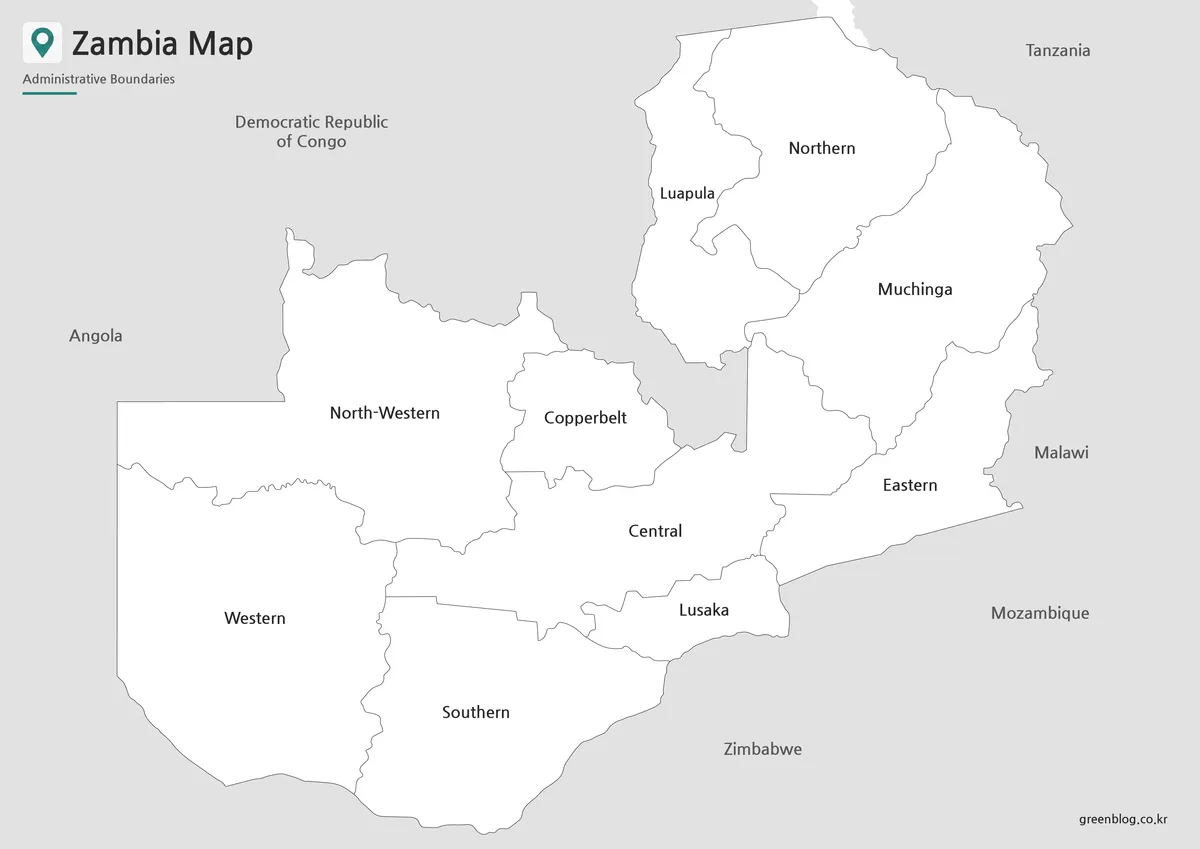
The monochrome version retains the same administrative divisions, all 10 province names, and the same six surrounding labels. Its main advantage is functional: the boundaries do not depend on colored fills. That makes the image suitable for printers set to grayscale, photocopied worksheets, reports with a restrained visual style, and materials that may be reproduced many times.
Black and white does not make the map more detailed. Roads, settlements, waterways, physical relief, and measurement aids remain absent. If students must identify provinces, the existing labels make this a reference sheet rather than a blank assessment. For a test, cover the text before printing or use the outline version and provide a separate answer key.
When placing the image in a document, preserve its aspect ratio and avoid stretching it to fill a differently shaped box. A trial print is useful because thin internal lines can soften on draft-quality office printers. Increasing the image’s physical size is generally preferable to artificially sharpening it.
Blank Zambia Outline Map for Editing
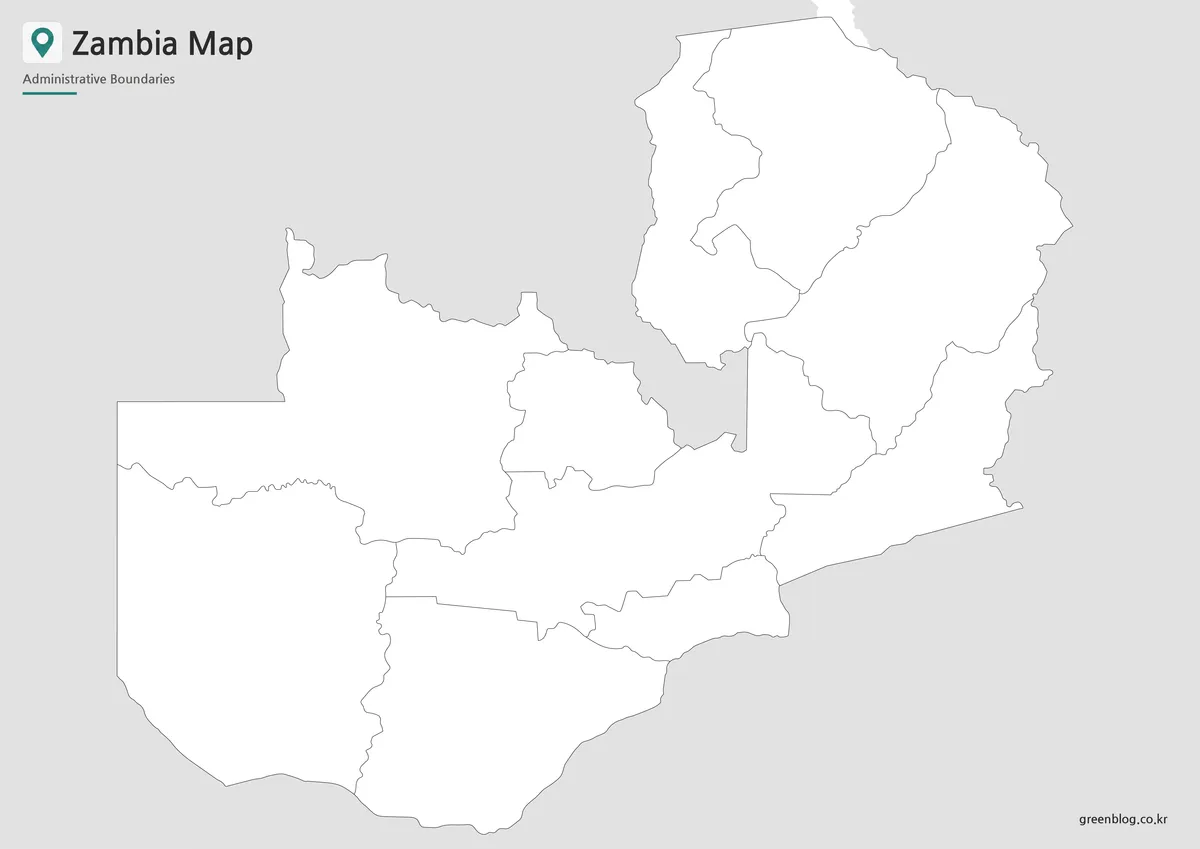
The third file removes the internal province network and every geographic label. Only the title treatment and the national outline remain. It is therefore a country-outline base, not a blank province map. Anyone planning to shade individual provinces must first add accurate internal boundaries from an appropriate administrative source.
This version is useful for locating Zambia in a regional activity, adding a small number of verified city or resource markers, creating a flag-color exercise, or building a simple thematic graphic. Keep an untouched copy before editing. Place annotations on separate layers when possible, and include a legend if colors or symbols acquire a meaning.
The clean silhouette also makes omissions more obvious: it contains no border labels at all, so users must supply all eight neighboring countries if that is the assignment. For accessible documents, add descriptive alt text that explains the information you placed on the outline rather than merely calling it a map.
Why a Zambia Map Is Useful
Zambia is landlocked and sits where southern, central, and eastern African connections meet. Its eight neighbors are Angola, the Democratic Republic of the Congo, Tanzania, Malawi, Mozambique, Zimbabwe, Botswana, and Namibia. Seeing the outline beside those countries explains the national setting more effectively than a list alone, especially where the borders bend around narrow or projecting territories.
At the administrative level, a labeled Zambia map provides a manageable overview before a reader studies districts or cities. The 10-province structure supports lessons about relative position: which provinces touch international borders, which lie inland, and how eastern and western parts of the country connect through Central and Southern. It can also serve as a neutral base for comparing information collected from a current, cited dataset.
However, the artwork should not be used to calculate distance, plan travel, establish a legal boundary, or locate an emergency service. There is no scale, coordinate grid, transport network, or survey detail. For those tasks, consult a current authoritative map designed for the specific purpose.
Practical Uses for the Zambia Map Collection
For classroom work, the three files can form a simple progression. Begin with the color map for orientation, provide the monochrome version as a reference during reading, and use the outline for recall or annotation. A teacher can ask learners to list all 10 provinces, then compare the six surrounding labels in the artwork with the complete list of eight neighbors. That turns a visual limitation into a source-checking exercise.
For presentations, use one map per slide and keep explanatory labels outside the country shape when space permits. For reports, add a caption that states whether the graphic shows provinces or only the national outline. For data graphics, verify that every value uses the same date and geographic level, then add a legend and source. Do not use the decorative province colors as if they were a preexisting data scale.
Editors can also crop the generous white margin, add callouts, or place the image over a branded background, provided the country outline is not distorted. Because WEBP support can vary in older publishing workflows, conversion to PNG may be helpful, but the dimensions and proportions should remain unchanged. Review text legibility and contrast after any conversion.
Basic Zambia Information for Map Users
Use the following checklist when reading or adapting the files:
- Country: Zambia, a landlocked state in Africa.
- Capital: Lusaka; the artwork labels Lusaka Province but does not plot the capital city.
- First-level divisions: 10 provinces, all named on the color and monochrome files.
- International neighbors: eight in total; six are labeled on the province maps, while Namibia and Botswana are omitted.
- Image format: three WEBP files, each measuring 1200 × 849 pixels.
- Not included: district boundaries, roads, railways, rivers, terrain, city points, scale, coordinates, and north arrow.
Administrative names and boundaries can change, and a downloadable image does not update itself. Before using the graphic in a publication, compare the labels with a current official source. The linked provincial directory below is a practical check for the 10 province names represented here.
Frequently Asked Questions
What is included in this Zambia map download?
The Zambia map download includes color, black and white, and outline versions. Each one is designed for a different use, such as visual explanation, printing, or editing.
Can I use the Zambia map for classroom materials?
Yes. The map works well for geography worksheets, classroom handouts, student reports, and presentation slides.
Which version is best for printing?
The black and white version is usually the best choice for printing because it keeps labels and province boundaries clean without relying on color.
Is the outline map useful for editing?
Yes. The blank outline map can be used to add province labels, resource markers, travel routes, classroom notes, or infographic annotations.
Does the map show neighboring countries?
Yes. The map is designed to help users understand Zambia’s position among surrounding African countries while keeping the layout simple.
Map File Information
This download includes color, black and white, and outline images for province reference, printing, presentation layouts, and custom annotation.
- Included Versions: Color province map, black and white province map, blank country outline
- File Type: WEBP image files
Related Maps
Additional Resources
- Zambia Statistics Agency: Provincial Contacts — an official directory listing Zambia’s provinces and their provincial centers.
Green Map creates custom-edited map images using open geographic data sources such as geoBoundaries, Natural Earth, OpenStreetMap, and government open data.
These maps are edited visual materials, not raw data files, and are provided for education, documents, presentations, and graphic reference.