A Myanmar Map has to explain an unusually long country: Kachin reaches toward the eastern Himalayas in the north, a broad central zone spreads around Sagaing, Mandalay, Magway, and Shan, and the Tanintharyi coast continues far south beside Thailand. This collection keeps that north–south structure visible while showing the country in its wider setting between South Asia and mainland Southeast Asia.
The set contains a labeled color administrative map, a labeled black-and-white version, a blank outline, and a separate national flag image. The maps were arranged for an A3 landscape layout and are intended for lessons, country profiles, presentation slides, printed reference sheets, labeling exercises, and custom graphics. Each version answers a different question: color helps separate adjoining units, monochrome keeps the names without colored fills, and the outline creates an uncluttered base for new labels or categories.
The artwork should be read as a general administrative reference, not as a road, terrain, or live control map. It shows 14 labeled first-level units, neighboring countries, several surrounding seas, and a red star at the capital area. It does not show highways, rivers, elevation, city networks, township boundaries, or current areas of operational control. The capital star is not accompanied by a Nay Pyi Taw text label, so its meaning is best explained in nearby copy or a presentation legend.
Table of Contents
Myanmar Map Overview
The administrative picture has two equal groups: seven states and seven regions. The states labeled on the image are Kachin, Kayah, Kayin, Chin, Mon, Rakhine, and Shan. The regions are Ayeyarwady, Bago, Magway, Mandalay, Sagaing, Tanintharyi, and Yangon. A Myanmar Map makes the contrast between these large northern and eastern areas and the smaller, more tightly arranged lower-country units much easier to see than a name list alone.
Kachin forms the northern end, with Sagaing extending down its western side and Shan occupying much of the east. Chin is a narrow western unit beside India and Bangladesh, while Rakhine follows the Bay of Bengal coast farther south. Mandalay and Magway sit near the center; the red capital marker appears in this central corridor, but Nay Pyi Taw is not presented as a fifteenth labeled state or region.
The lower half is especially useful for map-reading practice. Bago occupies a central position above Yangon, Ayeyarwady spreads across the delta-facing southwest, and Mon and Kayin run along the southeastern side. Tanintharyi then forms the long southern extension beside Thailand and the Andaman Sea. Kayah is compact and positioned between Shan and Kayin, which makes its label easier to miss when the image is reduced.
For regional orientation, the map names Myanmar’s five land neighbors—Bangladesh, India, China, Laos, and Thailand—and also includes Nepal, Bhutan, Cambodia, and Vietnam as wider context. Water labels include the Bay of Bengal, Andaman Sea, Gulf of Thailand, and South China Sea. These surrounding references explain position and direction, but they are not a complete political or physical map of Asia.
Included Map Versions
This package provides three coordinated boundary views plus a flag image. The color and black-and-white editions retain the same English unit names and regional context. The outline edition removes the names and fills while preserving the national silhouette and first-level divisions. Because the geometry is consistent, readers can move from recognition to recall without learning a different layout.
- Color administrative map: 14 labeled states and regions with alternating pastel fills
- Black-and-white map: the same unit names and boundaries on white interiors
- Blank outline: internal divisions without Myanmar or neighboring-country labels
- National flag: yellow, green, and red bands with a central white star
Select the version according to the task rather than treating one as universally better. A presenter comparing several units benefits from color; a report author may prefer the quieter monochrome image; and a teacher preparing a recall activity needs the blank outline. None of the versions contains independently selectable vector regions, so claims about one-click boundary editing should be avoided.
Color Myanmar Administrative Map
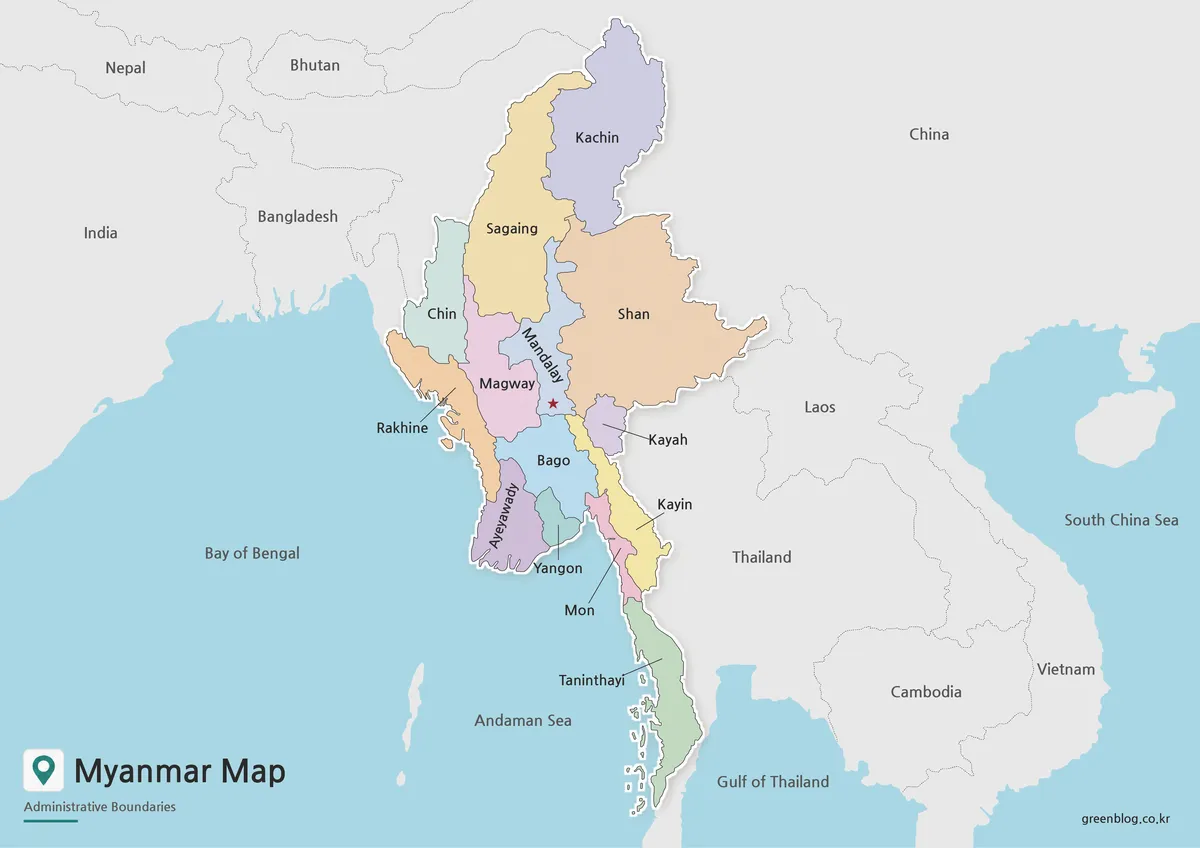
The color Myanmar Map gives each adjoining state or region a different muted fill. This is most useful around the central cluster, where Mandalay, Magway, Bago, Shan, Kayah, and Kayin meet within a relatively small area of the page. The fills also clarify the narrow coastal forms of Rakhine, Mon, and Tanintharyi without requiring heavy boundary lines.
The strongest visual comparison is between the broad inland units and the long, narrow southern forms. Sagaing and Shan occupy large areas, while Yangon and Kayah are compact. Ayeyarwady’s delta-facing outline is visibly different from the straighter inland boundaries. These color differences are categorical only: they do not encode population, language, ethnicity, elevation, climate, or political affiliation.
Use the color edition for an opening slide, a country-location panel, or a labeled reference displayed beside a worksheet. If new data is added, use a separate legend and cite its date and source. The existing pastel palette already performs the job of boundary separation, so additional thematic colors should be transparent or visually distinct enough to avoid implying that the original fills represent data.
Black and White Printable Version
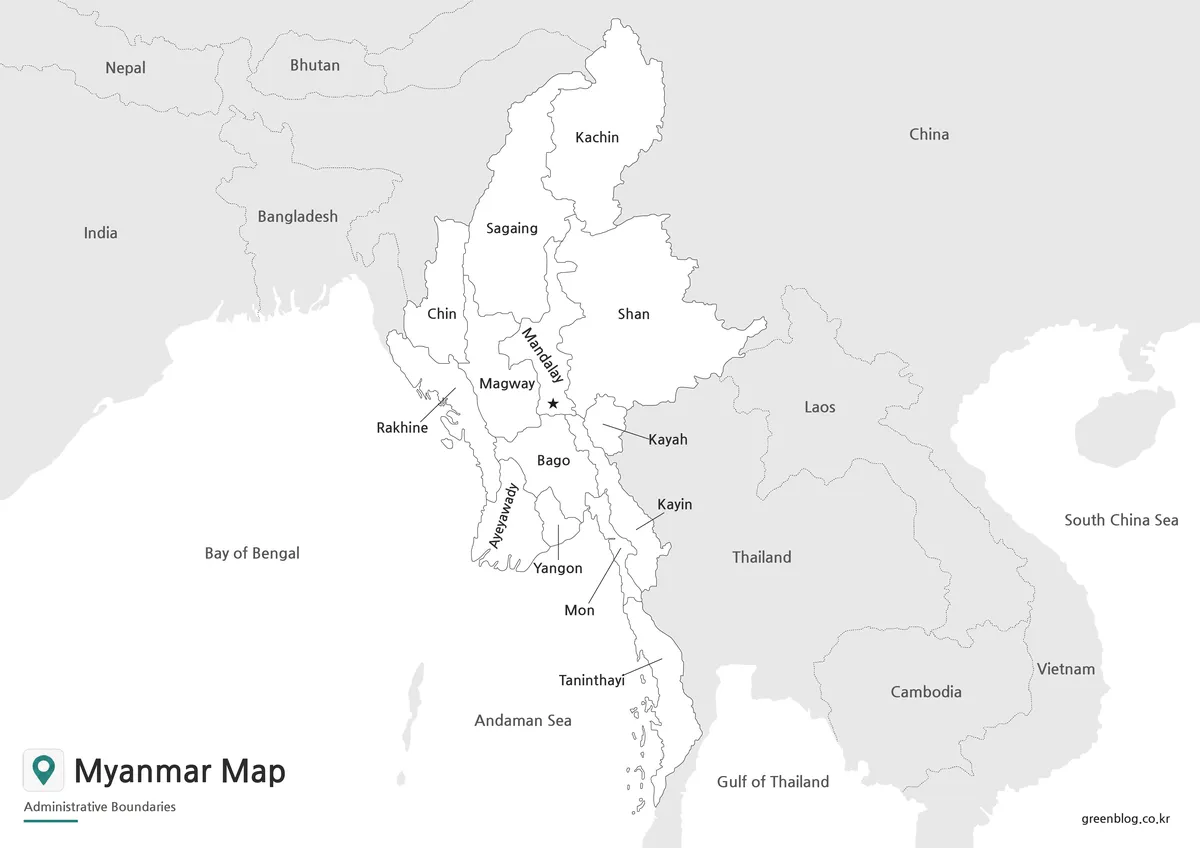
The black-and-white Myanmar Map preserves the unit labels, internal boundaries, neighboring countries, sea names, and capital star while changing the administrative interiors to white. This makes it a practical reference for economical printing and for documents that already contain charts, logos, or colored highlights.
Monochrome does not mean blank. Students can still identify Kachin in the north, Shan in the east, Rakhine on the western coast, and Tanintharyi in the far south. The names remain useful for guided study, but they leave less room than the outline version for a full labeling exercise. Short notes, arrows, circles, and one or two accent colors are better suited to this edition.
Before printing multiple copies, test the small central and lower-country labels. Kayah, Yangon, Mon, Ayeyarwady, and Mandalay occupy constrained spaces or use angled leader lines. Keep the original landscape proportions, and avoid cropping the long Tanintharyi extension or the contextual labels at the page edges. A modest white margin will help the map survive different printer settings.
Blank Myanmar Outline Map for Editing
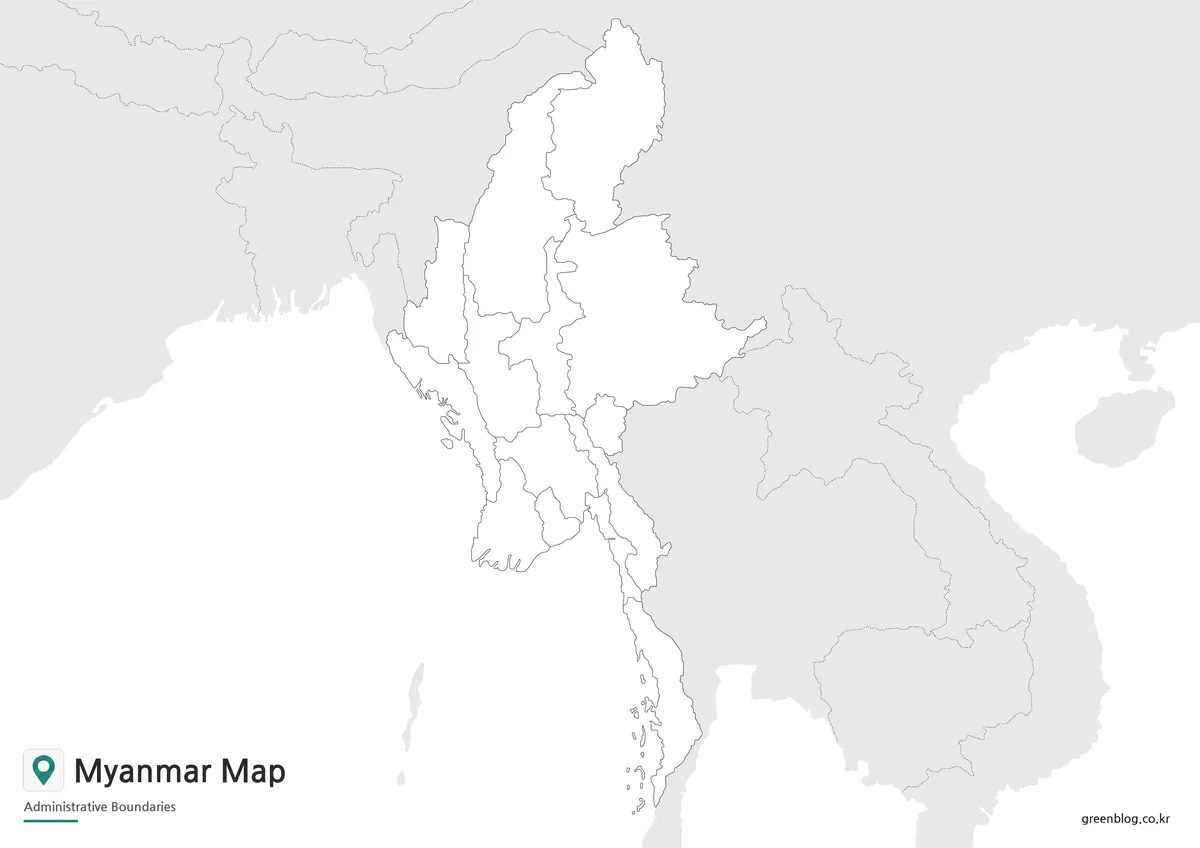
The blank Myanmar Map outline removes the state and region names, surrounding labels, capital symbol, and color fills. What remains is the country silhouette and the main internal divisions. This version supports memory exercises, localized labels, custom color keys, and simplified data displays without competing with embedded text.
A classroom sequence can begin with the color map, continue with the labeled monochrome view, and finish with the outline. Learners might identify the seven states and seven regions, distinguish coastal from inland units, or trace the north–south sequence from Kachin to Tanintharyi. A presentation designer can instead group units into project-specific categories, provided those categories are clearly described as an added layer.
The downloadable resource is an image, not a GIS boundary dataset or a vector file with separate administrative objects. Users can add text boxes, transparent fills, markers, and arrows in common image or page-layout software, but selecting one region may require manual tracing or a fill tool. Keep an untouched copy and do not rely on the generalized lines for surveying, navigation, or legal boundary decisions.
Myanmar Flag
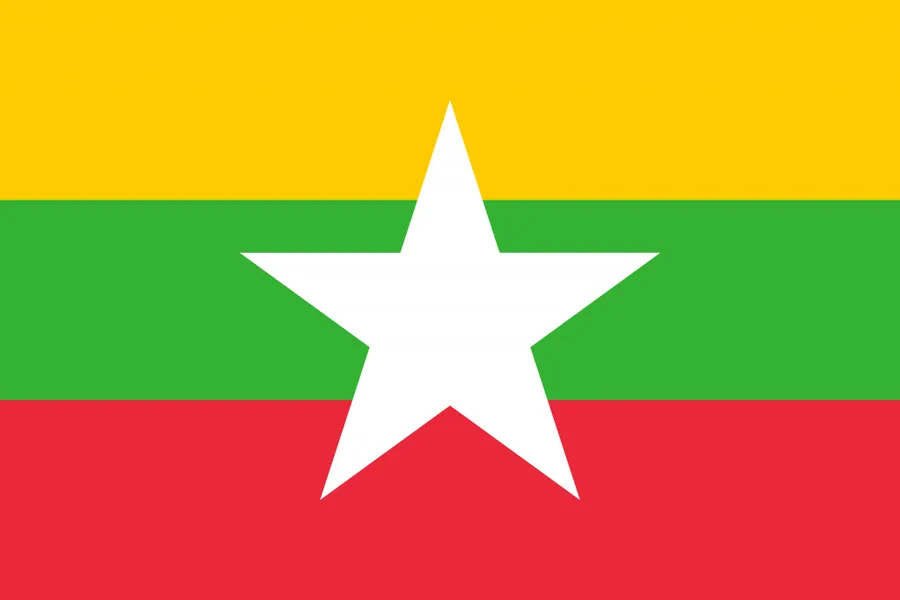
The separate flag image uses three horizontal bands—yellow above green above red—with a large white five-pointed star centered across them. It can accompany the maps in a country profile, classroom display, or regional comparison slide. Because it is a separate rectangular image rather than a map layer, it is best placed beside a title or introductory facts rather than over the administrative boundaries.
The star on the flag and the small red star on the map have different functions. The flag star is part of the national design, while the map star marks the capital area. Explaining that difference prevents readers from treating the map symbol as a decorative element or assuming that the flag image identifies a particular state or region.
Practical Uses for This Myanmar Map
Choose the Myanmar Map version that matches what the reader must do. Use color for fast visual separation, monochrome for a labeled printed reference, and the outline for recall, annotation, or a new thematic scheme. The shared geometry makes the three files useful as a progressive teaching set or as coordinated graphics across several pages of one report.
For an A3 landscape print, retain the aspect ratio and check that the southern coastline and small central labels remain clear. On a presentation slide, keep the map large enough for Ayeyarwady, Yangon, Mon, Kayah, and Mandalay to be read from a distance. If space is limited, crop only surrounding context—not Myanmar’s northern tip, western coast, or Tanintharyi extension.
For online use, accompany the image with descriptive alternative text and a short explanation of what the colors do and do not represent. If the map is used with population, disaster, travel, or administrative information, add a dated source and a legend. Boundaries and areas of effective control can be sensitive or change over time, so this general reference should not be presented as a live operational map.
Frequently Asked Questions
Is this Myanmar Map suitable for A3 printing?
Yes. This Myanmar Map was prepared in an A3-sized layout, so it works well for classroom materials, presentation boards, and printed reference sheets.
What information is included on the map?
The map includes administrative boundaries, major regional labels, the capital marker, and surrounding country references depending on the version.
Which version is best for printing?
The black and white version is best for most printed materials because it keeps labels and boundaries clear while reducing color use.
Can I edit the outline map?
Yes. The blank outline version is suitable for adding colors, labels, city markers, travel routes, or infographic data.
Why are neighboring countries shown?
Myanmar borders several countries, so including nearby country names helps readers understand its location in Southeast Asia more easily.
Map File Information
The ZIP package groups three administrative map images and a separate Myanmar flag for print, study, presentation, and annotation projects.
- Included Versions: Color, labeled black and white, blank outline, and flag
- Printable Size: A3 landscape layout
- File Type: Image files in one ZIP archive
- Intended Use: Lessons, reports, presentations, labeling, coloring, and custom graphics
Related Maps
Additional Resources
- UN Myanmar Country Analysis — This report provides broader background on Myanmar’s states, regions, capital territory, and human-development context.
Green Map creates custom-edited map images using open geographic data sources such as geoBoundaries, Natural Earth, OpenStreetMap, and government open data.
These maps are edited visual materials, not raw data files, and are provided for education, documents, presentations, and graphic reference.