A Maine Map must balance two very different shapes: an expansive northern interior and a deeply indented Atlantic coast. Maine narrows toward York County in the southwest, widens across the central counties, and reaches north through Aroostook County. Along the lower and eastern edge, bays, peninsulas, offshore islands, and close county boundaries create much more visual detail than the state’s broad inland areas.
This collection presents that structure in three coordinated county views. The color edition separates the 16 counties with muted fills; the black-and-white edition keeps the same labels and boundary context without color; and the outline edition removes all labels and fills for annotation. The download files are high-resolution JPG images prepared for A3 printing, while the images shown on the page provide a direct preview of each layout.
Teachers can move from a labeled reference to a blank recall exercise, while editors and presentation creators can select the amount of visual guidance their project needs. The maps show county divisions rather than roads, towns, terrain, or travel routes. Their main purpose is to explain administrative position, the contrast between the large northern counties and compact southern counties, and Maine’s relationship to New Hampshire, Quebec, New Brunswick, and the Atlantic Ocean.
Table of Contents
Maine Map Versions Included
Maine has 16 counties. The state map places Aroostook across the far north, with Piscataquis, Somerset, and Penobscot forming much of the large interior below it. Franklin and Oxford occupy the western side, while Washington and Hancock meet the eastern and southeastern coast. Waldo and Kennebec sit between the interior and the more compact coastal or southern counties.
The lower portion contains Androscoggin, Cumberland, York, Sagadahoc, Lincoln, and Knox. Several of these names must fit into narrow or irregular shapes, so their labels use different orientations: New Hampshire and Androscoggin are vertical or angled, while most other county names remain horizontal. This is an important reading detail when using the map at a reduced size.
Outside the state, the labeled editions provide a simple frame rather than a full regional atlas. Quebec appears along the northwest, New Brunswick on the east, New Hampshire on the southwest, and the Atlantic Ocean below the coast. These reference labels help viewers understand why Maine is the only U.S. state on the map with one neighboring state and two Canadian provincial neighbors.
- Color county map: 16 named counties separated by distinct fills
- Labeled monochrome map: County names and surrounding-area labels without county colors
- Blank outline map: State coastline and county boundaries without names or fills
- Download format: High-resolution JPG files arranged for A3 output
Maine Map Color Version
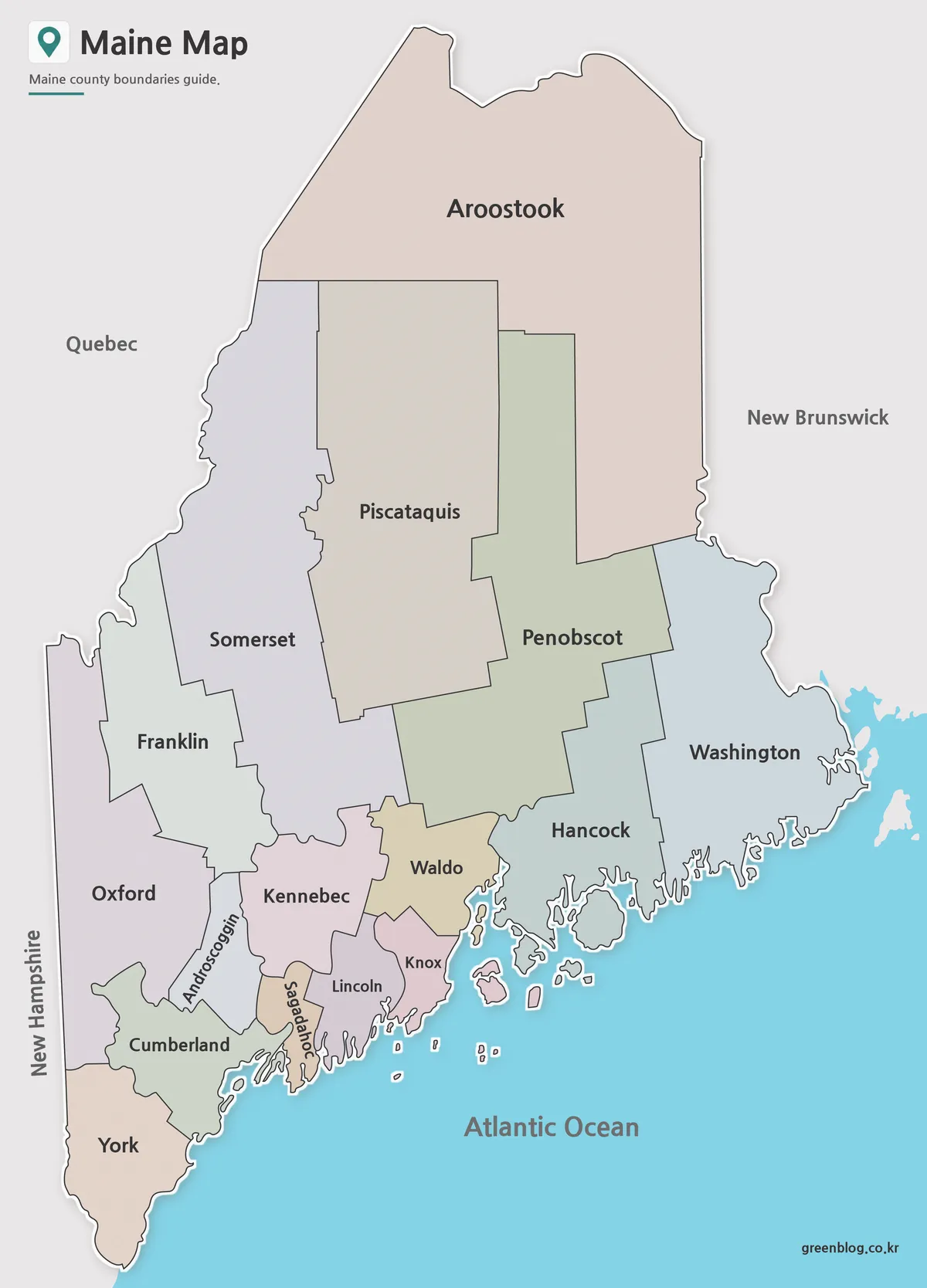
The color version is the quickest way to distinguish counties that share long internal borders. In the north, Aroostook occupies a single large field, while Piscataquis, Somerset, and Penobscot form broad blocks beneath it. Farther south, alternating fills prevent the smaller shapes around Kennebec, Waldo, Knox, Lincoln, Sagadahoc, Androscoggin, Cumberland, and York from visually merging.
Blue water gives the irregular coast a strong edge, and the neutral surrounding land keeps attention on Maine. Washington County’s eastern coast, Hancock County’s islands and bays, and the narrow coastal counties west of Penobscot are easier to follow when their fills differ. The map also keeps county names inside or across their shapes, so color acts as a second identifier rather than replacing the labels.
Choose this edition for a projected introduction, a county comparison, or a page where viewers need immediate separation without reading every boundary line first. If you add data, use a legend that clearly explains your new symbols; the existing pastel colors identify categories only and do not represent values. Avoid placing additional text over the tightly packed Midcoast area, where labels and coastline details already compete for space.
Labeled Version for Reports and Presentations
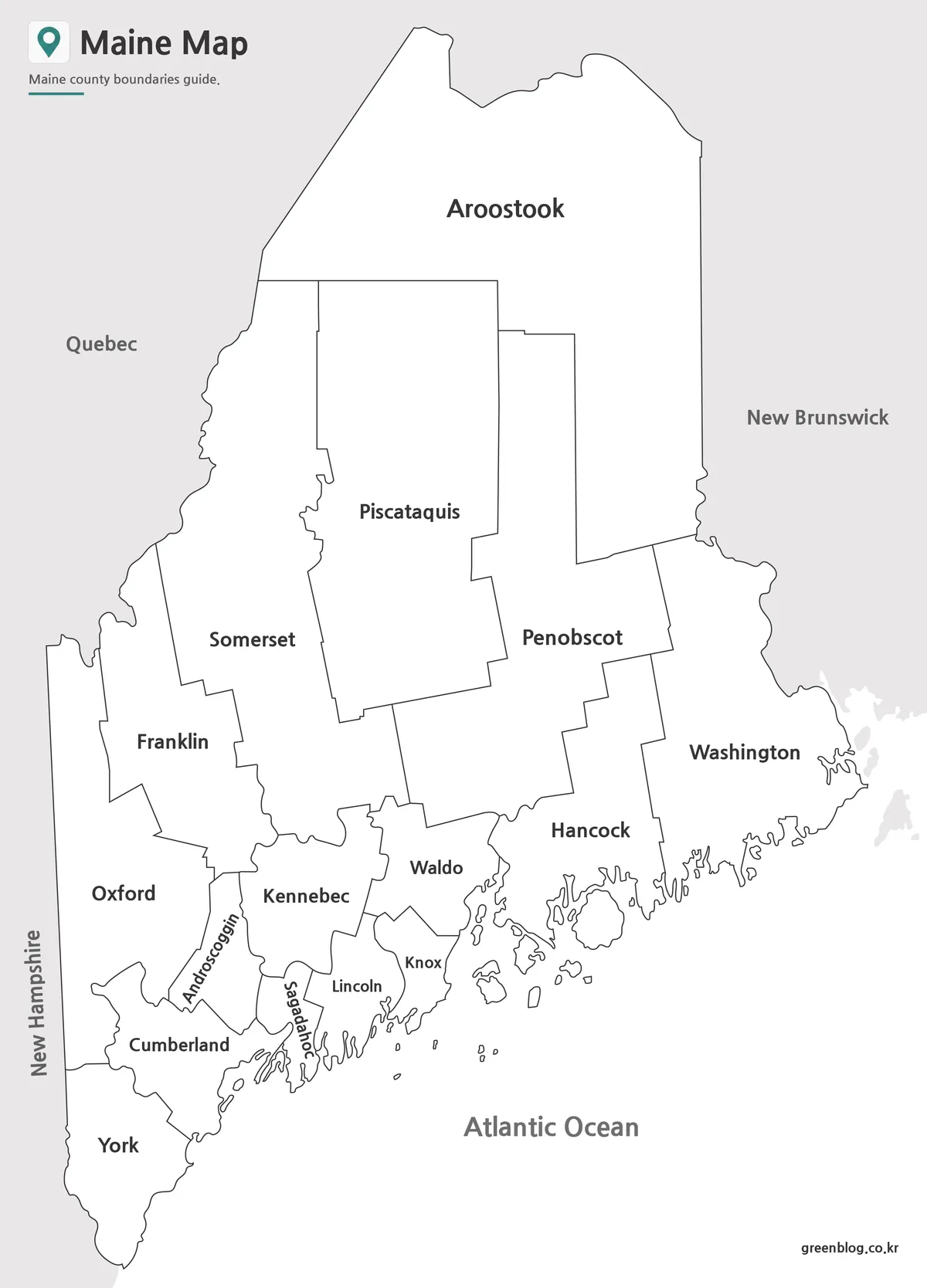
The black-and-white edition retains all 16 county names, the state outline, county boundaries, and the surrounding labels. White county interiors leave room for light pencil or marker notes, while a pale gray background separates Quebec, New Brunswick, and New Hampshire from the state. The Atlantic Ocean remains named beneath the coastline, but the page does not introduce city markers, highways, or physical features.
This format suits a report in which color would distract from other charts, a classroom packet reproduced on a monochrome copier, or an answer key paired with the blank outline. It also provides a clearer base for circling a county or drawing a simple directional arrow. Because the county names are already present, it is better for orientation and review than for an unlabeled identification test.
Before printing at a smaller paper size, inspect Androscoggin, Sagadahoc, Lincoln, and Knox in the preview. Their narrow shapes and close labels create the most demanding part of the layout. Keeping the original portrait proportions is more important than filling every edge of the sheet; forced stretching can make the southern counties appear wider and can compress the long north-to-south form.
Outline Map for Editing and Custom Projects
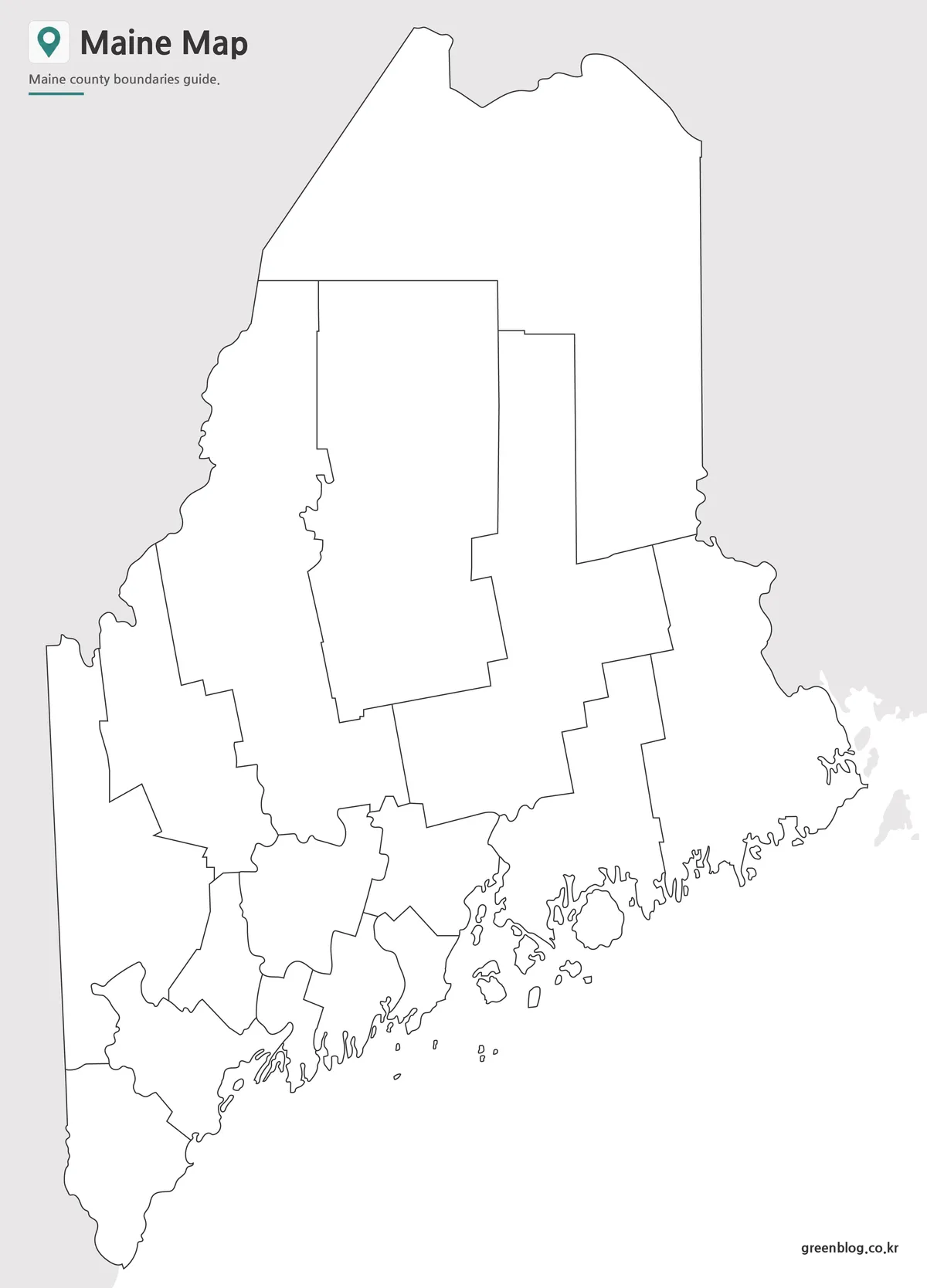
The outline edition removes every county name, neighboring-region label, ocean label, and color fill. What remains is Maine’s outer shape, its coastal islands and inlets, and the complete network of 16 county divisions. The clean interior makes it the most flexible file for a worksheet, custom county key, language-localized graphic, or thematic overlay.
A geography activity might ask students to identify Aroostook at the broad northern end, trace the New Hampshire boundary beside Oxford and York, or label the chain of counties along the Atlantic side. A presentation creator could shade inland and coastal groups, add a single site marker, or compare a selected county with the statewide frame. Keeping a separate legend prevents the narrow southern shapes from becoming crowded.
The download is a raster JPG, not a vector source with independently selectable county paths. Add text, arrows, or transparent fills on layers in an image or page-layout application, and keep an untouched copy before editing. At this statewide scale, the coastline is simplified for readability; it should not be used for navigation, parcel work, or measurement of individual islands and shore segments.
Designed for Education and Regional Analysis
Select the map by task rather than by appearance alone. Use color when the audience must separate several adjacent counties quickly, monochrome when names need to remain visible in a restrained document, and the blank outline when readers will supply labels or categories themselves. Since all three share the same geometry, they can be paired as a reference sheet, exercise page, and answer aid.
For A3 output, print in portrait orientation and preserve the source proportions. A proof page can confirm whether the small coastal shapes and vertical labels remain legible on a particular printer. If the map is inserted into a landscape slide, allow extra width beside it for notes instead of cropping the northern tip or southern coast to fill the frame.
County boundaries are appropriate for broad administrative comparison, but the files contain no municipal boundaries, roads, hydrology, elevation, or population values. Any data added by the user should include a source date and legend. For accessible online use, provide descriptive alternative text and repeat essential conclusions in nearby text rather than relying only on color or labels embedded in the image.
Frequently Asked Questions
Does the Maine Map include county boundaries?
Yes. All versions include Maine county boundaries.
Can the Maine Map be printed in A3 size?
Yes. The files were prepared in high resolution for A3 printing.
Which Maine Map version is best for editing?
The outline version is the best choice for annotations, graphic editing, and custom projects.
Is the labeled Maine Map useful for classroom activities?
Yes. It includes county names and major cities while maintaining a clean layout for educational use.
Map File Information
The ZIP package groups three county-map JPG files for reference, monochrome printing, and custom annotation.
- Included Versions: Color, labeled black and white, and blank outline
- Printable Size: A3
- File Type: JPG files in one ZIP archive
- Intended Use: Lessons, reports, presentations, coloring, and annotations
Related Maps
Additional Resources
- Maine Counties — The Maine Secretary of State provides the names of all 16 counties for further study.
Green Map creates custom-edited map images using open geographic data sources such as geoBoundaries, Natural Earth, OpenStreetMap, and government open data.
These maps are edited visual materials, not raw data files, and are provided for education, documents, presentations, and graphic reference.