A Utah Map becomes easier to orient when the Great Salt Lake, Utah Lake, and all 29 county boundaries appear together. The supplied portrait layout places the compact northern counties around the two lakes above the much larger county shapes of western, eastern, and southern Utah. That contrast is visible in three coordinated versions: a pastel color map, a labeled black-and-white map, and an unlabeled outline.
The artwork is a county reference rather than a road, city, terrain, or national-park map. County names are included on the first two images, while the outline removes text and fills for labeling or data work. Teachers, students, presenters, and designers can therefore choose between immediate identification and a clean base for customization without mistaking the files for vector source material.
Utah borders Idaho and Wyoming to the north, Colorado to the east, Arizona to the south, and Nevada to the west; it also touches New Mexico at the Four Corners. The visible neighbor labels emphasize Idaho, Wyoming, Nevada, and Arizona. On the Utah Map itself, lake shapes provide the strongest internal landmarks because cities and highways are not plotted.
Table of Contents
Three County Views on One Shared Layout
Every preview uses a 1200 × 1697 portrait canvas and the same county geometry. The color and monochrome maps label all 29 counties, including small northern areas such as Davis, Morgan, Weber, and Rich as well as broad counties such as Tooele, Millard, Uintah, Grand, Garfield, and San Juan. The outline preserves those shapes but leaves every county unnamed.
The downloadable collection is identified as high-resolution A3 material in JPG format and is packaged in a ZIP archive. The website previews are WEBP images, which should not be confused with the download specification. No PNG, SVG, PDF, editable vector, transparent-background, or layered source file is confirmed by the supplied materials.
Reading 29 Counties on a Utah Map
Northern Utah has the densest boundary pattern in the collection. Box Elder fills much of the northwest around the Great Salt Lake, while Cache and Rich reach the Idaho and Wyoming sides. Weber, Davis, and Morgan occupy comparatively small spaces near the lake’s eastern side, and Summit stretches eastward beneath the Wyoming border. These shapes help users understand why a north-focused classroom exercise can require more label room than a southern one.
Salt Lake County sits below the Great Salt Lake and above Utah County, with Tooele extending across the west. Utah Lake appears inside Utah County and gives the central section a second recognizable water feature. Farther east, Wasatch, Duchesne, Uintah, Carbon, Emery, and Grand form a sequence of differently sized areas whose boundaries are easier to follow when color or labels are present.
The southern half is dominated by wider county shapes. Washington, Iron, Garfield, Kane, and San Juan reach the Arizona side, while Beaver, Piute, Wayne, and several central counties form the transition from the broad lower tier to the smaller northern cluster. San Juan occupies the southeast corner where Utah meets Colorado, Arizona, and New Mexico, although the small Four Corners contact is not separately labeled in the image.
Color for County-to-County Comparison
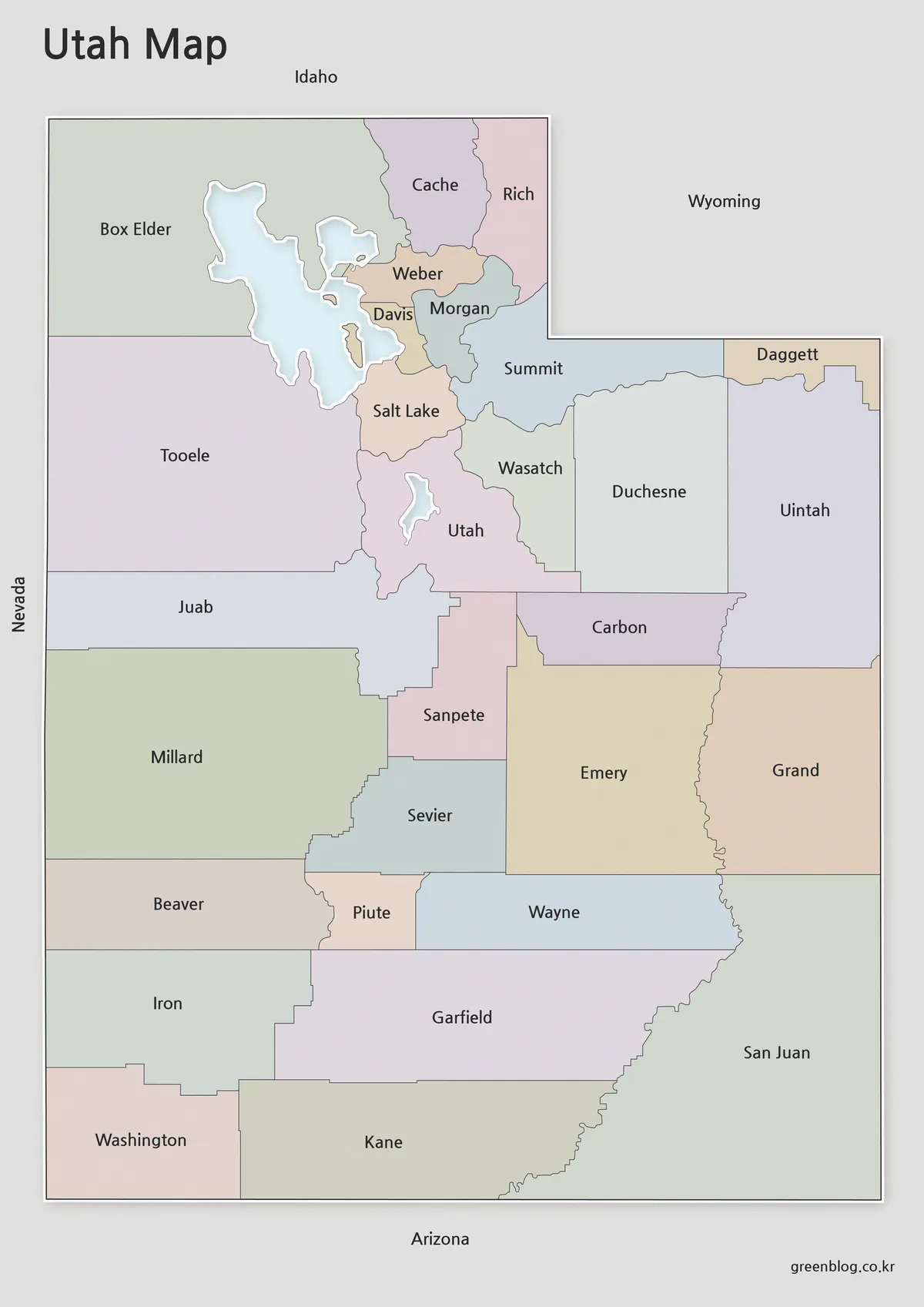
The color Utah Map uses soft contrasting fills to separate adjoining counties without adding a statistical legend. The colors do not represent population, politics, elevation, land ownership, or tourism regions. Their purpose is simply to make shared boundaries easier to trace, especially around Davis, Weber, Morgan, Salt Lake, Summit, Wasatch, and Utah counties.
This view is the clearest choice for projected slides, county comparison, and quick visual reference. A presenter can move from the lake-centered north to the wide western counties or the southeastern San Juan corner without asking viewers to distinguish similar white spaces. The pale lake fill also separates water from county areas while retaining a restrained palette.
Labeled Boundaries for Monochrome Printing
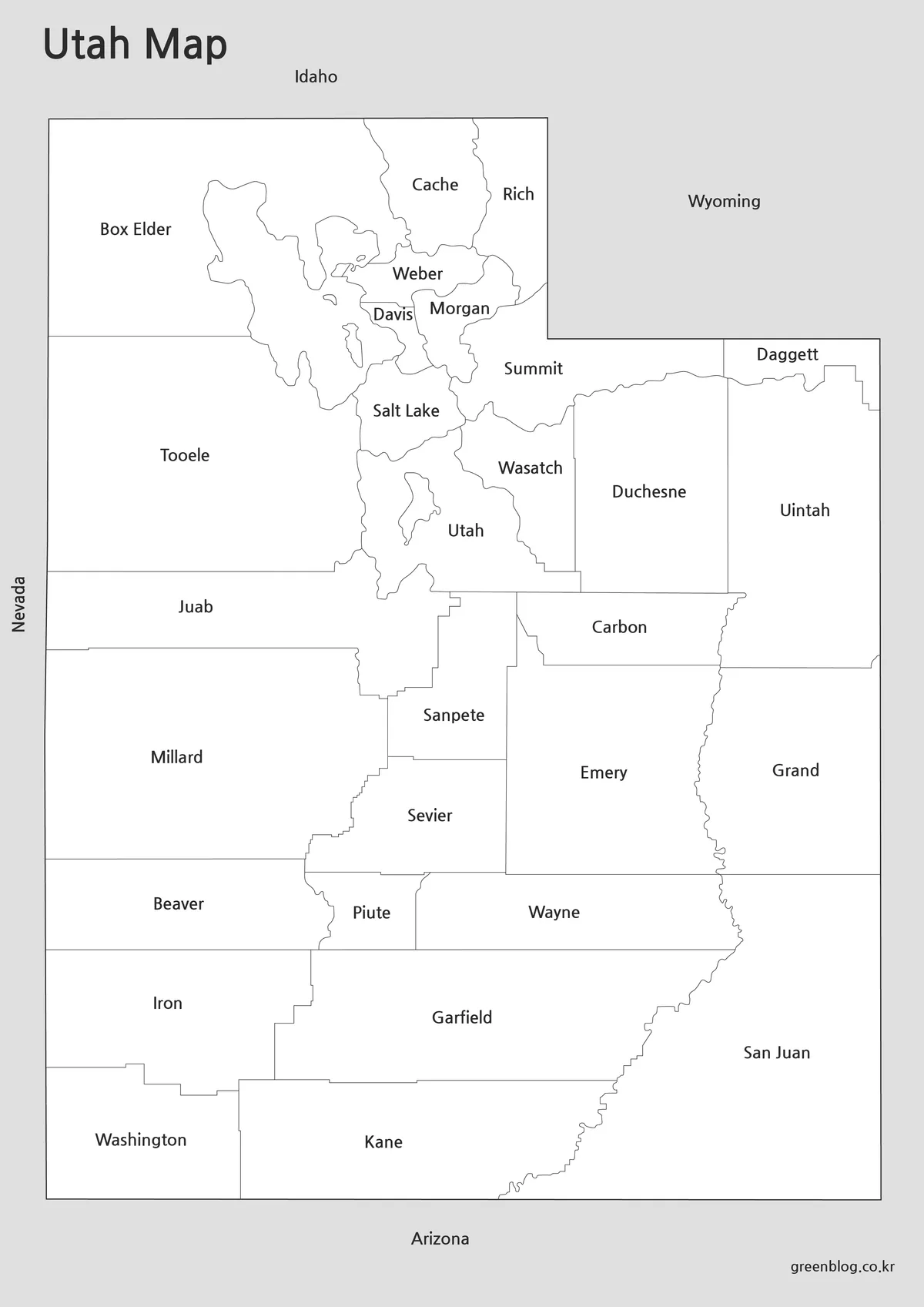
The black-and-white version keeps the full county label set, the state boundary, internal lines, the two lakes, and the four visible neighboring-state names. White county interiors reduce visual competition with the text, making this version suitable for document pages, printed references, and answer keys. It also leaves room for a limited number of pencil marks or highlights.
Small labels in northern Utah are already positioned to avoid the tightest boundary intersections, while larger counties have more open space around their names. That balance is valuable when the map is reduced from A3, but users should still preview a test page before printing a full set. Heavy annotations may obscure the labels, so the blank version is better for complex tasks.
An Outline for Labels, Routes, and Data
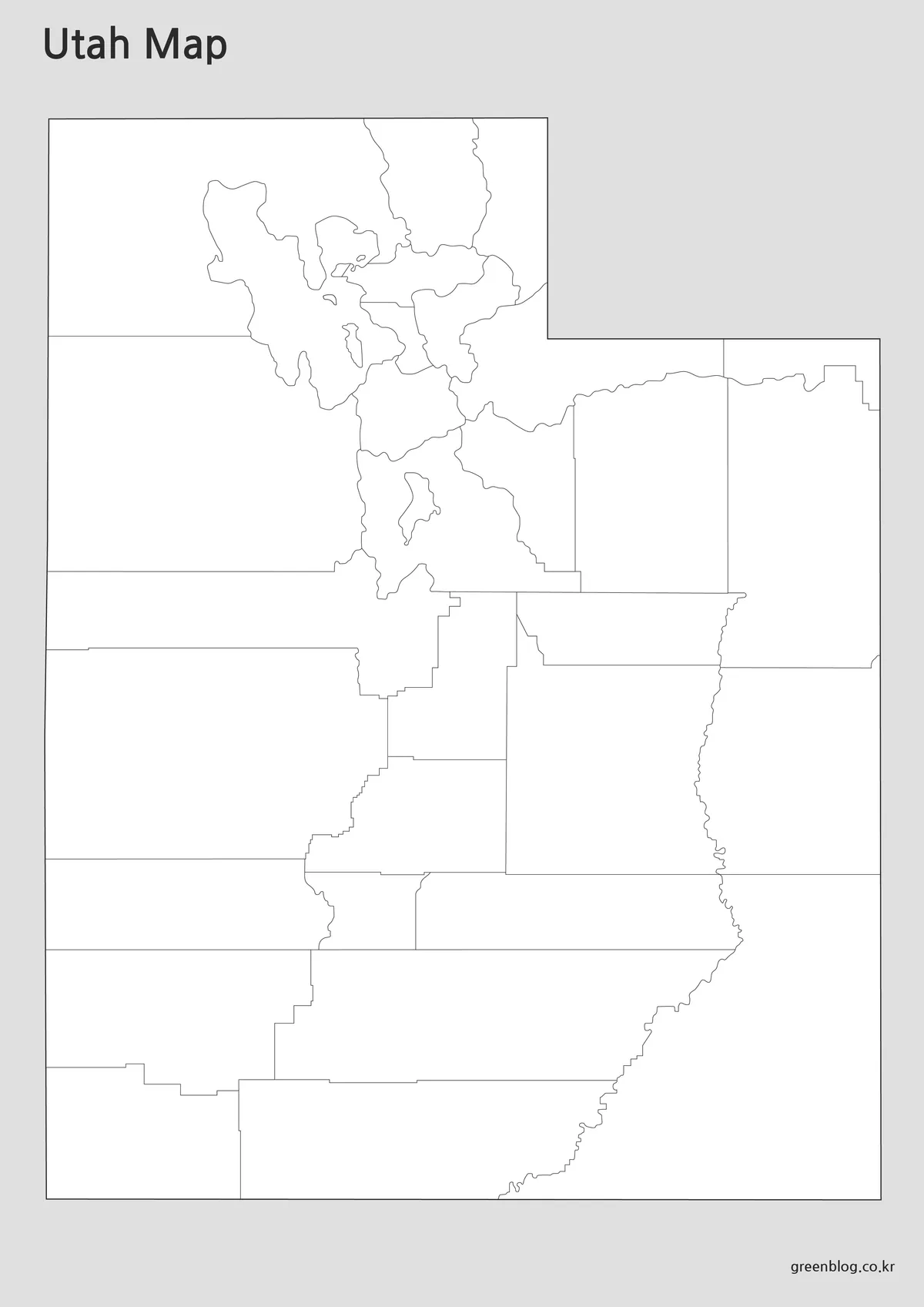
The outline removes county and neighboring-state names while preserving the state silhouette, all internal county divisions, and the lake shapes. Students can label the 29 counties, color northern and southern groups, or identify counties that touch the state border. Designers can add route lines, service areas, location markers, or category fills without first deleting existing text.
A practical labeling sequence begins with Box Elder around the Great Salt Lake, Salt Lake and Utah counties beside the two water features, and San Juan in the southeast. Those anchors make the remaining shapes easier to place. Because the file is a raster JPG, digital notes should be added on a separate layer or overlaid in presentation software while an untouched copy is retained.
Selecting and Printing the Best Version
Use the color map when county separation must be understood at a glance, the black-and-white map when names need to remain visible in a monochrome document, and the outline when the reader must supply information. Since all three images share the same portrait proportions, they can be placed on consecutive slides or worksheets without changing the map position.
For A3 output, preserve the aspect ratio and use a print preview to protect the outer frame from hardware margins. “Fit to page” is helpful when the entire state and neighbor labels must remain visible; actual-size printing is preferable when consistent scale across several pages is important. A single test print can confirm that the fine lake outlines and compact northern boundaries remain clear.
Frequently Asked Questions
Can I print the Utah Map in A3 size?
Yes. The files were prepared and reviewed for high-resolution A3 printing.
Which Utah Map version is best for editing?
The outline version is the best choice for custom editing, annotations, coloring, and infographic work.
Does the collection include printable versions?
Yes. Every version was reviewed with both digital viewing and printed output in mind.
Is the Utah Map useful for travel planning?
Yes. The Utah Map provides a clear view of major regions, neighboring states, and geographic relationships that can help with route planning.
Map File Information
Download the three Utah county-map versions together for printing, reference, or annotation.
- Included Versions: Color labeled, black-and-white labeled, and blank outline maps
- Printable Size: A3
- File Type: JPG / ZIP
- Intended Use: Lessons, handouts, presentations, route notes, and county projects
Related Maps
Additional Resources
- U.S. Census Bureau Utah Geographic Guide — Review official explanations of Utah’s counties, county subdivisions, places, and other geographic areas.
Green Map creates custom-edited map images using open geographic data sources such as geoBoundaries, Natural Earth, OpenStreetMap, and government open data.
These maps are edited visual materials, not raw data files, and are provided for education, documents, presentations, and graphic reference.