This Gifu Prefecture Map has to balance two very different administrative patterns on one portrait page. Takayama, Hida, Gujo, and Gero occupy broad shapes across the north and center, while dozens of smaller municipalities gather near the southern edge. The contrast is so strong that five compact western areas are identified by numbers and a separate key instead of labels placed inside their boundaries.
Gifu is an inland prefecture in central Honshu. The labeled maps place Toyama and Ishikawa to the north and northwest, Fukui and Shiga on the west, Mie and Aichi along the south, and Nagano to the east. That ring of seven neighboring prefectures gives readers useful orientation without adding roads, railways, rivers, terrain, attractions, or point markers.
The collection contains a pastel municipal reference, a black-and-white labeled sheet, and an unlabeled boundary version. All three Gifu Prefecture Map previews measure 1200 × 1350 pixels and use the same municipal geometry. They can therefore be paired as a reference, worksheet, and completed comparison while retaining identical positions and proportions.
Table of Contents
Gifu Prefecture Map Overview
Gifu Prefecture currently has 42 municipalities. The supplied artwork represents all of them, but it is not coded by municipal type: most labels omit “City,” “Town,” or “Village.” For example, Hida and Mino are municipality names on this page, not labels for the wider historical Hida and Mino regions. Shirakawa Village is the notable exception because its type is written directly on the map, while Higashishirakawa appears without the village suffix.
The northern half is comparatively easy to scan. Shirakawa Village occupies the northwestern projection, Hida spans the top center, and Takayama fills the very large northeastern area. Gujo forms a long central corridor below them, with Gero to its east. Their broad shapes leave enough room for names to sit inside the boundaries without leader lines.
Below Gujo, the administrative pattern becomes progressively denser. Ibigawa, Motosu, Yamagata, Mino, Seki, Hichiso, Shirakawa, Higashishirakawa, and Nakatsugawa form a transition between the large northern units and the compact urbanized south. Farther east, Ena, Mizunami, Toki, Tajimi, Kani, Mitake, Minokamo, Yaotsu, Kawabe, Tomika, and Sakahogi create a close chain of irregular boundaries.
The southwest contains the page’s most crowded labels. Gifu, Kakamigahara, Ginan, Kasamatsu, Hashima, Ogaki, Tarui, Sekigahara, Yoro, Kaizu, Ikeda, Ono, and several tiny neighbors occupy a fraction of the space available to Takayama. The Gifu Prefecture Map handles the smallest five with a numbered key: 1 Wanouchi, 2 Anpachi, 3 Godo, 4 Mizuho, and 5 Kitagata. Readers should keep that key visible when cropping or placing the map in a slide.
The labeled artwork is a municipal-boundary guide, not a general-purpose atlas. Gifu City is written as “Gifu” rather than marked as the prefectural capital, and no municipality has a city-center symbol. Boundary shapes and names are the main information layer; distances, routes, physical geography, and legal survey detail need separate sources.
Included Map Versions
The three versions share one portrait layout but answer different reader needs. The color map separates adjacent municipalities, the monochrome sheet preserves names with less visual competition, and the outline removes the answers for labeling or custom classification. Each Gifu Prefecture Map keeps the title, “Gifu Boundaries Guide” subtitle, outer prefectural shape, internal municipal lines, gray surrounding land, and site mark.
- Pastel labeled view: 42 municipal areas, a five-item number key, and seven neighboring prefecture names.
- Monochrome labeled view: the same municipal names, key, and boundary network on white interiors.
- Blank outline view: internal boundaries without municipality names, numbers, the key, or surrounding prefecture labels.
The downloadable package is arranged for high-resolution A3 printing. The supplied previews are WebP images, while the protected archive should be treated simply as a ZIP containing image files; the materials do not establish a vector, GIS, or editable source format. This distinction matters when planning extensive recoloring or data-driven work.
Color Map for Regional Comparison
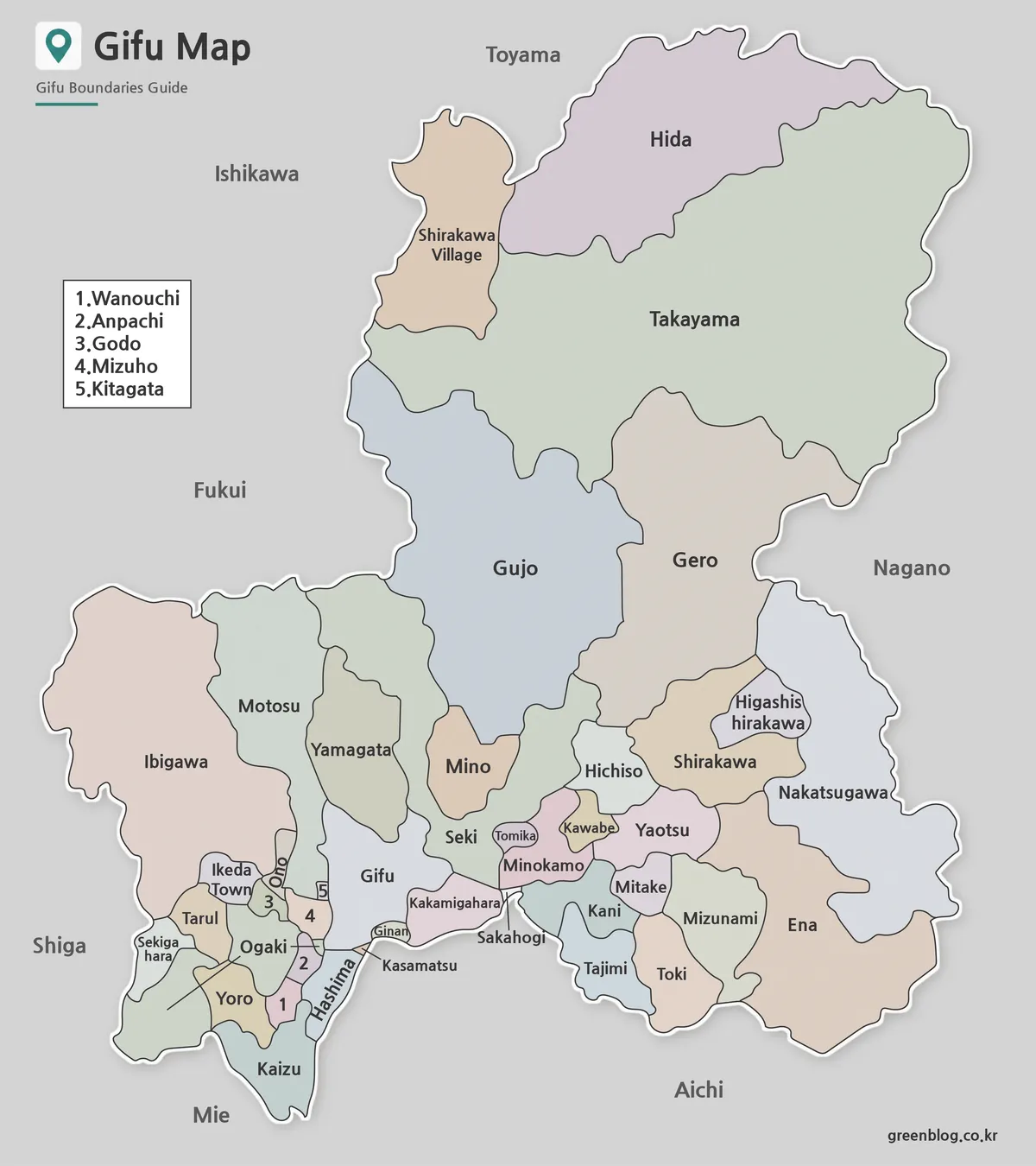
Pastel fills make the scale difference between north and south immediately visible. Takayama’s large green area, Hida’s lavender shape, and Gujo’s blue corridor dominate the upper portion, while changing colors help separate the many small polygons around Gifu, Ogaki, Minokamo, Kani, and Tajimi. The effect is especially helpful where several boundaries meet within a short distance.
Color on this Gifu Prefecture Map is categorical rather than statistical. The palette does not represent population, elevation, land use, tourism zones, or municipal status, and there is no quantitative legend. A presenter can use the fills to point out neighboring areas, but any thematic interpretation requires a new legend, a cited dataset, and a reference date.
Black and White Printable Version
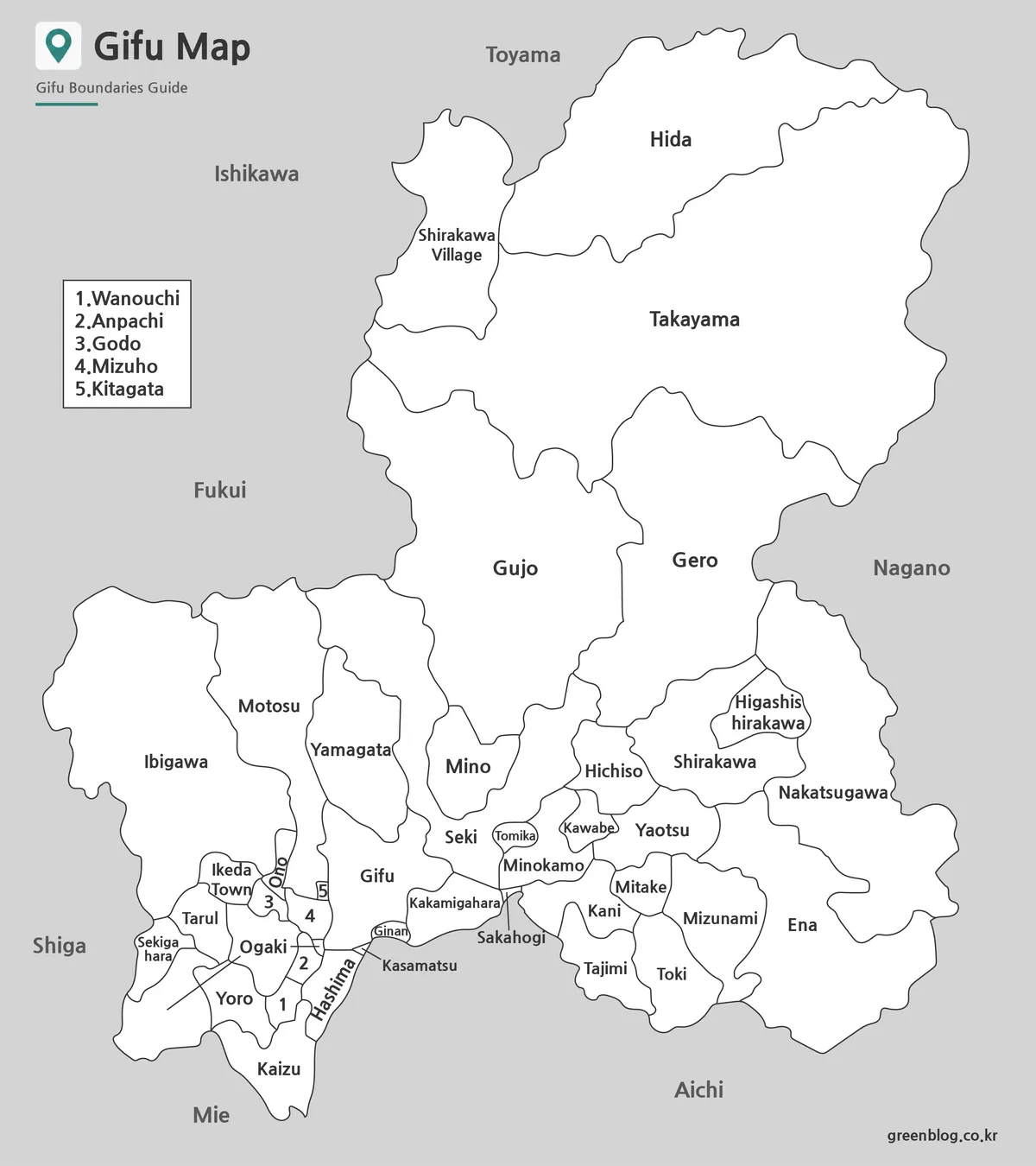
The black-and-white version shifts attention from color blocks to names and line relationships. Large labels remain easy to find in the north, while the numbered key prevents Wanouchi, Anpachi, Godo, Mizuho, and Kitagata from becoming unreadable in the southwest. It suits a report or classroom answer sheet when the reader needs municipal names but not a color scheme.
Check the bottom edge before publishing this preview. Unlike the color version, which places Mie at the southwest and Aichi farther east, the monochrome artwork displays “Aichi” and “Mie” together near the lower-right edge. The municipal geometry is unchanged, but accompanying text should not use that label placement to explain the actual order of neighboring prefectures.
Blank Outline Map for Editing
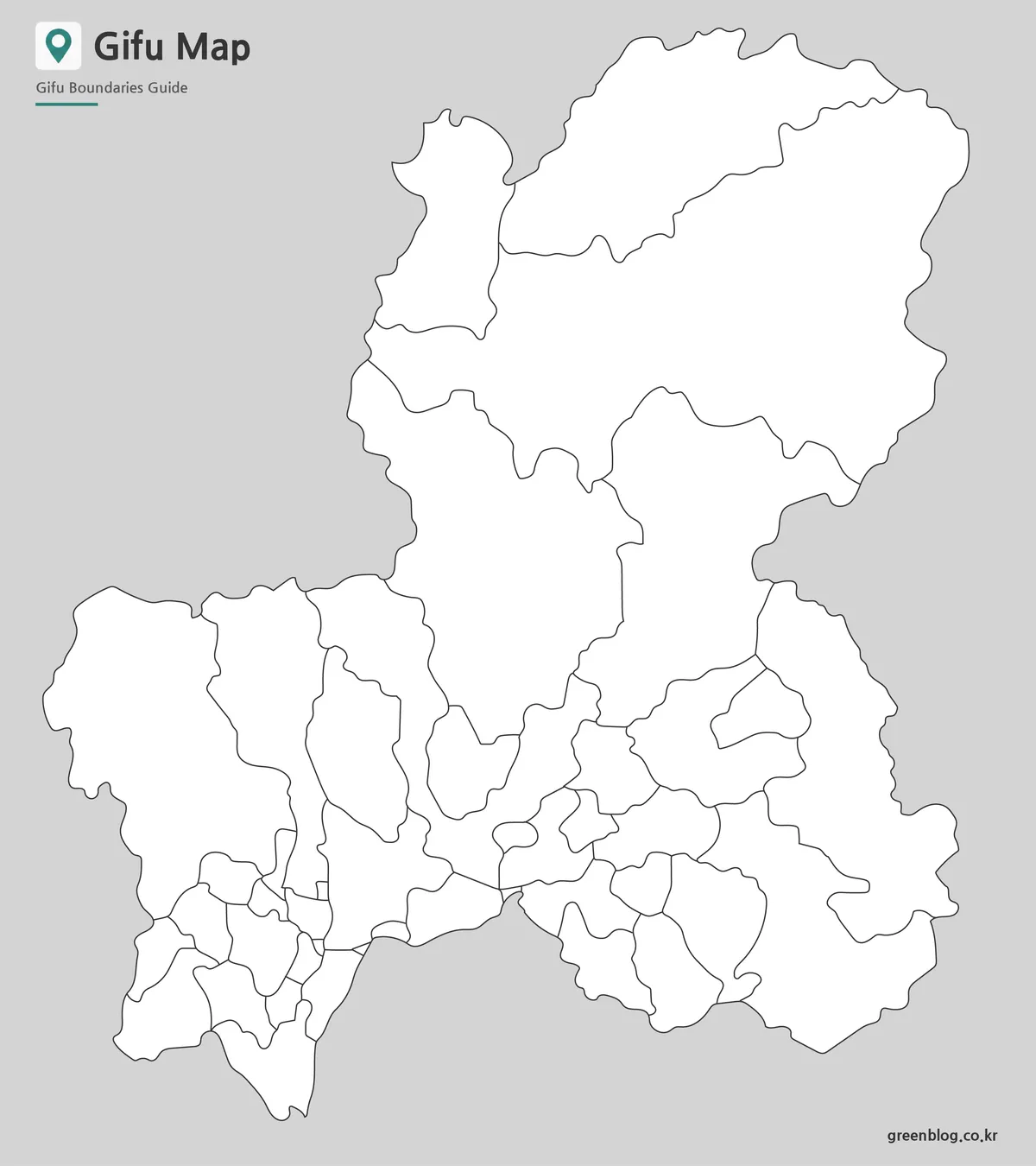
The outline edition of the Gifu Prefecture Map strips away every municipality label, the five-number key, and all neighboring prefecture names. It retains the page title, subtitle, site mark, white Gifu area, gray surroundings, and the complete internal boundary pattern. This makes it a blank activity map rather than a bare prefectural silhouette.
Students can label the five broad northern municipalities first, then work through the denser center and south with the completed map beside them. Another exercise can ask learners to locate the municipalities bordering Nagano or distinguish Shirakawa Village from Shirakawa Town. Designers may add symbols or verified values, but the raster image should not be described as a vector drawing.
Practical Uses for This Map Collection
For an A3 lesson, pair the color Gifu Prefecture Map with the outline and keep the numbered southwest key on the same page. Learners can copy the large northern names first, match the five numbered areas, and then identify the compact municipalities around Gifu City and the eastern corridor toward Nakatsugawa. This sequence follows the real visual difficulty of the artwork instead of treating all 42 shapes as equally easy.
Use the monochrome sheet when names must remain visible in a report, worksheet answer key, or photocopied reference. Choose the color view for a slide where adjacent municipalities need quick separation. Select the outline for custom labels, route sketches, regional groupings, or sourced data categories, and add a clear legend whenever colors are assigned a meaning.
When reducing the portrait page, inspect the southern cluster rather than judging legibility from Takayama alone. The number list, slim Hashima shape, and small boundaries around Ginan, Kasamatsu, Sakahogi, and Tomika are the first elements likely to become difficult to read. A test print can confirm whether the chosen scale preserves them.
Frequently Asked Questions
What versions are included in the Gifu Prefecture Map download?
The collection includes a color map, a black and white labeled map, and a blank outline map.
Can I print the map in A3 size?
Yes. The files are prepared for high-resolution A3 printing, though print quality may vary depending on your printer settings.
Which version is best for editing?
The outline map is the best choice for editing, custom coloring, labeling, and infographic projects.
Is the black and white map suitable for classroom use?
Yes. The black and white version is designed for worksheets, handouts, and printed educational materials.
Map File Information
The archive contains the three Gifu municipal views displayed above for printing, reference, labeling, and custom graphics.
- Included Versions: Color labeled, black-and-white labeled, and blank outline maps
- Printable Size: A3 high resolution
- File Type: Image files in a ZIP archive
- Intended Use: Lessons, answer keys, reports, slides, annotations, and design projects
Related Maps
Additional Resources
The Gifu Prefectural Government’s municipality directory provides the current official list of cities, towns, and villages with links to their local offices.
Green Map creates custom-edited map images using open geographic data sources such as geoBoundaries, Natural Earth, OpenStreetMap, and government open data.
These maps are edited visual materials, not raw data files, and are provided for education, documents, presentations, and graphic reference.