At what age do education systems formally place the transition into programmes that follow upper secondary education but remain below tertiary education? UNESCO Institute for Statistics (UIS) indicator 999987 reports the official entrance age to post-secondary non-tertiary education, corresponding to ISCED level 4.
The 2025 extract contains 157 countries and separately reported areas. Values range from age 15 to age 20. Age 18 is the clear mode, appearing in 78 observations, or 49.7% of the total. Another 41 observations are age 19, so ages 18 and 19 together account for 75.8% of the dataset.
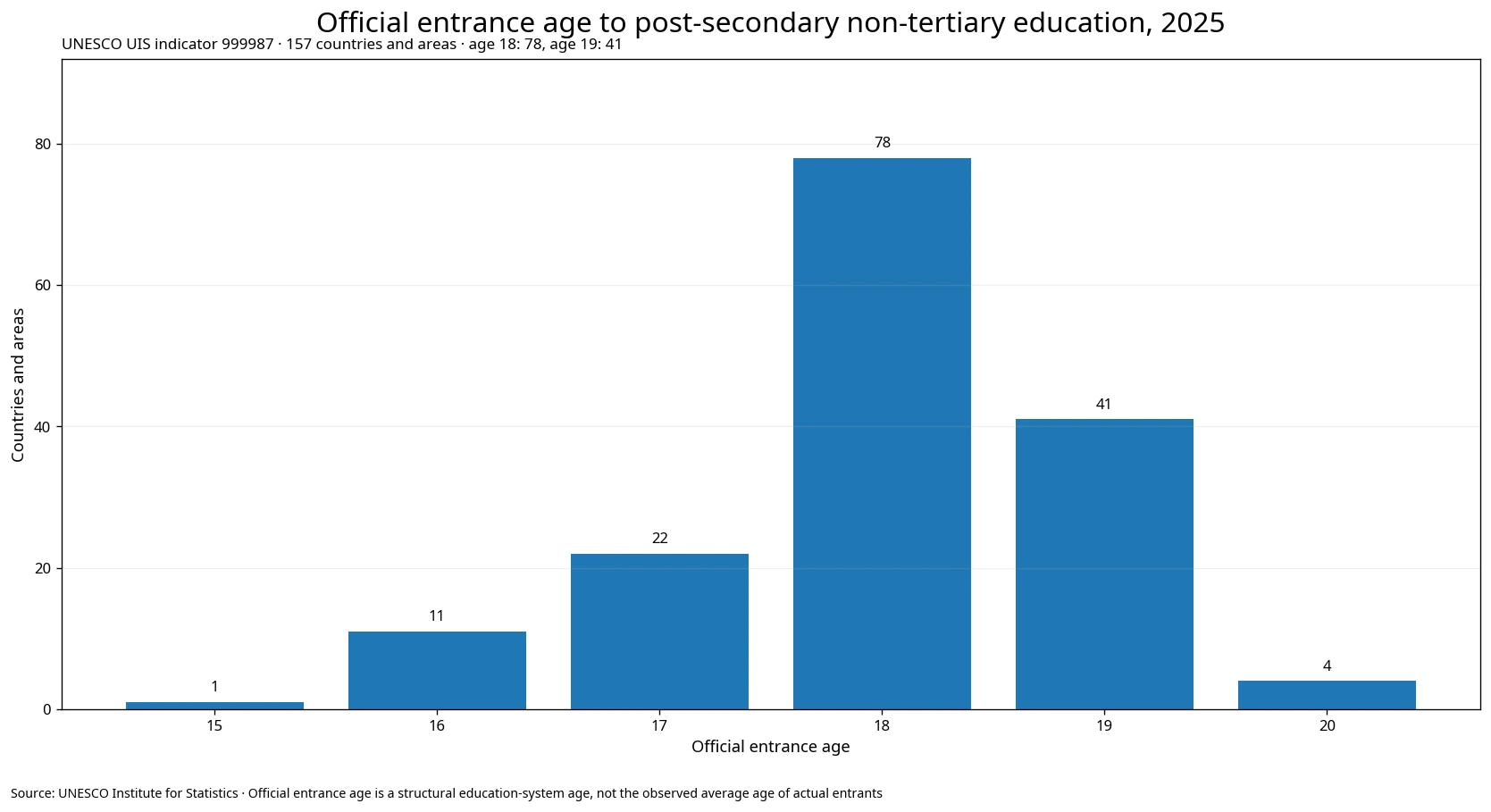
Table of Contents
Official entrance age is not the observed average age of actual entrants
UIS defines official entrance age as the age at which students would enter a programme or level if they started the lowest education level at the official age, studied full-time and progressed through the system without repeating or skipping grades. It is therefore a structural education-system age.
An official entrance age of 18 does not mean every student begins an ISCED 4 programme on the eighteenth birthday. School-year cut-off rules, delayed entry, repetition, breaks in education, employment, military service and adult-learning pathways can all make actual entrant ages more dispersed.
Researchers who need the real age distribution of new entrants would require age-specific administrative or survey data. The current indicator describes the formal design of the education pathway rather than observed individual behaviour.
Post-secondary non-tertiary education is beyond upper secondary but below tertiary
ISCED level 4 builds on completed upper-secondary education. It can prepare learners for labour-market entry or strengthen their route toward tertiary education, but the content remains below the complexity of tertiary programmes.
Programmes can be vocational, professional or general in orientation, and national labels vary widely. Some systems use technician diplomas, specialized vocational qualifications or preparatory programmes. The international category is based on the level and entry requirements rather than one universal institution name.
That distinction matters because post-secondary does not automatically mean tertiary. Short-cycle tertiary education begins at ISCED 5, followed by bachelor’s, master’s and doctoral levels. Indicator 999987 should not be relabeled as a university entrance-age indicator.
Age 18 appears in nearly half of the 157 observations
Age 18 is reported by 78 countries and areas, or 49.7% of the dataset. Age 19 appears in 41, or 26.1%, while age 17 appears in 22, or 14.0%.
| Official entrance age | Countries / areas | Share of 157 |
|---|---|---|
| Age 15 | 1 | 0.6% |
| Age 16 | 11 | 7.0% |
| Age 17 | 22 | 14.0% |
| Age 18 | 78 | 49.7% |
| Age 19 | 41 | 26.1% |
| Age 20 | 4 | 2.5% |
The median is 18, the mode is 18 and the unweighted mean is 18.01. The first quartile is 18 and the third quartile is 19, so the middle half of observations falls between ages 18 and 19.
Because the series contains only six whole-year values, the frequency distribution is more informative than the decimal mean alone. Ages 18 and 19 account for 119 of 157 observations, showing a strong common structural timing despite differences across national education systems.
Age 15 and age 20 are rare ends of the distribution
Burundi is the only age-15 observation. The age-16 group contains 11 observations, including Australia, Austria, Bhutan, Myanmar, Singapore and Seychelles. Age 17 appears in 22 observations, including France, New Zealand, Pakistan and Ukraine.
At the other end, only Albania, Iceland, Niger and the United Republic of Tanzania are reported at age 20. These later formal entry points are unusual relative to the age-18 and age-19 concentration, but they are not evidence of weaker education systems.
| Age | Selected examples |
|---|---|
| Age 15 | Burundi |
| Age 16 | Australia, Austria, Singapore, Bhutan |
| Age 17 | France, New Zealand, Pakistan, Ukraine |
| Age 18 | Canada, China, India, Japan, United States, Portugal |
| Age 19 | Germany, Netherlands, Norway, Poland, Sweden, South Africa |
| Age 20 | Albania, Iceland, Niger, United Republic of Tanzania |
The formal start of ISCED 4 is partly shaped by the structure that comes before it. A system with a later upper-secondary completion point may naturally place post-secondary non-tertiary entry later, while a shorter preceding pathway can produce an earlier entrance age.
Countries sharing age 18 can still have very different systems
Canada, China, India, Japan, Portugal and the United States all report age 18, but that does not make their ISCED 4 programmes equivalent. Programme purpose, admission requirements, duration, vocational orientation, qualifications and provider types can differ substantially.
Germany, the Netherlands, Norway, Poland, Sweden and South Africa are among the age-19 observations. A one-year difference can matter for formal pathway design, but the number alone does not establish which system is more efficient or more successful.
Official entrance age does not measure participation, completion, learning quality, employment outcomes or popularity of the programmes. Systems with the same age can have very different enrollment levels and policy roles for ISCED 4.
Entrance age and programme duration are separate indicators
Knowing that a programme officially starts at age 18 does not tell us how long the ISCED 4 stage lasts. UIS operational guidance notes that programmes at this level are often between six months and two years in full-time-equivalent duration, but national structures vary.
An age-18 system may offer a one-year programme, several alternative qualifications or a longer sequence. An age-19 system is not automatically shorter or longer. Official entrance age and theoretical duration must be checked separately.
A fuller pathway analysis would connect the entrance age with the official duration of upper secondary education, ISCED 4 programme duration and the formal entrance point to tertiary education.
It should not be confused with the official entrance age to tertiary education
The phrase post-secondary can sound similar to college or university education, but ISCED 4 is explicitly non-tertiary. Short-cycle tertiary education starts at ISCED 5, and degree levels occupy ISCED 6 through 8.
In some national systems, ISCED 4 and tertiary programmes may begin at similar ages. That does not make them the same level. International classification depends on content complexity, programme objectives and entry requirements, not simply the age or the name of the institution.
Questions about formal university starting age therefore require a tertiary-level entrance-age indicator. Indicator 999987 is specifically about the formal entry point into post-secondary non-tertiary education.
Earlier is not automatically better and later is not automatically worse
This indicator is descriptive rather than evaluative. An earlier formal entrance age means the pathway reaches ISCED 4 sooner under the theoretical progression model, but it does not prove broader access, stronger learning or better employment outcomes.
A later age can reflect a longer preceding education structure or a different sequencing of qualifications. Likewise, an age of 15 or 16 does not prove that students receive more education overall. Explaining individual country values requires the national education structure and programme definitions.
The most appropriate use of the dataset is to identify the dominant international pattern and the relatively rare earlier or later structural arrangements, not to rank systems by performance.
The common 2025 reference year improves structural comparability
All 157 retained observations use 2025, so the distribution does not mix different national reference years. That makes the comparison cleaner than a latest-value table in which some countries might reflect older education structures.
Coverage still should not be described as every country in the world. Countries or areas absent from the extract are not assigned an age of zero and are not treated as having no ISCED 4 structure.
The unweighted mean of 18.01 years is also not the average starting age of the world’s students. Every country or area receives equal weight, regardless of population, and the values are formal system ages rather than observed individual ages.
Data source and calculation method
Country values come from UNESCO Institute for Statistics indicator 999987, “Official entrance age to post-secondary non-tertiary education (years),” using the 2025 NATIONAL observations in this comparison. The generic internal unit label is clarified in the completed data metadata as years of age.
- UNESCO UIS official API — indicator 999987
- UNESCO UIS Data Browser Glossary — official entrance age
- UNESCO UIS — ISCED 4 post-secondary non-tertiary education
Age-group counts, shares, the mean of 18.01, median of 18 and quartiles are calculated directly from the 157 non-missing observations. No missing value is converted to zero. The featured visual uses a distribution chart rather than forcing every small territory into a simplified world polygon map, so all 157 observations are retained.
The strongest conclusion supported by the dataset is that formal entry to post-secondary non-tertiary education is heavily concentrated at ages 18 and 19 in 2025. Actual entrant ages, participation rates, programme duration, education quality and labour-market outcomes are separate questions.
Frequently Asked Questions
What does an official entrance age of 18 mean for ISCED 4?
It means age 18 is the theoretical entry point if a student begins education at the official age, studies full-time and progresses without repeating or skipping grades.
Is post-secondary non-tertiary education the same as college or university?
No. ISCED 4 follows upper secondary but remains below tertiary education. Short-cycle tertiary education begins at ISCED 5.
What is the most common official entrance age in 2025?
Age 18. It appears in 78 of 157 observations, while age 19 appears in 41. Together they account for 75.8% of the dataset.
Does an earlier official entrance age mean a better education system?
No. The indicator describes formal education structure, not enrollment, quality, programme duration, learning outcomes or employment results.
Related Articles
- Official Pre-Primary Entrance Age | 223 Countries and Areas in 2025
- School Life Expectancy 2024 | 8 Countries and Areas at 18+ Years
- Post-Secondary Attainment 2023 | 9 Countries Above 50%
Green Map creates custom-edited map images using open geographic data sources such as geoBoundaries, Natural Earth, OpenStreetMap, and government open data.
These maps are edited visual materials, not raw data files, and are provided for education, documents, presentations, and graphic reference.