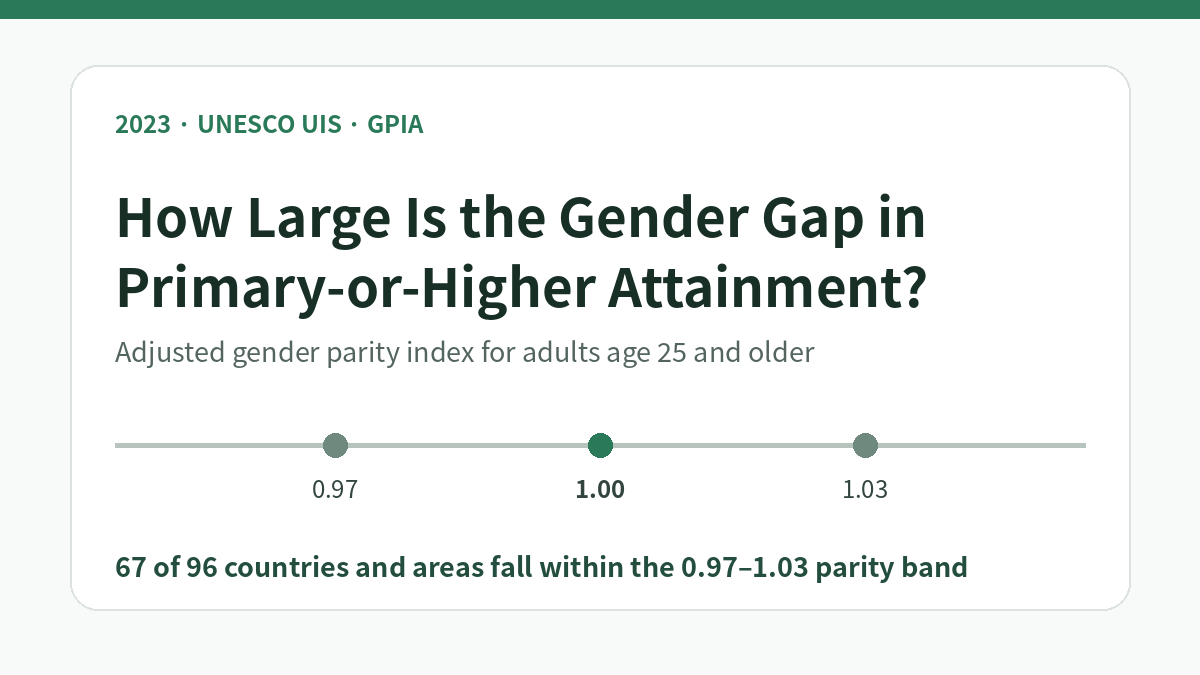
How similar are the shares of female and male primary teachers who meet the minimum teacher-training requirements set by their countries? UNESCO Institute for Statistics indicator TRTP.1.GPIA is the adjusted gender parity index (GPIA) for the proportion of primary teachers with the minimum required training.
Among the 80 country and area observations dated 2023, 41 fall within the 0.97–1.03 parity band. Female teachers have higher coverage in 27 observations, while male teachers have higher coverage in 12. The median is 1.002 and the mean is 1.036, both close to parity.
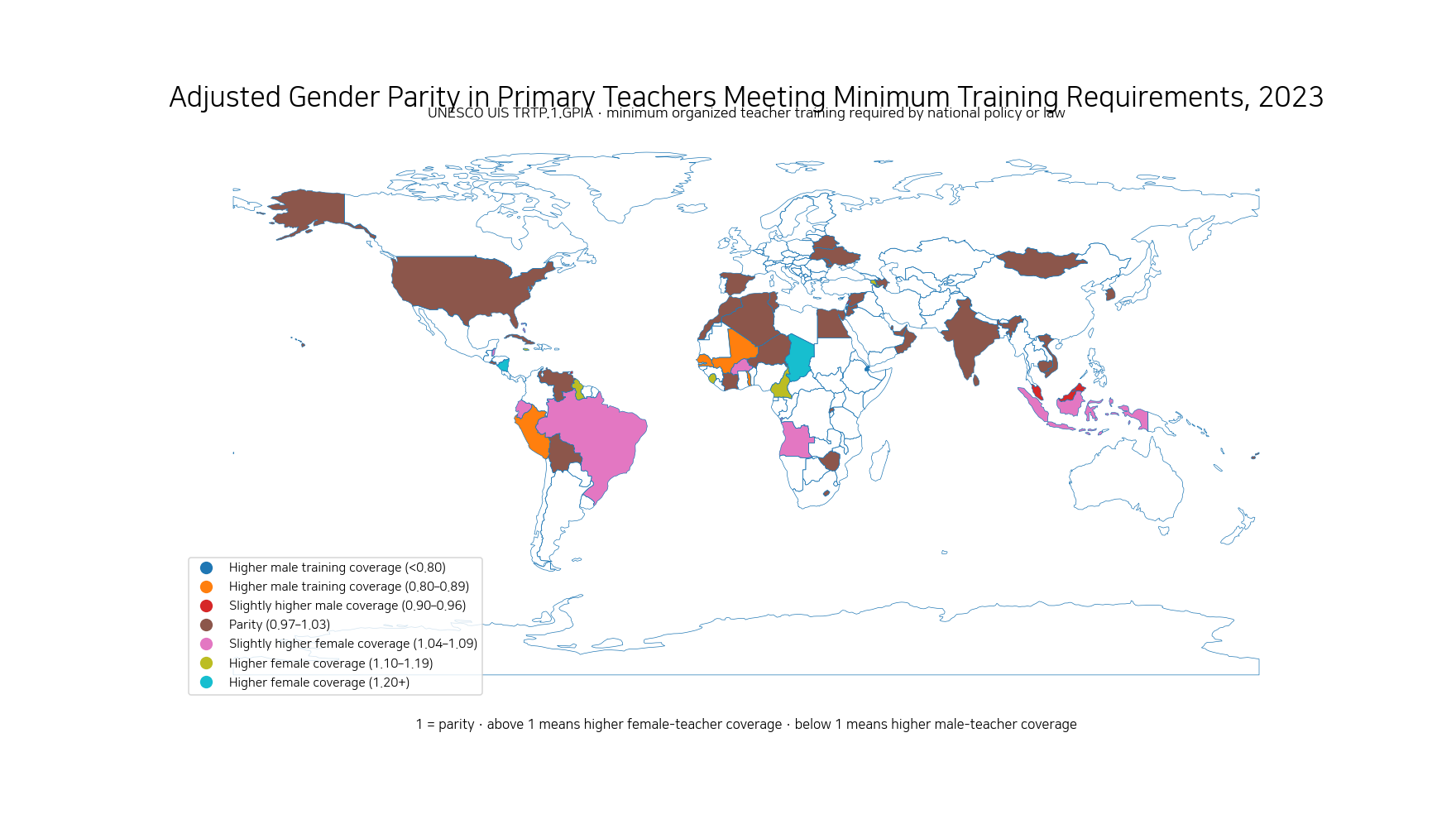
Table of Contents
The minimum requirement refers to organized teacher training, not simply an academic credential
The terminology requires care. UIS defines SDG 4.c.1 around teachers who have received at least the minimum organized pedagogical teacher training, pre-service or in-service, required for teaching at the relevant level in a given country.
This commonly includes pedagogical knowledge such as teaching methods and classroom management, along with professional knowledge of the legal and institutional framework of teaching. It is distinct from the UIS concept of a ‘qualified teacher’, which focuses on minimum academic qualifications according to national standards.
National minimum teacher-training requirements differ
UIS defines a trained teacher according to the relevant national policy or law. There is no single identical international certificate or training duration applied to every country in this indicator.
One country may require completion of a specific teacher-education programme, while another may recognize combinations of pre-service and in-service training. The data therefore compare coverage of national minimum training requirements rather than one universal global standard.
GPIA compares coverage among female and male primary teachers
The underlying indicator is the percentage of primary teachers meeting the minimum teacher-training requirement. GPIA compares that percentage between female and male teachers.
A value of 1 indicates equal coverage. Above 1 means a higher share of female teachers meet the requirement, while below 1 means a higher share of male teachers meet it. The 0.97–1.03 range is a practical parity band.
Forty-one of 80 observations fall within the parity band
41 observations lie between 0.97 and 1.03. A substantial number are reported at exactly 1.000, and the median of 1.002 is very close to parity.
27 observations are above 1.03 and 12 are below 0.97. More pronounced gaps occur in 14 observations above 1.10 and 6 below 0.90.
Many reporting systems are exactly at 1.000
Andorra, Bahrain, Cambodia, the Cook Islands, Cuba, Côte d’Ivoire, Jordan, Mauritius, Morocco, Oman, Palestine, Qatar, Spain, Tunisia, the United Arab Emirates and the United States are among the observations reported at 1.000.
An index of 1.000 means equal female and male coverage, not necessarily universal training. Female and male coverage could both be 80%, or both could be 100%, and GPIA would still be 1.
| Country or area | ISO3 | GPIA | Interpretation |
|---|---|---|---|
| Andorra | AND | 1.000 | Parity |
| Bahrain | BHR | 1.000 | Parity |
| Cambodia | KHM | 1.000 | Parity |
| Cook Islands | COK | 1.000 | Parity |
| Cuba | CUB | 1.000 | Parity |
| Côte d’Ivoire | CIV | 1.000 | Parity |
| Jordan | JOR | 1.000 | Parity |
| Mauritius | MUS | 1.000 | Parity |
| Morocco | MAR | 1.000 | Parity |
| Oman | OMN | 1.000 | Parity |
| Palestine | PSE | 1.000 | Parity |
| Qatar | QAT | 1.000 | Parity |
| Republic of Korea | KOR | 1.000 | Parity |
| Republic of Moldova | MDA | 1.000 | Parity |
Female-teacher coverage is higher in 27 observations
Brazil records 1.066, Indonesia 1.042, Burkina Faso 1.099, Armenia 1.119 and Belize 1.083, all above 1.03.
These values mean the share of female primary teachers meeting the minimum teacher-training requirement is higher than the corresponding share among male teachers. They do not mean there are more female teachers, nor that female teachers receive a higher level of training.
Tokelau, San Marino and Tuvalu have the largest female-higher gaps
Tokelau has the highest value at 2.000. San Marino is 1.511, Tuvalu 1.393, Saint Lucia 1.339, Nicaragua 1.297 and Chad 1.218.
A high GPIA indicates higher coverage among female teachers. A value of 2.000 should not be read as female coverage being exactly twice male coverage because the adjusted parity index is transformed around 1.
| Higher female-teacher coverage | ISO3 | GPIA |
|---|---|---|
| Tokelau | TKL | 2.000 |
| San Marino | SMR | 1.511 |
| Tuvalu | TUV | 1.393 |
| Saint Lucia | LCA | 1.339 |
| Nicaragua | NIC | 1.297 |
| Chad | TCD | 1.218 |
| Jamaica | JAM | 1.179 |
| Micronesia | FSM | 1.171 |
| Guyana | GUY | 1.161 |
| Barbados | BRB | 1.138 |
| Sierra Leone | SLE | 1.127 |
| Armenia | ARM | 1.119 |
Some countries have higher coverage among male teachers
Nauru has the lowest value at 0.194. Djibouti is 0.788, Peru 0.824, Togo 0.825, Mali 0.876 and Senegal 0.900.
These values indicate that a higher share of male primary teachers meet the minimum teacher-training requirement. They do not imply that male teachers are more numerous or have higher overall educational attainment.
| Higher male-teacher coverage | ISO3 | GPIA |
|---|---|---|
| Nauru | NRU | 0.194 |
| Djibouti | DJI | 0.788 |
| Peru | PER | 0.824 |
| Togo | TGO | 0.825 |
| Mali | MLI | 0.876 |
| Senegal | SEN | 0.900 |
| Lebanon | LBN | 0.931 |
| Brunei Darussalam | BRN | 0.941 |
| Tonga | TON | 0.949 |
| Trinidad and Tobago | TTO | 0.952 |
| Turks and Caicos Islands | TCA | 0.968 |
| Malaysia | MYS | 0.970 |
Many major comparison cases are close to parity
The United States and Spain are 1.000, Singapore is 0.999, India 1.013, Indonesia 1.042, Brazil 1.066, Malaysia 0.970 and Sri Lanka 0.970.
The Republic of Korea appears only as one comparison row because the country-focus contract does not identify it as materially notable. The article therefore keeps the global distribution and the main outliers as the primary evidence structure.
| Country | GPIA | Female vs male minimum-training coverage |
|---|---|---|
| United States | 1.000 | Parity |
| Republic of Korea | 1.000 | Parity |
| Spain | 1.000 | Parity |
| Singapore | 0.999 | Parity |
| India | 1.013 | Parity |
| Indonesia | 1.042 | Higher female-teacher coverage |
| Brazil | 1.066 | Higher female-teacher coverage |
| United Arab Emirates | 1.000 | Parity |
| Armenia | 1.119 | Higher female-teacher coverage |
| Burkina Faso | 1.099 | Higher female-teacher coverage |
| Bahamas | 1.035 | Higher female-teacher coverage |
| Belize | 1.083 | Higher female-teacher coverage |
| Malaysia | 0.970 | Higher male-teacher coverage |
| Sri Lanka | 0.970 | Parity |
Parity does not mean high overall teacher-training coverage
A GPIA of 1 is an equity result, not a level result. Female and male coverage could both be low or both be high while producing the same parity index.
Assessing whether a country has enough trained teachers requires the underlying female, male and total percentages. The current article focuses on the gender gap rather than ranking absolute teacher-training coverage.
Trained teachers and qualified teachers are different UIS concepts
A trained teacher has met the minimum organized teacher-training requirements for the level taught according to national policy or law. A qualified teacher has the minimum academic qualifications required to teach at that level, typically according to national standards.
The concepts can overlap but are not identical. A teacher may meet an academic-qualification requirement without completing the relevant organized pedagogical training, or the two requirements may be structured differently in national regulation.
National definitions limit fine-grained ranking
UIS metadata work has documented substantial variation in national definitions of trained and qualified teachers. This limits the value of treating very small differences such as 1.02 versus 1.04 as precise international rankings.
Larger departures from parity and the number of countries inside the 0.97–1.03 band are more informative for understanding gender differences in national training coverage.
Gender parity in training coverage is not a complete measure of teaching quality
Meeting a minimum teacher-training requirement is an important structural measure of teacher preparation, but it does not directly measure classroom quality or student learning outcomes.
The content and quality of training, ongoing professional support, teacher experience, class size, school resources and student context all matter. GPIA should therefore be read as a gender-equity indicator within teacher preparation.
The 2023 dataset covers 80 countries and areas, not the whole world
This same-year extract contains 80 country and area observations. The finding that 41 are in the parity band applies to this reporting set rather than every country worldwide.
A country without a 2023 value is not evidence of zero coverage or no gender disparity. It simply does not have a row in this extract.
Blank map areas do not mean a GPIA of zero
The source table contains 80 observations, of which 55 match separate polygons in the low-resolution world boundary layer used here. Small islands and territories can have valid statistics without a visible polygon.
Missing values remain unclassified. They are never filled with zero because zero would falsely imply an extreme female disadvantage in minimum-training coverage.
Data source and interpretation
Country values come from the UNESCO UIS Data Browser for TRTP.1.GPIA, using the 2023 observations. The trained-teacher definition follows the UIS Glossary.
The UIS Data Browser glossary defines SDG 4.c.1 as the percentage of teachers who have received at least the minimum organized pedagogical teacher training required for the relevant level in the country. The package provider tag is corrected from World Bank to UNESCO UIS, and the generic unit ‘value’ is clarified as adjusted GPIA.
Frequently Asked Questions
Does the minimum requirement mean an academic qualification?
Not primarily in SDG 4.c.1. A trained teacher is one who has met the minimum organized pre-service or in-service teacher-training requirement set by national policy or law.
What does a GPIA of 1 mean?
It means female and male primary teachers have the same rate of meeting the minimum teacher-training requirement. It does not mean the coverage rate is 100%.
What does a GPIA above 1 mean?
It means a higher share of female primary teachers meet the minimum teacher-training requirement than male primary teachers.
Are minimum teacher-training requirements identical across countries?
No. UIS uses the minimum organized teacher-training requirements defined by the relevant national policy or law, so detailed requirements can differ.
Related Maps
Green Map creates custom-edited map images using open geographic data sources such as geoBoundaries, Natural Earth, OpenStreetMap, and government open data.
These maps are edited visual materials, not raw data files, and are provided for education, documents, presentations, and graphic reference.