OpenAlex records for publication year 2025 show China with 111,226 research works assigned at least one topic in the Artificial Intelligence subfield (1702) when results are grouped by authorship country. The United States follows with 72,959, India with 49,129, Indonesia with 25,860, and the United Kingdom with 20,679. These numbers need a precise interpretation. The grouping is based on countries linked to authorships, not a mutually exclusive assignment of each work to one nation. A paper with authors affiliated in several countries can appear in several country groups. For that reason, country counts are useful for comparing how often national affiliations appear in 2025 AI research, but summing all 212 country values does not produce a unique global count of AI works and should not be used as the denominator for simple global shares.
The scope is deliberately narrow: 2025 works in OpenAlex that are assigned any topic within Artificial Intelligence subfield 1702, grouped by authorship country. The unit is a count of works associated with each country group. It is not a count of researchers, institutions, citations, grants, patents, or research spending. The country attached to an authorship also reflects institutional affiliation rather than an author’s nationality or the physical location where experiments were conducted. This makes the measure useful for mapping the geography of author affiliations in AI publishing, while also setting clear limits on what can be inferred from the ranking.
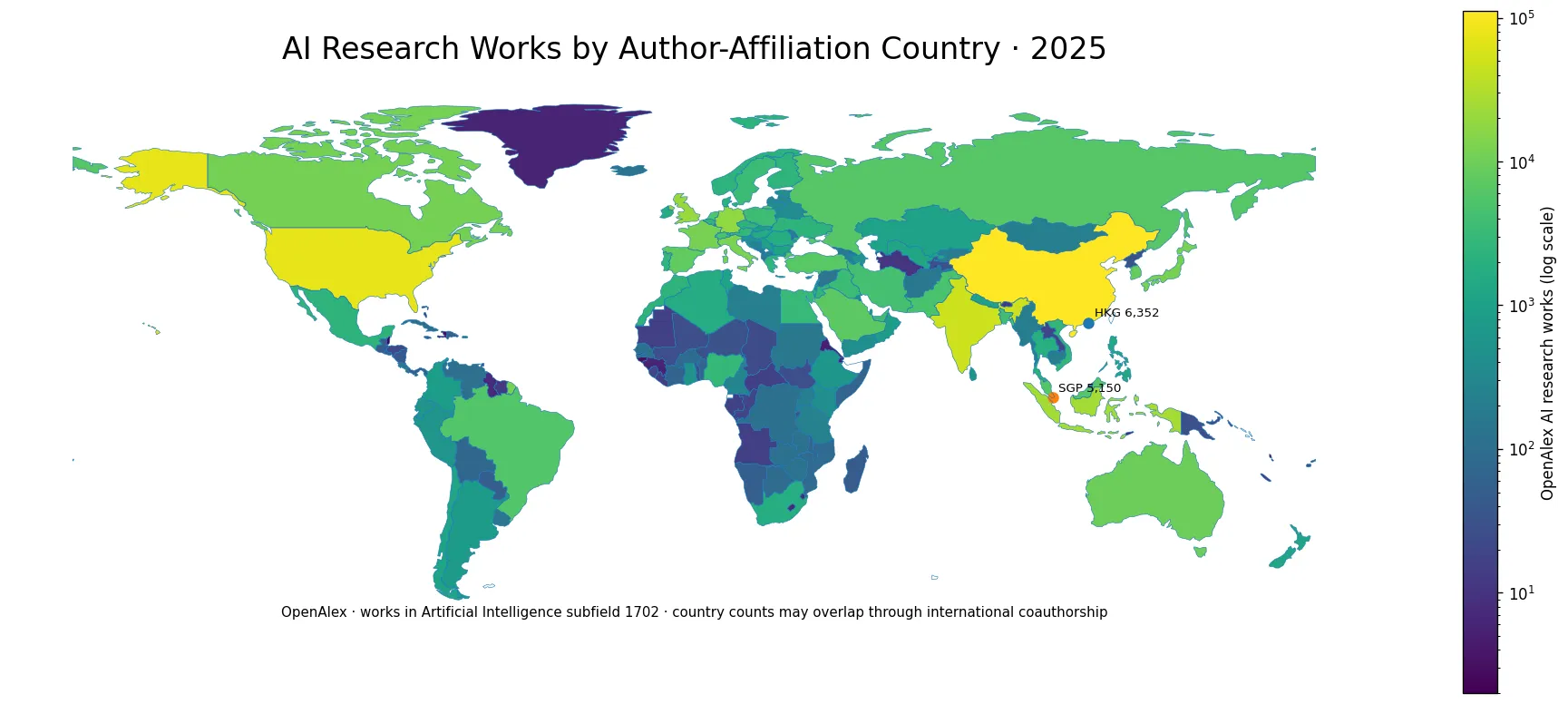
Table of Contents
China, the United States, and India form the largest three groups
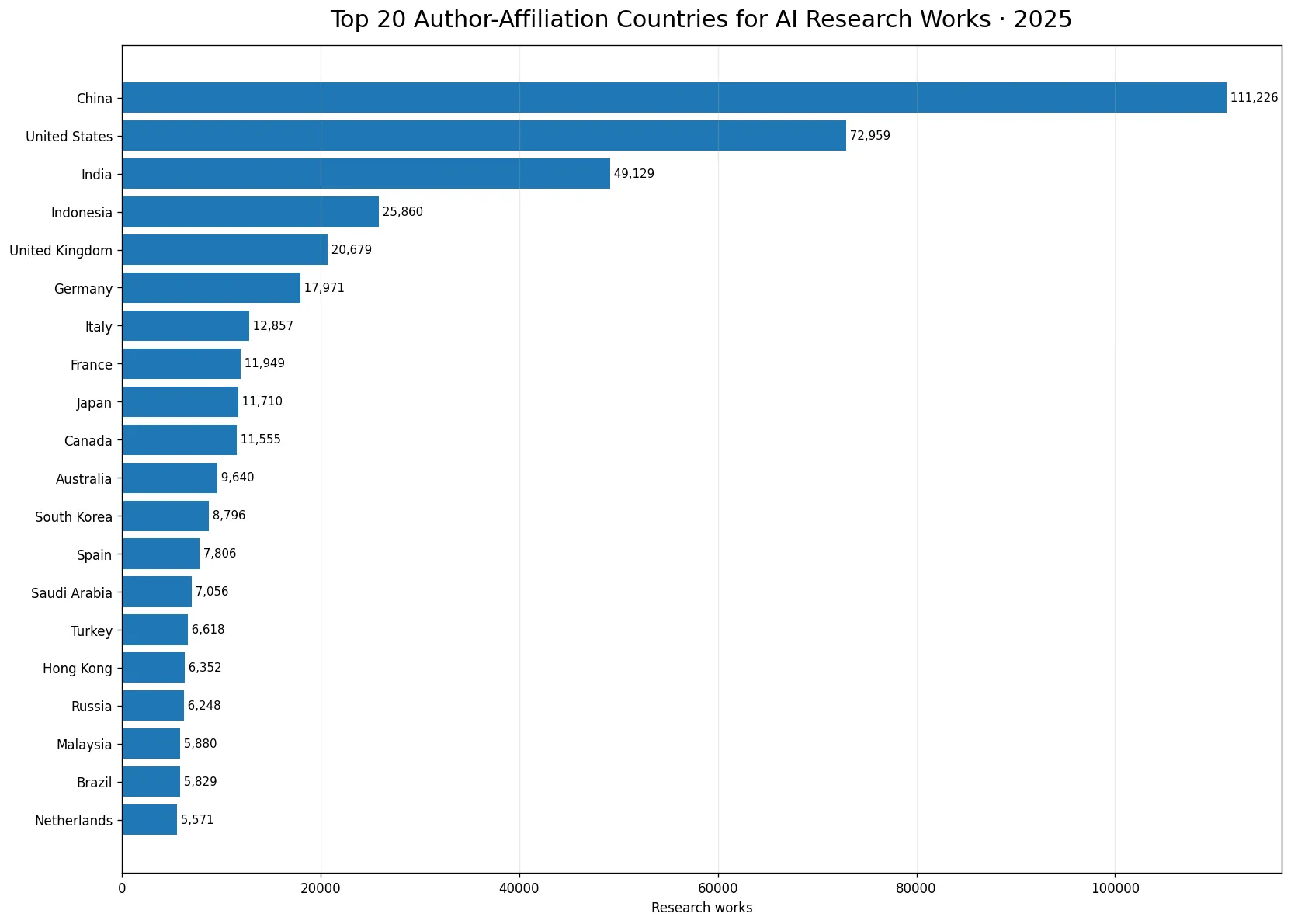
China records 111,226 works, about 1.52 times the U.S. count and 2.26 times the Indian count. The United States is about 1.49 times India. Indonesia comes next at 25,860, followed by the United Kingdom at 20,679 and Germany at 17,971. The gaps are not uniform. There is a large step down from China to the United States and another substantial gap to India, while values become more closely spaced further down the top group. That pattern is more informative than treating the leading countries as one homogeneous tier: the 2025 affiliation distribution has a very large upper tail and then a long sequence of progressively smaller national counts.
Ten countries exceed 10,000 works
There are 10 country groups with at least 10,000 works. After China, the United States, India, Indonesia, the United Kingdom, and Germany, the list includes Italy at 12,857, France at 11,949, Japan at 11,710, and Canada at 11,555. A total of 21 countries reach at least 5,000 works, and 59 reach at least 1,000. This shows that large-scale AI publishing activity is spread across a substantial set of countries, even though the very largest counts are concentrated near the top. The count alone does not reveal why a country sits in a particular position. Research-system size, number of active institutions, field composition, international collaboration, and indexing coverage can all matter, but those drivers require separate evidence.
| Country or economy | AI research works |
|---|---|
| China | 111,226 |
| United States | 72,959 |
| India | 49,129 |
| Indonesia | 25,860 |
| United Kingdom | 20,679 |
| Germany | 17,971 |
| Italy | 12,857 |
| France | 11,949 |
| Japan | 11,710 |
| Canada | 11,555 |
| Australia | 9,640 |
| South Korea | 8,796 |
| Spain | 7,806 |
| Saudi Arabia | 7,056 |
| Turkey | 6,618 |
| Hong Kong | 6,352 |
| Russia | 6,248 |
| Malaysia | 5,880 |
| Brazil | 5,829 |
| Netherlands | 5,571 |
The median is far below the mean
Across the 212 country groups, the arithmetic mean is 2,534.5 works and the median is only 143.5. The first quartile is 16.75 and the third quartile is 1,278.75. The mean is roughly seventeen times the median, which is a strong sign of a right-skewed distribution. A small number of very large country counts pull the average upward, while most countries sit far below that average. That is why an ‘average country’ of roughly 2,500 works would be a poor description of the center of the distribution. The median country is closer to 144 works, while the leaders range from tens of thousands to more than one hundred thousand.
More than half of the country groups have at least 100 works
117 of the 212 country groups have at least 100 works, and 169 have at least 10. That leaves 43 country groups below 10 works. The minimum observed value is 1. Those small counts are genuine observations, not missing values or zeros created during analysis. All 212 country keys in the latest snapshot carry a numeric count. Some small territories are not represented as separate polygons in the low-resolution geographic boundary used for the map, so the visual cannot display every one of the 212 country keys equally well. The underlying ranking and tables still retain all values.
International collaboration makes country counts non-exclusive
This is the most important limitation of the metric. A single work can include authors affiliated with institutions in China, the United States, Germany, and other countries. In an authorship-country grouping, that work can contribute to each relevant country group. As a result, the sum of the country counts is not the number of unique global AI works. Turning that sum into a denominator would create a different statistic—country-affiliation appearances across grouped works—rather than a clean national share of unique publications. If the analytical question is the total number of unique 2025 AI works, the correct approach is to query the overall filtered work count without country grouping. The grouped results used here answer a different question: where the authorship affiliations attached to AI works are located.
Affiliation country is not the same as author nationality
OpenAlex country information in this grouping comes from institutional affiliations connected to authorships. It should not be described as the citizenship or nationality of the researchers. Nor does it necessarily identify the place where the research activity physically occurred. Researchers can hold multiple affiliations, institutions can operate across borders, and collaborative papers can connect many countries. This makes the indicator a map of institutional affiliation links in the scholarly record rather than a demographic measure of researchers. Careful wording matters because phrases such as ‘Chinese researchers produced X papers’ can overstate what the data directly establish. A safer description is that X works were associated with authorships linked to Chinese institutions.
The 2025 values can change as OpenAlex updates its index
OpenAlex continuously improves bibliographic records, topic assignments, author identities, and institutional links. A work published in 2025 can be added later, receive a corrected affiliation, or be reclassified as metadata improves. The two verified snapshots collected on consecutive days already show small revisions for several countries, while the overall ranking remains broadly stable. This means the values should be understood as a snapshot of the OpenAlex index observed on September 20, 2026, not as an immutable historical census. For reproducible trend analysis, researchers should preserve a dated snapshot or rerun every year using the same filter and grouping logic.
Publication volume is not a complete measure of research impact
A high work count shows a large volume of AI-related scholarly output connected to a country’s affiliations, but it does not establish higher citation impact, stronger research quality, greater originality, or larger economic returns. Impact questions require additional measures such as citation counts, field-normalized impact, highly cited work shares, venue quality, or downstream use. Productivity questions may require denominators such as number of researchers, R&D spending, or institutional capacity. The 2025 country ranking is therefore best treated as one descriptive dimension of AI research activity. It is useful for scale and geographic coverage, but it should not be turned into a single league table of national AI capability.
A logarithmic map is necessary because the range is enormous
The largest country count exceeds 111,000 while the minimum is one work. On a linear color scale, nearly all medium and small countries would collapse into a narrow band of similar colors. The map therefore uses a logarithmic color scale to reveal spatial variation below the very top values. The original work counts are not transformed in the table or top-20 bar chart; only the map’s color encoding uses the logarithmic scale. This makes it easier to see that substantial AI publication activity appears across Asia, North America, Europe, and other regions rather than being visible only in the two or three largest countries.
What the 2025 snapshot can tell us
The strongest direct conclusions are descriptive. China has the largest country-group count, the United States and India are the next two, ten countries exceed 10,000 works, and the distribution is extremely skewed relative to its median. The data also show that AI-related publication activity reaches a very broad geographic set of 212 country and territory keys. What the snapshot cannot establish by itself is causation, growth over time, national research efficiency, collaboration quality, or the unique share of world AI papers. Those questions require different denominators, historical series, or work-level analysis.
Source and calculation method
Source: OpenAlex Works API, operated by OurResearch. The filter uses publication_year=2025 and topics.subfield.id=1702 for Artificial Intelligence, then groups results by authorships.countries. The latest verified snapshot contains 212 country keys. Descriptive statistics calculated from those counts are a mean of 2,534.5, median of 143.5, first quartile of 16.75, and third quartile of 1,278.75. Country counts are not mutually exclusive because internationally coauthored works can be associated with several countries, so no global publication share is calculated from their sum. The map joins ISO-like country codes to world boundaries and uses a logarithmic color scale only for visualization.
Frequently Asked Questions
Which author-affiliation country had the most AI research works in OpenAlex for 2025?
China had the largest count at 111,226, followed by the United States at 72,959 and India at 49,129.
Can the country counts be summed to get the unique global number of AI works?
No. Internationally coauthored works can be counted in more than one authorship-country group, so the country counts are not mutually exclusive.
Does authorship country mean the researcher’s nationality?
No. It reflects countries linked to institutional affiliations in OpenAlex authorship records, not citizenship or nationality.
Can the 2025 counts change later?
Yes. OpenAlex continuously updates bibliographic, affiliation, and topic metadata, so historical-year counts can be revised slightly.
Related Articles
Green Map creates custom-edited map images using open geographic data sources such as geoBoundaries, Natural Earth, OpenStreetMap, and government open data. These maps are edited visual materials, not raw data files, and are provided for education, documents, presentations, and graphic reference.