Students whose origin was Sweden were recorded in 70 destination countries and territories in the 2020 UNESCO Institute for Statistics (UIS) series used here. The United Kingdom was the largest destination with 2,912 students. The United States followed extremely closely at about 2,851, while Denmark was third with 1,509. Together, those three destinations accounted for just over half of the sum of all 70 reported destination values.
The statistic is more specific than a simple count of Swedish citizens living or studying overseas. UIS defines an internationally mobile student as someone who physically crosses an international border for education in a destination country that is different from the student’s country of origin. For tertiary students, origin is preferably based on prior education, with usual residence and citizenship used only when better measures are unavailable. That definition matters when comparing these figures with other “foreign student” statistics.
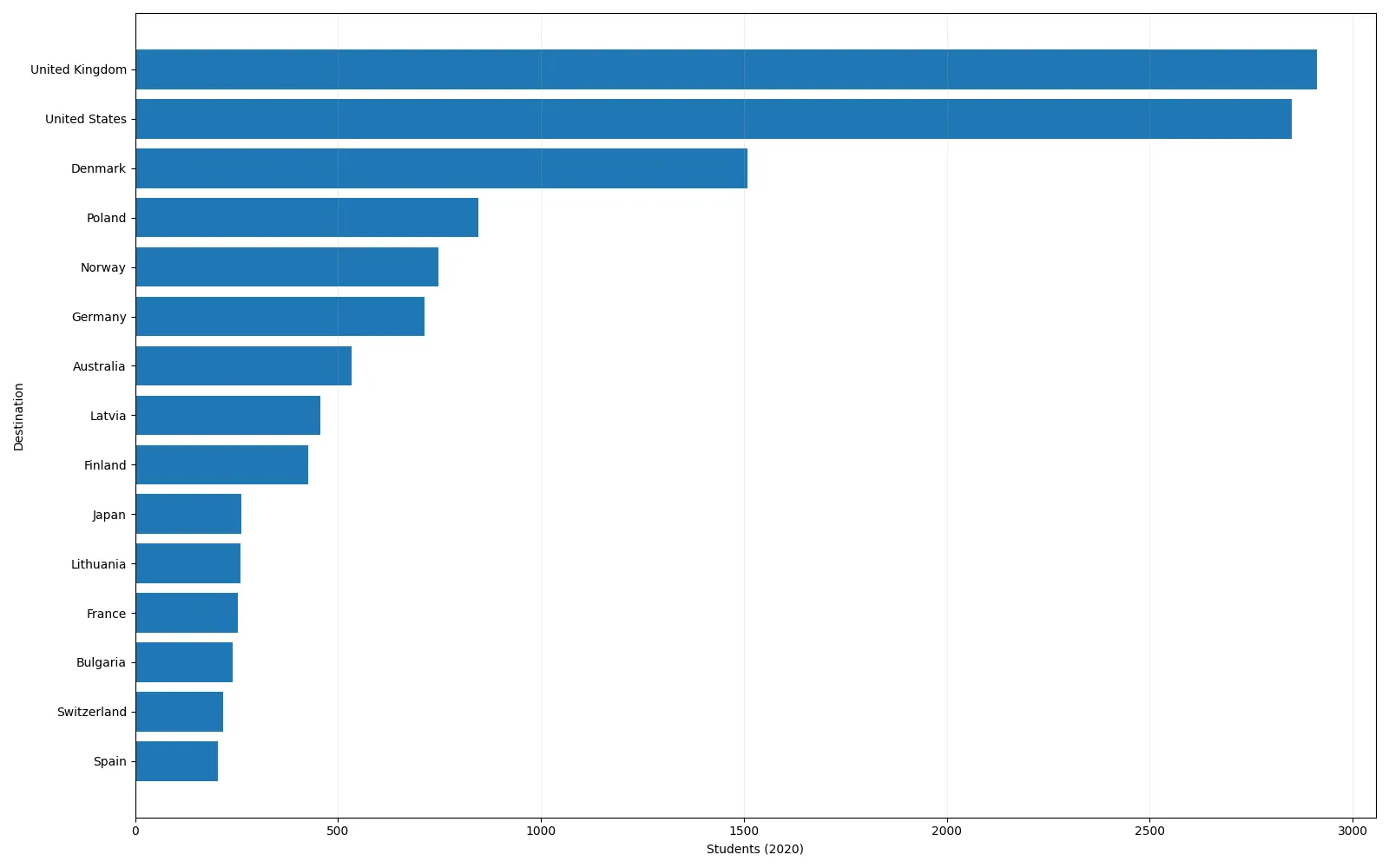
Table of Contents
The leading destinations in 2020
The top of the ranking was dominated by two countries. The United Kingdom represented about 20.2% of the sum of the 70 destination observations, while the United States represented about 19.8%. Combined, they made up almost exactly 40.0% of the observed total. The raw difference between the two was only about 61 students, so they formed a much tighter top pair than a simple first-versus-second ranking might suggest.
Denmark was clearly separated from that pair but still substantial. Its 1,509 students accounted for about 10.5% of the observed sum. Poland followed with 846, Norway with 748, Germany with 713, and Australia with 534. Those seven destinations were the only ones in the series with at least 500 students from Sweden in 2020.
| Rank | Destination | Students | Share of 70-row sum |
|---|---|---|---|
| 1 | United Kingdom | 2,912 | 20.2% |
| 2 | United States | 2,851 | 19.8% |
| 3 | Denmark | 1,509 | 10.5% |
| 4 | Poland | 846 | 5.9% |
| 5 | Norway | 748 | 5.2% |
| 6 | Germany | 713 | 4.9% |
| 7 | Australia | 534 | 3.7% |
| 8 | Latvia | 456 | 3.2% |
| 9 | Finland | 426 | 3.0% |
| 10 | Japan | 261 | 1.8% |
| 11 | Lithuania | 260 | 1.8% |
| 12 | France | 253 | 1.8% |
| 13 | Bulgaria | 241 | 1.7% |
| 14 | Switzerland | 216 | 1.5% |
| 15 | Spain | 204 | 1.4% |
Student counts in the table are displayed as whole people for readability. The United States value in the UIS data is 2,850.672119…, so it is shown as 2,851. Shares and cumulative percentages were calculated from the unrounded values. Preserving that distinction avoids introducing a small but unnecessary rounding error into the comparisons.
The United Kingdom and United States together represented about 40%
One of the most useful findings is not simply that the United Kingdom ranked first, but that the top two destinations were almost the same size. The United Kingdom exceeded the United States by only about 2.2% relative to the U.S. value. Denmark, in third place, was roughly half the size of the United Kingdom. That creates a clear structure: two very large destinations, one large third destination, and then a gradual step down through the next group.
The concentration does not explain why students chose those destinations. The dataset does not contain variables for tuition, language, university reputation, degree availability, scholarship rules, migration policy, or personal preference. Those factors may be relevant in real life, but attributing the ranking to any one of them would go beyond what this indicator can establish. The defensible conclusion is about location and scale: a large share of the recorded students from Sweden was concentrated in a small number of host countries.
European destinations remained prominent beyond the top three
After Denmark, several European countries formed the next tier: Poland had 846 students, Norway 748, and Germany 713. Latvia and Finland also appeared in the top ten with 456 and 426 respectively. Lithuania, France, Bulgaria, Switzerland, and Spain occupied places 11 through 15. This makes Europe highly visible throughout the upper half of the ranking, not only because the United Kingdom and Denmark were near the top.
At the same time, distance alone cannot explain the distribution. The United States was second, Australia was seventh, and Japan was tenth. The data therefore show an international pattern in which nearby European destinations and major long-distance study destinations both attracted meaningful numbers of students from Sweden. It is better to describe that combination than to reduce the ranking to a single geographic explanation.
The top 10 destinations accounted for about 78% of the observed sum
Cumulative shares show how concentrated the distribution was. The top three destinations accounted for about 50.4% of the sum of the 70 observations. The top five reached about 61.5%, and the top ten reached about 78.0%. In other words, 70 destinations were represented, but most of the recorded volume sat within a relatively short list of countries.
The long tail is equally informative. Forty-three destinations had fewer than 50 students. Some countries were recorded with only two or three students. That means geographic reach and numerical importance were very different concepts in this series: students from Sweden appeared across many destinations, yet the largest destinations contained a disproportionate share of the total observed count.
The same skew is visible when comparing the mean and median. The average across all 70 rows was about 206 students, but the median was only 27. A small number of very large destinations pulled the mean upward. For a sense of a “typical” destination, the median is therefore more representative, while rankings and cumulative shares are more useful for identifying where the largest concentrations occurred.
What “internationally mobile student” means in the UIS statistics
UIS describes internationally mobile students as people who physically cross a national border in order to participate in education in another country. For tertiary education, the preferred way to identify the country of origin is the country where the student obtained the qualification that preceded tertiary study. If that cannot be operationalized, the country of usual or permanent residence may be used; citizenship is a last-resort proxy.
This approach distinguishes mobility from a simple nationality-based measure. A person can be a citizen of the destination country yet still count as internationally mobile if the student completed prior qualifying education abroad and then crossed the border to study. Conversely, a foreign citizen who did not move across a border for education does not automatically fit the same concept. That is why UIS mobility counts should not be assumed to match every national dataset labelled “international students” or “foreign students.”
UIS also distinguishes physical educational mobility from activity that does not involve crossing a border. Distance learning delivered from a foreign institution to a student who remains in the origin country is not international student mobility under this definition. This conceptual boundary is important because it keeps the indicator focused on actual cross-border education movement.
Why the 70 reported destinations should not automatically be treated as a complete global total
The values in this 2020 series cover 70 destination rows and sum to about 14,423.7. That is the total of the observations returned for this indicator and year, not necessarily a guarantee that every possible destination worldwide is represented. International education statistics depend on national reporting, coverage, definitions, and data availability, so an absent country should not automatically be interpreted as having zero students.
For that reason, the percentages in this analysis are explicitly shares of the 70-row observed sum. This keeps the denominator tied to the evidence actually available. Within that fixed set, the ranking is straightforward: the United Kingdom, United States, and Denmark were the three largest destinations, and the top ten represented about 78% of the observed total.
The middle of the ranking adds useful context
The gap between the largest destinations and the middle of the table is substantial. Lithuania had 260 students, France 253, Bulgaria 241, Switzerland 216, and Spain 204. Romania followed at 191 and Canada at 183. Czechia had 140, while Austria and Hungary each had 137. These destinations form a middle tier between the few very large host countries and the long list of destinations with only a few dozen students.
The Republic of Korea was recorded with 38 students, placing it well below the largest destinations. That figure is best interpreted as one peer observation among many rather than as the organizing focus of the dataset. The broader pattern is the steep fall from the top destinations to a long tail of smaller host countries.
The reference year matters
Every value in this comparison refers to 2020. International student mobility can change substantially from year to year, so this ranking should not be presented as a current preference list. A trend question such as whether the United Kingdom gained or lost share over time would require the same indicator for multiple years and consistent country coverage.
The year is particularly important because 2020 was an unusual period for international travel and higher education operations. This single-year snapshot is still useful for identifying where students from Sweden were recorded and how concentrated the distribution was, but it cannot by itself show a normal long-run pattern or explain how mobility changed before and after that year.
Source and calculation method
The underlying series is UNESCO Institute for Statistics indicator 26609. UIS is UNESCO’s statistical office for internationally comparable education data. Its official definition of internationally mobile students is available in the UIS glossary, which explains the physical border-crossing requirement and the preferred hierarchy for determining country of origin.
Country values come from the UNESCO UIS public API for indicator 26609. Destinations were ranked by their 2020 values. Each share was calculated by dividing the destination value by the sum of the 70 returned destination observations. The U.S. value was rounded only for display; calculations used the original numeric value.
The main result is therefore clear without adding assumptions: the United Kingdom and United States were the dominant destinations in the 2020 observations, and Denmark formed a strong third place. The top three together accounted for just over half of the observed sum, while the top ten accounted for about 78%. At the same time, dozens of smaller destinations show that student mobility from Sweden was geographically broad even though it was numerically concentrated.
Frequently Asked Questions
Which country hosted the most internationally mobile students from Sweden in 2020?
The United Kingdom ranked first with 2,912 students in UNESCO UIS indicator 26609. The United States followed at about 2,851, and Denmark ranked third with 1,509.
Does this indicator simply count Swedish citizens studying abroad?
No. UIS defines internationally mobile students by cross-border educational movement and preferably identifies origin using prior education. Usual residence and citizenship are fallback measures when needed.
Can the sum of the 70 destinations be treated as the complete worldwide total?
It is safer to treat it as the sum of the 70 reported destination observations in this 2020 series. Coverage can depend on reporting and data availability, so an unreported destination should not automatically be interpreted as zero.
Related Maps
Green Map creates custom-edited map images using open geographic data sources such as geoBoundaries, Natural Earth, OpenStreetMap, and government open data.
These maps are edited visual materials, not raw data files, and are provided for education, documents, presentations, and graphic reference.