What share of students in short-cycle tertiary education are enrolled in vocational programmes? UNESCO Institute for Statistics (UIS) indicator GTVP.5.V answers that question by dividing vocational-programme enrolment at ISCED level 5 by total enrolment in all programme orientations at the same level.
The 2023 extract contains 86 countries and separately reported areas. Sixty observations, or 69.8%, are exactly 100%, and 63 are at least 95%. The median is 100% and the unweighted mean is 85.3%. With so many observations at the ceiling, the informative contrast is not a long list of top-ranked countries but the smaller group where short-cycle tertiary enrolment is split more visibly between vocational and other programme orientations.
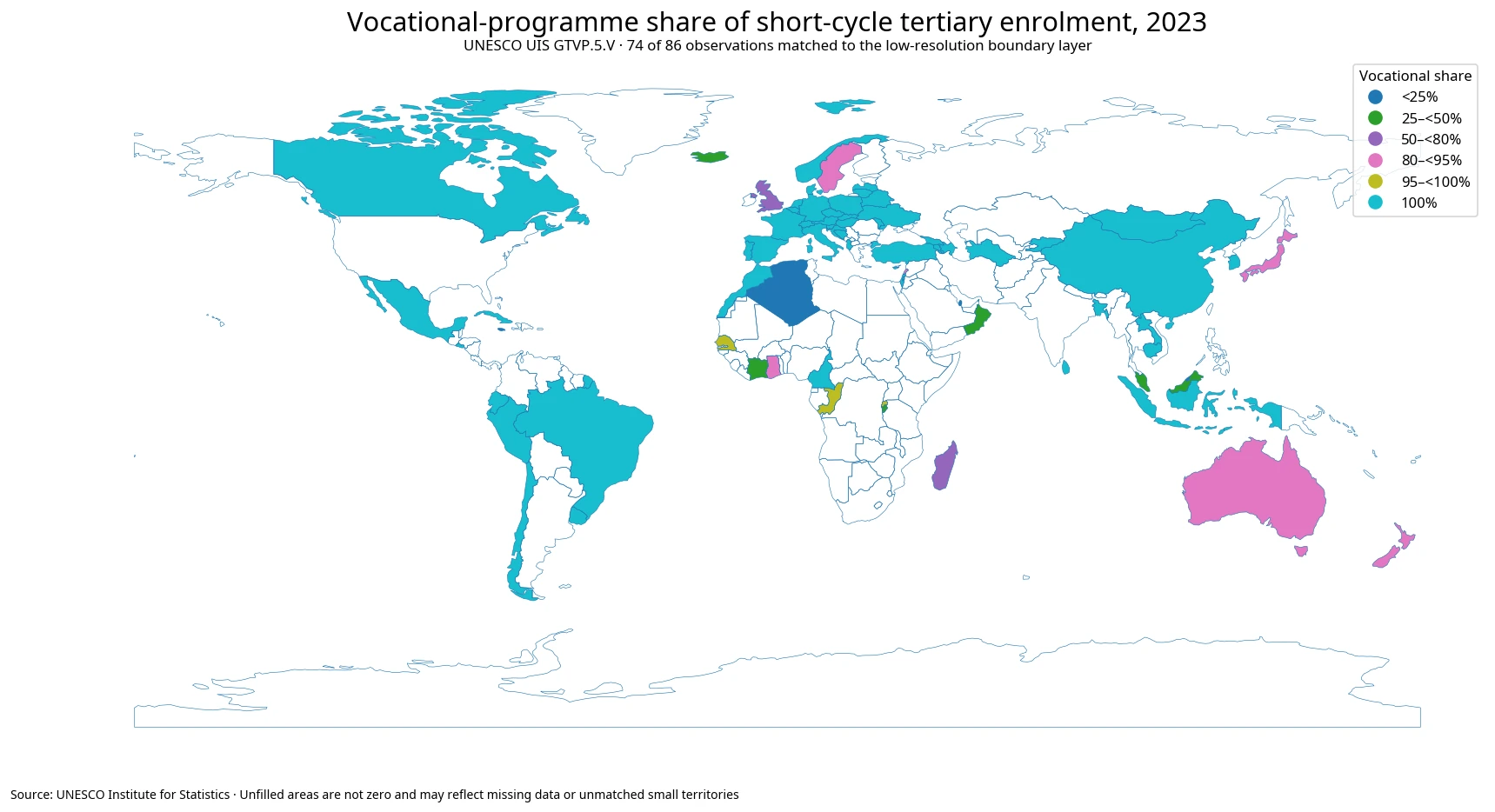
Table of Contents
A value of 100% means all reported ISCED 5 enrolment is vocational
UIS defines percentage of vocational enrolment as the number of students enrolled in vocational programmes at a given education level divided by total enrolment in all programmes at that same level. For GTVP.5.V the level is ISCED 5, short-cycle tertiary education.
A 100% value therefore means all short-cycle tertiary enrolment covered by the statistic is classified as vocational. It does not mean all tertiary students in the country are in vocational education, because bachelor’s, master’s and doctoral levels are outside the ISCED 5 denominator.
It also does not reveal the number of students. A small ISCED 5 system can report 100% if every student at that level is in a vocational programme, while a much larger system could report a lower percentage. Absolute enrollment requires separate headcounts.
Short-cycle tertiary is the first tertiary level, but national qualifications differ
ISCED 5 sits above upper-secondary and post-secondary non-tertiary education and below bachelor’s-or-equivalent programmes. It often contains shorter, professionally oriented or technically focused tertiary programmes, but the national labels and institutional arrangements are not uniform.
UIS ISCED examples include professional training colleges, technical diploma programmes and Higher National Diploma-type qualifications. Some programmes are mainly designed for labour-market entry, while some can also provide credit or access toward a bachelor’s programme.
For that reason, short-cycle tertiary should be treated as an internationally harmonized education level rather than a perfect synonym for one specific type of college in every country. The vocational share describes programme orientation within that level.
Sixty of 86 observations are exactly 100%
There are 60 observations at exactly 100%, 63 at or above 95%, 65 at or above 90% and 69 at or above 80%. Only 17 are below 80%, 14 below 50% and 7 below 25%.
| 2023 vocational share | Countries / areas | Share of 86 |
|---|---|---|
| 100% | 60 | 69.8% |
| 95% to <100% | 3 | 3.5% |
| 80% to <95% | 6 | 7.0% |
| 50% to <80% | 3 | 3.5% |
| 25% to <50% | 7 | 8.1% |
| Below 25% | 7 | 8.1% |
The median and third quartile are both 100%, while the first quartile is about 92.0%. The mean is lower at 85.3% because a relatively small lower tail pulls the average down.
This ceiling-heavy distribution makes a conventional top-country ranking unhelpful. Sixty reporting units are tied at the maximum. Most of the visible structural variation lies among countries below 100%, especially those below 80% or 50%.
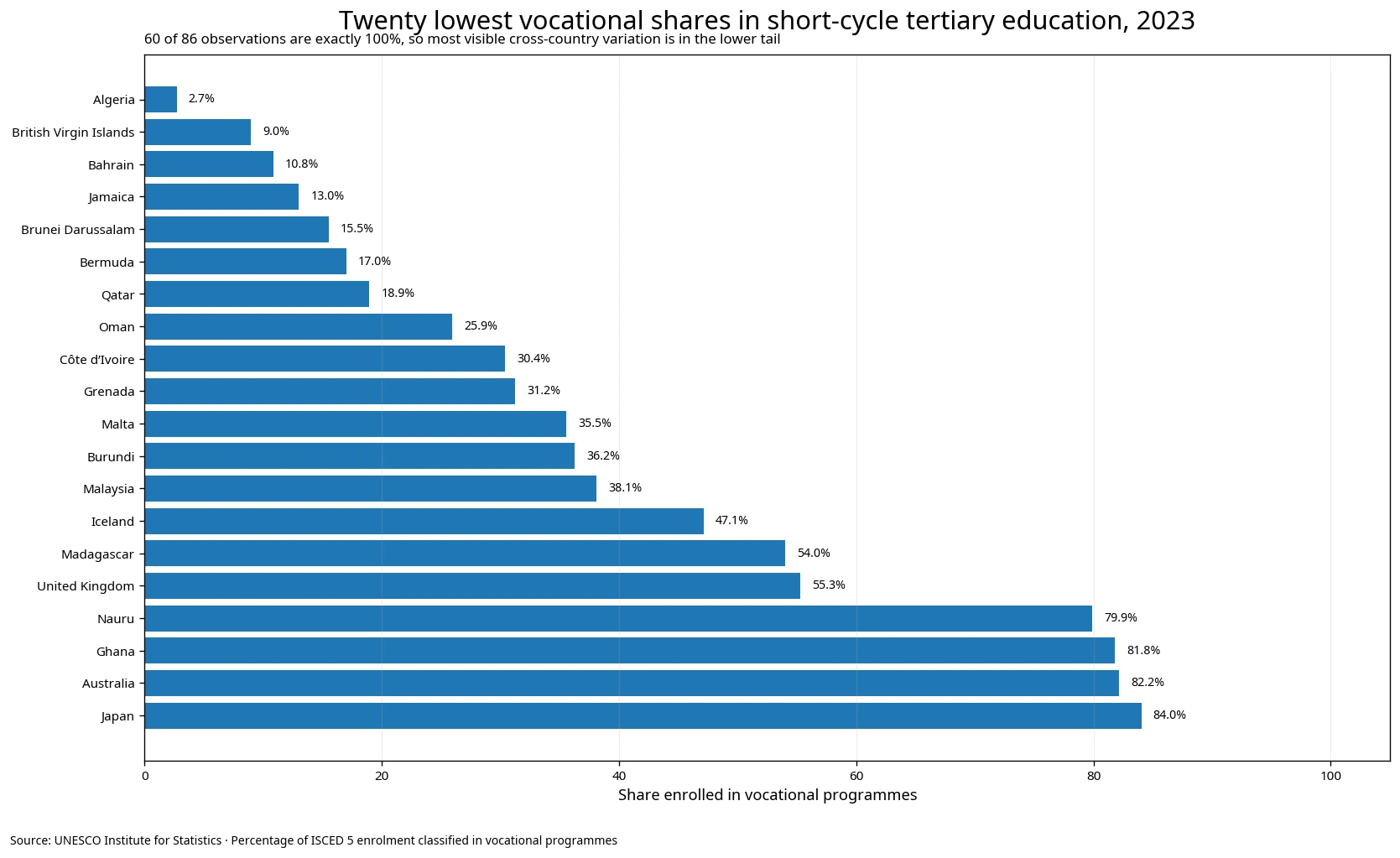
Algeria is lowest at 2.7%, followed by the British Virgin Islands at 9.0%
Algeria has the minimum observation at 2.7%. The British Virgin Islands report 9.0%, Bahrain 10.8%, Jamaica 13.0%, Brunei Darussalam 15.5%, Bermuda 17.0% and Qatar 18.9%.
| Country / area | Vocational-programme share |
|---|---|
| Algeria | 2.7% |
| British Virgin Islands | 9.0% |
| Bahrain | 10.8% |
| Jamaica | 13.0% |
| Brunei Darussalam | 15.5% |
| Bermuda | 17.0% |
| Qatar | 18.9% |
| Oman | 25.9% |
| Côte d’Ivoire | 30.4% |
| Grenada | 31.2% |
| Malta | 35.5% |
| Burundi | 36.2% |
| Malaysia | 38.1% |
| Iceland | 47.1% |
| Madagascar | 54.0% |
| United Kingdom | 55.3% |
| Nauru | 79.9% |
| Ghana | 81.8% |
| Australia | 82.2% |
| Japan | 84.0% |
Oman is 25.9%, Côte d’Ivoire 30.4%, Grenada 31.3%, Malta 35.5%, Burundi 36.2%, Malaysia 38.1% and Iceland 47.1%. The United Kingdom is 55.3%, while Australia is 82.2%, Japan 84.0%, New Zealand 91.7% and Sweden 92.8%.
A lower share is not evidence that vocational education is weak. It can mean that general or other non-vocational short-cycle tertiary programmes account for a larger part of ISCED 5, or that much of the country’s vocational education is organized at ISCED 4, ISCED 6, adult training or other institutional settings.
The large number of 100% values reflects programme structure as well as policy
Short-cycle tertiary systems vary widely in size and purpose. In some countries ISCED 5 may be almost entirely composed of occupationally oriented qualifications. In others, general or academically oriented short-cycle programmes coexist with vocational programmes.
Cross-country differences therefore reflect more than a simple national preference for vocational education. They also depend on where programmes are placed in the ISCED ladder and how national qualifications are mapped to general or vocational orientation.
Small differences near the ceiling should not be treated as performance rankings. A contrast between 96.8% and 98.4% is much less structurally informative than the contrast between 2.7% and 100%.
Vocational share is not an employment or quality indicator
Vocational education is designed to provide knowledge, skills and competencies linked more directly to particular occupations or trades. That orientation can support labour-market preparation, but the enrollment share does not measure whether graduates find jobs or whether programmes are high quality.
A country with a 100% vocational share at ISCED 5 is not automatically better on employment, earnings, qualification recognition or employer satisfaction. Programme quality, work-based learning, employer participation, economic conditions and local labour demand all matter.
Conversely, a low ISCED 5 vocational share does not prove that vocational and technical education is unimportant nationally. The relevant programmes may be concentrated at upper secondary, post-secondary non-tertiary, bachelor’s, adult or employer-based levels outside this indicator’s denominator.
The complement to 100% represents other programme orientation at the same level
The UIS programme-orientation statistic uses all general and vocational enrolment at the selected level as the denominator. A vocational share of 55.3% therefore leaves roughly 44.7% of the same ISCED 5 enrolment outside the vocational orientation under this classification.
That complement should not automatically be translated into one national institution type or qualification label. International general/vocational categories do not always map one-to-one onto familiar domestic terms such as academic college, applied college or technical institute.
Country-specific descriptions require national ISCED mappings or education ministry documentation. This comparison remains at the harmonized programme-orientation level.
Many countries share the 100% ceiling
The Republic of Korea records 100%, alongside China, Canada, Germany, France and many other 100% observations. This means the reported ISCED 5 enrolment is entirely vocational under the UIS classification; it does not describe the vocational share of all tertiary education or rank education outcomes.
The map matches 74 of 86 observations, while all 86 remain in the statistics
Seventy-four observations match separate polygons in the low-resolution world boundary layer. The unmatched group includes Andorra, Bahrain, Bermuda, Grenada, Hong Kong, Macao, Monaco, Malta, Nauru, Singapore, Seychelles and the British Virgin Islands.
Those observations remain in the mean, median, band counts and lower-tail table. A missing polygon is a visualization limitation, not evidence of a zero value. Missing statistical observations are also never zero-filled.
The map gives a quick spatial overview, while the lower-tail chart is more useful for this particular distribution because so many countries share the same ceiling value.
A common 2023 reference year improves comparison but does not establish a trend
All 86 observations use 2023, so the comparison avoids mixing current programme structures with much older national values. This is an important advantage over latest-value datasets that can combine many reference years.
A one-year cross-section cannot show whether a country’s vocational share is rising or falling. Programme reclassification or changes in the structure of ISCED 5 can also shift the value over time, so trend analysis requires several years of the same indicator.
The unweighted mean of 85.3% is not the share of all short-cycle tertiary students worldwide. Each country or separately reported area receives equal weight regardless of enrollment size. A global student-weighted share would require ISCED 5 enrollment counts by country.
Data source and calculation method
Country values come from UNESCO Institute for Statistics indicator GTVP.5.V, “Share of all students in short-cycle tertiary education enrolled in vocational programmes, both sexes (%),” using the 2023 NATIONAL observations in this comparison. The official unit is percent; the generic internal unit label has been clarified accordingly.
- UNESCO UIS official API — GTVP.5.V
- UNESCO UIS Data Browser Glossary — percentage of vocational enrolment
- UNESCO UIS ISCED 2011 Operational Manual — ISCED 5 short-cycle tertiary education
The mean of 85.3%, median of 100%, ceiling counts and percentage bands are calculated directly from the 86 non-missing observations. No missing value is converted to zero, and no enrollment count or employment outcome is inferred. The map uses 74 matched polygons, while all 86 observations remain in the statistics.
The strongest conclusion supported by the dataset is that short-cycle tertiary enrollment is classified as entirely or almost entirely vocational in a large majority of the reporting systems in 2023, while a smaller lower tail shows much more mixed programme orientation. Student volume, programme quality, employment outcomes and the institutional causes of the differences require additional data.
Frequently Asked Questions
What does a 100% vocational share at ISCED 5 mean?
It means all short-cycle tertiary enrolment covered by the UIS statistic is classified in vocational programmes. It does not mean all tertiary students or all young people are in vocational education.
Is short-cycle tertiary education the same qualification in every country?
No. ISCED 5 is an international comparison level. National programme names, durations, institutions and links to bachelor's education can differ.
Does a higher vocational share mean better employment outcomes?
No. The indicator describes programme orientation, not employment, earnings, programme quality or employer satisfaction.
How many 2023 observations are exactly 100%?
Sixty of the 86 countries and separately reported areas are exactly 100%, and 63 are at or above 95%.
Related Articles
- Lower Secondary General-Programme Share | 120 Countries in 2024
- Secondary Vocational Enrolment Share | 2018–2020 World Map
- Short-Cycle Tertiary Attainment Map – Latest Values for Adults 25+
Green Map creates custom-edited map images using open geographic data sources such as geoBoundaries, Natural Earth, OpenStreetMap, and government open data.
These maps are edited visual materials, not raw data files, and are provided for education, documents, presentations, and graphic reference.