Where did internationally mobile tertiary students from the Netherlands study in 2021? UNESCO Institute for Statistics data identify the destination country while holding the student origin constant at the Netherlands. Belgium is the largest reported destination with 4,172 students, followed by the United Kingdom with 3,576 and Germany with 1,995. The United States is also a major destination at about 1,863.
The 71 destination observations sum to about 18,042. That sum should not automatically be treated as a complete official total of every Dutch-origin student studying abroad, because destination reporting coverage can vary. It is, however, a consistent denominator for describing concentration within this 2021 extract. The top three destinations account for 54.0% of the observed sum, the top five for 69.0% and the top ten for 83.4%.
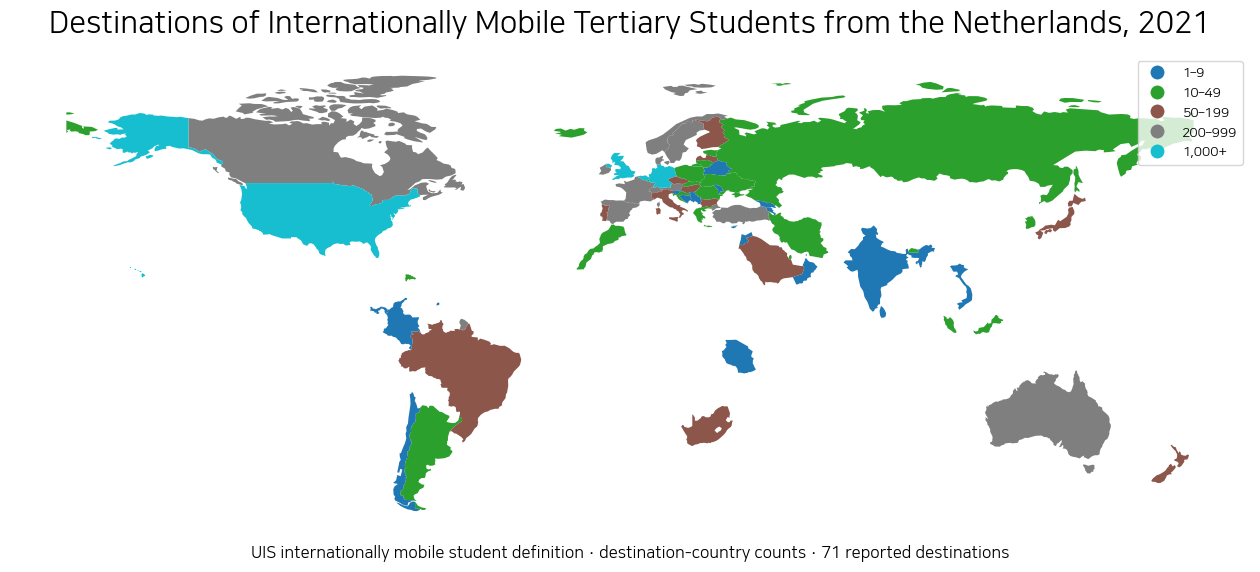
Table of Contents
The indicator is about Dutch-origin students abroad, not students moving into the Netherlands
The official indicator wording begins with ‘Inbound internationally mobile students’, which can be confusing when the origin filter is overlooked. In this table, each row is a destination country. The origin is fixed at students from the Netherlands. Belgium’s value of 4,172 therefore means internationally mobile students from the Netherlands enrolled in tertiary education in Belgium.
UIS defines an internationally mobile student as someone who physically crosses an international border for educational activity in a destination country different from the country of origin. For tertiary students, the preferred origin measure is the country in which the student obtained the qualification leading into tertiary education. Usual residence can be used when necessary, and citizenship is a last-resort proxy.
This is therefore not simply a count of Dutch citizens living abroad. UIS international student mobility also excludes arrangements that do not involve physical cross-border movement, such as distance learning from a foreign institution while remaining in the country of origin. Its coverage differs from short-term credit mobility that is credited at a home institution.
Belgium, the United Kingdom and Germany account for more than half of the observed destinations
Destination concentration is the clearest pattern. Belgium, the United Kingdom and Germany together account for 9,743 students, or about 54.0% of the 71-destination sum. Two of those countries, Belgium and Germany, share a land border with the Netherlands, while the United Kingdom is geographically close across the North Sea.
Adding the United States and Türkiye brings the top-five share to 69.0%. The top ten reach 83.4%, while the median destination has only 26 students. The distribution therefore combines a small set of very large destinations with a long tail of countries hosting relatively few students from the Netherlands.
| Rank | Destination | ISO3 | 2021 students |
|---|---|---|---|
| 1 | Belgium | BEL | 4,172 |
| 2 | United Kingdom | GBR | 3,576 |
| 3 | Germany | DEU | 1,995 |
| 4 | United States | USA | about 1,863 |
| 5 | Türkiye | TUR | 842 |
| 6 | Austria | AUT | about 673 |
| 7 | Switzerland | CHE | 576 |
| 8 | Sweden | SWE | about 485 |
| 9 | Denmark | DNK | 459 |
| 10 | France | FRA | 403 |
European destinations account for about 78.6% of the observed total
Grouping destination countries by continent gives about 14,189 students in Europe, or 78.6% of the 71-destination sum. This is a broad geographic Europe calculation rather than a European Union membership calculation.
Nine of the top ten destinations are in Europe: Belgium, the United Kingdom, Germany, Türkiye, Austria, Switzerland, Sweden, Denmark and France. The United States is the only non-European destination in the top ten and is the largest destination outside Europe.
The geographic pattern should not be turned into a causal claim. Distance, language, programme availability, tuition, living costs, admissions, university networks and labour-market access may all matter, but the supplied destination-count dataset does not contain those explanatory variables.
The United States is the largest destination outside Europe
The United States has a 2021 value of about 1,863, placing it fourth overall. Australia has 312, Canada 237, Japan 93 and the Republic of Korea 37. These values show that long-distance destinations are clearly present even though the overall distribution remains heavily European.
The contrast is not that all non-European destinations are small. Rather, Europe combines several simultaneously large destinations, which raises its share of the observed total. The United States stands out as a separate high-volume destination beyond that regional cluster.
Why do a few student counts contain decimals?
Most destination values are whole numbers, but the UIS extract contains decimal observations for the United States, Austria and Sweden. A fractional value should not be interpreted as a literal fraction of a student. Internationally comparable education datasets can contain adjusted or estimated values. For readability, this article rounds those observations to the nearest student and labels them as approximate where appropriate.
That distinction matters more for very close small values than for the major destination ranking. Belgium, the United Kingdom and Germany are separated by large margins, so the overall concentration pattern is not sensitive to whether estimated observations are displayed with decimals or rounded.
Internationally mobile students are not the same as foreign students
A foreign student is commonly defined by citizenship relative to the destination country. International student mobility is instead based on movement across a national border for education. A student can therefore be internationally mobile even if citizenship alone would not classify that person as foreign in the same way.
Conversely, someone with foreign citizenship who has long resided and studied in the destination country without a qualifying international education move can be treated differently across foreign-student and mobile-student statistics. The UIS measure should therefore not be relabelled as a count of Dutch nationals abroad.
Why the 71-destination sum is not necessarily a complete Dutch outbound total
The 71 observations sum to about 18,042. Destination-country mobility statistics depend on national reporting coverage and availability, so the set of reported destinations may not capture every student in every country with identical completeness. That is why the article uses the sum to describe the composition of this extract rather than presenting it as an exhaustive national total.
Within the extract, the denominator is still useful. It allows consistent calculations such as Belgium’s share of reported destinations or the combined concentration of the top ten. Those statements are explicitly scoped to the 71 available destination observations.
Map gaps should not be read as zero students
Of the 71 statistical rows, 65 match separate country polygons in the low-resolution world boundary layer used for the map. Small states and territories such as Bahrain, Hong Kong, Liechtenstein, Macao, Monaco, Malta and Mauritius may not appear as separate polygons at this resolution even though their observations remain in the underlying table.
The map groups counts into 1–9, 10–49, 50–199, 200–999 and 1,000+ students. Countries without a value in this extract are left unclassified rather than treated as zero. No observation and a confirmed zero are different statistical statements.
Data source and calculation method
Country values are based on the UNESCO UIS Data Browser and UIS indicator 26599 for 2021. The definition of internationally mobile students follows the UIS Glossary.
Destination rankings are obtained by sorting the 71 reported values from largest to smallest. Concentration shares use the sum of those 71 observations as the denominator. The Europe share groups destination countries by a broad continent classification. Decimal source observations are retained for calculations and rounded only for reader-facing count displays.
Frequently Asked Questions
Is this a count of international students entering the Netherlands?
No. The student origin is fixed at the Netherlands and each row is a destination country. The values show how many Netherlands-origin internationally mobile tertiary students study in each destination.
Does Netherlands-origin mean Dutch citizenship?
Not necessarily. UIS prefers prior education to identify a tertiary student's country of origin, with usual residence and then citizenship used as fallback approaches when needed.
What were the largest destinations in 2021?
Belgium had 4,172 students, the United Kingdom 3,576 and Germany 1,995. Together they account for about 54.0% of the sum across the 71 reported destinations.
Is the sum of about 18,042 a complete total of all Dutch students abroad?
It should not be treated as automatically exhaustive. Destination reporting coverage can vary. The article uses the 71-observation sum as a denominator for describing the composition of the available 2021 destination data.
Related Maps
Green Map creates custom-edited map images using open geographic data sources such as geoBoundaries, Natural Earth, OpenStreetMap, and government open data.
These maps are edited visual materials, not raw data files, and are provided for education, documents, presentations, and graphic reference.