How many young people of official lower-secondary age were enrolled in school in 2024? UNESCO Institute for Statistics (UIS) indicator NERT.2.CP contains 119 country and area observations. The median is 93.36%. The United Arab Emirates is highest at 99.99%, followed by Switzerland at 99.89%, France at 99.89%, and Lithuania at 99.88%.
The UIS definition of total net enrolment rate uses the official age group for the education level as the denominator and counts students of that age who are enrolled in any level of education in the numerator. For lower secondary, the measure therefore asks whether official lower-secondary-age young people are somewhere in the education system, not only whether they are enrolled specifically in lower secondary.
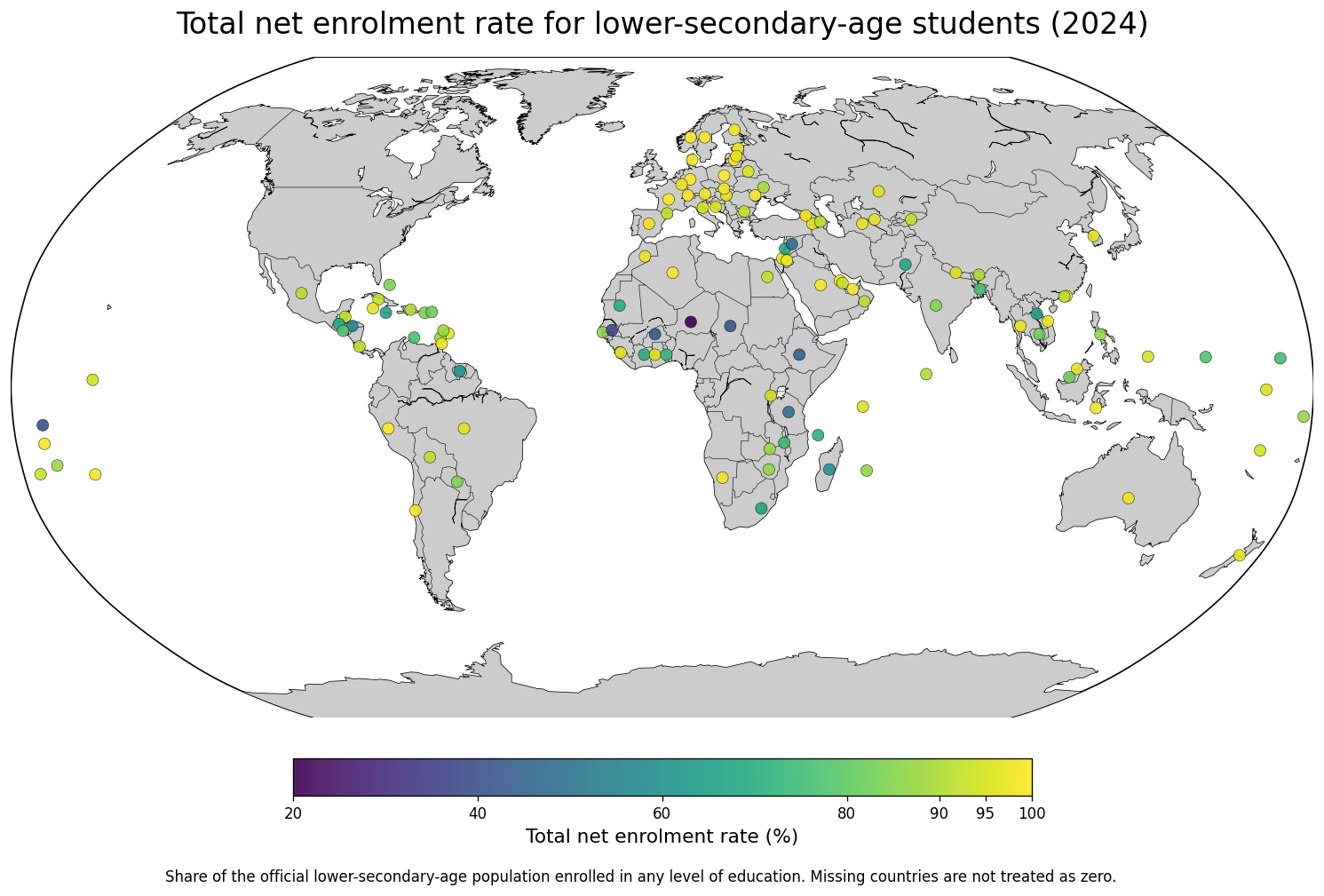
Table of Contents
The median across 119 observations is 93.36%
The median is 93.36% and the unweighted mean is 86.78%. The middle half of the country observations lies between 83.15% and 97.80%. 74 observations are at or above 90%, 52 are at or above 95%, 28 are at or above 98%, and 16 reach at least 99%.
At the other end, 27 observations are below 80%, 19 below 70%, and 8 below 50%. The distribution therefore combines a large near-universal group with a much lower tail. The gap between those groups is more substantively important than tiny differences among countries already above 99%.
| Total net enrolment rate band | Countries or areas | Share of observations |
|---|---|---|
| Below 50% | 8 | 6.7% |
| 50–69.9% | 11 | 9.2% |
| 70–79.9% | 8 | 6.7% |
| 80–89.9% | 18 | 15.1% |
| 90–94.9% | 22 | 18.5% |
| 95–97.9% | 24 | 20.2% |
| 98% or more | 28 | 23.5% |
Several systems are effectively at universal participation
The United Arab Emirates records 99.99%, Switzerland 99.89%, France 99.89%, Lithuania 99.88%, Poland 99.85%, and Peru 99.83%. Algeria, Indonesia, Sweden, and Germany are also around 99.6%.
| Rank | Country or area | 2024 total net enrolment rate |
|---|---|---|
| 1 | United Arab Emirates | 99.99% |
| 2 | Switzerland | 99.89% |
| 3 | France | 99.89% |
| 4 | Lithuania | 99.88% |
| 5 | Poland | 99.85% |
| 6 | Peru | 99.83% |
| 7 | Algeria | 99.79% |
| 8 | Indonesia | 99.64% |
| 9 | Sweden | 99.61% |
| 10 | Germany | 99.61% |
| 11 | Republic of Moldova | 99.48% |
| 12 | Saudi Arabia | 99.36% |
| 13 | China, Hong Kong Special Administrative Region | 99.32% |
| 14 | Samoa | 99.21% |
| 15 | Norway | 99.13% |
At this end of the scale, ranking 99.85% against 99.89% has little practical meaning. Both values indicate that almost the entire official lower-secondary-age population is enrolled somewhere in education. The measure still says nothing directly about attendance regularity, grade placement, learning outcomes, safety, or instructional quality.
Niger is lowest at 20.29%
Niger has the lowest observation at 20.29%, followed by Senegal at 36.10%, Tokelau at 39.56%, Burkina Faso at 40.69%, Chad at 41.38%, and Ethiopia at 45.23%. The Syrian Arab Republic is at 48.69% and Tanzania at 49.00%, bringing the number below 50% to eight.
| Low-end order | Country or area | 2024 total net enrolment rate |
|---|---|---|
| 1 | Niger | 20.29% |
| 2 | Senegal | 36.10% |
| 3 | Tokelau | 39.56% |
| 4 | Burkina Faso | 40.69% |
| 5 | Chad | 41.38% |
| 6 | Ethiopia | 45.23% |
| 7 | Syrian Arab Republic | 48.69% |
| 8 | United Republic of Tanzania | 49.00% |
| 9 | Honduras | 55.66% |
| 10 | Suriname | 60.36% |
| 11 | Madagascar | 61.24% |
| 12 | Lao People’s Democratic Republic | 64.32% |
| 13 | Jamaica | 66.47% |
| 14 | Lebanon | 67.51% |
| 15 | Guatemala | 67.62% |
A low total net enrolment rate means a large share of the official lower-secondary-age population is not enrolled in any level of education. The indicator does not identify why. Distance, cost, conflict and displacement, child labour, disability, school capacity, household income, gender disparities, and data coverage can all matter.
Total net enrolment is the complement of the corresponding out-of-school rate
The UIS metadata states that the total net enrolment rate is complementary to the corresponding out-of-school rate. Under the same age group, education level, year, and methodology, a total net enrolment rate of 90% corresponds to an out-of-school rate of about 10%.
The matching conditions matter. An out-of-school indicator covering the combined primary-to-upper-secondary age range is not the direct complement of a lower-secondary-only total net enrolment rate. Country, year, official age group, and indicator scope must line up before subtracting from 100.
Total net enrolment differs from a standard net enrolment rate
A standard net enrolment rate generally focuses on students of the official age group who are enrolled in the corresponding education level. Total net enrolment is broader because it counts the official age group when enrolled in any level of education.
This distinction matters where pupils enter late, repeat grades, or advance early. A lower-secondary-age student who is still in primary school can still be counted as participating in education under the total net concept. The indicator is therefore strong for access and participation but weak for judging age-appropriate progression.
A rate above 95% can still represent a large number of out-of-school adolescents
A 95% rate looks close to universal, but the remaining 5% can represent a large absolute number in a country with a large lower-secondary-age population. The same percentage can imply very different numbers of students across countries.
The present dataset contains percentages, not the number of adolescents outside school. Policy planning for the scale of support requires the official age-group population or direct out-of-school counts in addition to the rate.
The common 2024 reference year improves comparability
All 119 observations are dated 2024. That avoids a common problem in international education tables where each country contributes its latest value from a different year. A synchronized year makes the geographic comparison easier to interpret.
Coverage is still incomplete and the unweighted mean should not be described as a world student rate. Each country or area contributes one row regardless of population size, so a small island and a country with millions of lower-secondary-age students carry equal weight in the simple mean.
Large differences remain within the same regions
India records 84.94%, Bangladesh 76.06%, and Pakistan 67.79%, while Indonesia is much higher at 99.64%. In Latin America, Brazil records 96.43% and Mexico 90.87%.
These contrasts show why a continental label is not enough to explain participation. Official school ages, school supply, urban-rural access, household resources, policy, conflict exposure, and administrative coverage can differ sharply within the same region.
One peer observation is above the country-row median
The Republic of Korea records 97.10% in 2024, above the 93.36% median across the 119 observations and within the 95%-or-higher group. The figure describes enrolment participation for the official lower-secondary-age population; it is not a measure of reading performance, instructional quality, or daily attendance.
The word ‘lower secondary’ identifies the age group, not necessarily the grade attended
Because the numerator includes enrolment in any education level, the indicator should not be paraphrased as ‘the percentage enrolled in lower secondary school’ without qualification. Some students of official lower-secondary age can still be in primary education or, in some systems, be enrolled at a different level.
Questions about correct grade placement, repetition, over-age enrolment, or progression need more specific indicators. NERT.2.CP answers a narrower access question: what share of the official lower-secondary-age population is connected to formal education through enrolment?
Data scope and source
The analysis uses 119 national-level 2024 observations from the UNESCO Institute for Statistics official API indicator NERT.2.CP, titled ‘Total net enrolment rate, lower secondary, both sexes (%)’.
The observed range is 20.29% to 99.99%, with a median of 93.36% and an unweighted mean of 86.78%. Rankings, quartiles, and rate bands are calculated directly from the supplied values. Missing countries are not converted to zero.
The main takeaway
The median 2024 total net enrolment rate is 93.36% across the 119 available countries and areas, and 74 observations are at or above 90%. At the lower end, 8 observations are below 50%, with Niger lowest at 20.29%. The indicator measures whether people of official lower-secondary age are enrolled in any level of education. It should be separated from lower-secondary-specific enrolment, attendance, grade progression, and learning outcomes.
Frequently Asked Questions
Does total net enrolment rate mean the share enrolled specifically in lower secondary?
Not exactly. It measures the share of the official lower-secondary-age population enrolled in any level of education.
How is total net enrolment related to the out-of-school rate?
For the same official age group, level, year, and methodology, the two are complementary to 100%.
Does a rate near 100% prove high education quality?
No. It measures enrolment participation, not attendance regularity, learning outcomes, grade placement, or instructional quality.
Related Articles
Green Map creates custom-edited map images using open geographic data sources such as geoBoundaries, Natural Earth, OpenStreetMap, and government open data.
These maps are edited visual materials, not raw data files, and are provided for education, documents, presentations, and graphic reference.