How common is lower-secondary-or-higher attainment among adults who live in rural areas? UNESCO Institute for Statistics indicator EA.2T8.AG25T99.RUR measures the percentage of the rural population age 25 and older, both sexes, who completed lower-secondary education or any higher level.
Across the 85 country and area observations dated 2022, the unweighted median is 66.0% and the mean is 59.8%. 24 observations are at or above 90%, while 15 are at or above 95%. The Republic of Korea is 78.0%, ranking 37th among the 85 observations.
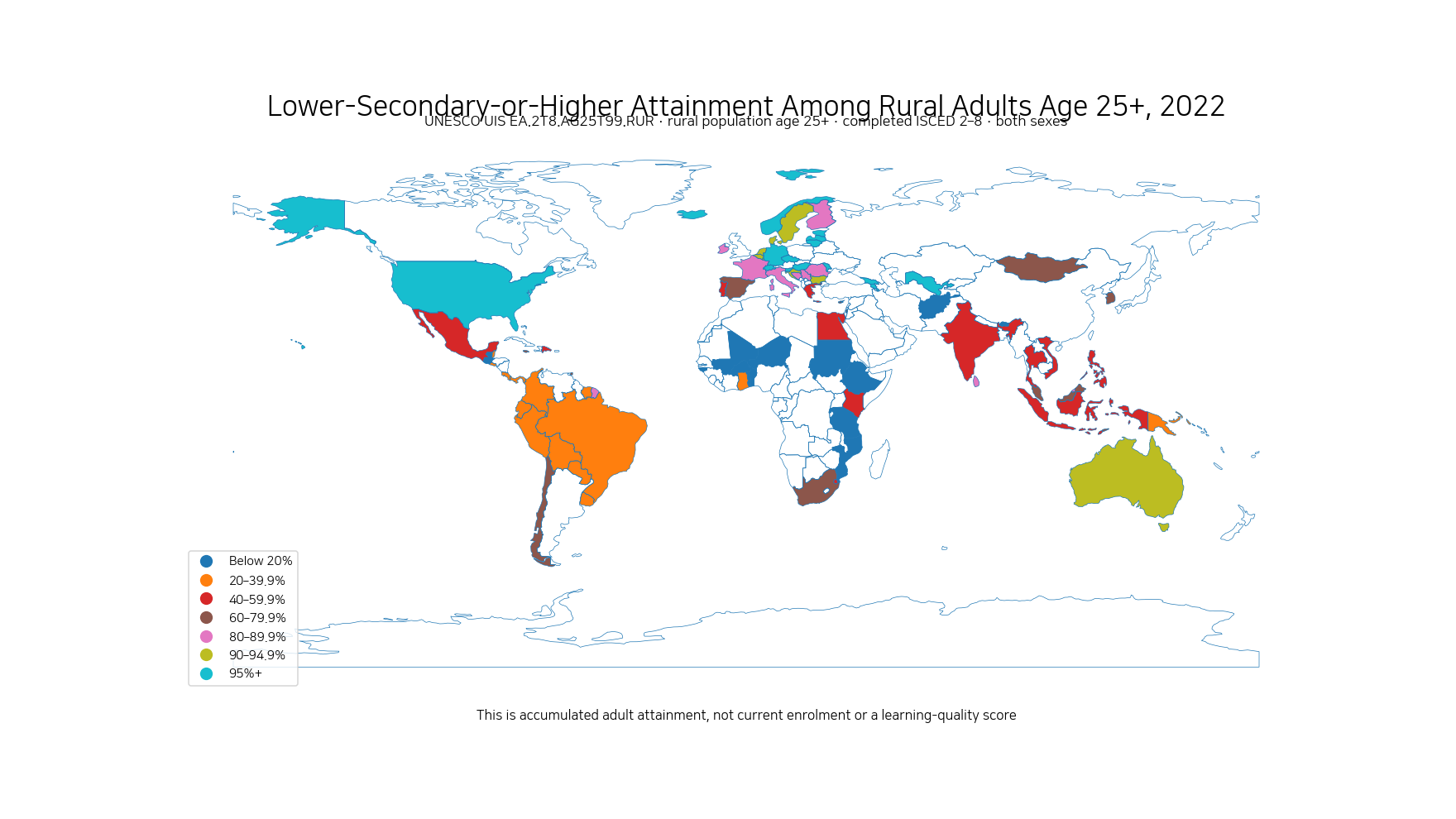
Table of Contents
This is accumulated adult attainment, not a current school completion rate
The population in this indicator is rural residents age 25 and older. It does not measure children currently enrolled in lower-secondary school, the graduation rate of today’s students or the share of a current cohort finishing a grade level.
Using age 25 and above makes the indicator a stock measure of education accumulated across generations. Current policy reforms may take years to change the overall percentage because older adults remain in the denominator.
Lower-secondary-or-higher includes upper secondary and tertiary education
The code 2T8 spans ISCED levels 2 through 8. That means people who completed upper-secondary, post-secondary non-tertiary, short-cycle tertiary, bachelor’s, master’s or doctoral education are also included because they crossed the lower-secondary threshold.
A value of 80% does not mean 80% of rural adults stopped after lower secondary. It means 80% completed at least that level, including everyone whose highest completed education was above it.
The rural filter makes this different from a national attainment rate
The suffix RUR is essential. The indicator describes rural residents only, not the country’s entire age-25-plus population. Countries can have large urban-rural differences in school access, migration and the location of higher-education and professional employment.
Highly educated adults may move toward cities, lowering the rural share even when national attainment is high. In other systems, rural and urban educational access may be much closer. The rural percentage should therefore not be relabelled as a national adult-attainment rate.
The median across 85 same-year observations is 66.0%
The median is 66.0%, the first quartile 34.4% and the third quartile 91.2%. The middle half of the observations spans a wide range, showing that rural adult attainment differs dramatically across reporting countries.
33 observations are at least 80%, 24 are at least 90% and 15 are at least 95%. At the lower end, 14 are below 20% and 10 are below 10%.
Uzbekistan, Czechia, Iceland and Norway are near universal attainment
Uzbekistan has the highest 2022 observation at 100.0%. Czechia is 99.9%, Iceland 99.8%, Norway 99.6% and Switzerland 99.0%. Latvia, Slovenia, Estonia and Armenia are also above 98%.
Small gaps near the top should not be treated as rankings of education quality. UIS notes that attainment records the level of education completed and does not directly measure learning achievement or the quality of education.
| Rank | Country | ISO3 | Rural lower-secondary-or-higher attainment |
|---|---|---|---|
| 1 | Uzbekistan | UZB | 100.0% |
| 2 | Czechia | CZE | 99.9% |
| 3 | Iceland | ISL | 99.8% |
| 4 | Norway | NOR | 99.6% |
| 5 | Switzerland | CHE | 99.0% |
| 6 | Latvia | LVA | 98.5% |
| 7 | Slovenia | SVN | 98.3% |
| 8 | Estonia | EST | 98.2% |
| 9 | Armenia | ARM | 98.0% |
| 10 | Hungary | HUN | 97.6% |
| 11 | Republic of Moldova | MDA | 97.6% |
| 12 | Germany | DEU | 97.3% |
| 13 | Georgia | GEO | 97.1% |
| 14 | United States | USA | 96.9% |
| 15 | Lithuania | LTU | 96.0% |
Korea is 78.0%, above the 85-observation median
The Republic of Korea records 78.0%, about 12 percentage points above the 66.0% median. The United States is 96.9%, Germany 97.3%, Australia 94.0% and France 89.8%.
Spain is 78.9%, Italy 80.2%, South Africa 64.3%, Mexico 45.7%, Indonesia 42.5%, India 42.1% and Brazil 36.7%.
| Country | 2022 rural attainment | High-to-low rank |
|---|---|---|
| Republic of Korea | 78.0% | 37 |
| United States | 96.9% | 14 |
| Germany | 97.3% | 12 |
| France | 89.8% | 25 |
| Australia | 94.0% | 16 |
| Norway | 99.6% | 4 |
| Finland | 88.3% | 27 |
| Spain | 78.9% | 35 |
| Italy | 80.2% | 33 |
| South Africa | 64.3% | 44 |
| India | 42.1% | 56 |
| Indonesia | 42.5% | 54 |
| Mexico | 45.7% | 52 |
| Brazil | 36.7% | 61 |
Mali, Niger and Burkina Faso are below 6%
Mali has the lowest observation at 3.9%, followed by Niger at 4.1%, Burkina Faso 5.5%, Benin 6.3%, Mozambique 6.7% and Guinea-Bissau 7.1%. Tanzania, Ethiopia, Togo and Rwanda are also below 10%.
The indicator alone cannot establish why those values are low. Historical access to schooling, distance, household resources, conflict, gender inequality, transport, teacher supply and migration can all matter. A geographic pattern is evidence of difference, not proof of one cause.
| Low-rank side | Country | ISO3 | Rural lower-secondary-or-higher attainment |
|---|---|---|---|
| 1 | Mali | MLI | 3.9% |
| 2 | Niger | NER | 4.1% |
| 3 | Burkina Faso | BFA | 5.5% |
| 4 | Benin | BEN | 6.3% |
| 5 | Mozambique | MOZ | 6.7% |
| 6 | Guinea-Bissau | GNB | 7.1% |
| 7 | United Republic of Tanzania | TZA | 8.2% |
| 8 | Ethiopia | ETH | 8.4% |
| 9 | Togo | TGO | 8.7% |
| 10 | Rwanda | RWA | 9.6% |
| 11 | Afghanistan | AFG | 10.7% |
| 12 | Sudan | SDN | 14.6% |
| 13 | Bhutan | BTN | 16.5% |
| 14 | Guatemala | GTM | 19.1% |
| 15 | Comoros | COM | 24.2% |
Adult attainment reflects decades of educational opportunity
Because the denominator includes adults across many age groups, the indicator changes more slowly than current enrolment or completion measures. A country can dramatically improve lower-secondary participation among today’s young people while older rural generations keep the adult attainment rate lower for years.
Conversely, countries with long-standing rural access to lower-secondary schooling can retain very high attainment even without a recent policy shift. The measure is therefore especially useful for the accumulated educational stock of the rural adult population.
This question is different from the site’s national latest-value article
Green Map already has a lower-secondary-or-higher attainment article using each country’s latest available national observation. That article mixes reference years and covers urban and rural residents together. The present dataset uses one reference year, 2022, and rural residents only.
The two series should not be mechanically subtracted to estimate an urban-rural gap because year and source-series coverage may differ. A direct rural gap requires matched-year urban or national observations from the same statistical framework.
A high attainment rate is not a direct measure of learning quality or living standards
A high percentage means many rural adults completed at least lower-secondary education. It does not directly reveal reading or mathematics proficiency, the quality of schooling, income, employment quality or rural infrastructure.
UIS also cautions that countries can classify qualifications differently when mapping them to ISCED. The international classification improves comparability, but very small numerical differences should not be treated as precise rankings of educational quality.
Blank map areas do not mean zero
The source table contains 85 country and area observations, of which 84 match separate polygons in the low-resolution world boundary layer used here. Small islands and separately reported areas can have valid statistics without a distinct visible polygon.
Countries without a 2022 value remain unclassified. Missing data are not filled with zero because that would falsely imply that no rural adults completed lower-secondary education.
Data source and interpretation
Country values come from the UNESCO UIS Data Browser for EA.2T8.AG25T99.RUR, using the 2022 observations. The concept follows the UIS youth/adult educational attainment definition.
UIS defines attainment as the percentage of the relevant adult population completing at least a given education level and allows disaggregation by location. The source package’s internal provider tag named the World Bank, but the official indicator and dataset are UNESCO UIS, so the completed metadata corrects the provider to UNESCO UIS.
Frequently Asked Questions
Is this the current lower-secondary graduation rate?
No. It is the cumulative share of rural adults age 25+ who completed lower-secondary education or a higher level.
Does lower-secondary-or-higher include upper-secondary and university education?
Yes. The indicator spans ISCED levels 2 through 8, so all higher completed levels are included.
What does Korea’s 78.0% mean?
It means about 78% of Korea's rural population age 25+ in the 2022 observation had completed at least lower-secondary education.
Is this the national adult attainment rate?
No. The indicator is restricted to rural residents, so it should not be interpreted as the urban-and-rural national rate.
Related Maps
Green Map creates custom-edited map images using open geographic data sources such as geoBoundaries, Natural Earth, OpenStreetMap, and government open data.
These maps are edited visual materials, not raw data files, and are provided for education, documents, presentations, and graphic reference.