How common is at least some primary education among adults living in rural areas? UNESCO Institute for Statistics indicator EA.S1T8.AG25T99.RUR measures the percentage of the rural population age 25 and older, both sexes, who have attained at least some primary education (ISCED 1). It captures cumulative educational exposure among rural adults rather than current school participation.
Across the 72 country and area observations available for 2023, the unweighted median is 98.9%. 34 observations are at least 99%, including 28 reported at 100%. At the other end, 14 are below 80%, and Burkina Faso has the lowest value at 9.3%.
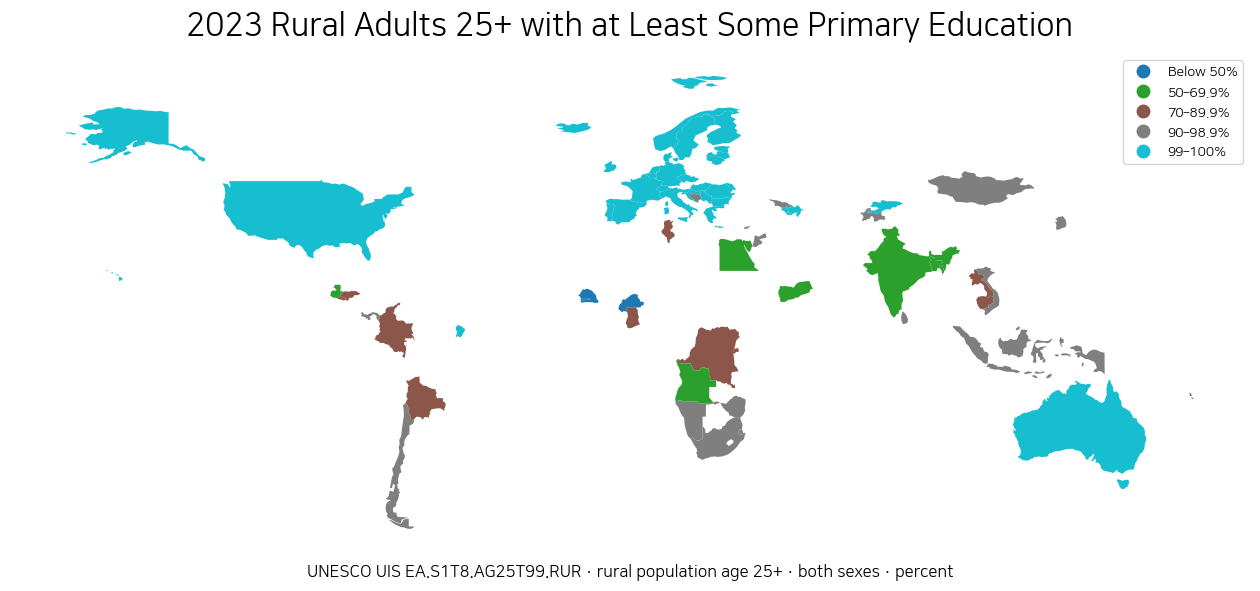
Table of Contents
This is not a primary-school completion rate
The phrase ‘at least some primary’ does not mean that primary education was fully completed. It includes adults who have had some primary-level education as well as those who reached higher levels. The indicator is therefore different from primary completion, primary enrolment and literacy.
The residence filter matters just as much. These observations refer to rural residents age 25 and older, not the entire national adult population. They should not be interpreted as national totals that combine urban and rural residents. A direct urban-rural gap would require a corresponding urban series.
Thirty-four of the 72 observations are at least 99%
34 observations fall in the 99–100% band. 18 are in 90–98.9%, 11 in 70–89.9%, 6 in 50–69.9%, and 3 are below 50%.
Australia, Belgium, Germany, France, the United States and the Netherlands are among the countries reported at 100%. A value of 100% should be read as the published proportion reaching the top of this indicator’s scale, not as a claim that every rural adult completed primary school.
The unweighted mean is 89.5%, lower than the median because a smaller group of low observations pulls the average down. These summary statistics give every country or area the same weight and are not a population-weighted average of the world’s rural adults.
Burkina Faso, Senegal and Gambia have the lowest observations
The lowest 2023 values are Burkina Faso at 9.3%, Senegal at 22.4% and Gambia at 37.3%. They are followed by Yemen at 50.3%, Angola at 57.0%, Guatemala at 66.6%, Bangladesh at 68.4%, India at 68.8% and Egypt at 69.4%.
The indicator does not identify the causes of those differences. Historical school access, cohort effects, rural infrastructure, conflict, income and other factors may matter, but causal explanations require additional data beyond this attainment percentage.
The Republic of Korea is at 94.6%
The Republic of Korea has a 2023 value of 94.6%. That is above 90% but below the 72-observation median of 98.9%. It refers specifically to rural residents age 25 and older and should not be relabelled as the educational attainment of all Korean adults.
Indonesia is at 96.8% and South Africa at 90.8%. India is at 68.8%, Angola at 57.0% and Burkina Faso at 9.3%. Even under the same rural age-25-plus definition, the spread across countries remains very large.
| Country | ISO3 | 2023 value |
|---|---|---|
| Republic of Korea | KOR | 94.6% |
| United States | USA | 100.0% |
| Germany | DEU | 100.0% |
| France | FRA | 100.0% |
| Australia | AUS | 100.0% |
| Indonesia | IDN | 96.8% |
| South Africa | ZAF | 90.8% |
| India | IND | 68.8% |
| Angola | AGO | 57.0% |
| Burkina Faso | BFA | 9.3% |
The distribution is concentrated near the top but has a long lower tail
44 of the 72 observations are at least 95%, and 34 are at least 99%. That concentration near the upper end coexists with a smaller set of much lower values, which is why a single mean does not describe the distribution well.
The map shows a broad 99–100% band across many countries, while much lower values appear in parts of Sub-Saharan Africa, South Asia and the Middle East. This is a descriptive spatial pattern and does not by itself demonstrate the effect of any specific education policy or regional characteristic.
A high value does not measure education quality or completion
A high percentage means that many rural adults have had at least some primary-level education or more. It does not reveal how many completed primary school, how many years of schooling they finished, or how well they can read or perform mathematics.
Primary completion, literacy and learning outcomes answer different questions and should be examined alongside this measure when the goal is to assess the depth or quality of basic education. The strength of EA.S1T8.AG25T99.RUR is its focus on cumulative exposure to formal education among rural adults.
A 2023 cross-section does not show how quickly countries are improving
The dataset is a one-year cross-section. It cannot show whether a country’s rural adult attainment is rising quickly, stagnating or declining relative to earlier years. A trend analysis would require multiple years of the same indicator.
Because the population is age 25 and older, the measure also reflects many generations. Recent improvements in school access among children can take years to change the adult attainment distribution substantially.
Data source and calculation method
Country values come from the UNESCO UIS Data Browser for indicator EA.S1T8.AG25T99.RUR, using the 2023 national observations. The concept of educational attainment follows the UIS description of educational attainment for the population age 25 and above.
The mean, median and band counts treat the 72 country and area observations equally; they are not population-weighted. The package contains the same 72 UIS observations twice under two normalized dataset names, so the analysis uses the explicit percent dataset once and does not double-count duplicate records.
Frequently Asked Questions
Is this the primary-school completion rate?
No. It is the percentage of rural adults age 25+ who have at least some primary education or a higher level. It does not require full completion of primary school.
Does Korea’s 94.6% describe all Korean adults?
No. The 2023 value is specifically for rural residents age 25 and older, both sexes. It should not be interpreted as the national adult attainment rate.
Does a value of 100% mean everyone completed primary school?
No. The indicator is 'at least some primary education.' A 100% value means the published proportion reaches 100% for this measure, not that primary completion is universal.
Can this dataset explain why countries differ?
No. It reports the attainment percentage. Explaining differences would require additional evidence on school access, cohorts, conflict, income, infrastructure and other factors.
Related Maps
Green Map creates custom-edited map images using open geographic data sources such as geoBoundaries, Natural Earth, OpenStreetMap, and government open data.
These maps are edited visual materials, not raw data files, and are provided for education, documents, presentations, and graphic reference.