How many students repeat a grade in lower-secondary general education? UNESCO Institute for Statistics (UIS) indicator 41940 reports the number of repeaters across all grades of lower-secondary general education, both sexes combined, for each reporting country and area.
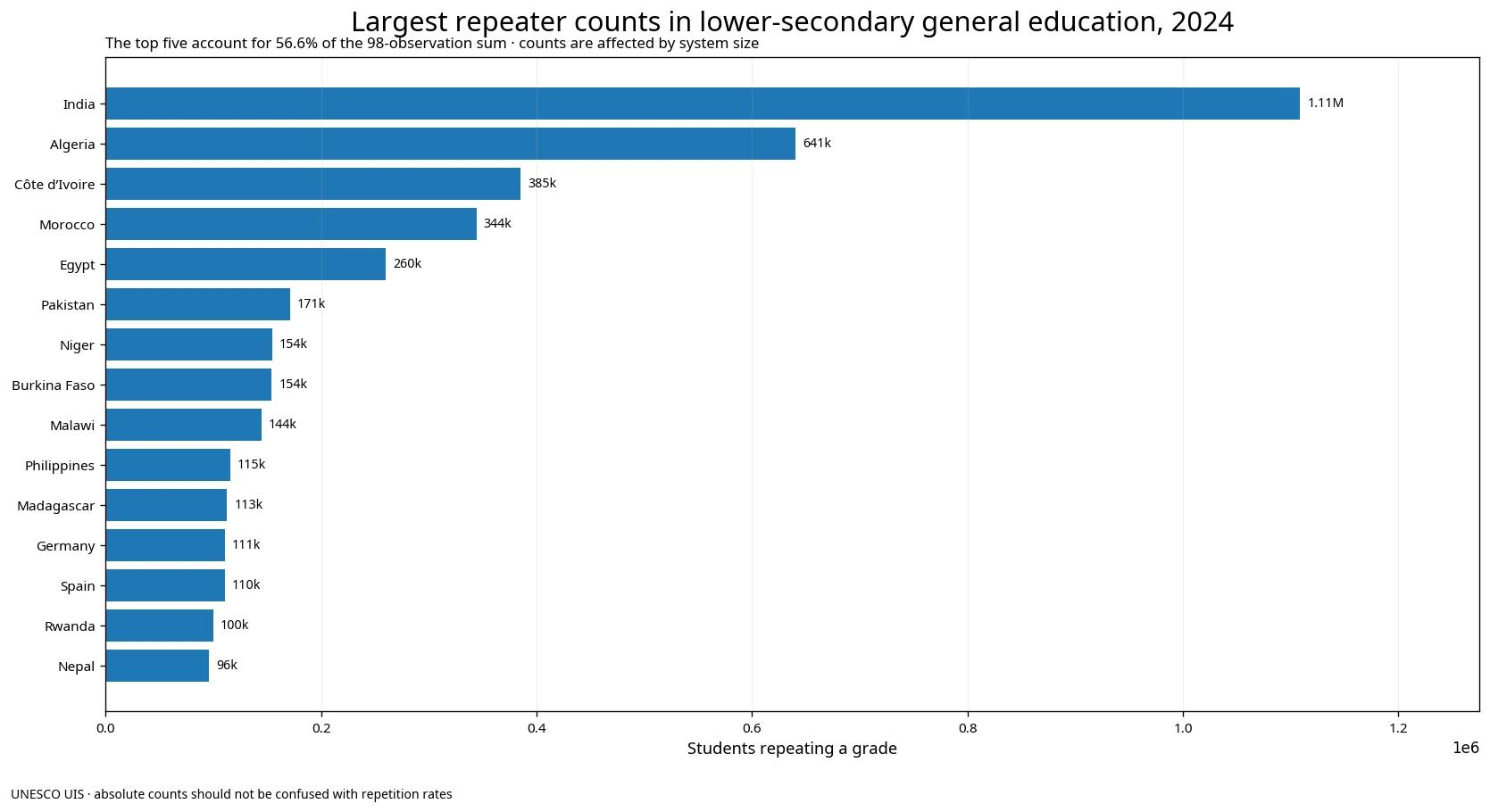
The 2024 extract contains 98 observations with an observed sum of about 4,841,612 students. India has the largest count at 1,109,013, followed by Algeria at 640,587, Côte d’Ivoire at 385,055, Morocco at 344,105 and Egypt at 260,280. The top five alone account for 56.6% of the 98-observation sum.
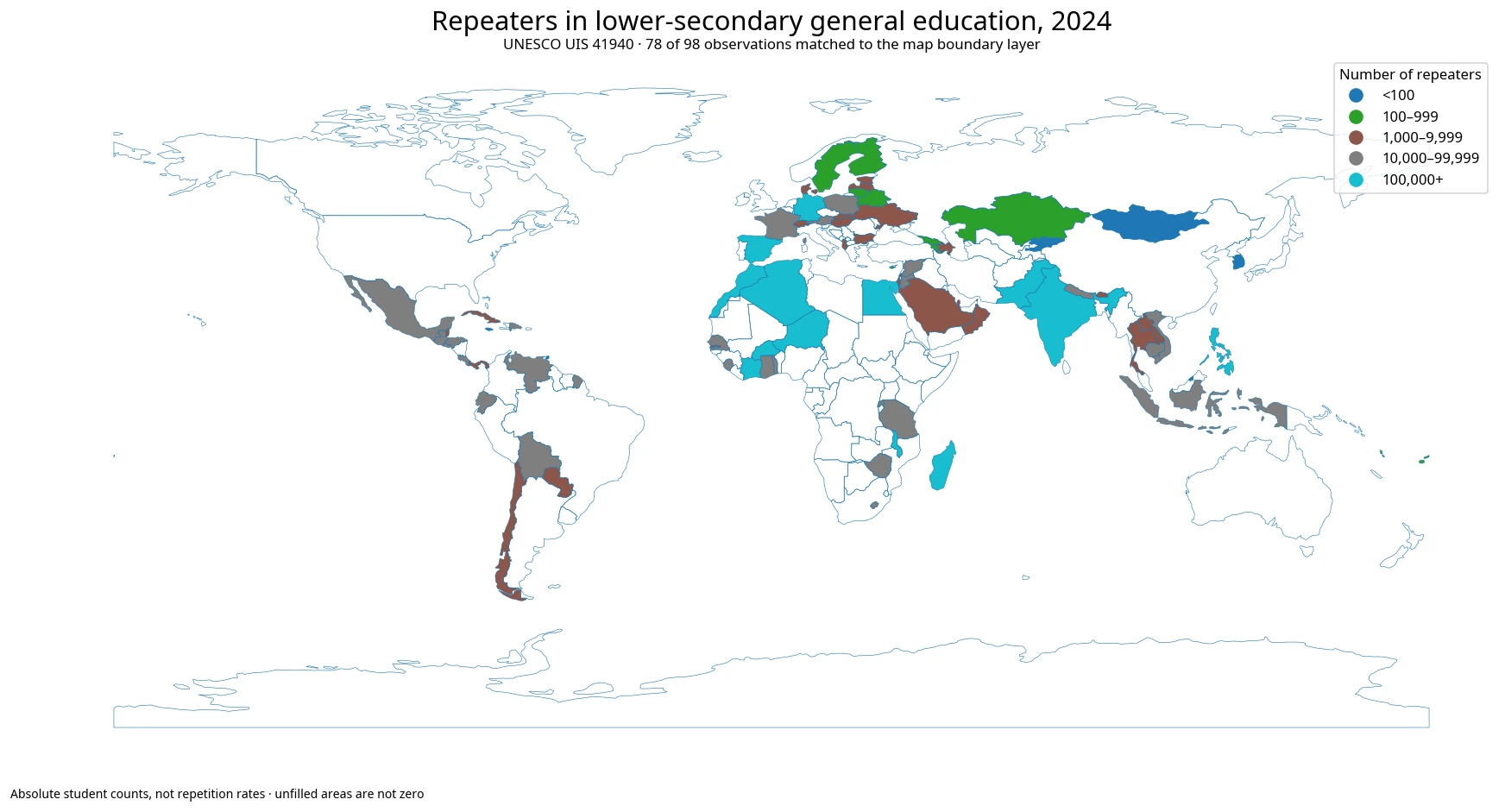
Table of Contents
Who counts as a repeater?
UIS defines a repeater as a student enrolled in the same grade for a second or further time. Students completing a second programme at the same education level after successfully finishing a first programme are not counted as repeaters. The concept refers to students repeating predominantly the same subject matter as in the previous year, and re-entrants to the same programme can be included.
Indicator 41940 combines all grades of lower-secondary general education. It is not a single-grade measure, and it does not automatically include every vocational or technical programme classified at lower-secondary level.
Most importantly, this series is a number, not a repetition rate. A country with 100,000 repeaters does not necessarily have a higher proportion of students repeating a grade than a country with 10,000. A percentage comparison requires the relevant enrollment denominator and the separate UIS repetition-rate methodology.
India alone accounts for 22.9% of the observed sum
India represents 22.9% of the 98-observation sum. Adding Algeria and Côte d’Ivoire brings the top three to 44.1%, while the top ten account for 71.8%.
| Rank | Country / area | Repeaters in 2024 | Share of 98-row sum |
|---|---|---|---|
| 1 | India | 1,109,013 | 22.9% |
| 2 | Algeria | 640,587 | 13.2% |
| 3 | Côte d’Ivoire | 385,055 | 8.0% |
| 4 | Morocco | 344,105 | 7.1% |
| 5 | Egypt | 260,280 | 5.4% |
| 6 | Pakistan | 171,142 | 3.5% |
| 7 | Niger | 154,292 | 3.2% |
| 8 | Burkina Faso | 154,147 | 3.2% |
| 9 | Malawi | 144,455 | 3.0% |
| 10 | Philippines | 115,382 | 2.4% |
| 11 | Madagascar | 112,590 | 2.3% |
| 12 | Germany | 110,633 | 2.3% |
| 13 | Spain | 110,401 | 2.3% |
| 14 | Rwanda | 99,927 | 2.1% |
| 15 | Nepal | 96,028 | 2.0% |
The upper group includes very large education systems and countries where the observed repeater count is substantial relative to the reporting set. Germany and Spain both exceed 110,000 repeaters and are among the top 15.
This ranking should not be converted into a league table of education-system performance. Absolute counts are strongly affected by total lower-secondary enrollment, and countries also differ in grade-retention and automatic-promotion policies.
The mean of 49,404 is far above the median of 4,415.5
The unweighted mean is about 49,404 repeaters, while the median is only 4,415.5. The mean is roughly 11.2 times the median because a small number of very large observations pull the average upward.
The first quartile is 701 and the third quartile is 21,812. Thirteen observations are at or above 100,000 repeaters and 39 are at or above 10,000. At the other end, 17 observations are below 100 and 3 are below 10.
This strongly right-skewed distribution makes the median and concentration shares useful companions to the mean. Describing 49,404 as the size of a typical national repeater population would exaggerate the count for most reporting systems.
Absolute repeater counts are heavily influenced by education-system size
Two quantities jointly determine an absolute repeater count: the number of students enrolled in lower-secondary general education and the proportion who repeat a grade. A very large education system can have a substantial number of repeaters even when its repetition rate is moderate.
A small education system can show the opposite pattern: a relatively high repetition rate but a small absolute count. Comparing India with a small island system on counts alone therefore does not answer which system has the higher repetition risk.
For internal-efficiency analysis, the repeater count is best used together with repetition rates, enrollment totals, promotion rates and dropout measures. The current series directly answers only the scale question: how many students are repeating a grade?
Grade-retention and automatic-promotion policies affect cross-country comparisons
UIS warns that education authorities differ in whether and how often students may repeat a grade. Some systems use grade retention as a formal response to insufficient progress, while others rely more heavily on automatic promotion combined with support in the next grade.
A low repeater count therefore does not automatically prove that students are learning well or that internal efficiency is high. If automatic promotion is widespread, students with learning difficulties may still advance to the next grade.
Likewise, a high count should not be attributed to poor teaching alone. Attendance, assessment rules, school capacity, re-entry after interruption and national promotion policies can all affect repetition. Indicator 41940 does not contain those causal variables.
The series covers general programmes at lower-secondary level
The indicator name explicitly specifies lower-secondary general education. In many countries, most lower-secondary enrollment is general, but some systems already separate vocational or technical pathways at this stage.
Where general programmes do not represent 100% of lower-secondary enrollment, the repeater count in indicator 41940 should not be treated as the total number of repeaters across every lower-secondary programme orientation.
The site’s related lower-secondary general-programme share article provides useful context for that denominator structure. Keeping ISCED level and programme orientation explicit prevents the statistic from being broadened beyond the source definition.
A small absolute count is still different from a low repetition rate
The Republic of Korea records 77 repeaters and ranks 85th among the 98 observations. The absolute number is small, but it does not by itself establish a near-zero repetition rate or superior internal efficiency. A rate comparison requires the relevant lower-secondary enrollment denominator.
The 98-observation sum is not automatically the world total
The observed values add to approximately 4,841,612 repeaters. Because the 2024 extract does not contain every country and area, this sum is used only as the total of the 98 reported observations.
Countries absent from the file are not assigned zero. Missing data and a measured zero are different states, and zero-filling would distort the sum, distribution and rank structure.
A complete world total would require comprehensive same-year coverage or a separate official aggregate. The strength of this dataset is the direct comparison of countries and areas that do have a 2024 observation.
Blank map areas do not mean zero repeaters
78 of the 98 statistical observations match independent polygons in the low-resolution world boundary layer. Small islands and separately reported areas can have valid data without a visible polygon at this resolution.
All 98 observations remain in the tables and statistical calculations even when a polygon match is unavailable. Unfilled map areas are never converted to zero.
The map uses broad count bands because the values range from single digits to more than one million. A single linear color scale would compress most middle-sized observations and make the spatial pattern difficult to read.
Data source and calculation method
Country values come from UNESCO Institute for Statistics indicator 41940, “Repeaters in lower secondary general education, all grades, both sexes (number),” using the 2024 NATIONAL observations in this comparison. UIS defines a repeater as a student enrolled in the same grade for a second or further time.
- UNESCO UIS official API — indicator 41940
- UNESCO UIS — Number of repeaters definition
- UNESCO UIS — Repetition rate by grade definition
- UNESCO UIS Survey of Formal Education — repeater reporting guidance
The observed sum of about 4,841,612, mean of 49,404, median of 4,415.5, quartiles and concentration shares are calculated directly from the 98 non-missing observations. The generic internal unit label is clarified as students/count. No repetition rate is inferred without an enrollment denominator, and missing countries are not zero-filled.
The strongest conclusion supported by the dataset is that absolute repeater counts in lower-secondary general education are highly uneven across the 2024 reporting set. Comparisons of internal efficiency, learning difficulty or policy performance require repetition rates and additional enrollment, promotion and dropout indicators.
Frequently Asked Questions
How does UIS define a repeater?
A repeater is a student enrolled in the same grade for a second or further time, repeating predominantly the same subject matter as in the previous year.
Can this number be read as a repetition rate?
No. It is an absolute student count. A repetition rate requires an enrollment denominator from the relevant cohort or grade.
Does a high repeater count prove poor education quality?
No. Counts are affected by enrollment size and by national policies on grade retention and automatic promotion, among other factors.
How many countries and areas are included in the 2024 comparison?
The dataset contains 98 country and area observations for 2024. Missing places are not treated as zero.
Related Articles
- Lower Secondary General-Programme Share | 120 Countries in 2024
- Secondary Education Standard Duration 2025 | Six Years Most Common
- Out-of-School Rate 2024 | 27 Countries and Areas Above 20%
Green Map creates custom-edited map images using open geographic data sources such as geoBoundaries, Natural Earth, OpenStreetMap, and government open data.
These maps are edited visual materials, not raw data files, and are provided for education, documents, presentations, and graphic reference.