A Malaysia Map must connect two main land areas separated by the South China Sea. Peninsular Malaysia extends south from Thailand, while Sabah and Sarawak occupy the northern part of Borneo beside Indonesian territory. The supplied landscape layout keeps both parts at a readable scale and preserves the long water gap that explains why the country appears divided on regional maps.
The Malaysia Map set contains three administrative views and one separate national flag image. The color, black-and-white, and blank maps each measure 1,200 × 849 pixels; the flag measures 900 × 450 pixels. All four supplied previews are WebP images, and the map views share the same 13-state and three-federal-territory framework.
The labeled versions identify the states, Kuala Lumpur, Putrajaya, and Labuan, while also placing Thailand, Indonesia, Vietnam, and the Philippines around the country. Water labels include the South China Sea, Gulf of Thailand, Sulu Sea, Celebes Sea, and Karimata Strait. These resources suit administrative reference, classroom labeling, country-profile slides, print handouts, and custom regional graphics, but they are not road, terrain, population, or navigation maps.
Table of Contents
Malaysia Map Overview
The central map-reading challenge is distance rather than a single continuous outline. The western group contains 11 states on the Malay Peninsula along with the federal territories of Kuala Lumpur and Putrajaya. Far to the east, the Borneo group contains Sarawak, Sabah, and the small island federal territory of Labuan. A wide sea occupies the middle of the composition, so shrinking the water gap would give readers a misleading impression of proximity.
On the peninsula, Perlis and Kedah occupy the far north below Thailand. Pulau Pinang is shown off the west coast, with Perak below and east of it; Kelantan and Terengganu face the northeastern coast. Pahang fills much of the central-east area, while Selangor, Negeri Sembilan, Melaka, and Johor continue toward the southern tip.
Kuala Lumpur and Putrajaya are too small for centered labels at this scale, so the artwork uses leader lines near Selangor. Pulau Pinang, Perlis, Kedah, Kelantan, Terengganu, and several other compact areas also depend on careful label placement. This Malaysia Map therefore works best when displayed wide enough for the leader lines to remain distinct from state boundaries.
East Malaysia is visually simpler at the state level but more complex along the coast. Sarawak stretches across the southwest of the Malaysian part of Borneo, Sabah occupies the northeast, and Labuan appears as a small offshore unit with a leader line. The maps show neighboring Indonesian land in gray and retain surrounding islands as location context without turning the page into a complete Southeast Asia atlas.
Regional Color Malaysia Map
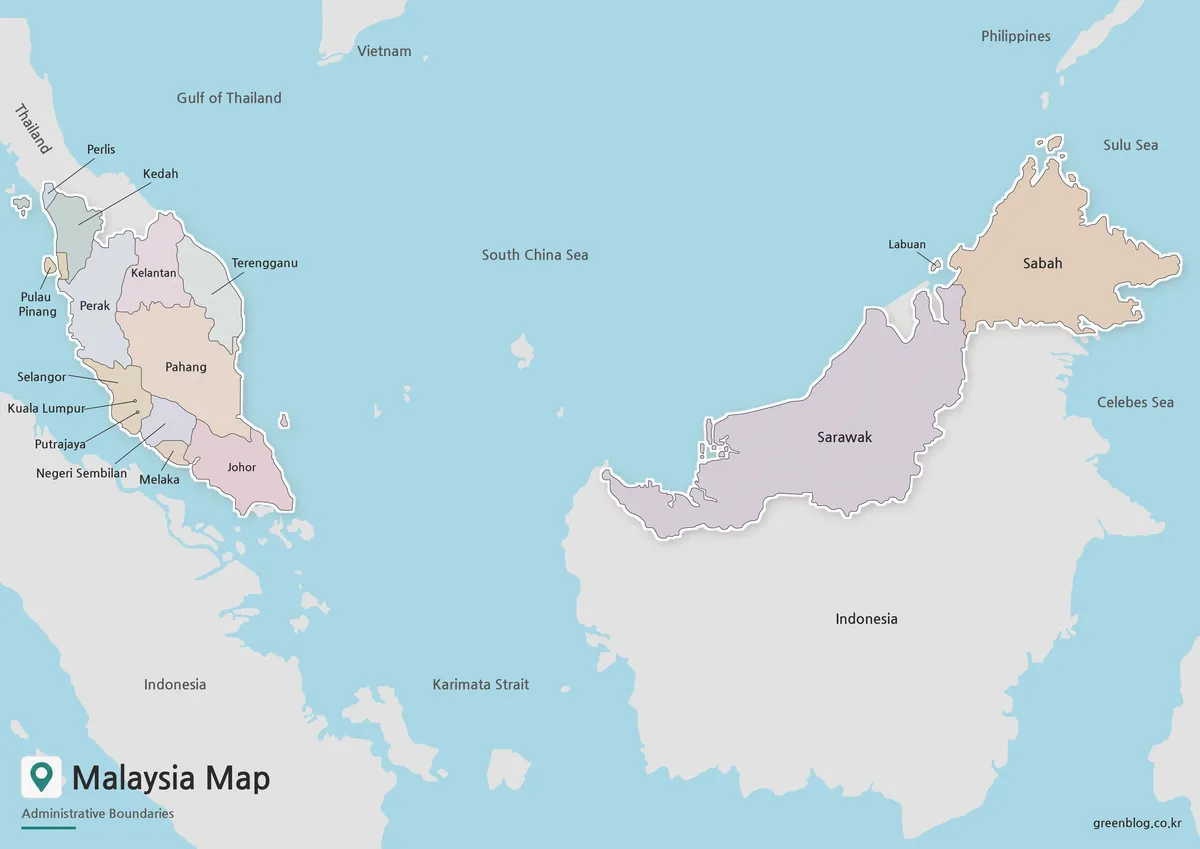
The color view makes adjacent units easier to separate, particularly on the narrow peninsula. Muted fills distinguish Perak from Kelantan, Pahang from Terengganu and Johor, and the small west-coast units from their neighbors. Sarawak and Sabah receive contrasting fills on Borneo, while the surrounding land remains gray and the water blue.
Use this version when the audience needs a quick first reading of the administrative pattern. It can serve as a classroom answer key, a country-introduction slide, or the reference side of a comparison sheet. The colors are categorical only; they do not represent population, elevation, political affiliation, economic values, or any ranked measure.
The wide canvas also preserves regional context that a tightly cropped national silhouette would lose. Thailand appears above the peninsula, Indonesia below both main sections, and the Philippines and Vietnam help orient the northern sea area. Not every neighboring country is labeled, so the image should not be treated as an exhaustive border reference.
Black and White Printable Map
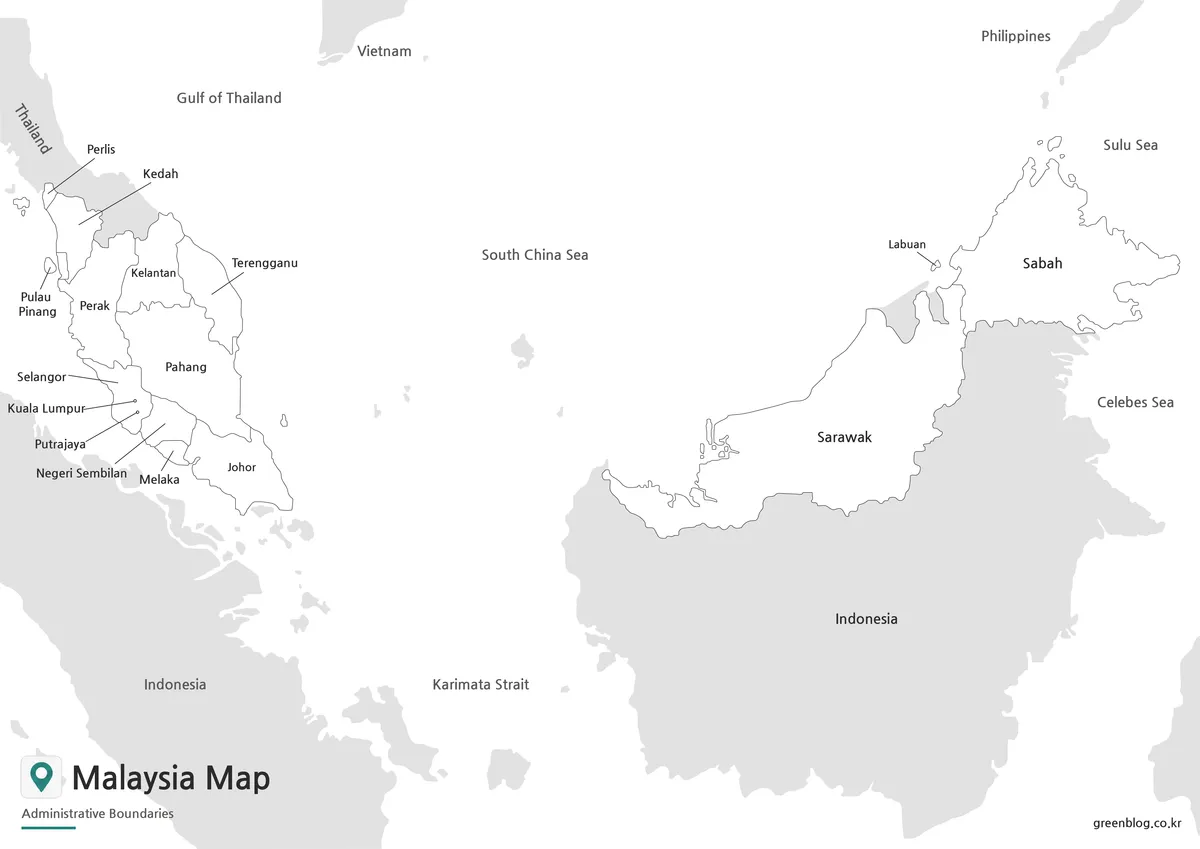
The monochrome Malaysia Map retains state and territory names, surrounding labels, sea names, coastlines, and leader lines while replacing regional fills with white. This makes the administrative divisions available in a cleaner document style. It is appropriate when readers need labels but do not need color to distinguish each unit.
Students can use it to trace the separation between the peninsula and Borneo, identify the northern and southern ends of the peninsula, or compare the size of Sarawak with the compact federal territories. Presenters can add one accent color, arrows, or numbered callouts without competing with the original palette. Because the answers remain printed, this version is better as a reference sheet than as a recall test.
Before printing a class set, check a single copy at the intended paper size. Automatic scaling can make the Kuala Lumpur and Putrajaya leader lines difficult to distinguish, and Labuan can become easy to overlook. Keep the original landscape ratio and avoid cropping either side merely to reduce the large central water area.
Blank Outline Map for Editing
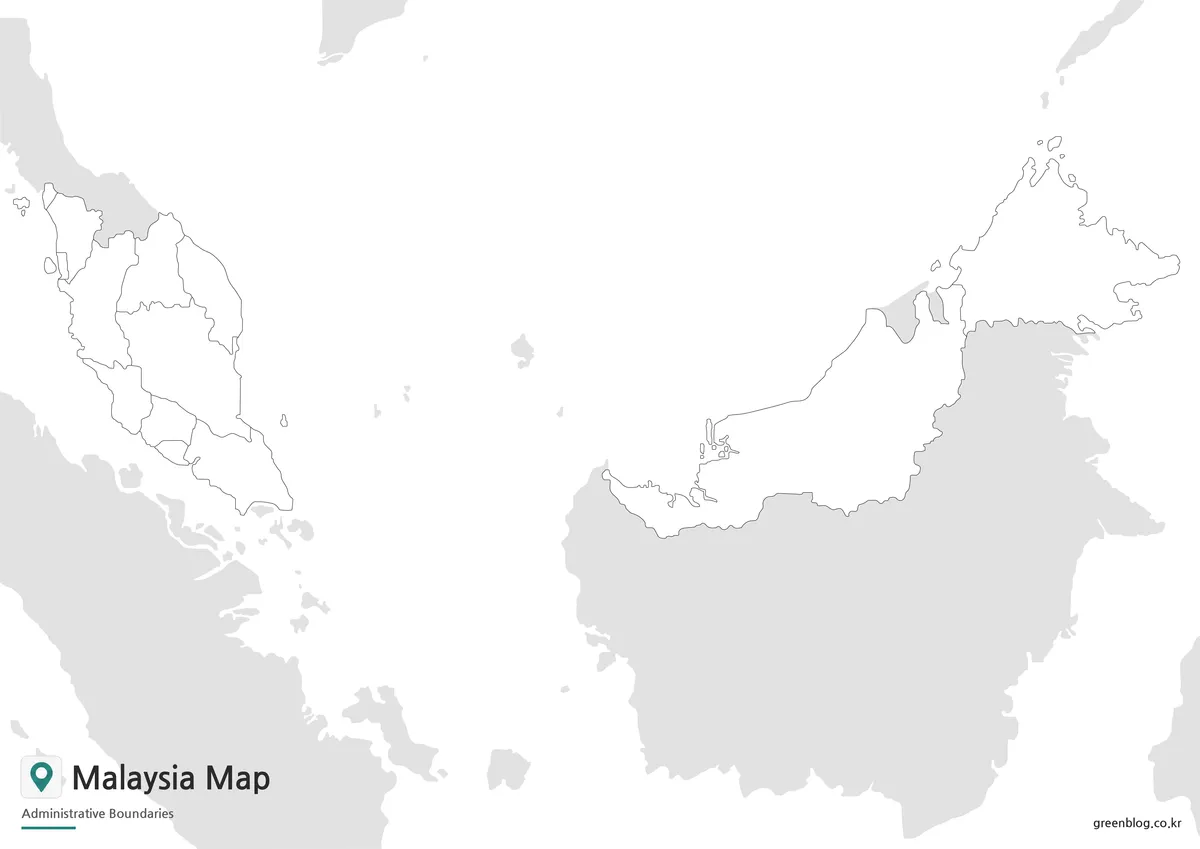
The blank Malaysia Map removes place names, sea labels, and color fills while preserving the country’s state and territory boundaries. Gray surrounding land and the broad white sea area still provide positional context. The result is an activity base rather than a finished reference map.
A teacher can ask students to label the 11 peninsular states, add Sabah and Sarawak, then locate Kuala Lumpur, Putrajaya, and Labuan. A second exercise can add Thailand, Indonesia, Brunei, Singapore, the South China Sea, and nearby waters with the help of a current atlas. Designers can apply a new category system, but every color and legend should be tied to a clear source rather than inferred from the decorative reference version.
The supplied file is a raster preview, not a confirmed vector or layered editing file. Enlargement beyond its natural dimensions may soften fine coastlines and the smallest territorial outlines. For a thematic graphic, test the output size first and keep labels outside compact units when centered text would obscure the boundary.
Malaysia Flag Image
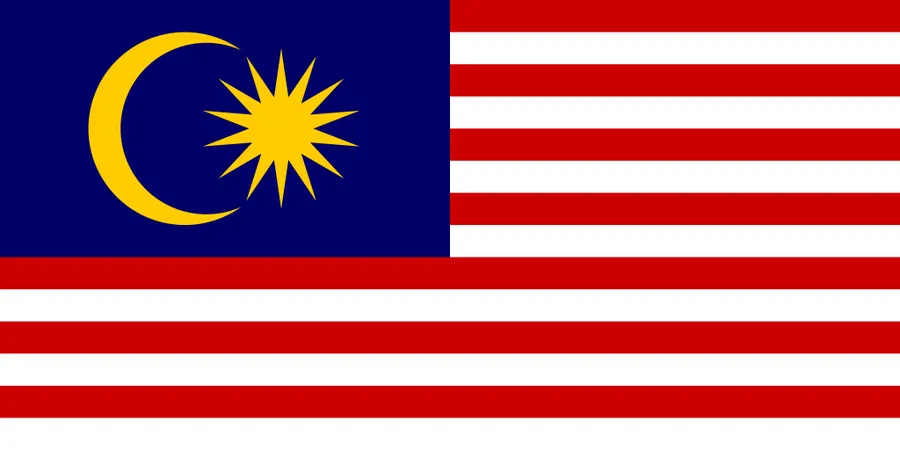
The fourth resource is a separate flag, not another map style. Its 900 × 450-pixel canvas shows red and white horizontal stripes, a dark blue canton, and a yellow crescent with a 14-point star. The 14 stripes and star points represent the 13 member states together with the federal government.
Pair the flag with a Malaysia Map on a country-profile cover, an introductory slide, or a classroom matching card. Keep the two images as distinct visual elements so readers do not mistake the flag for a legend or thematic color key. The flag is most useful for national identification, while the maps explain location and internal divisions.
Administrative Areas Included
Malaysia consists of 13 states and three federal territories. The map labels all 16 first-level units, although the compact territories require leader lines or small offshore placement. The following grouping helps readers check a labeling exercise without confusing geographic regions with administrative status.
- Peninsular states: Johor, Kedah, Kelantan, Melaka, Negeri Sembilan, Pahang, Perak, Perlis, Pulau Pinang, Selangor, and Terengganu.
- Borneo states: Sabah and Sarawak.
- Federal territories: Kuala Lumpur, Putrajaya, and Labuan.
Kuala Lumpur is the national capital, while Putrajaya is the federal administrative center. Both are enclosed by Selangor on the peninsula and appear close together at this national scale. Labuan lies off the coast of Sabah, so its tiny island form and leader line should be checked whenever the map is reduced for a worksheet or mobile screen.
The map uses “Pulau Pinang,” the Malay name shown on the artwork, rather than the English form “Penang.” It also uses “Melaka” instead of “Malacca.” Preserving those visible spellings in an answer key avoids creating an apparent mismatch between the labels and accompanying text.
Practical Uses for This Map Set
Choose the version according to what the reader must do. Color provides immediate separation, monochrome supplies names in a restrained print style, and outline requires the reader to add information. The flag supports national identification but does not replace any geographic view.
- Build a 16-unit labeling worksheet with separate peninsula and Borneo stages.
- Compare states with federal territories without implying that they share identical status.
- Explain how the South China Sea separates the country’s two main regions.
- Use the labeled map as an answer key beside the blank outline.
- Place the flag beside a country profile or Southeast Asia presentation.
- Add a specialized current source when roads, distances, terrain, or travel routes matter.
A Malaysia Map is especially effective in a regional comparison because it prevents Sabah and Sarawak from being overlooked when attention stays on the peninsula. When precise boundaries, district-level data, or transport planning are required, supplement this set with an authoritative current map at the appropriate scale.
FAQ
What is included in this Malaysia Map collection?
The collection includes a color map, a black and white map, a blank outline map, and a Malaysia flag image.
Does the map include both Peninsular Malaysia and East Malaysia?
Yes. The map includes both West Malaysia on the Malay Peninsula and East Malaysia on Borneo.
Are the federal territories included?
Yes. Kuala Lumpur, Putrajaya, and Labuan are included along with the main state divisions.
Can I use the Malaysia Map for printing?
Yes. The map was prepared as an A3 high-resolution resource, making it suitable for printed handouts, reports, classroom materials, and presentation sheets.
Which version is best for editing?
The blank outline map is the best option for editing because it removes labels and colors, leaving a clean boundary base.
Map File Information
The package includes three consistent administrative map views and a separate national flag image for reference, print, lessons, and presentation work.
- Included Versions: Color map · Black and white map · Outline map · Flag image
- Printable Size: Maps prepared for A3 output
- File Type: Image files
- Intended Use: Worksheets, reports, slides, and custom regional graphics
Related Maps
Additional Resources
- Tourism Malaysia: About Malaysia — The official tourism site introduces the country’s 13 states, three federal territories, destinations, and regional travel context.
Green Map creates custom-edited map images using open geographic data sources such as geoBoundaries, Natural Earth, OpenStreetMap, and government open data.
These maps are edited visual materials, not raw data files, and are provided for education, documents, presentations, and graphic reference.