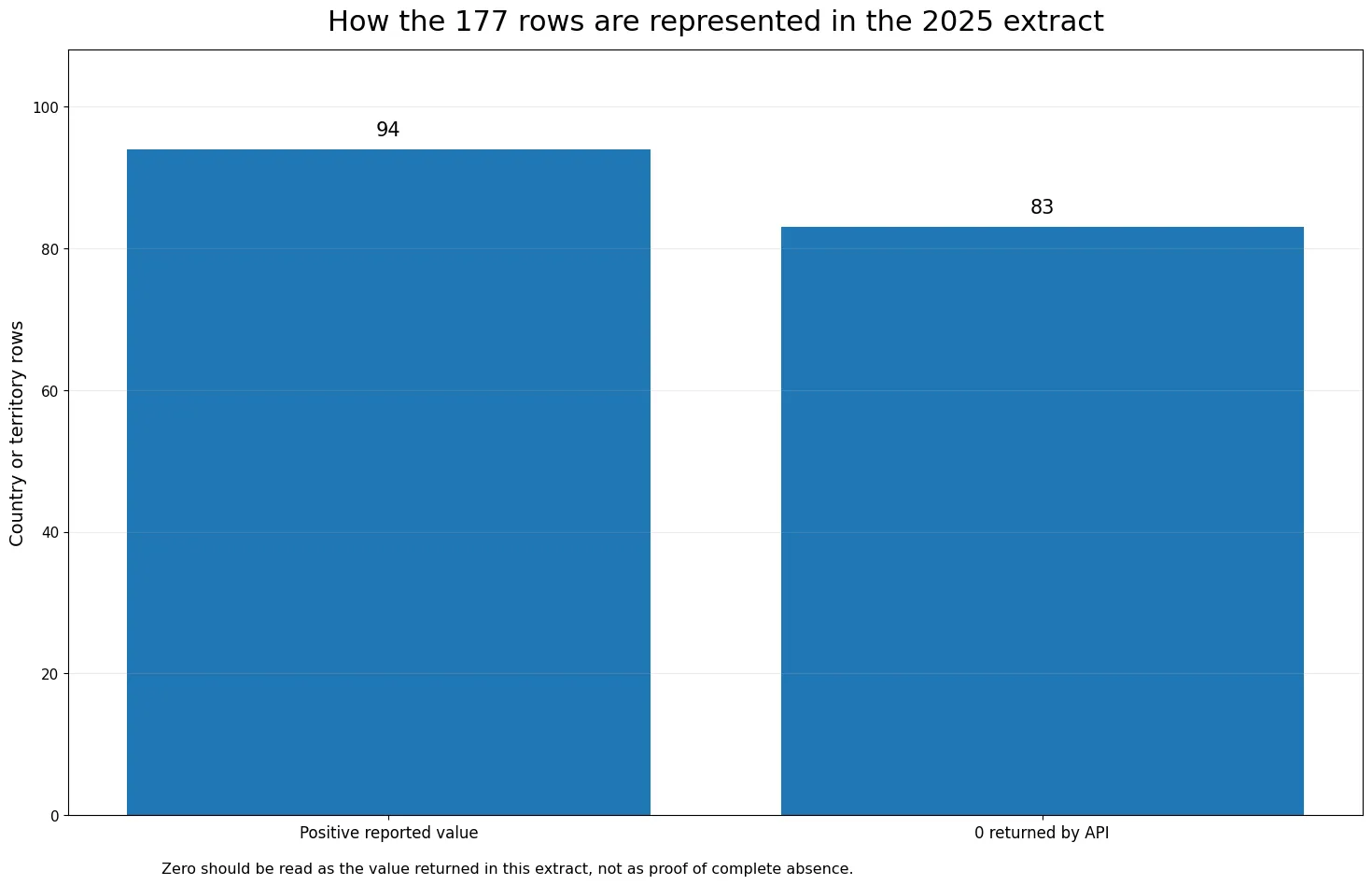
A stateless person is someone who is not recognized as a national by any state under the operation of its law. In the 2025 UNHCR Refugee Statistics extract used here, there are 177 country or territory rows. Ninety-four rows contain a positive reported value and 83 return zero. The largest values are Bangladesh 1,177,962, Côte d’Ivoire 930,958, Thailand 610,791 and Myanmar 519,647. These numbers should be read as reported statistics rather than a complete census of every stateless person in the world.
UNHCR’s end-2025 headline figure is about 4.5 million reported stateless people, while the agency stresses that the true number is likely to be substantially higher. Many countries do not report statelessness data at all, and some countries are able to identify only part of the population. That limitation is essential when reading a map: a zero in this API extract does not prove that no stateless person is present. The visualizations therefore keep reported zero separate from missing map geometry and do not replace unavailable values with zero.
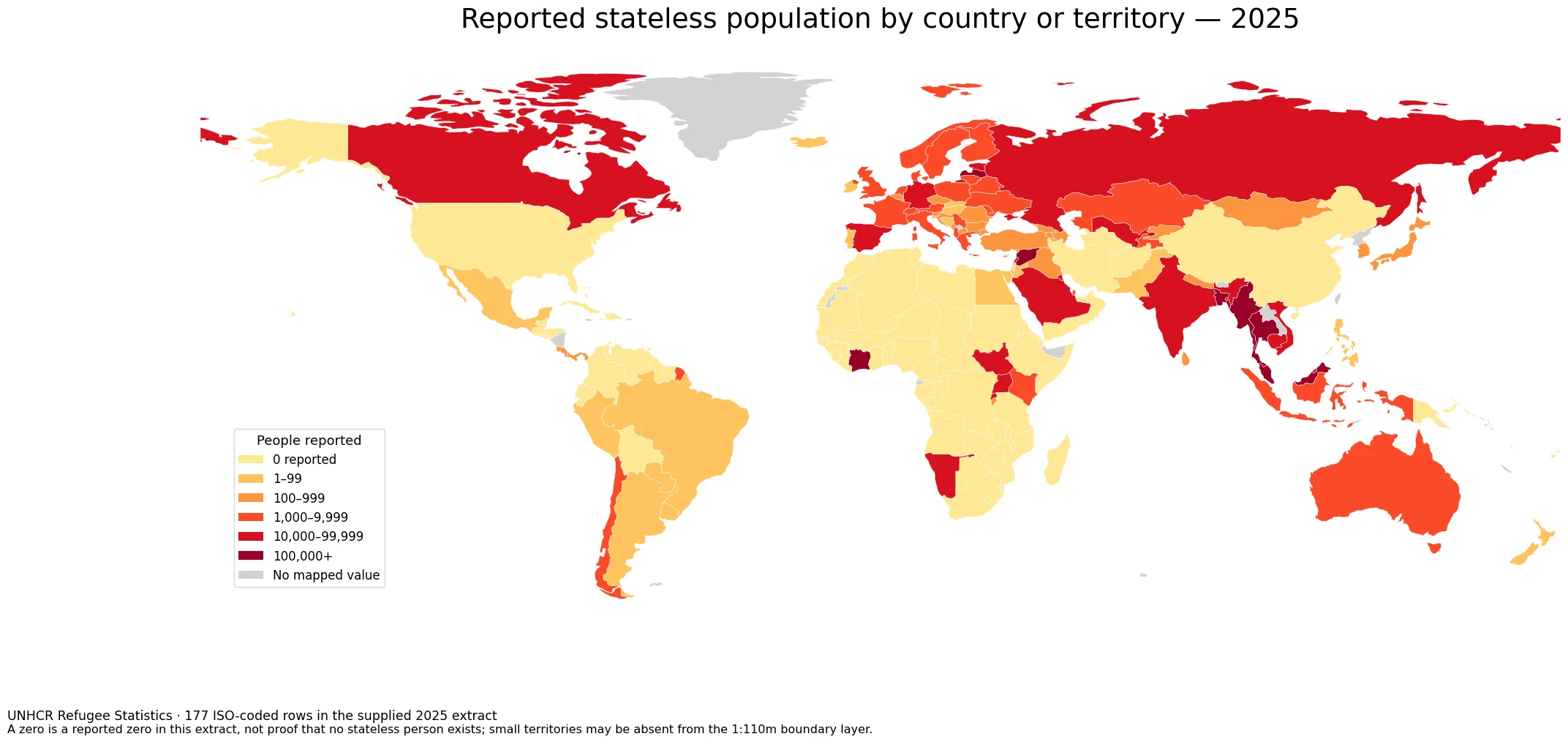
Table of Contents
What counts as stateless in UNHCR statistics
The international legal definition comes from the 1954 Convention relating to the Status of Stateless Persons. A stateless person is someone who is not considered a national by any state under the operation of its law. This is different from merely lacking a passport or identity document. A person can have a nationality without holding a passport, while another person may have some form of documentation but still lack a legally recognized nationality. The statistical category is therefore about nationality status, not simply possession of papers.
UNHCR’s statistical coverage is not identical in every country. In some settings, published figures may also include people of undetermined nationality. UNHCR notes that terminology and reporting practices have not always been applied consistently across country operations, which makes cross-country and time-series comparisons difficult. It has worked with international statistical bodies to improve common definitions, including the International Recommendations on Statelessness Statistics published in 2026.
The Refugee Data Finder definitions and methodology explain these distinctions. They are important because the number attached to a country reflects both the people who can be identified under the mandate and the capacity of institutions to detect, register and report them. A large reported count can therefore reflect a large affected population, strong identification efforts, or both. A low count cannot safely be treated as evidence that statelessness is unimportant.
Four rows account for about 72% of the extracted total
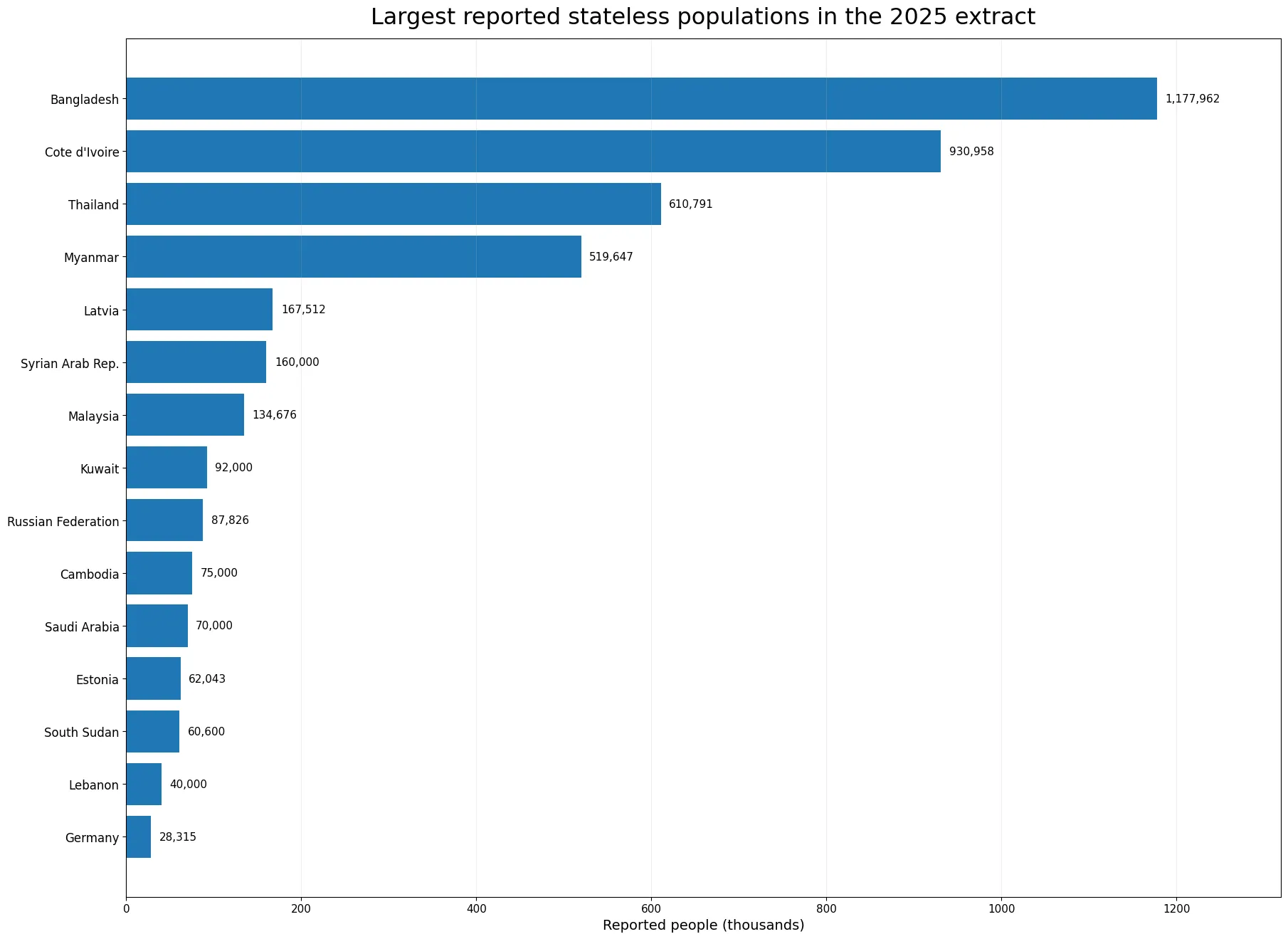
Within the 177-row extract, the four largest values are Bangladesh 1,177,962, Côte d’Ivoire 930,958, Thailand 610,791 and Myanmar 519,647. Together they amount to 3,239,358, or roughly 72.4% of the sum of the rows in this extract. Extending the calculation to the ten largest rows raises the share to about 88.4%. The reported distribution is therefore highly concentrated rather than evenly spread across countries.
The next values are Latvia 167,512, the Syrian Arab Republic 160,000, Malaysia 134,676, Kuwait 92,000, the Russian Federation 87,826 and Cambodia 75,000. A ranking of these values should not be converted into a scorecard of government performance or the severity of legal exclusion. Countries differ in population size, nationality law, administrative records, survey coverage, registration systems and the way populations of undetermined nationality are handled. Those differences can affect what is visible in the statistics.
Why 83 zero rows do not mean 83 countries have no stateless people
The API extract returns zero for 83 country or territory rows. Those zeros are present in the source data; they were not created by filling missing cells during analysis. Even so, “reported zero” and “confirmed absence” are not equivalent. Stateless populations can be difficult to identify because people may lack birth registration, nationality documents or access to administrative procedures. Some may avoid official contact, and some governments do not yet have systems capable of producing complete statistics.
UNHCR’s current Refugee Data Finder summary says that about 4.5 million stateless people were reported as residing in 100 countries at end-2025 and that the real number is believed to be significantly higher. The extract used for this article contains 177 ISO-coded rows because an API response can include many zero-valued rows as well. These counts describe different things: the number of rows returned by a query is not the same as the number of countries represented in UNHCR’s headline reporting.
The median is 15 because the distribution is extremely uneven
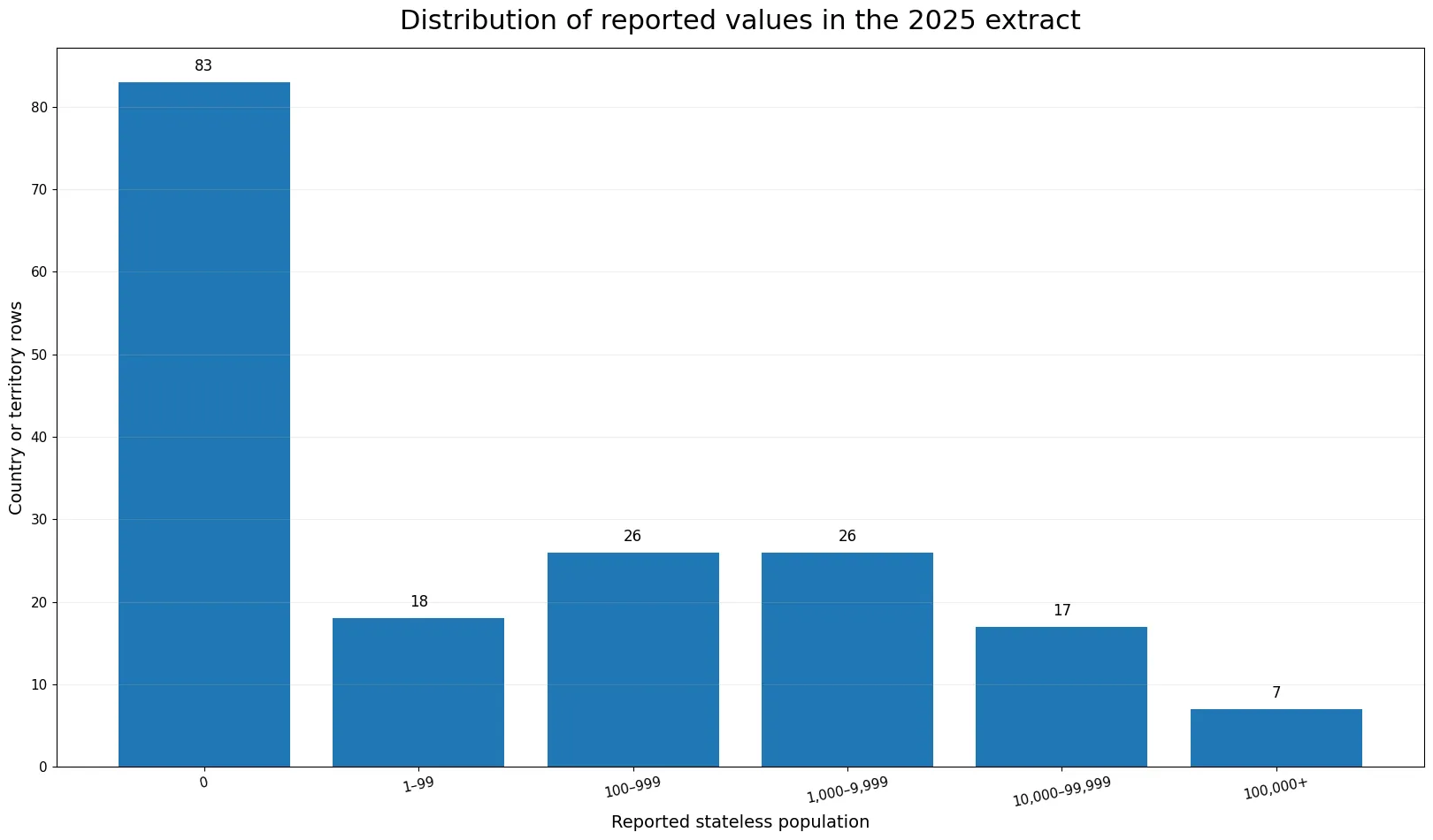
Across all 177 rows, the median is only 15 people, while the arithmetic mean is about 25,295. The large gap is a direct consequence of the shape of the data. Eighty-three rows are zero and many positive rows are small, but a handful of countries have values in the hundreds of thousands or above one million. Among the 94 positive rows only, the median is about 1,314. This is a classic case where the mean alone does not describe a typical country well.
The count bands make the skew clearer: 83 rows are zero, 18 are between 1 and 99, 26 are between 100 and 999, another 26 are between 1,000 and 9,999, 17 are between 10,000 and 99,999, and only seven reach 100,000 or more. Because the scale runs from zero to more than 1.17 million, a simple linear color ramp would compress most countries into nearly the same shade. Broad count bands are more useful for showing where the reported population is concentrated.
Statelessness can overlap with refugee or displacement status
Statelessness and forced displacement describe different characteristics. A person may be stateless without ever leaving the country where they were born. Another person can be both stateless and a refugee, asylum-seeker or internally displaced person. UNHCR’s reporting historically tended to assign one legal or protection status per person, but reporting of dual status expanded from 2017 for displaced Rohingya and was extended to all such populations from 2020. This means that adding the stateless total to refugee or displacement totals can double-count people.
The high values for Bangladesh and Myanmar are closely connected to the large Rohingya population, but the country-level table used here does not provide enough detail to explain every component of those totals. It does not show origin, age, sex, legal subcategory or displacement status within each country row. To explain why a national figure changed, the appropriate next step is to examine UNHCR’s disaggregated country data, changes in nationality law and registration practice, and the relevant time series rather than inferring a cause from a single map.
Cross-country comparisons are better for scale than for performance
Statelessness is one of the harder population categories to compare internationally. Determining nationality status can require legal analysis and administrative evidence, while the people most affected may be among those least visible in civil registration or household data. UNHCR explicitly notes that concepts and definitions have sometimes been applied inconsistently across operations and that comparisons between countries, or even over time within one country, can be challenging. The 2026 International Recommendations on Statelessness Statistics are designed to improve national production of these statistics, but they do not retroactively remove every difference in existing data.
The most defensible use of this dataset is therefore descriptive: identify where very large reported populations are concentrated, see how many rows return small or zero values, and locate cases that deserve deeper country-level research. It is not a valid basis for declaring one government better or worse than another. A fuller assessment would need population denominators, nationality law, birth registration, migration and displacement data, naturalization pathways, administrative coverage and evidence on how stateless populations are identified.
All 177 country and territory rows for 2025
The table below lists every row in the supplied 2025 UNHCR extract, ordered from the largest reported value to the smallest. Country names are retained as they appear in the source. Zero-valued rows are not removed. For a specific country, the number should be checked against UNHCR’s country-level material and national sources before drawing conclusions about current legal or demographic conditions.
| Country or territory | Year | Reported people |
|---|---|---|
| Bangladesh | 2025 | 1,177,962 |
| Cote d'Ivoire | 2025 | 930,958 |
| Thailand | 2025 | 610,791 |
| Myanmar | 2025 | 519,647 |
| Latvia | 2025 | 167,512 |
| Syrian Arab Rep. | 2025 | 160,000 |
| Malaysia | 2025 | 134,676 |
| Kuwait | 2025 | 92,000 |
| Russian Federation | 2025 | 87,826 |
| Cambodia | 2025 | 75,000 |
| Saudi Arabia | 2025 | 70,000 |
| Estonia | 2025 | 62,043 |
| South Sudan | 2025 | 60,600 |
| Lebanon | 2025 | 40,000 |
| Germany | 2025 | 28,315 |
| Viet Nam | 2025 | 25,177 |
| India | 2025 | 22,694 |
| Brunei Darussalam | 2025 | 20,863 |
| Uzbekistan | 2025 | 16,000 |
| Namibia | 2025 | 14,796 |
| Rwanda | 2025 | 14,500 |
| Spain | 2025 | 11,580 |
| Canada | 2025 | 10,288 |
| Uganda | 2025 | 10,284 |
| Kenya | 2025 | 9,800 |
| Ukraine | 2025 | 9,795 |
| Denmark | 2025 | 8,493 |
| Australia | 2025 | 8,183 |
| Kazakhstan | 2025 | 7,857 |
| Sweden | 2025 | 5,838 |
| Belarus | 2025 | 5,444 |
| United Kingdom of Great Britain and Northern Ireland | 2025 | 4,881 |
| Netherlands (Kingdom of the) | 2025 | 4,134 |
| Tajikistan | 2025 | 3,980 |
| Greece | 2025 | 3,743 |
| Rep. of Moldova | 2025 | 3,422 |
| Austria | 2025 | 3,199 |
| France | 2025 | 3,057 |
| Italy | 2025 | 3,000 |
| Indonesia | 2025 | 2,639 |
| Albania | 2025 | 2,301 |
| Lithuania | 2025 | 2,143 |
| Chile | 2025 | 1,694 |
| Serbia and Kosovo: S/RES/1244 (1999) | 2025 | 1,556 |
| Poland | 2025 | 1,504 |
| Norway | 2025 | 1,491 |
| Switzerland | 2025 | 1,332 |
| Finland | 2025 | 1,296 |
| Qatar | 2025 | 1,200 |
| Singapore | 2025 | 1,109 |
| Panama | 2025 | 942 |
| Belgium | 2025 | 837 |
| Croatia | 2025 | 807 |
| Burundi | 2025 | 734 |
| Japan | 2025 | 534 |
| Kyrgyzstan | 2025 | 526 |
| Bulgaria | 2025 | 517 |
| Georgia | 2025 | 480 |
| Nepal | 2025 | 475 |
| Costa Rica | 2025 | 465 |
| Türkiye | 2025 | 464 |
| Czechia | 2025 | 433 |
| Montenegro | 2025 | 300 |
| North Macedonia | 2025 | 300 |
| Armenia | 2025 | 287 |
| Romania | 2025 | 257 |
| Rep. of Korea | 2025 | 248 |
| Azerbaijan | 2025 | 241 |
| Iraq | 2025 | 233 |
| Sri Lanka | 2025 | 232 |
| Malta | 2025 | 171 |
| Cyprus | 2025 | 122 |
| Cabo Verde | 2025 | 115 |
| Slovenia | 2025 | 110 |
| Luxembourg | 2025 | 102 |
| Mongolia | 2025 | 100 |
| Slovakia | 2025 | 71 |
| Hungary | 2025 | 63 |
| Pakistan | 2025 | 60 |
| Philippines | 2025 | 55 |
| Ireland | 2025 | 54 |
| Portugal | 2025 | 46 |
| Israel | 2025 | 35 |
| Iceland | 2025 | 33 |
| Peru | 2025 | 33 |
| New Zealand | 2025 | 29 |
| Argentina | 2025 | 25 |
| Bosnia and Herzegovina | 2025 | 25 |
| Brazil | 2025 | 15 |
| Jordan | 2025 | 13 |
| Mexico | 2025 | 13 |
| Egypt | 2025 | 5 |
| Paraguay | 2025 | 5 |
| Uruguay | 2025 | 5 |
| Afghanistan | 2025 | 0 |
| Algeria | 2025 | 0 |
| Angola | 2025 | 0 |
| Aruba | 2025 | 0 |
| Bahamas | 2025 | 0 |
| Bahrain | 2025 | 0 |
| Barbados | 2025 | 0 |
| Belize | 2025 | 0 |
| Benin | 2025 | 0 |
| Bolivia (Plurinational State of) | 2025 | 0 |
| Botswana | 2025 | 0 |
| British Virgin Islands | 2025 | 0 |
| Burkina Faso | 2025 | 0 |
| Cameroon | 2025 | 0 |
| Cayman Islands | 2025 | 0 |
| Central African Rep. | 2025 | 0 |
| Chad | 2025 | 0 |
| China | 2025 | 0 |
| China, Hong Kong SAR | 2025 | 0 |
| Colombia | 2025 | 0 |
| Comoros | 2025 | 0 |
| Congo | 2025 | 0 |
| Cuba | 2025 | 0 |
| Curacao | 2025 | 0 |
| Dem. Rep. of the Congo | 2025 | 0 |
| Djibouti | 2025 | 0 |
| Dominica | 2025 | 0 |
| Dominican Rep. | 2025 | 0 |
| Ecuador | 2025 | 0 |
| El Salvador | 2025 | 0 |
| Eritrea | 2025 | 0 |
| Eswatini | 2025 | 0 |
| Ethiopia | 2025 | 0 |
| Fiji | 2025 | 0 |
| Gabon | 2025 | 0 |
| Gambia | 2025 | 0 |
| Ghana | 2025 | 0 |
| Guatemala | 2025 | 0 |
| Guinea | 2025 | 0 |
| Guinea-Bissau | 2025 | 0 |
| Guyana | 2025 | 0 |
| Haiti | 2025 | 0 |
| Honduras | 2025 | 0 |
| Iran (Islamic Rep. of) | 2025 | 0 |
| Lesotho | 2025 | 0 |
| Liberia | 2025 | 0 |
| Libya | 2025 | 0 |
| Liechtenstein | 2025 | 0 |
| Madagascar | 2025 | 0 |
| Malawi | 2025 | 0 |
| Mali | 2025 | 0 |
| Mauritania | 2025 | 0 |
| Mauritius | 2025 | 0 |
| Monaco | 2025 | 0 |
| Morocco | 2025 | 0 |
| Mozambique | 2025 | 0 |
| Nauru | 2025 | 0 |
| Niger | 2025 | 0 |
| Nigeria | 2025 | 0 |
| Oman | 2025 | 0 |
| Papua New Guinea | 2025 | 0 |
| Saint Kitts and Nevis | 2025 | 0 |
| Saint Lucia | 2025 | 0 |
| Senegal | 2025 | 0 |
| Sierra Leone | 2025 | 0 |
| Sint Maarten (Dutch part) | 2025 | 0 |
| Somalia | 2025 | 0 |
| South Africa | 2025 | 0 |
| Sudan | 2025 | 0 |
| Suriname | 2025 | 0 |
| Togo | 2025 | 0 |
| Trinidad and Tobago | 2025 | 0 |
| Tunisia | 2025 | 0 |
| Turkmenistan | 2025 | 0 |
| Turks and Caicos Islands | 2025 | 0 |
| United Arab Emirates | 2025 | 0 |
| United Rep. of Tanzania | 2025 | 0 |
| United States of America | 2025 | 0 |
| Vanuatu | 2025 | 0 |
| Venezuela (Bolivarian Republic of) | 2025 | 0 |
| Yemen | 2025 | 0 |
| Zambia | 2025 | 0 |
| Zimbabwe | 2025 | 0 |
Source and scope
The country values come from the UNHCR Refugee Statistics 2025 population API, using the stateless field for country or territory of asylum. UNHCR compiles its population statistics primarily from governments and its own operations. End-year figures for the previous year are normally released in June; the annual 2025 statistics were released on 11 June 2026. The Refugee Data Finder methodology provides the definitions, data structure and reporting cautions used to interpret the series.
This comparison is useful for understanding the spatial concentration of reported stateless populations. It does not establish the complete global number of stateless people, prove that a zero-valued country has no stateless residents, or explain why a country has a high or low count. Those questions require more detailed legal, administrative and demographic evidence than one country-level indicator can provide.
Frequently Asked Questions
What does stateless mean?
A stateless person is someone who is not considered a national by any state under the operation of its law. It is not the same as simply lacking a passport.
Which country has the largest reported value in this 2025 extract?
Bangladesh has the largest value at 1,177,962, followed by Côte d’Ivoire, Thailand and Myanmar.
Does a zero mean there are no stateless people in that country?
No. Zero is the value returned in this API extract. UNHCR warns that statelessness data are incomplete in many countries and the true global number is higher than the reported total.
Can stateless and refugee totals be added together?
Not without checking overlap. A person can be both stateless and a refugee, asylum-seeker or internally displaced person, so simple addition can double-count people.
Related Articles
Green Map creates custom-edited map images using open geographic data sources such as geoBoundaries, Natural Earth, OpenStreetMap, and government open data. These maps are edited visual materials, not raw data files, and are provided for education, documents, presentations, and graphic reference.