Among adults living in rural areas, the share who completed short-cycle tertiary education or a higher level varies widely across countries. UNESCO Institute for Statistics (UIS) indicator EA.5T8.AG25T99.RUR measures the percentage of the rural population age 25 and older, both sexes combined, who completed ISCED level 5 or any higher level. Among the 76 countries and areas with a 2022 observation, the unweighted median is 12.1% and the mean is 15.4%.
This is not a university enrollment rate or the percentage of people currently attending college. It is an accumulated adult educational-attainment measure. The population is restricted to rural residents age 25 and older, so the value can differ substantially from a national rate that combines urban and rural populations. Migration of highly educated adults, the location of tertiary institutions, and differences across birth cohorts can all affect the rural stock of completed education.
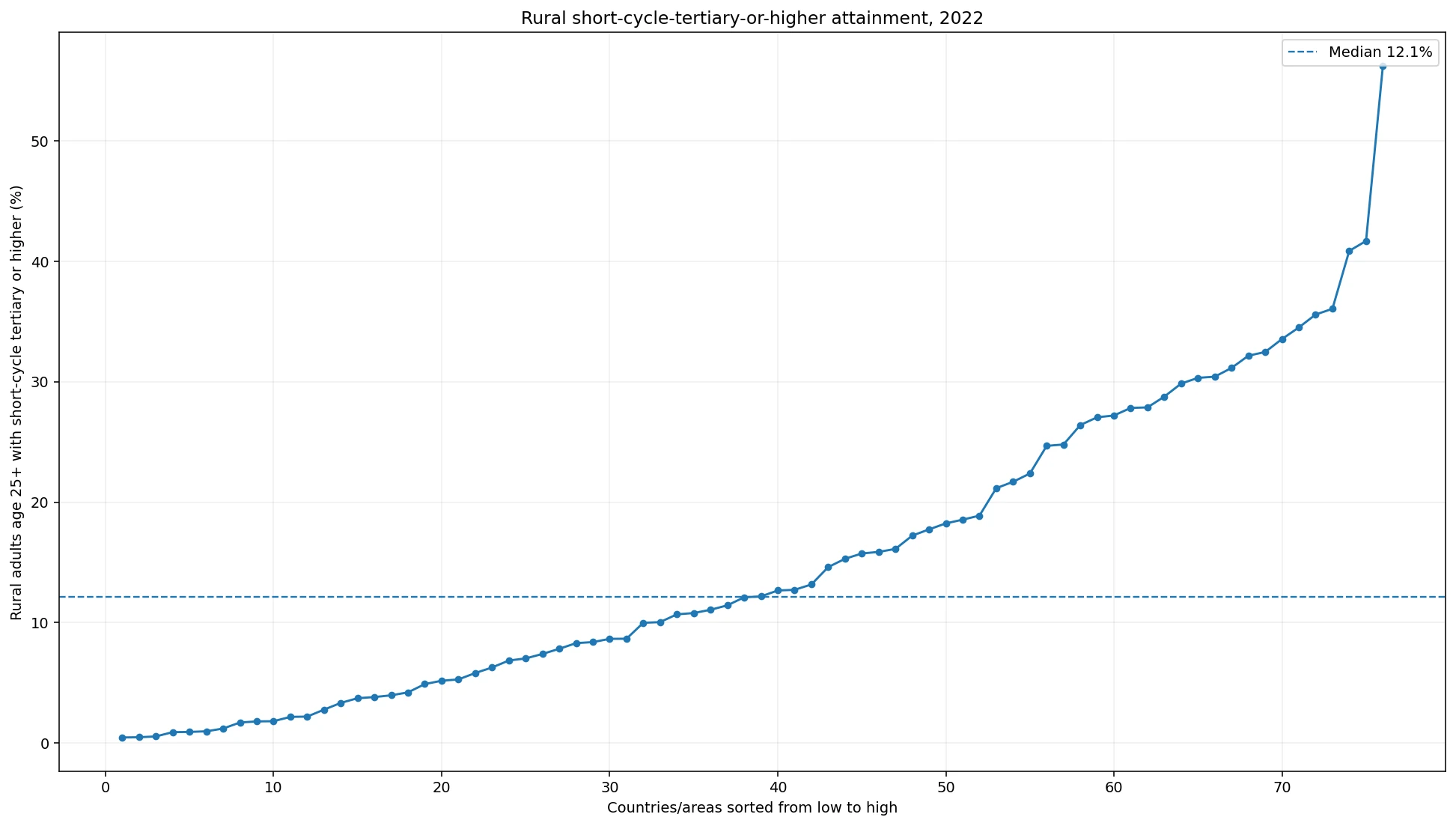
Table of Contents
The indicator measures accumulated attainment among rural adults, not current college participation
The age threshold is central to the definition. Population 25+ covers adults who have generally had time to complete the main stages of formal education. A country can expand tertiary enrollment rapidly among today’s young adults while the age-25-plus attainment rate changes more slowly because older cohorts remain in the denominator. The indicator therefore reflects education accumulated across generations rather than the performance of one graduating class or one academic year.
The RUR suffix is equally important. The measure excludes urban residents and should not be relabeled as the national adult attainment rate. In some countries, universities and professional jobs are concentrated in metropolitan areas, which can encourage tertiary-educated adults to move away from rural communities. In others, commuting patterns, regional institutions, settlement systems, or statistical definitions of rural areas may produce smaller differences. Because this dataset does not provide a matched urban series, it does not support a direct urban-rural gap calculation by itself.
The educational threshold begins at short-cycle tertiary, ISCED level 5. Adults who completed bachelor’s-equivalent, master’s-equivalent or doctoral-equivalent education are also counted because the indicator includes level 5 or higher. National qualifications do not all use the same degree names, so short-cycle tertiary should be interpreted as an internationally harmonized education level rather than as one identical credential in every country.
The median is 12.1%, with the middle half between about 5.1% and 25.2%
Across the 76 observations, the first quartile is 5.1%, the median is 12.1% and the third quartile is 25.2%. The unweighted mean, 15.4%, is about 3.2 percentage points above the median. Higher observations in the 30% to 50% range pull the mean upward, while the lower tail includes several values below 1%. The full distribution is therefore more informative than either average alone.
These statistics are not population-weighted global estimates. Uzbekistan, Luxembourg and the United States each contribute one row, regardless of the size of their rural age-25-plus population. Estimating the share of all rural adults worldwide who reached this education threshold would require population weights or an official aggregate designed for that purpose. The mean and median here describe the distribution of reporting country and area observations.
| 2022 attainment band | Countries/areas | Share of 76 |
|---|---|---|
| Below 1% | 6 | 7.9% |
| 1–4.9% | 13 | 17.1% |
| 5–9.9% | 13 | 17.1% |
| 10–19.9% | 20 | 26.3% |
| 20–29.9% | 12 | 15.8% |
| 30–39.9% | 9 | 11.8% |
| 40% or more | 3 | 3.9% |
The 10–19.9% band is the largest, containing 20 observations. Twenty-four observations are at or above 20%, 12 are at or above 30%, and only three reach 40% or more. At the other end, 19 observations are below 5%, including six below 1%. The values form a broad continuum rather than two sharply separated groups.
Uzbekistan is highest at 56.2%, while Ireland and Luxembourg exceed 40%
Uzbekistan has the highest 2022 observation at 56.2%. Ireland follows at 41.7% and Luxembourg at 40.9%. The United States records 36.1%, Australia 35.6%, Belgium 34.5%, Sweden 33.5% and Switzerland 32.5%. European countries are prominent near the upper end of this 76-observation set, but the coverage is not a complete census of every country in the world. Countries without a reported 2022 value are missing observations, not zero values.
| Rank | Country/area | ISO3 | 2022 rural attainment |
|---|---|---|---|
| 1 | Uzbekistan | UZB | 56.2% |
| 2 | Ireland | IRL | 41.7% |
| 3 | Luxembourg | LUX | 40.9% |
| 4 | United States of America | USA | 36.1% |
| 5 | Australia | AUS | 35.6% |
| 6 | Belgium | BEL | 34.5% |
| 7 | Sweden | SWE | 33.5% |
| 8 | Switzerland | CHE | 32.5% |
| 9 | Republic of Korea | KOR | 32.2% |
| 10 | Norway | NOR | 31.1% |
| 11 | Cyprus | CYP | 30.4% |
| 12 | Estonia | EST | 30.3% |
A high percentage means that a larger share of rural adults age 25+ completed at least ISCED level 5. It does not directly measure learning quality, field of study, employment outcomes, earnings, productivity or the value of credentials in the labor market. Small differences among high-value countries should therefore not be converted into a broad ranking of education systems.
Selected countries show the spread under the same 2022 rural definition
The Republic of Korea records 32.2% in 2022, ranking ninth among the 76 reported observations and sitting about 20.0 percentage points above the 12.1% median. The United States is at 36.1%, Australia 35.6%, Switzerland 32.5%, Norway 31.1% and Germany 24.8%. Because these rows use the same rural, age-25-plus, both-sexes and 2022 definition, the comparison avoids the reference-year mismatch that can occur in latest-available-value datasets.
The 32.2% figure is nevertheless a rural rate, not a national rate for all adults. Urban residents are outside the denominator. A precise national-versus-rural comparison would require a corresponding national or urban UIS series for the same year and the same attainment definition. This article does not infer that missing comparison.
Burkina Faso and Mozambique are around one-half of one percent
At the lower end, Burkina Faso records 0.47% and Mozambique 0.49%. Honduras is at 0.56%, Senegal 0.91%, Guinea-Bissau 0.93% and Mali 0.98%. Togo is at 1.21%, Benin 1.71%, Rwanda 1.80% and Guatemala 1.82%. These are very low shares of rural adults meeting the short-cycle-tertiary-or-higher threshold, but the indicator does not identify a single reason for those outcomes.
| Low-end order | Country/area | ISO3 | 2022 rural attainment |
|---|---|---|---|
| 1 | Burkina Faso | BFA | 0.47% |
| 2 | Mozambique | MOZ | 0.49% |
| 3 | Honduras | HND | 0.56% |
| 4 | Senegal | SEN | 0.91% |
| 5 | Guinea-Bissau | GNB | 0.93% |
| 6 | Mali | MLI | 0.98% |
| 7 | Togo | TGO | 1.21% |
| 8 | Benin | BEN | 1.71% |
| 9 | Rwanda | RWA | 1.80% |
| 10 | Guatemala | GTM | 1.82% |
| 11 | Peru | PER | 2.18% |
| 12 | El Salvador | SLV | 2.20% |
Historical access to secondary and tertiary education, household resources, the geographic distribution of colleges, transport, migration of graduates toward cities, cohort differences and labor-market structures may all matter in practice. None of those explanatory variables is included in this cross-sectional attainment percentage. Causal claims about a particular country require additional official statistics and research rather than an inference from the ranking alone.
The 10–20% range is the most common, and the distribution is continuous
Twenty observations fall between 10% and 19.9%. Another 13 are in the 5–9.9% range and 13 are in the 1–4.9% range, while 12 fall between 20% and 29.9%. The distribution therefore does not divide neatly into high-attainment and low-attainment countries. Values extend gradually from below 1% to above 50%, with many observations in the middle. Broad bands and absolute percentage differences are often more informative than a one-place change in rank.
Germany is at 24.8%, Indonesia 6.3%, Mexico 5.8%, South Africa 5.2% and Brazil 4.9%. Values close to a threshold should not be treated as fundamentally different simply because they fall on opposite sides of 5% or 20%. Survey design, national education structures and the mapping of qualifications into ISCED categories can also introduce practical limits on very fine comparisons.
Unlike a latest-value national article, this dataset holds year and rural scope constant
Adult short-cycle-tertiary-or-higher attainment can also be compared using each country’s latest available national observation. That approach can cover more countries, but reference years may differ and urban and rural residents are combined. The present EA.5T8.AG25T99.RUR extract answers a narrower question: how reported rural adult attainment differed across countries in the common reference year 2022.
The two approaches are complementary rather than interchangeable. A latest-value national article is useful for a broad snapshot of the newest reported national levels. This 2022 rural dataset is better suited to a same-year rural comparison. Subtracting one from the other would not produce a valid urban-rural gap if the population scope, provider series or year differs. A proper gap requires matched series under the same statistical framework, while a trend requires repeated years of the same indicator.
A high attainment rate does not directly measure current policy performance or education quality
Adult attainment is a stock measure. A high 2022 value cannot be attributed automatically to a policy adopted shortly before 2022 because many older cohorts are included. Recent expansion of tertiary education among younger adults may take years to change the overall rural age-25-plus share. Conversely, countries with long-established access can retain high adult attainment even if current enrollment growth is modest.
The measure also says nothing directly about what people studied, whether their qualification is used in their current job, the quality of instruction, learning outcomes, employment rates or earnings. Those questions require different indicators. The safest interpretation stays close to the definition: the percentage of rural adults age 25+ who completed ISCED level 5 or a higher education level.
Missing countries are not zero, and 76 observations should not be generalized to the whole world
The verified extract contains 76 country and area observations for 2022. Countries without a value are omitted rather than assigned 0%. A missing observation and a measured zero are statistically different. Reporting schedules, sample availability, national data systems and the availability of rural disaggregation can all affect which countries appear in a given year.
Comparability also has limits. Rural classifications are harmonized for international reporting but do not describe identical settlement environments everywhere. Short-cycle tertiary programs can have different national names and institutional structures. UIS and ISCED provide a common classification that makes broad comparison possible, yet very small decimal differences should not be treated as exact rankings of educational performance.
Data source and calculation method
Country values come from the official UNESCO UIS API for indicator EA.5T8.AG25T99.RUR. The unit is percent, the reference year used here is 2022, the population is rural residents age 25 and older, and both sexes are combined.
The mean of 15.4%, median of 12.1%, quartiles, band counts and rankings were calculated directly from the 76 reported 2022 observations. Each country or area receives equal weight in these descriptive statistics. Missing values were not replaced by zero, and the cross-section was not used to infer annual growth rates, causal effects or population-weighted global totals.
Frequently Asked Questions
Is this a current college enrollment or graduation rate?
No. It is the accumulated share of rural adults age 25+ who completed ISCED level 5 or a higher education level.
Does short-cycle tertiary or higher include bachelor’s, master’s and doctoral attainment?
Yes. The threshold begins at ISCED level 5, so adults who completed higher tertiary levels are included as well.
Can this be interpreted as the national adult attainment rate?
No. The RUR series covers rural residents only and should be kept separate from a national rate that combines urban and rural populations.
Do countries missing from the 2022 extract have a value of zero?
No. Missing observations are not measured zeros and should not be replaced by 0%.
Related Articles
- Where Is Bachelor’s-or-Higher Attainment Most Common Among Rural Adults? (2022)
- Rural Adult Lower-Secondary-or-Higher Attainment in 2022
- Short-Cycle Tertiary Attainment – Latest Values for Adults 25+
Green Map creates custom-edited map images using open geographic data sources such as geoBoundaries, Natural Earth, OpenStreetMap, and government open data.
These maps are edited visual materials, not raw data files, and are provided for education, documents, presentations, and graphic reference.