UNESCO Institute for Statistics data for 2024 report the male share of enrolment in public early childhood education institutions for 81 countries and territories. The unweighted mean was 51.48% and the median was 51.27%. Most observations were close to an even sex composition: 62 values were between 48% and 52%, and 73 were between 45% and 55%. Hong Kong SAR, China had the highest reported value at 74.22%, while the Cook Islands had the lowest at 37.55%.
The denominator is the key to reading the indicator correctly. A value of 52% means that males account for about 52% of pupils enrolled in public early childhood education programmes in that country or territory. It does not mean that 52% of all male early childhood enrolment is in public institutions. The indicator is therefore about the sex composition of public-institution enrolment.
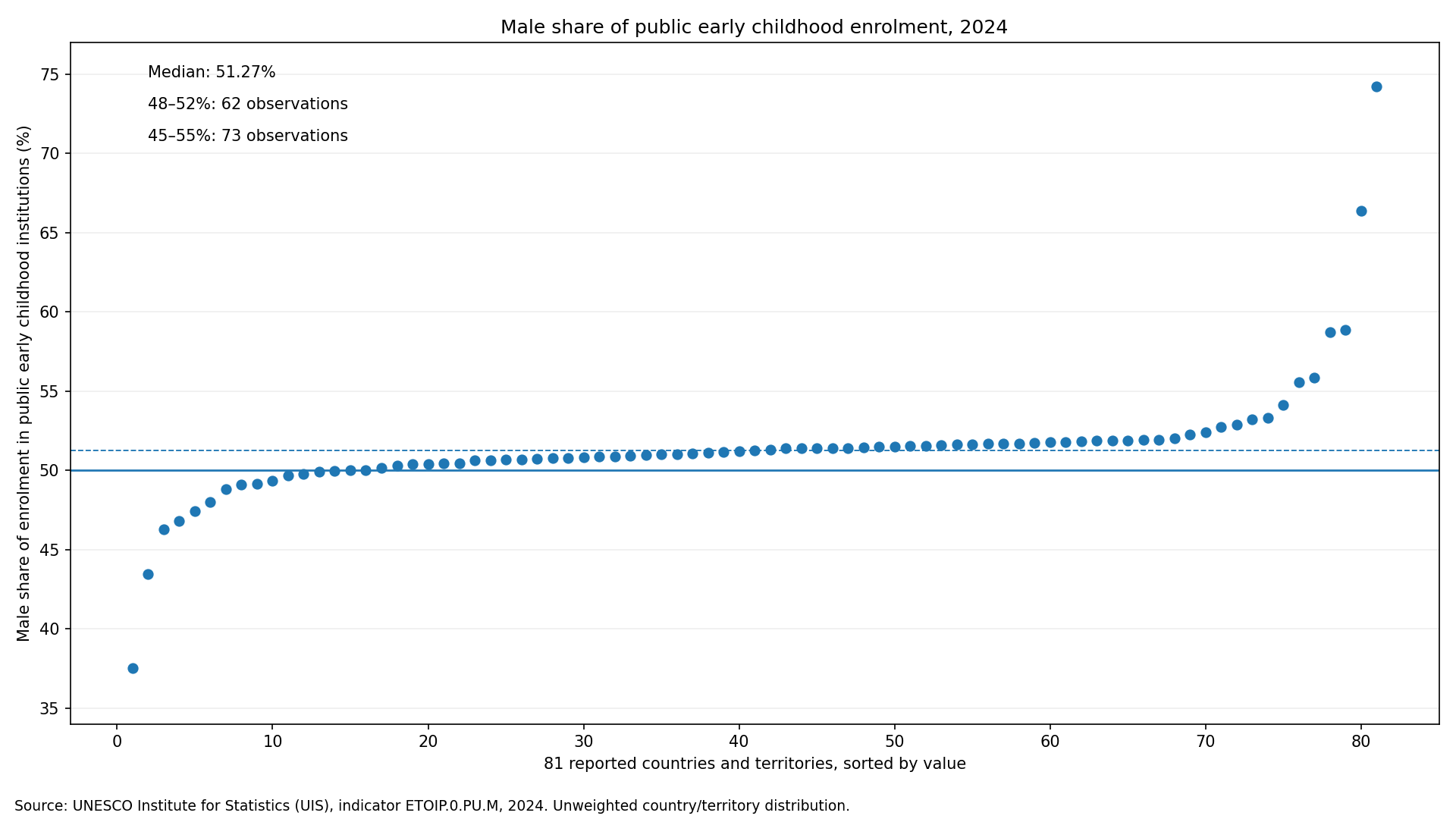
Table of Contents
Why 50% is the central reference
Because the measure describes the male share within public early childhood enrolment, 50% is the point at which male and female enrolment are approximately equal in size. A value above 50% means males were more numerous within the reported public-institution enrolment, while a value below 50% means females were more numerous. This is a composition measure, not a participation-rate measure.
Among the 81 reported observations, 67 were above 50% and 14 were below 50%. Exactly 0 equalled 50%. Those counts should not be treated as evidence that one sex has systematically better access to early childhood education. A country may have nearly equal male and female shares in public institutions even if overall participation is low, and the reverse can also occur.
The central distribution is unusually tight
The first quartile was 50.43% and the third quartile was 51.79%, leaving only 1.36 percentage points between the middle half of the observations. The mean and median were also close. These statistics reinforce the visual pattern: most reported systems had a public early childhood enrolment composition near 50% male.
A tight distribution changes how rankings should be read. A country at 51.8% can rank many places above one at 51.3%, even though the substantive difference is small. The larger analytical value lies in identifying observations that move clearly away from the dense 48–52% cluster rather than focusing on tiny rank differences.
Hong Kong SAR and Maldives were the clearest high-side outliers
Hong Kong SAR, China recorded 74.22%, followed by Maldives at 66.39%. Uzbekistan and the Cayman Islands were also well above the center. In total, 6 observations exceeded 55%. These values indicate a larger male share within public early childhood enrolment than was typical among the 81 reported units.
A high male share does not by itself show that boys had better overall access to early childhood education. The indicator does not include the total population of early-childhood-age children, overall enrolment rates, or the number of places available in public institutions. Those questions require separate participation and enrolment indicators.
The lower end shows the opposite composition
The Cook Islands reported 37.55%, and the United Arab Emirates 43.45%. Only 2 observations were below 45%. A value under 50% means female enrolment formed the larger share of the public-institution total; it does not mean male participation in early childhood education was necessarily low.
Large departures from 50% are useful signals for further investigation, but the present series does not explain their causes. Age structure, institutional coverage, public-sector geography, registration rules, or national data systems could all matter. None of those mechanisms can be identified from this percentage alone.
| Country or territory | Code | Male share |
|---|---|---|
| China, Hong Kong Special Administrative Region | HKG | 74.22% |
| Maldives | MDV | 66.39% |
| Uzbekistan | UZB | 58.88% |
| Cayman Islands | CYM | 58.73% |
| South Sudan | SSD | 55.84% |
| Monaco | MCO | 55.59% |
| Côte d’Ivoire | CIV | 48.01% |
| Qatar | QAT | 47.42% |
| Senegal | SEN | 46.79% |
| Niue | NIU | 46.27% |
| United Arab Emirates | ARE | 43.45% |
| Cook Islands | COK | 37.55% |
Do not confuse sex composition with the public-sector share
Two statements that sound similar answer different questions: ‘males are 52% of public early childhood enrolment’ and ‘52% of male early childhood enrolment is in public institutions.’ The first describes the sex composition inside the public sector. The second would describe how male enrolment is distributed between institution types. This UNESCO series is the first kind of measure.
That distinction is especially important when comparing this series with public-versus-private enrolment indicators. A system can have a small public sector but a nearly even male-female composition inside it, or a large public sector with a composition farther from 50%. Institution type and sex composition are separate dimensions.
The country mean is not a student-weighted world share
The simple mean of 51.48% gives every country or territory the same weight. A very large national education system and a small territory each contribute one observation. The result therefore should not be called the global male share of public early childhood enrolment. A true student-weighted global share would require public-institution enrolment counts for each reporting unit.
The median has a different but related limitation. It is the middle country-level observation after sorting the percentages; it does not represent the middle student worldwide. Its value is descriptive: it shows where the national and territorial observations are centered and helps reduce the influence of the few unusually high or low values.
Reported coverage is narrower than the global catalogue
All 81 rows used here contain a numeric 2024 observation, so there are no missing values inside the reported set. However, many national units in the broader UIS catalogue do not have a 2024 value for this indicator. Those absent units should remain no data rather than being assigned zero, because zero would imply that no male enrolment existed in public early childhood institutions.
A common reference year removes the problem of mixing 2021, 2022, 2023, and 2024 observations, but it does not make every national education system identical. Definitions, institutional structures, and statistical reporting practices can differ. For that reason, broad distribution patterns are generally more robust than overinterpreting differences of a few tenths of a percentage point.
What the indicator can and cannot answer
The series can answer a focused question: what share of reported public early childhood enrolment was male in each country or territory? It can also show how tightly the values cluster around 50%, where the largest departures occur, and whether the male or female share is larger within the public-institution total.
It cannot tell us the overall early childhood participation rate, the share of all children attending public institutions, education quality, teacher availability, household costs, or learning outcomes. Those dimensions need different indicators. Keeping the denominator clear is the most important step when combining this series with other education statistics.
Source and calculation notes
The source is UNESCO Institute for Statistics indicator ETOIP.0.PU.M for 2024. The analysis uses all 81 reported national and territorial observations in the supplied series. Means, quartiles, medians, and range counts were calculated directly from the published values, with no imputation or zero-filling. The UNESCO UIS data endpoint provides the official series.
All summary statistics are unweighted across reporting units. The 50% line is used only as the equal-composition reference inside public early childhood enrolment. It is not a benchmark for the size of the public sector or the overall level of participation.
Frequently Asked Questions
What does 50% mean in this indicator?
It means male and female enrolment are approximately equal in size within public early childhood institutions. It is not the public-sector participation rate.
Does a value of 55% mean 55% of male pupils attend public institutions?
No. It means males account for 55% of enrolment inside public early childhood institutions. The distribution of male enrolment by institution type is a different measure.
Is the 51.48% mean a global student-weighted share?
No. It is an unweighted average of 81 national and territorial percentages. Student counts would be needed to calculate a global weighted share.
Related Articles
Green Map creates custom-edited map images using open geographic data sources such as geoBoundaries, Natural Earth, OpenStreetMap, and government open data. These maps are edited visual materials, not raw data files, and are provided for education, documents, presentations, and graphic reference.