How common is a bachelor’s degree or equivalent among adults who live in rural areas? UNESCO Institute for Statistics indicator EA.6T8.AG25T99.RUR measures the percentage of the rural population age 25 and older, both sexes, who have completed Bachelor’s or equivalent education or a higher level. Master’s and doctoral attainment are therefore included in the numerator.
Across the 80 country and area observations available for 2022, the unweighted median is 10.2% and the mean is 11.4%. 18 observations are at or above 20% and 40 are at or above 10%. At the lower end, 29 are below 5%, including 10 below 1%.
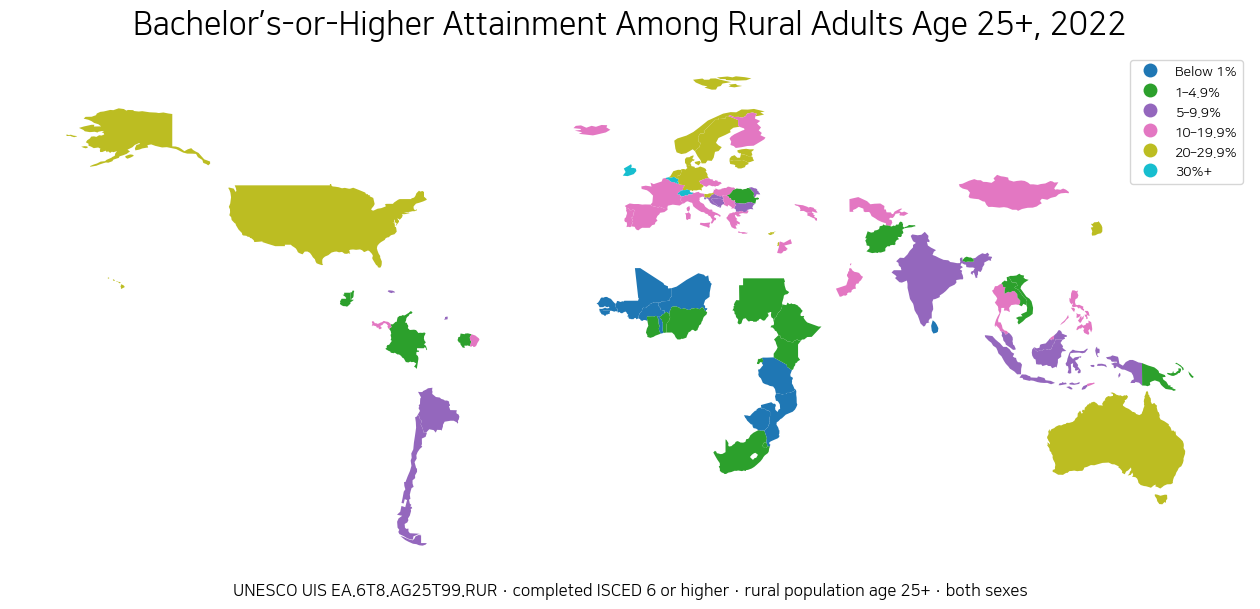
Table of Contents
The indicator is specifically about bachelor’s-or-higher attainment in rural areas
Three conditions define the measure. The population is age 25 and older, residence is rural, and the educational threshold is successful completion of Bachelor’s or equivalent education or higher. It is therefore different from current university enrolment, the annual number of graduates, and a national attainment rate that combines urban and rural residents.
In the ISCED framework, Bachelor’s or equivalent is level 6. The indicator code spans levels 6 through 8, so it also includes adults whose highest completed level is a Master’s or doctoral equivalent. Using ISCED allows countries with different degree names and institutional structures to be compared through a common education-level classification.
The rural residence filter is essential. Countries can have large differences between cities and rural areas in access to universities, professional employment and the migration of highly educated adults. The published rural percentage should not be relabelled as the national adult bachelor’s attainment rate.
The median across 80 observations is 10.2%
The unweighted median is 10.2% and the mean is 11.4%. The first quartile is 2.5% and the third quartile is 18.1%, meaning the middle half of the observations lies roughly within that interval.
Only 4 observations reach 30% or more, while 18 reach at least 20%. At the same time, 29 observations are below 5% and 10 are below 1%. The wide spread makes it more informative to examine the full distribution than to rely on a single average.
Luxembourg, Belgium and Switzerland have the highest values
Luxembourg has the highest 2022 observation at 36.1%. Belgium follows at 33.6%, Switzerland at 32.5% and Ireland at 31.5%. Lithuania is at 29.8%, the Netherlands 25.8% and Estonia 25.1%.
Germany is at 23.8%, Sweden 23.7%, Australia 23.3%, the United States 23.2%, Latvia 23.1%, Denmark 22.8% and Norway 22.6%. European countries are prominent near the top of this 80-observation set, but the coverage should not be treated as a complete ranking of every country in the world.
| Rank | Country | ISO3 | 2022 rate |
|---|---|---|---|
| 1 | Luxembourg | LUX | 36.1% |
| 2 | Belgium | BEL | 33.6% |
| 3 | Switzerland | CHE | 32.5% |
| 4 | Ireland | IRL | 31.5% |
| 5 | Lithuania | LTU | 29.8% |
| 6 | Netherlands | NLD | 25.8% |
| 7 | Estonia | EST | 25.1% |
| 8 | Germany | DEU | 23.8% |
| 9 | Sweden | SWE | 23.7% |
| 10 | Australia | AUS | 23.3% |
The Republic of Korea is at 21.9%, above the 80-country median
The Republic of Korea has a 2022 rural bachelor’s-or-higher attainment rate of 21.9%. That is above the 80-observation median of 10.2% and places Korea in the 20% or higher band. The figure is specifically for rural residents age 25 and older, not all Korean adults.
Among the comparison countries, the United States is at 23.2%, Germany 23.8%, Australia 23.3% and the Netherlands 25.8%. France is at 14.5%, India 6.8% and South Africa 1.8%. Even under the same rural age-25-plus definition, the accumulated level of tertiary attainment differs sharply.
| Country | ISO3 | 2022 rural bachelor’s-or-higher rate |
|---|---|---|
| Republic of Korea | KOR | 21.9% |
| United States | USA | 23.2% |
| Germany | DEU | 23.8% |
| France | FRA | 14.5% |
| Australia | AUS | 23.3% |
| India | IND | 6.8% |
| South Africa | ZAF | 1.8% |
| Netherlands | NLD | 25.8% |
Ten observations are below 1%
Niger has the lowest value at 0.031%. Zimbabwe is at 0.161%, Burkina Faso 0.248%, Guinea-Bissau 0.290%, Mali 0.490%, Mozambique 0.612%, Sri Lanka 0.637%, Tanzania 0.829%, Togo 0.869% and Senegal 0.912%.
The dataset does not establish why these values are low. Historical access to schooling, rural availability of tertiary education, migration of graduates toward cities, cohort differences, household resources, transport and labour-market structure may all matter. Causal explanations require evidence beyond this attainment percentage.
Rural attainment can differ from the national rate
Adults with bachelor’s degrees may move toward cities for professional employment, postgraduate study or public services. In countries where that migration is strong, rural educational attainment can be lower than the national average even when tertiary education is widely available nationally.
The opposite is also possible in places where metropolitan and rural classifications capture very different settlement patterns. A direct urban-rural gap requires a comparable urban series or the corresponding national total. This dataset contains the rural measure, so no urban value is inferred.
A high rate does not directly measure education quality or labour-market outcomes
A high bachelor’s-or-higher percentage means that a larger share of rural adults completed a tertiary level at ISCED 6 or above. It does not reveal field of study, learning quality, how well qualifications match available jobs, earnings, productivity or whether graduates use their degree in their occupation.
Degree structures also vary internationally. Some professions require advanced degrees in one country but not in another, and equivalent qualifications can carry different names. The UIS measure is valuable because it places these systems on a common ISCED level, but interpretation should remain within the scope of educational attainment.
An age-25-plus stock measure changes more slowly than current graduation flows
The age-25-plus population includes many cohorts. A recent increase in university participation among young rural adults can take years to change the overall attainment rate because older generations remain part of the denominator.
The measure is therefore better understood as accumulated educational attainment than as an indicator of one year’s university performance. To study progress over time, multiple years of EA.6T8.AG25T99.RUR should be compared rather than relying on the 2022 cross-section alone.
Blank areas on the map are not zero
Of the 80 statistical rows, 80 match separate polygons in the low-resolution world boundary layer used for the map. Small states and territories may not appear as separate shapes at this resolution even when they have a valid statistical observation.
Countries absent from the 2022 extract are also left unclassified. Missing data and a measured value of 0% are different statistical states. The map uses six bands from below 1% to 30% or more to keep both low and high observations visible.
Data source and calculation method
Country values come from the UNESCO UIS Data Browser and official indicator EA.6T8.AG25T99.RUR for 2022. The educational-attainment concept follows the UIS description of educational attainment for the population age 25 and above.
The mean, median, quartiles and threshold counts treat the 80 country and area observations equally; they are not population-weighted global estimates. The official unit is percent, and the published source values are used without transforming the indicator.
Frequently Asked Questions
Is this the national bachelor’s-or-higher attainment rate?
No. It applies only to rural residents age 25 and older. It should not be interpreted as a national rate that combines urban and rural populations.
Does bachelor’s-or-higher include Master’s and doctoral degrees?
Yes. The indicator covers completion at ISCED level 6 or higher, so Master’s-equivalent and doctoral-equivalent attainment are included.
What does Korea’s 21.9% mean?
It means that 21.9% of Korea's rural population age 25+ in the 2022 UIS observation had completed bachelor’s-equivalent education or a higher level.
Does a high bachelor’s-or-higher rate mean rural education quality is high?
Not by itself. The indicator measures completed education level, not learning quality, field of study, employment outcomes, earnings or how qualifications are used in the labour market.
Related Maps
Green Map creates custom-edited map images using open geographic data sources such as geoBoundaries, Natural Earth, OpenStreetMap, and government open data.
These maps are edited visual materials, not raw data files, and are provided for education, documents, presentations, and graphic reference.