Which countries send the largest numbers of internationally mobile tertiary students to South and West Asia? UNESCO Institute for Statistics indicator OE.5T8.40535 fixes the destination at the South and West Asia region and reports the number of internationally mobile tertiary students by country of origin, both sexes.
The 166 origin-country observations for 2023 sum to 75,424. Afghanistan is the largest origin with 16,398 students, followed by Nepal with 13,135 and Iraq with 6,713. Those three origins account for 48.1% of the observed sum, while the top ten account for 68.2%.
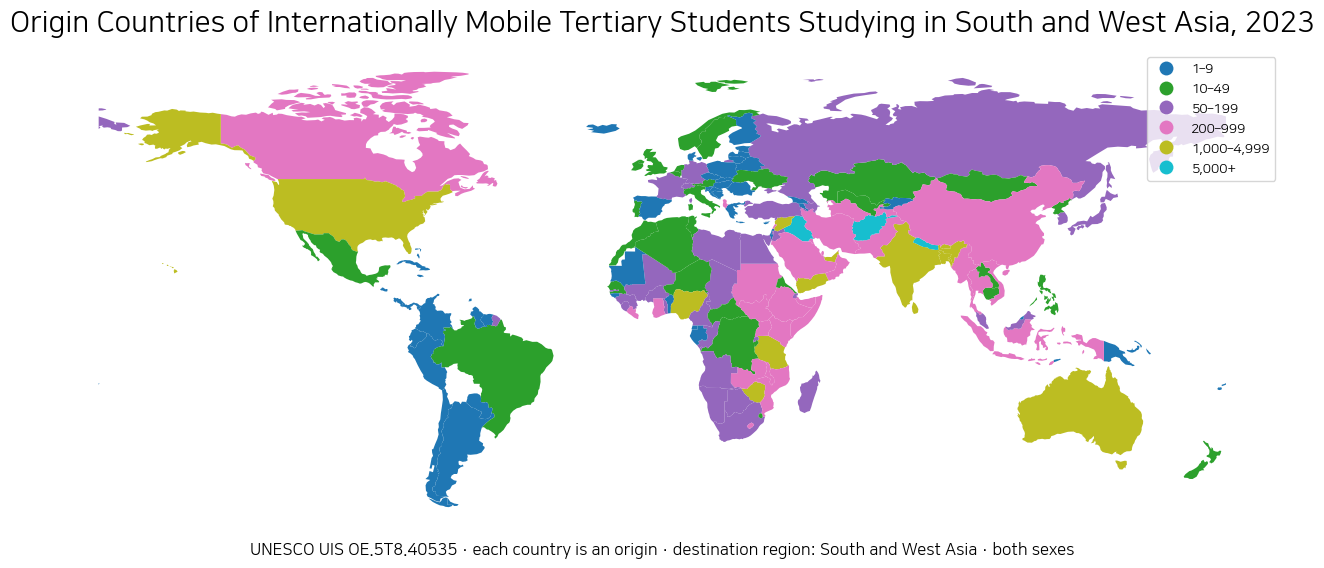
Table of Contents
Each country on the map is an origin, not a destination
Afghanistan’s value of 16,398 is not the number of foreign students enrolled in Afghanistan. It is the estimated number of internationally mobile tertiary students whose country of origin is Afghanistan and who study in another country located in the South and West Asia destination region.
The United States is read the same way. Its value of 2,995 represents U.S.-origin mobile tertiary students studying somewhere in South and West Asia. This dataset is therefore an origin-country distribution for one destination region, not a destination-country ranking of inbound students.
UIS defines internationally mobile students as people who physically cross an international border for educational activity in a destination country different from their country of origin. For tertiary students, origin is preferably based on the country of prior upper-secondary education, with usual residence and then citizenship used when necessary.
Afghanistan and Nepal alone account for about 39% of the observed total
Afghanistan and Nepal together contribute 29,533 students, or about 39.2% of the 166-origin sum. The mean is 454.4 students per origin country, but the median is only 36.5, showing how strongly a few very large origins pull up the average.
Adding Iraq raises the top-three share to 48.1%. The United States and Bangladesh bring the top five to 55.9%. With the United Arab Emirates, India, Bhutan, Nigeria and the Syrian Arab Republic included, the top ten reach 68.2%.
| Rank | Origin country | ISO3 | 2023 students |
|---|---|---|---|
| 1 | Afghanistan | AFG | 16,398 |
| 2 | Nepal | NPL | 13,135 |
| 3 | Iraq | IRQ | 6,713 |
| 4 | United States | USA | 2,995 |
| 5 | Bangladesh | BGD | 2,921 |
| 6 | United Arab Emirates | ARE | 2,355 |
| 7 | India | IND | 2,312 |
| 8 | Bhutan | BTN | 1,751 |
| 9 | Nigeria | NGA | 1,505 |
| 10 | Syrian Arab Republic | SYR | 1,391 |
Major origins include countries both near and far from the destination region
Afghanistan, Nepal, Bangladesh, India and Bhutan appear high in the ranking, but the upper group also includes the United States, Nigeria and Australia. That combination shows that tertiary institutions in South and West Asia receive internationally mobile students from a wide range of origins rather than only from nearby countries.
The indicator does not explain why students choose the region. Programme availability, tuition, scholarships, language, cultural or religious ties, family networks, migration pathways and institutional agreements could all matter, but OE.5T8.40535 does not contain those explanatory variables.
The Republic of Korea has 179 students in the 2023 estimate
The Republic of Korea has a 2023 value of 179. China has 791, Japan 111, Australia 1,120 and the United States 2,995. Korea is not among the largest origin countries, but the observation records a measurable flow of Korea-origin tertiary students into the South and West Asia destination region.
Canada has 341, Germany 51, France 58 and the United Kingdom 48. The wide variation among origins outside the destination region is another reason not to treat geographic distance as a sufficient explanation of student mobility.
| Origin country | ISO3 | 2023 students |
|---|---|---|
| Republic of Korea | KOR | 179 |
| United States | USA | 2,995 |
| Australia | AUS | 1,120 |
| China | CHN | 791 |
| Japan | JPN | 111 |
| Canada | CAN | 341 |
| Germany | DEU | 51 |
| France | FRA | 58 |
| United Kingdom | GBR | 48 |
Fifteen origin countries have at least 1,000 students
Of the 166 origins, 15 have at least 1,000 students and 59 have at least 100. At the other end, 89 are below 50 and 57 are below 10. The origin distribution therefore combines a small group of major flows with a long tail of very small ones.
The top 20 origins account for 81.3% of the observed sum. The remaining 146 origins share about 18.7%. The map uses count bands rather than a single linear scale so that small flows remain visible despite the very large values at the top.
These values are not each country’s total number of students abroad
OE.5T8.40535 is destination-specific. It counts only internationally mobile tertiary students studying in South and West Asia. Students from the same origin who study in Europe, North America, East Asia or another destination region are outside this indicator.
Afghanistan’s 16,398 therefore cannot be compared with the United States’ 2,995 as if the figures represented their entire outbound student populations. A total-outbound comparison requires the UIS indicator that covers all destination countries.
The UIS estimate is built from destination-country reporting
The indicator is explicitly labelled as a UIS estimate. Host countries report internationally mobile tertiary students and, where available, their countries of origin. UIS uses those destination-country reports to estimate the number of students from each origin studying abroad.
Origin information is not necessarily reported with identical completeness by every destination country, so outbound estimates can be understated for some origins. Large differences and broad concentration patterns are therefore more informative than tiny rank differences among countries with very small counts.
Internationally mobile students are different from foreign students
Foreign-student statistics usually classify students by citizenship relative to the host country. International mobility focuses on whether a student physically crossed an international border for education. A student can therefore be internationally mobile even when a citizenship-based classification would tell a different story.
A foreign citizen who has long lived in the destination country without a qualifying educational border crossing may also be treated differently across the two concepts. UIS does not count distance learning from a foreign institution while the student remains in the country of origin as international student mobility.
Blank map areas do not mean zero students
Of the 166 statistical rows, 150 match separate polygons in the low-resolution world boundary layer used for the map. Some small states and territories do not have separate polygons or direct ISO matches at this resolution even when their statistical observations are present.
The map groups values into 1–9, 10–49, 50–199, 200–999, 1,000–4,999 and 5,000+. Unmatched geographic areas are left unclassified rather than converted to zero, because a display gap is not the same as a measured student count of zero.
Data source and calculation method
Country values come from the UNESCO UIS Data Browser outbound-student indicator group for OE.5T8.40535, using the 2023 origin-country observations. The definition of internationally mobile students follows the UIS Glossary.
The 166 observed origin-country values sum to 75,424. The concentration shares, mean and median are calculated directly from that set. The unit is students (number), the provider is UNESCO Institute for Statistics, and the destination scope is South and West Asia rather than all countries.
Frequently Asked Questions
Are the country values destinations receiving international students?
No. Each row is a student origin country. The destination is fixed at the South and West Asia region, and the value is the number of internationally mobile tertiary students from that origin studying in the region.
Which origin countries have the largest 2023 values?
Afghanistan has 16,398, Nepal 13,135 and Iraq 6,713. Together they account for about 48.1% of the sum across the 166 reported origin countries.
How many students are reported for the Republic of Korea?
The 2023 UIS estimate is 179 Korea-origin internationally mobile tertiary students studying in the South and West Asia destination region.
Can these values be used as each country’s total number of students abroad?
No. This indicator is limited to one destination region. A country's total outbound student population requires the UIS indicator covering all destination countries.
Related Maps
Green Map creates custom-edited map images using open geographic data sources such as geoBoundaries, Natural Earth, OpenStreetMap, and government open data.
These maps are edited visual materials, not raw data files, and are provided for education, documents, presentations, and graphic reference.