UNESCO Institute for Statistics data for 2024 report the share of male pre-primary enrolment in private institutions for 80 countries and territories. The arithmetic mean across the reported observations was 51.69%, and the median was 51.06%. South Sudan recorded the highest value at 95.18%, followed by Venezuela at 72.42%. Armenia had the lowest reported value at 38.16%. Most observations, however, were clustered close to 50%.
The denominator matters. This indicator is not the percentage of private pre-primary pupils who are boys. It asks a different question: among male pupils enrolled in pre-primary education, what percentage are enrolled in private institutions? A value of 50% therefore means that about half of male pre-primary enrolment is in private institutions. It does not describe the female-male composition of private schools.
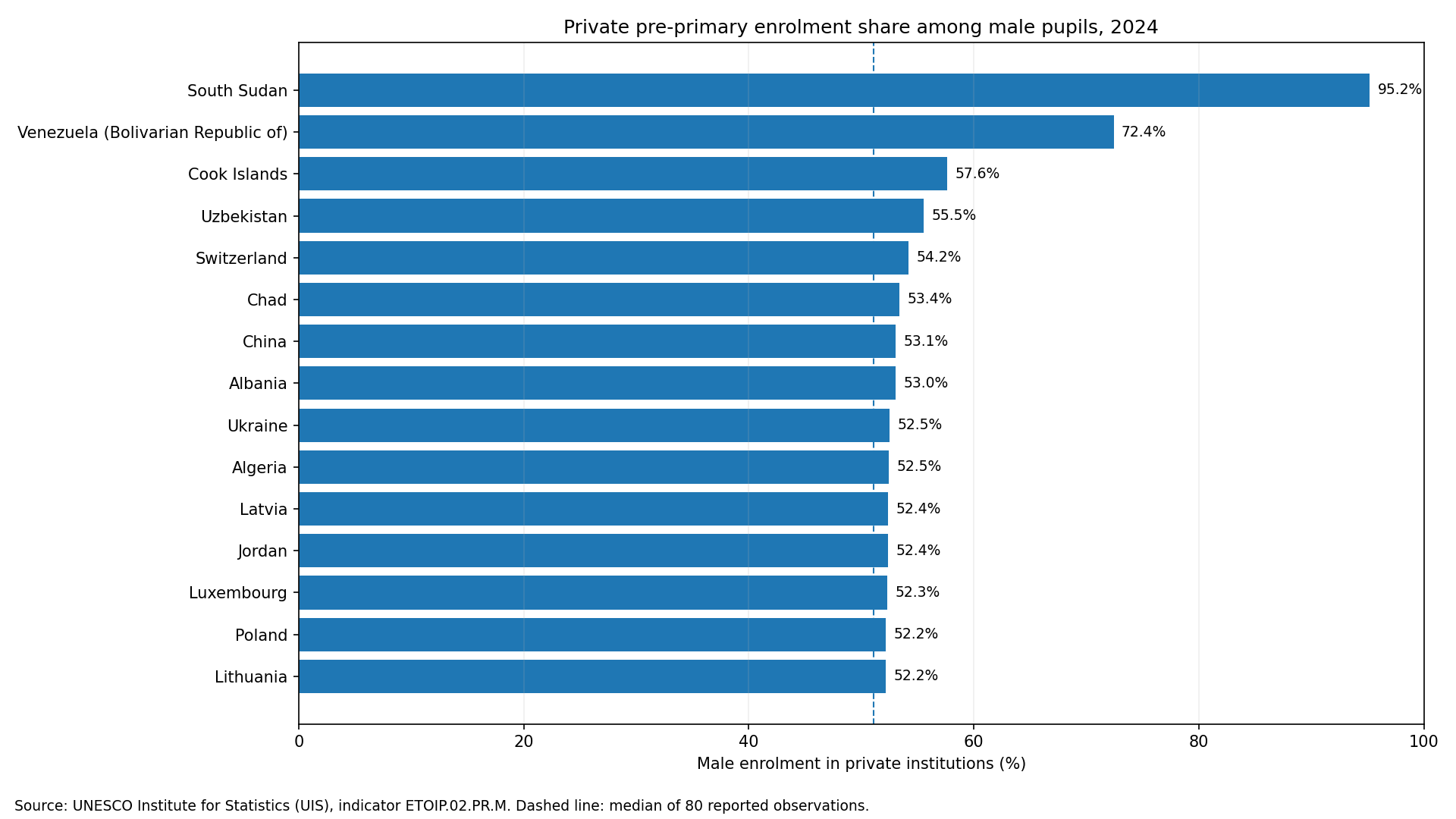
Table of Contents
Most reported values were concentrated around 50 percent
The middle half of the distribution ran from 50.24% at the first quartile to 51.70% at the third quartile. A total of 75 of the 80 observations fell between 45% and 55%, and 60 were inside the narrower 48% to 52% range. 65 observations were at least 50%, while 15 were below 50%. These counts show that the typical reported value was much closer to the midpoint than the largest values suggest.
The mean of 51.69% was slightly above the median of 51.06% because a small number of high observations pull the average upward. Only 2 countries or territories reached 60% or more. For that reason, the median and interquartile range are more useful than the mean alone when describing what is typical in this set of reported countries.
South Sudan and Venezuela stood well above the main cluster
South Sudan’s 95.18% was about 22.75 percentage points above Venezuela’s 72.42%. The next observation, the Cook Islands at 57.63%, was another large step down. The gaps among the first three positions show that the upper tail is not a smooth extension of the main 50% cluster.
A high private-institution share does not automatically mean that access to pre-primary education is high, low, better, or worse. The indicator only describes the institutional destination of boys who are already enrolled. To evaluate participation, a gross enrolment ratio, net enrolment measure, or another access indicator is needed. Differences in how education systems organize public, private, nonprofit, religious, and subsidized providers can also matter.
| Rank | Country or territory | Code | Private share |
|---|---|---|---|
| 1 | South Sudan | SSD | 95.18% |
| 2 | Venezuela (Bolivarian Republic of) | VEN | 72.42% |
| 3 | Cook Islands | COK | 57.63% |
| 4 | Uzbekistan | UZB | 55.55% |
| 5 | Switzerland | CHE | 54.17% |
| 6 | Chad | TCD | 53.38% |
| 7 | China | CHN | 53.07% |
| 8 | Albania | ALB | 53.03% |
| 9 | Ukraine | UKR | 52.52% |
| 10 | Algeria | DZA | 52.46% |
| 11 | Latvia | LVA | 52.37% |
| 12 | Jordan | JOR | 52.36% |
The lower end was mostly in the high-40-percent range
Armenia was the lowest observation at 38.16%, followed by Seychelles at 47.26%, Barbados at 47.97%, and Senegal at 47.99%. Aside from Armenia, many of the lower observations were still close to one half. This is another reason to interpret the distribution by distance from the center rather than focusing only on the first and last rank.
A lower private share does not imply lower male participation in pre-primary education. It may simply mean that a larger proportion of enrolled boys attend public or other non-private institutions. The indicator says nothing by itself about the number of boys enrolled, the proportion of the eligible age group enrolled, or the availability of places.
| Low-end order | Country or territory | Code | Private share |
|---|---|---|---|
| 1 | Armenia | ARM | 38.16% |
| 2 | Seychelles | SYC | 47.26% |
| 3 | Barbados | BRB | 47.97% |
| 4 | Senegal | SEN | 47.99% |
| 5 | Bahamas | BHS | 48.12% |
| 6 | Monaco | MCO | 48.31% |
| 7 | Côte d’Ivoire | CIV | 48.79% |
| 8 | Oman | OMN | 49.28% |
Fifty percent is not a gender-parity threshold
Because this series is already restricted to male enrolment, the 50% mark is not a female-male equality line. It is an institutional split within male enrolment. To study gender balance, analysts need the comparable female series or a gender parity index derived from male and female values. Confusing these questions can lead to a major interpretation error.
For example, a country with a male private share of 51% might have a female private share of 40%, 51%, or 60%. The male-only value cannot tell us which case applies. The ranking in this analysis compares institutional shares among boys across countries; it does not rank the size of gender gaps.
Private share and participation rate answer different questions
The private share describes how enrolled pupils are distributed between provider types. It does not measure how widely pre-primary education reaches children. A system could have a private share of 80% but low overall enrolment, or a private share of 20% alongside broad participation through public provision. Access and institutional structure should therefore be assessed with separate indicators.
The word private also should not be read as a synonym for commercial or for-profit provision. Depending on the national system, private institutions can include nonprofit foundations, religious organizations, community organizations, and providers that receive public subsidies. The UIS percentage cannot by itself reveal tuition levels, household costs, ownership models, or public funding arrangements.
Reported coverage is narrower than global coverage
The working 2024 series contains 80 national observations, each with a numeric value, but it does not cover every country or territory in the UIS catalogue. The source metadata lists additional national units without a reported observation. Accordingly, the 51.69% mean is the simple mean of the 80 reported cases, not a population-weighted world average and not a universal global figure.
Unreported units must not be converted to zero. Missing data and an observed value of zero are different statistical states. In this set, there are no official zero observations among the 80 reported rows, and the minimum is above 38%. A map that extends beyond the reported coverage should show unavailable units as no data.
The ranking describes structure, not educational performance
The unusually high values for South Sudan and Venezuela are descriptive facts about the institutional composition of reported male pre-primary enrolment. The dataset does not identify the causes. Public supply, the role of nonprofit providers, historical organization, local regulation, financing, and data coverage could all be relevant, but causal explanations require additional national evidence.
Likewise, similar percentages do not prove that two countries have similar education systems. One country could have a large pre-primary sector divided almost evenly between public and private providers, while another could have a small sector with a similar percentage. Ratios hide the size of the denominator, so absolute enrolment counts can materially change the context.
Why comparing male and female series can add context
A male-only series is useful when the analytical question is specifically where enrolled boys receive pre-primary education. If the question is whether girls and boys have similar institutional patterns, the female counterpart should be examined under the same year and definition. The difference or parity relationship between the two series can then be assessed without mistaking a 50% institutional share for gender equality.
This distinction also matters for policy interpretation. A country can have almost identical male and female private shares while both are very high, or can have very different male and female shares even when the overall private sector is moderate. Gender balance and provider structure are separate dimensions, and a single percentage cannot substitute for both.
Source and calculation notes
The source is the UNESCO Institute for Statistics 2024 indicator ETOIP.02.PR.M, “Percentage of enrolment in pre-primary education in private institutions, male (%)”. The comparison uses all 80 reported observations in the supplied official series. The mean, median, quartiles, range counts, and ranking were calculated directly from those values. The UNESCO UIS data endpoint provides the series.
Country rankings in this article are descriptive rankings of the published percentages. They are not rankings of education quality, affordability, access, or policy effectiveness. Those questions require additional indicators on participation, spending, learning conditions, costs, and the institutional definitions used in each education system.
Frequently Asked Questions
Which reported country had the highest male private pre-primary enrolment share in 2024?
South Sudan had the highest reported value at 95.18%, followed by Venezuela at 72.42%.
Does 50% mean gender parity?
No. The indicator is restricted to male enrolment. A 50% value means about half of enrolled boys are in private institutions.
Should countries without a reported value be treated as zero?
No. Missing observations must remain no data. None of the 80 reported observations in this series is zero.
Related Articles
Green Map creates custom-edited map images using open geographic data sources such as geoBoundaries, Natural Earth, OpenStreetMap, and government open data. These maps are edited visual materials, not raw data files, and are provided for education, documents, presentations, and graphic reference.