Part-time employment can describe very different labor-market arrangements across countries, so comparing the female and male series together is more informative than reading either one alone. The World Bank indicators used here are SL.TLF.PART.FE.ZS for women and SL.TLF.PART.MA.ZS for men. Both measure part-time workers as a percentage of employment for the relevant sex, using a common definition based on fewer than 35 actual hours worked per week. They do not measure the share of the whole population working part time, and they do not distinguish voluntary from involuntary part-time work.
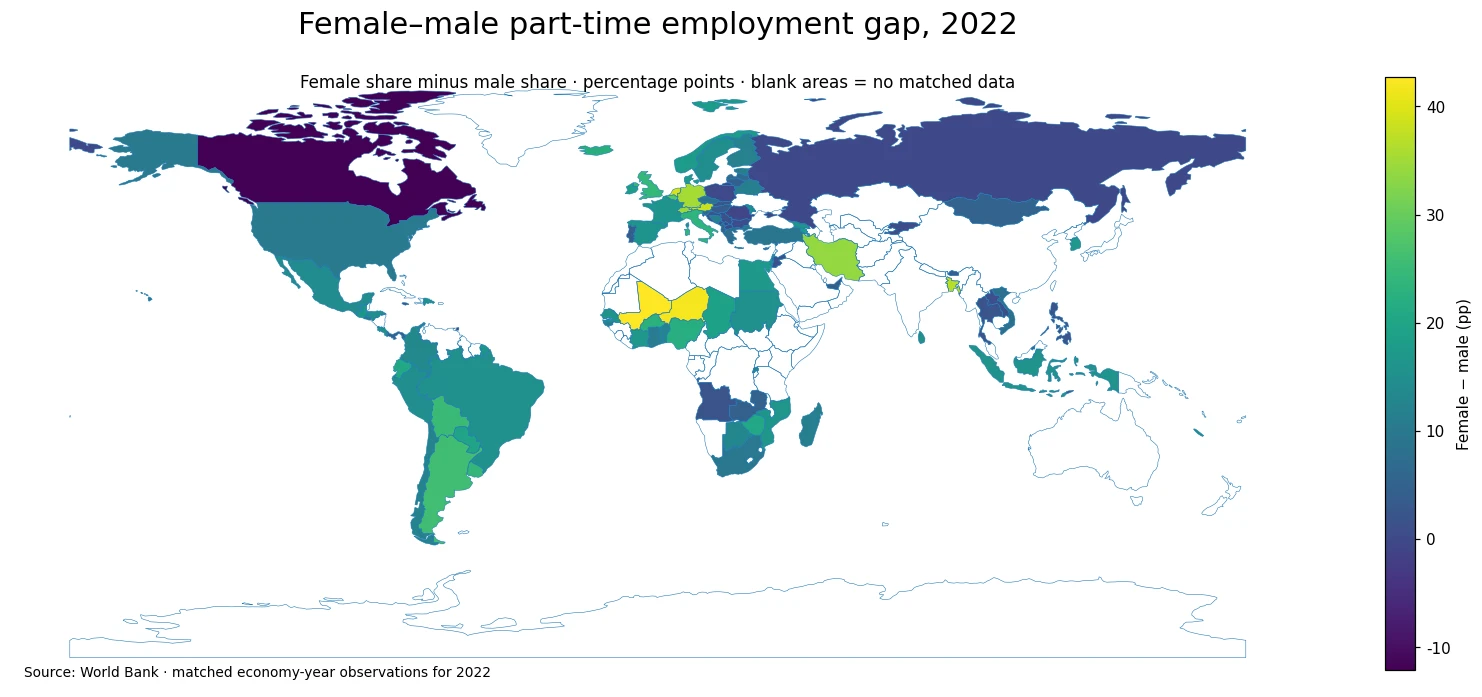
Table of Contents
The 2022 comparison contains 108 matched economies
Each source series contains 217 country or economy rows for 2022, including entries with no reported value. There are 108 non-missing female observations and 108 non-missing male observations, and the country codes align to the same 108 economies. The remaining 109 rows in each source are preserved as missing rather than imputed. That matching rule matters because a sex gap should compare women and men in the same place and the same observation year. No earlier or later value is substituted to create a pair. Of the matched economies, 102 connect to the low-resolution world polygons used for the map; several small islands and territories remain in the calculations even when they are not visible as colored polygons.
Across the 108 matched economies, the female part-time share averages 32.38% and has a median of 31.00%. The male series averages 19.75% with a median of 13.70%. The median country-level difference, calculated as female minus male, is 12.32 percentage points, while the mean difference is 12.63 points. The middle 50% of female observations runs from 13.78% to 48.32%; for men it runs from 6.62% to 30.31%. The separation is therefore visible in the center of the distribution, not only in a few extreme cases.
The indicator uses actual weekly hours, not the wording of an employment contract
The denominator is employment for each sex. If 40 of every 100 employed women in an economy work fewer than 35 actual hours per week, the female indicator is 40%. The male indicator is constructed in the same way. This is different from a legal or contractual definition of a part-time job. Someone can be counted in the measure because of actual hours even when the label attached to the job differs, and the measure can cover employees, self-employed workers, or other employed people as represented in the underlying labor statistics.
The indicator is also different from the employment-to-population ratio and from labor-force participation. People who are not employed are outside this denominator. A country with a high part-time share does not necessarily have a large percentage of its working-age population in part-time jobs, because the size of employment itself can differ. The series also does not say whether workers prefer shorter hours, are combining work with education or care, or would rather have a full-time job. Those questions require measures of underemployment, involuntary part-time work, earnings, job security, household responsibilities, and other labor-market characteristics.
Women have the higher part-time share in 102 of the 108 matched economies
The broadest pattern in the paired data is the direction of the gap. Women have the higher part-time employment share in 102 economies, while men have the higher share in only 6. None of the paired observations are exactly equal. This does not establish a universal causal explanation for the difference, but it shows that the sex gap is widespread across the 2022 country cross-section. The pattern appears in economies with very different income levels, regions, labor institutions, and sectoral structures, so a single explanation would be too narrow.
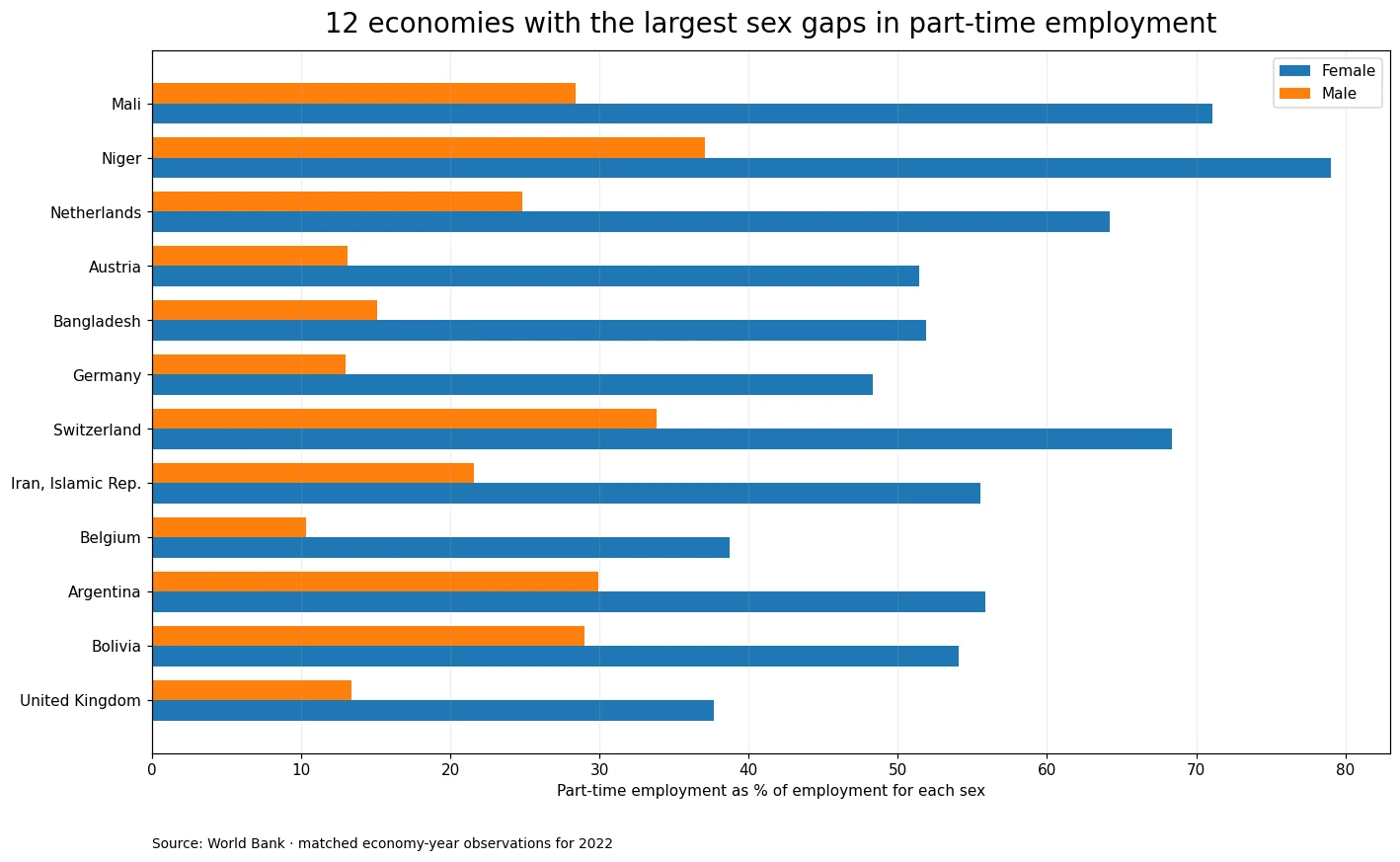
Mali, Niger and the Netherlands have gaps above 39 percentage points
| Economy | Female | Male | Female minus male |
|---|---|---|---|
| Mali | 71.1% | 28.4% | 42.7 pp |
| Niger | 79.1% | 37.1% | 42.0 pp |
| Netherlands | 64.2% | 24.8% | 39.4 pp |
| Austria | 51.4% | 13.1% | 38.4 pp |
| Bangladesh | 51.9% | 15.1% | 36.8 pp |
| Germany | 48.3% | 13.0% | 35.3 pp |
| Switzerland | 68.4% | 33.8% | 34.6 pp |
| Iran, Islamic Rep. | 55.5% | 21.6% | 33.9 pp |
| Belgium | 38.7% | 10.3% | 28.4 pp |
| Argentina | 55.9% | 29.9% | 26.0 pp |
Mali has the largest positive gap: 71.106% for women and 28.392% for men, a difference of 42.714 percentage points. Niger follows at 79.051% versus 37.069%, a 41.982-point gap. The Netherlands records 64.224% for women and 24.841% for men, producing a 39.383-point difference, while Austria reaches 38.351 points. Bangladesh and Germany are next at 36.808 and 35.334 points. Switzerland and Iran also exceed 30 points. The economies with the largest differences span Europe, West Africa, South Asia, the Middle East and South America, which reinforces that the pattern is not confined to a single geographic region.
A large gap can arise from different combinations of levels. In the Netherlands, Austria and Germany, the female share is high relative to a much lower male share. In Mali and Niger, male part-time employment is also substantial, but the female share is higher still. Those structures should not be treated as equivalent simply because the female-minus-male gap is similar. The paired chart is useful for this reason: it shows whether a gap reflects an unusually high female rate, an unusually low male rate, or high levels for both groups.
Only six economies have a higher male share, and Canada is the clearest reversal
The six negative gaps are Canada, St. Lucia, Kosovo, Romania, Samoa and the Russian Federation. Canada is an outlier within that group: the female share is 75.576%, while the male share is 87.681%, so the male value is 12.105 percentage points higher. The other reversals are much smaller. St. Lucia is 1.458 points in the male direction, Kosovo 1.151, Romania 0.744, Samoa 0.499 and the Russian Federation 0.295. Treating all six as one common pattern would therefore hide the fact that Canada is quantitatively very different from the rest.
An unusual observation in an international cross-section should first be read against the exact indicator definition and then checked across time before a structural explanation is attached to it. The World Bank series applies the common fewer-than-35-actual-hours rule, which may not match the headline part-time measure used in a national statistical release. A single year can also be affected by survey timing or labor-market conditions that do not persist. The 2022 values are suitable for a matched comparison, but they are not a substitute for a time series when the question is whether a country has experienced a lasting change.
A high female part-time share is not, by itself, a measure of job quality
Shorter hours can be a preferred arrangement for workers combining employment with study, childcare, other care responsibilities, health needs, or a gradual transition into or out of the labor market. They can also reflect a lack of full-time opportunities. The indicator does not separate those motives. It therefore cannot tell whether a wide female-male gap represents flexibility that workers value, constraints that fall disproportionately on women, or a mixture of both. To answer that question, the sex gap should be paired with data on involuntary part-time employment, hourly and monthly earnings, occupation, industry, contract security, caregiving time, and household composition.
The same caution applies to comparisons between countries. An economy with a 60% female part-time share is not automatically performing better or worse than one with a 10% share. Full-time work may be the normal institutional arrangement in one place, while combining shorter paid work with education or care may be common in another. Informal and self-employed work can also shape actual weekly hours differently from formal employee schedules. The map is best used to locate large differences and clusters; it is not a ranking of labor-market quality or gender equality.
Looking at both levels prevents the gap from hiding the broader labor pattern
Several economies have high part-time employment for both women and men. Senegal records 78.885% for women and 62.893% for men. Madagascar is 69.412% and 58.017%, Rwanda 67.233% and 53.858%, Guatemala 66.656% and 49.950%, Mozambique 66.511% and 49.938%, and Moldova 65.219% and 49.916%. These cases still have a female advantage in the part-time share, but the more general feature is that fewer-than-35-hour employment is common for both sexes. That differs from economies where male part-time work is uncommon and the female rate alone is high.
This distinction also helps with regional interpretation. The largest positive gaps include several European economies, yet some of the highest absolute levels for both sexes appear in Africa and Latin America. A region can contain economies with very different combinations of female and male values. It is therefore more informative to compare the paired levels than to assign a single regional narrative. Where a geographic pattern looks strong, the next step should be to examine education, sector, employment status, hours distribution and labor institutions for the relevant countries rather than assuming that geography itself explains the result.
What this comparison can and cannot establish
- The comparison uses only the 108 economies with non-missing female and male observations for the same year, 2022.
- Missing source values remain missing; they are not converted to zero or filled from a different year.
- Part-time employment means fewer than 35 actual weekly hours and is expressed as a share of employment for each sex.
- The median female share is 31.0% versus 13.7% for men, and women have the higher share in 102 of 108 matched economies.
- The sex gap describes working-time structure, not earnings, job security, voluntariness, care constraints or overall employment performance.
- A one-year cross-section should not be used to claim a long-term trend without checking the same indicator through time.
The official source series are the World Bank indicators SL.TLF.PART.FE.ZS for women and SL.TLF.PART.MA.ZS for men. The calculations here keep the 2022 economy-year pairs aligned and preserve missing observations as missing. When comparing these figures with another database or a national labor-force release, check the denominator, the weekly-hours threshold and the observation year before interpreting a difference as substantive.
Frequently Asked Questions
How is part-time employment defined in these World Bank indicators?
The series uses a common definition based on fewer than 35 actual hours worked per week and expresses part-time employment as a percentage of employment for the relevant sex.
Was the female part-time share usually higher than the male share in 2022?
Yes. Among the 108 economies with matched female and male observations, the female share was higher in 102, while the male share was higher in 6.
Does a large female-male gap prove that women face worse jobs?
No. The gap shows a difference in actual weekly working-time patterns, but it does not measure whether part-time work is voluntary, how much workers earn, job security, care responsibilities or overall job quality.
Related Articles
Green Map creates custom-edited map images using open geographic data sources such as geoBoundaries, Natural Earth, OpenStreetMap, and government open data. These maps are edited visual materials, not raw data files, and are provided for education, documents, presentations, and graphic reference.