A primary school counts as having a basic handwashing service only when the facility is functional and the required hygiene resources are available. UNESCO Institute for Statistics indicator SCHBSP.1.WWASH measures the proportion of primary schools with basic handwashing facilities.
Across the 103 country and area observations dated 2024, the median is 100.0% and the mean is 91.6%. Exactly 64 observations report 100%, and 77 are at or above 90%. The Republic of Korea reports 100%.
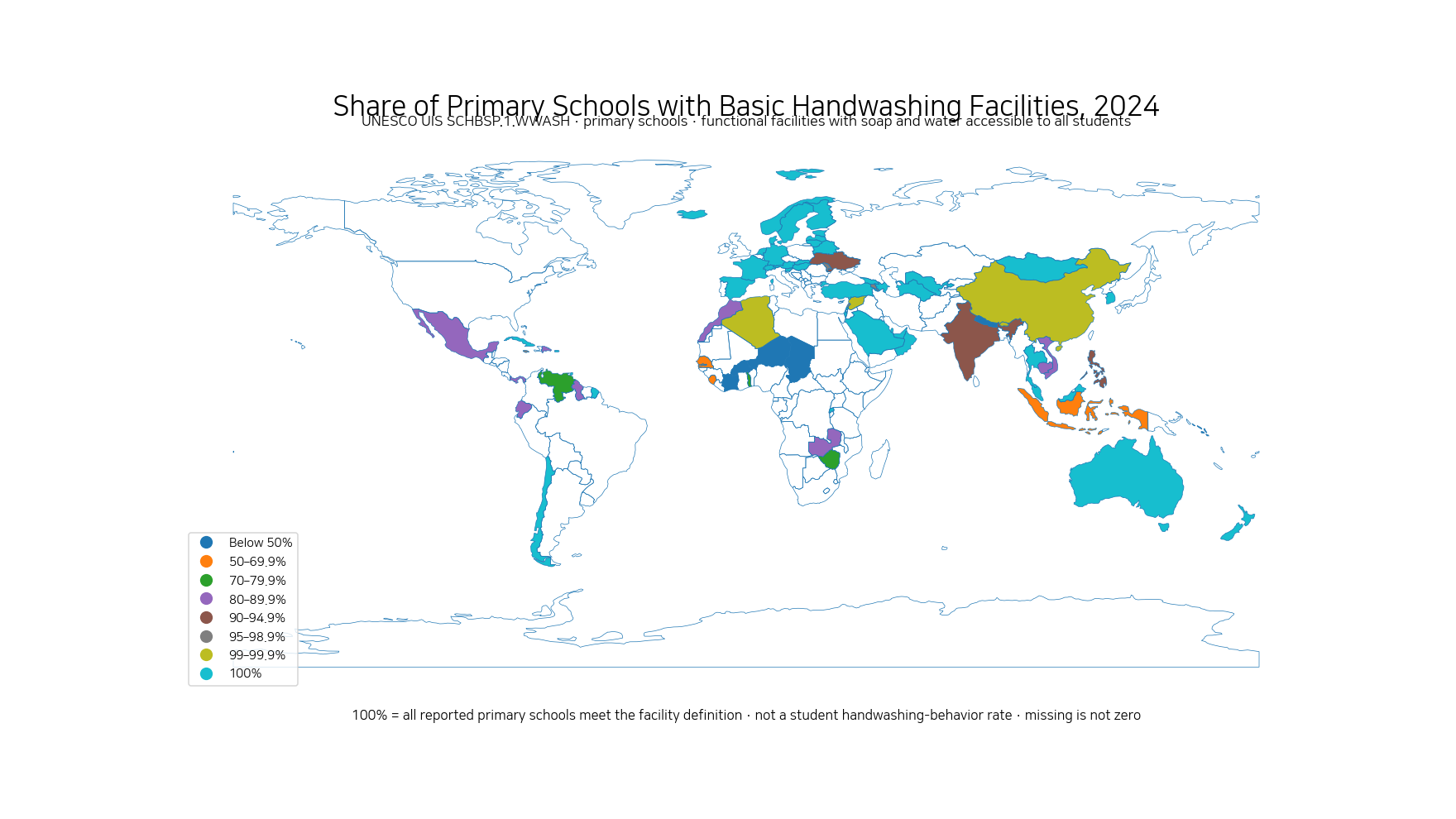
Table of Contents
Basic handwashing means a functional facility with water and soap
UIS defines basic handwashing facilities in schools as functional handwashing facilities or stations equipped with soap and water and accessible to all girls and boys.
A handwashing point does not have to be a fixed sink. It can include sinks with tap water, buckets with taps, tippy-taps, jugs or basins designated for handwashing. Soap can take different usable forms, including bar soap, liquid soap, powder detergent and soapy water.
A 100% value does not mean every student always washes their hands
The numerator is the number of schools that meet the facility definition and the denominator is the total number of schools at the education level. Korea’s 100% therefore means all reported primary schools meet the UIS basic-facility criterion.
The indicator does not measure individual handwashing behavior, frequency of use, whether students follow hygiene guidance correctly or whether the facility remains equally reliable every hour of every day. It is a school-infrastructure coverage indicator.
Sixty-four of the 103 observations report 100%
Exactly 64 observations are at 100%. 68 are at least 99%, 73 are at least 95%, and 77 are at least 90%.
The median itself is 100%, showing that full reported coverage is common in this same-year dataset. However, 26 observations remain below 90%, 14 below 80% and 10 below 70%.
Korea is 100%, while China is 99.1%
Korea is 100%, as are Germany, France, Australia, Spain, Norway, Sweden and Finland in this 2024 extract. China is 99.1%, India 93.8% and the Philippines 93.5%.
Mexico is 86.5%, Viet Nam 82.5% and Indonesia 64.0%. The range shows that substantial school-infrastructure gaps can remain even within the same broad region.
| Country | Primary schools meeting the basic handwashing standard |
|---|---|
| Republic of Korea | 100.0% |
| China | 99.1% |
| Germany | 100.0% |
| France | 100.0% |
| Australia | 100.0% |
| India | 93.8% |
| Mexico | 86.5% |
| Indonesia | 64.0% |
| Spain | 100.0% |
| Norway | 100.0% |
| Sweden | 100.0% |
| Finland | 100.0% |
| Philippines | 93.5% |
| Viet Nam | 82.5% |
Niger is 25.9%, with the Solomon Islands and Chad also below 30%
Niger has the lowest observation at 25.9%. The Solomon Islands are 27.5%, Chad 29.4% and Burkina Faso 40.0%.
Côte d’Ivoire is 48.7%, Nepal 49.9%, Sierra Leone 52.5%, Gambia 57.4% and Senegal 62.4%. These values indicate that many primary schools in those reporting systems did not yet meet the basic handwashing-facility definition.
| Low-rank side | Country or area | ISO3 | 2024 share |
|---|---|---|---|
| 1 | Niger | NER | 25.9% |
| 2 | Solomon Islands | SLB | 27.5% |
| 3 | Chad | TCD | 29.4% |
| 4 | Burkina Faso | BFA | 40.0% |
| 5 | Côte d’Ivoire | CIV | 48.7% |
| 6 | Nepal | NPL | 49.9% |
| 7 | Sierra Leone | SLE | 52.5% |
| 8 | Gambia | GMB | 57.4% |
| 9 | Senegal | SEN | 62.4% |
| 10 | Indonesia | IDN | 64.0% |
| 11 | Samoa | WSM | 70.2% |
| 12 | Togo | TGO | 74.6% |
| 13 | Venezuela (Bolivarian Republic of) | VEN | 76.3% |
| 14 | Zimbabwe | ZWE | 79.8% |
| 15 | Comoros | COM | 81.0% |
Six observations are below 50%
6 observations are below 50%, and 4 are below 40%. When fewer than half of primary schools meet the basic definition, handwashing infrastructure remains a major school-service challenge.
The indicator alone cannot identify the cause. Water supply, school financing, rural access, maintenance systems, soap availability and the coverage of administrative reporting can all contribute.
Water alone or an installed sink is not enough
The basic-service definition requires a functional handwashing facility and the availability of soap and water. A school with a broken sink or no soap may fail the basic-service criterion even if hardware is present.
That distinction matters because building infrastructure and maintaining reliable service are different tasks. Sustained coverage requires water, supplies and upkeep, not just construction.
Access for all girls and boys is part of the definition
School-level access is not only about whether one handwashing point exists somewhere on the premises. The service is meant to be accessible to all girls and boys, making usability and availability part of the concept.
The indicator still does not measure queueing time, the number of taps per student, disability-specific accessibility or service reliability throughout the day. Those operational details require more granular data.
Handwashing is only one component of school WASH and infrastructure
UIS school-infrastructure monitoring includes basic drinking water, sanitation and handwashing services alongside other facilities such as electricity, Internet access, computers for pedagogical use and adapted infrastructure.
A 100% handwashing-facility value does not imply that drinking water, toilets, accessibility, electricity or digital infrastructure are also universal. Each component needs its own indicator.
This is a school-based percentage, not a student-weighted percentage
Each school is counted as a school. A small primary school and a very large primary school can each contribute one unit to the numerator and denominator.
For that reason, 80% of schools meeting the standard does not necessarily mean exactly 80% of students have access. A student-weighted access measure would need enrollment counts by school.
National averages can hide internal geographic differences
A national school percentage can mask urban-rural or regional disparities. A country can report a high national average while remote schools remain less well served, or a lower national average while some urban areas already have universal coverage.
The current dataset contains national values only, so no subnational gap is inferred. Evaluating equity within countries requires regional school-infrastructure data and information on maintenance and service quality.
The legend separates 100% because full coverage is so common
With a median of 100% and 64 exact 100% observations, broad 20-point map categories would hide most differences near the top.
The map therefore separates 90–94.9%, 95–98.9%, 99–99.9% and 100%, while also preserving lower bands for countries where major infrastructure gaps remain.
The 2024 extract does not include every country
The dataset contains 103 countries and areas, not the entire world. Several familiar major countries, including the United States, United Kingdom, Canada, Japan and Brazil, are absent from this same-year extract.
The statement that 64 observations report 100% therefore means 64 of the 103 available 2024 observations, not 64 of all countries in the world.
Full reported coverage still requires maintenance
A school can meet the basic criterion in one reporting year and later experience water interruptions, broken fixtures or shortages of soap. Infrastructure coverage does not directly measure the resilience of the maintenance system.
Sustaining universal coverage requires recurrent supply, repairs, cleaning and hygiene management. A 100% value is therefore an important baseline achievement rather than proof that no further operational work is needed.
Blank map areas do not mean zero
The source table contains 103 observations, of which 72 match separate polygons in the low-resolution world boundary layer used here. Small islands and territories can have valid statistics without a visible polygon.
Countries without a 2024 observation remain unclassified. Missing values are never replaced with zero because zero would falsely imply that no primary school meets the basic handwashing standard.
Data source and interpretation
Country values come from the UNESCO UIS Data Browser for SCHBSP.1.WWASH, using the 2024 observations. The definitions of basic handwashing facilities and the proportion of schools with those facilities follow the UIS glossary.
The source metadata stored the unit generically as ‘value’, but the public indicator is a percentage of primary schools. The source package’s internal provider tag named the World Bank, while the official indicator and data are UNESCO UIS, so the completed metadata corrects the provider to UNESCO UIS.
Frequently Asked Questions
What counts as a basic handwashing facility?
A functional handwashing facility with soap and water available and accessible to all girls and boys.
What does Korea’s 100% mean?
It means all reported primary schools in Korea met the UIS basic-handwashing-facility definition in 2024. It does not mean every student always washes their hands.
Is this a student percentage?
No. It is the percentage of primary schools meeting the facility definition, calculated from school counts.
Does 100% handwashing coverage mean all school sanitation is adequate?
Not necessarily. Drinking water, toilets, maintenance, accessibility and actual usage require separate indicators or evidence.
Related Maps
Green Map creates custom-edited map images using open geographic data sources such as geoBoundaries, Natural Earth, OpenStreetMap, and government open data.
These maps are edited visual materials, not raw data files, and are provided for education, documents, presentations, and graphic reference.