How many years of primary and secondary education are legally guaranteed free from tuition fees? UNESCO Institute for Statistics indicator YEARS.FC.FREE.1T3 measures the number of years of tuition-free primary and secondary education guaranteed in legal frameworks.
Across the 193 country and area observations dated 2025, the median is 12 years and the mean is 10.8. Twelve years is the most common value, reported by 82 observations, while 27 report 13 years. 109 countries and areas guarantee at least 12 years. The Republic of Korea reports 12 years.
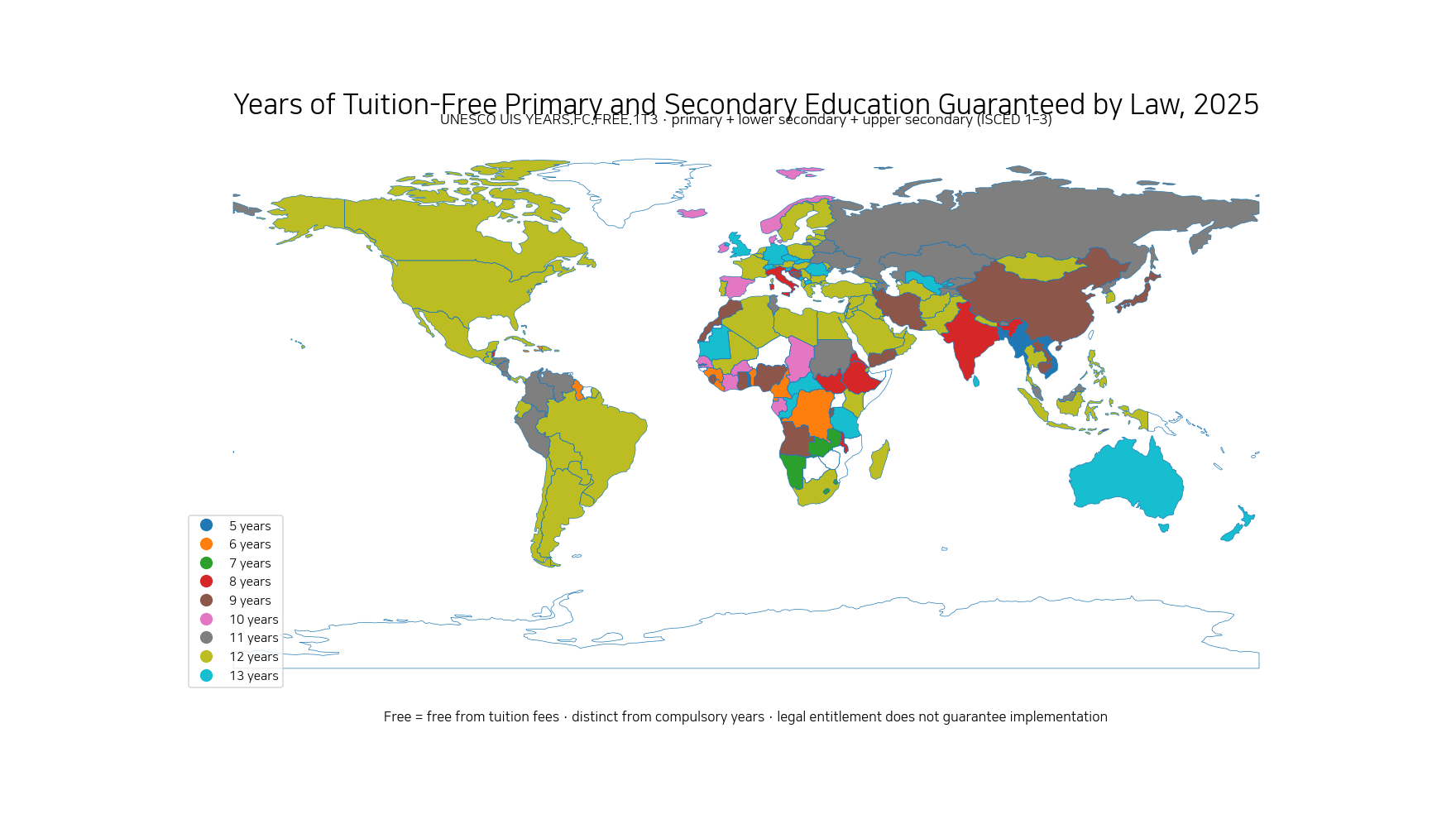
Table of Contents
Free means free from tuition fees
In SDG indicator 4.1.7, free education refers to the years of primary and secondary education to which children and young people are legally entitled without tuition fees.
That does not mean every education-related cost is zero. Uniforms, books, meals, transport, boarding, examinations or extracurricular costs may still exist depending on the country and programme. For clarity, this article uses the phrase ‘tuition-free’ rather than implying that all household education costs disappear.
Free education years are not the same as compulsory education years
UIS reports the number of free years and the number of compulsory years as separate parts of SDG 4.1.7. Free education is a legal entitlement not to pay tuition; compulsory education is a legal obligation to participate in education.
A country can guarantee 12 years without tuition fees while requiring fewer than 12 years of compulsory attendance. Another country can align the two. The two series should therefore not be substituted for one another.
The indicator covers primary, lower-secondary and upper-secondary education
The code 1T3 spans ISCED levels 1 through 3: primary, lower-secondary and upper-secondary education. In everyday terms, that roughly corresponds to primary school, lower secondary and high school.
Pre-primary education is excluded. Free or compulsory pre-primary entitlement is monitored under a separate SDG indicator, so years of tuition-free early childhood education are not added to the current number.
Twelve years is the most common legal guarantee
Twelve years appears in 82 of the 193 observations. Thirteen years appears in 27, 11 years in 24, 10 years in 12 and 9 years in 18.
109 observations guarantee at least 12 years, 133 guarantee at least 11 and 145 guarantee at least 10. 48 observations are below 10 years. The overall range runs from 5 to 13 years.
Twenty-seven countries and areas report 13 years
The 13-year group includes Australia, Germany, the United Kingdom, New Zealand, Czechia, Switzerland, Romania, Slovakia, Slovenia and Sri Lanka, along with a number of smaller states and territories.
A 13-year value does not mean all countries use exactly the same grade structure. Entry ages and durations of primary and secondary levels differ. The indicator standardizes the total number of legally tuition-free grades across ISCED 1–3.
| Country or area | ISO3 | 2025 tuition-free guarantee |
|---|---|---|
| Australia | AUS | 13 years |
| Bermuda | BMU | 13 years |
| Central African Republic | CAF | 13 years |
| Comoros | COM | 13 years |
| Congo | COG | 13 years |
| Cook Islands | COK | 13 years |
| Czechia | CZE | 13 years |
| Germany | DEU | 13 years |
| Gibraltar | GIB | 13 years |
| Liechtenstein | LIE | 13 years |
| Luxembourg | LUX | 13 years |
| Malta | MLT | 13 years |
| Mauritania | MRT | 13 years |
| Mauritius | MUS | 13 years |
| Montenegro | MNE | 13 years |
| New Zealand | NZL | 13 years |
| North Macedonia | MKD | 13 years |
| Romania | ROU | 13 years |
| San Marino | SMR | 13 years |
| Slovakia | SVK | 13 years |
| Slovenia | SVN | 13 years |
| Sri Lanka | LKA | 13 years |
| Switzerland | CHE | 13 years |
| Tuvalu | TUV | 13 years |
| United Kingdom | GBR | 13 years |
| United Republic of Tanzania | TZA | 13 years |
| Uzbekistan | UZB | 13 years |
Korea reports 12 years, the same headline total as the United States, France and Canada
The Republic of Korea reports 12 years. The United States, France, Canada, Brazil, Mexico, Indonesia, Sweden and Finland also report 12 years.
Germany, the United Kingdom, Australia and New Zealand report 13 years. China and Japan each report 9, India 8, Spain and Norway 10, and Italy 8 years. The legal entitlement is not identical even among high-income countries.
| Country | 2025 tuition-free years |
|---|---|
| Republic of Korea | 12 years |
| United States | 12 years |
| China | 9 years |
| Japan | 9 years |
| Germany | 13 years |
| France | 12 years |
| United Kingdom | 13 years |
| Canada | 12 years |
| Australia | 13 years |
| India | 8 years |
| Brazil | 12 years |
| Mexico | 12 years |
| Indonesia | 12 years |
| Spain | 10 years |
| Italy | 8 years |
| Norway | 10 years |
| Sweden | 12 years |
| Finland | 12 years |
| New Zealand | 13 years |
| Philippines | 12 years |
Bangladesh, Myanmar, Togo and Viet Nam report the minimum of five years
The minimum in the 2025 data is 5 years, reported by Bangladesh, Myanmar, Togo and Viet Nam. 10 observations report six years, 4 report seven and 12 report eight.
A lower value means fewer grades are legally guaranteed free from tuition fees. It does not by itself reveal actual enrollment or the full cost borne by households. Governments may subsidize non-tuition costs, or families may still face substantial indirect costs even when tuition is free.
| Country | ISO3 | 2025 tuition-free guarantee |
|---|---|---|
| Bangladesh | BGD | 5 years |
| Myanmar | MMR | 5 years |
| Togo | TGO | 5 years |
| Viet Nam | VNM | 5 years |
A 12-year legal guarantee does not automatically mean 12 years of participation
UIS explicitly notes a limitation: legislation does not guarantee effective implementation. A right can exist in law while families still face barriers such as distance, transport, school capacity, safety, work obligations or other costs.
The indicator is therefore best understood as a measure of government legal commitment to the right to education. Out-of-school rates, completion rates and learning outcomes are needed to assess whether students actually participate and progress.
Long tuition-free entitlement does not automatically produce a low out-of-school rate
A country can legally guarantee 12 tuition-free years and still have a substantial out-of-school rate at upper-secondary age. Tuition is only one of many barriers to participation.
Conversely, enrollment can be high in a system with a shorter formal tuition-free guarantee. Legal entitlement and actual participation measure different parts of the education system and are most useful when read together.
Thirteen years should not be treated as a universal education-quality ranking
More years of tuition-free entitlement mean a broader legal guarantee, but the number is not a complete quality score. It does not measure learning outcomes, teacher quality, school infrastructure, equity or whether indirect household costs are affordable.
School structures also differ across countries. The map therefore compares legal scope, not overall education-system performance.
The same total can come from different age and grade structures
UIS prefers the number of grades specified in law. When legislation specifies ages rather than grades, the indicator can be calculated using the official primary-school entrance age and the upper age of the free or compulsory entitlement.
Two countries can therefore both report 12 years while using different entry ages or primary-secondary grade structures. The indicator standardizes the total duration for international comparison.
The 2025 observations are based on legal and administrative sources
UIS identifies national legislation, formal education standards and administrative information on education-system structure as the source material for this indicator.
This means the statistic records what is guaranteed in legal frameworks rather than asking households whether education feels free in practice. Recent legislative changes can also create timing differences between national reform and international database updates.
Blank map areas do not mean zero years
The source table contains 193 country and area observations, of which 154 match separate polygons in the low-resolution world boundary layer used here. Small islands and territories can have valid statistics without a visible polygon.
Missing observations are left unclassified. They are never converted to zero, because zero would mean no legally guaranteed tuition-free years rather than no data.
Data source and interpretation
Country values come from the UNESCO UIS Data Browser for YEARS.FC.FREE.1T3, using the 2025 observations. The official concept follows the UIS SDG 4.1.7 definition.
UIS records free and compulsory years separately; this article uses only the FREE series. The source package’s internal provider tag named the World Bank, but the official indicator and dataset are UNESCO UIS, so the completed metadata corrects the provider to UNESCO UIS.
Frequently Asked Questions
Does 12 years of free education mean every education cost is free?
No. The indicator refers to education legally free from tuition fees. Uniforms, books, meals, transport and other costs may still exist.
How many years does Korea guarantee?
In the 2025 UNESCO UIS data, the Republic of Korea guarantees 12 years of tuition-free primary and secondary education.
Are free education years the same as compulsory education years?
No. Free education is a legal entitlement to education without tuition fees; compulsory education is the legal obligation to participate. UIS records them separately.
Does the indicator include pre-primary education?
No. YEARS.FC.FREE.1T3 covers ISCED levels 1–3. Free and compulsory pre-primary education is monitored separately.
Related Maps
Green Map creates custom-edited map images using open geographic data sources such as geoBoundaries, Natural Earth, OpenStreetMap, and government open data.
These maps are edited visual materials, not raw data files, and are provided for education, documents, presentations, and graphic reference.