Where did Germany-origin internationally mobile tertiary students study in 2023? UNESCO Institute for Statistics (UIS) destination data show Austria far ahead at about 38,178 students, followed by Switzerland at 12,325, the United Kingdom at 7,937, and the United States at about 6,850. The 74 supplied destination observations sum to about 108,683, and Austria, Switzerland, and the United Kingdom account for 53.8% of that observed sum.
The official indicator title begins with ‘Inbound internationally mobile students from Europe: Students from Germany,’ which can be misread if the origin filter is overlooked. Germany is fixed as the student origin and each country row is a destination. Austria’s observation therefore represents Germany-origin internationally mobile tertiary students studying in Austria, not Austrian students studying in Germany and not Austria’s total international-student population.
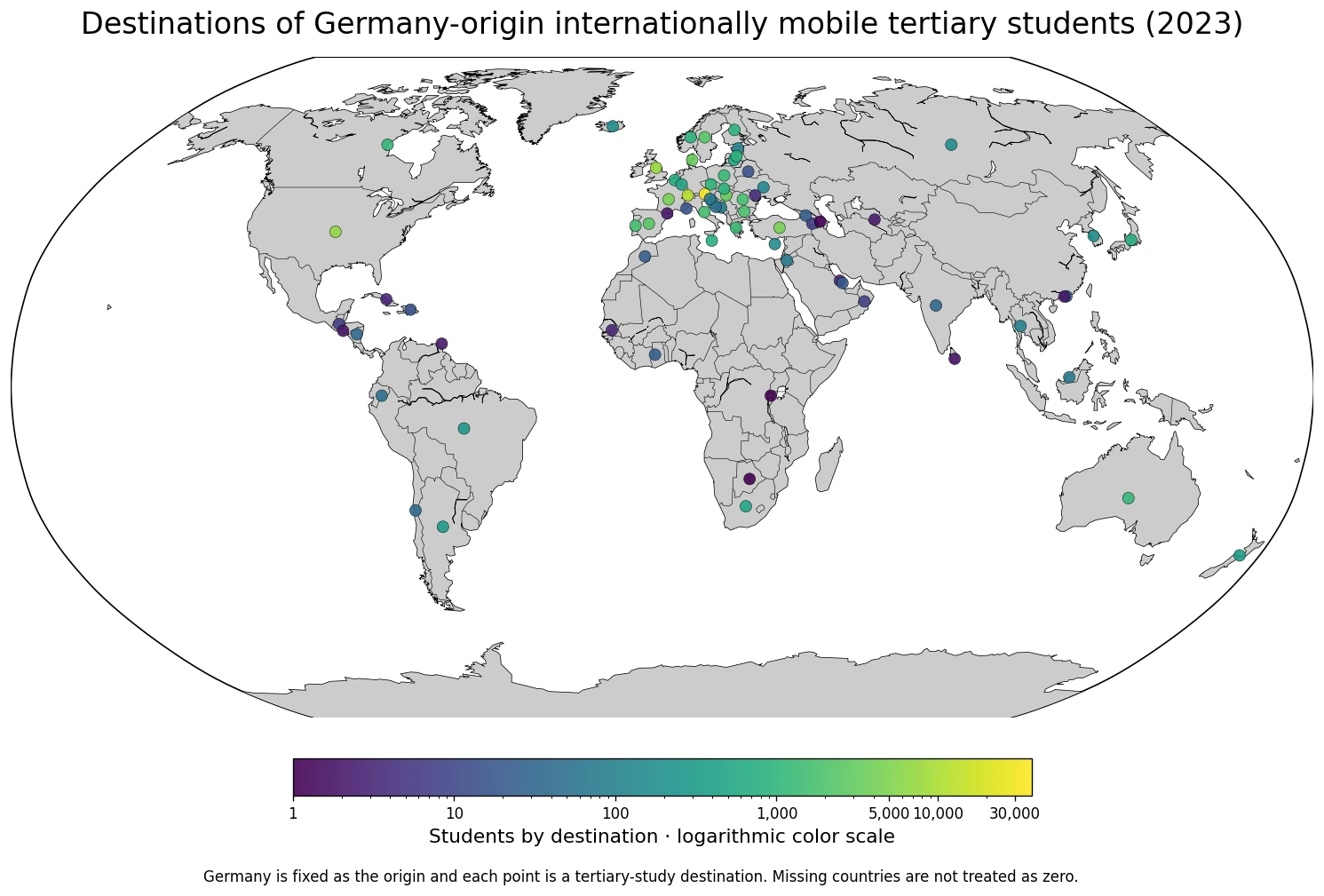
Table of Contents
Austria is by far the largest destination
Austria records about 38,178 students, more than three times Switzerland’s 12,325. The United Kingdom records 7,937, the United States about 6,850, Türkiye 4,448, and France about 4,391. Many of the largest destinations are in Europe, although the United States, Australia, and Canada show that long-distance mobility is also significant.
The three largest destinations account for 53.8% of the observed sum, the top five for 64.2%, and the top ten for 78.8%. Germany-origin student mobility is geographically broad but numerically concentrated. Austria’s exceptionally large observation is the strongest feature of the distribution.
| Rank | Destination country or territory | Germany-origin internationally mobile students |
|---|---|---|
| 1 | Austria | about 38,178 |
| 2 | Switzerland | 12,325 |
| 3 | United Kingdom of Great Britain and Northern Ireland | 7,937 |
| 4 | United States of America | about 6,850 |
| 5 | Türkiye | 4,448 |
| 6 | France | about 4,391 |
| 7 | Hungary | 3,341 |
| 8 | Denmark | 3,248 |
| 9 | Sweden | about 2,483 |
| 10 | Spain | 2,434 |
| 11 | Bulgaria | 1,813 |
| 12 | Portugal | 1,734 |
| 13 | Italy | 1,727 |
| 14 | Romania | 1,713 |
| 15 | Greece | 1,294 |
Intra-European mobility dominates the upper end
Switzerland, the United Kingdom, Türkiye, France, Hungary, Denmark, Sweden, Spain, Bulgaria, Portugal, Italy, Romania, Greece, and Poland all rank among the larger destinations. The map therefore shows a strong concentration within Europe rather than a distribution dominated by distant destinations.
The dataset does not establish why those destinations are large. Language, distance, university programmes, tuition, admission rules, degree compatibility, personal networks, and employment plans could all influence destination choices, but indicator 26585 contains no variables that isolate those causes. The evidence supports a distributional description rather than a causal claim.
Half of the destinations have 144 students or fewer
The median is 144 students and the middle half of the observations runs from 16 to 914. The mean is 1,469, nearly an order of magnitude above the median, because Austria, Switzerland, the United Kingdom, and the United States pull the average sharply upward. For this strongly right-skewed distribution, the median and concentration shares are more informative than the mean alone.
| Destination-count band | Countries or territories | Share of observations |
|---|---|---|
| Below 10 | 16 | 21.6% |
| 10–49 | 13 | 17.6% |
| 50–99 | 6 | 8.1% |
| 100–499 | 10 | 13.5% |
| 500–999 | 11 | 14.9% |
| 1,000–4,999 | 14 | 18.9% |
| 5,000 or more | 4 | 5.4% |
4 destinations have at least 5,000 students and 14 fall between 1,000 and 4,999. At the lower end, 35 observations are below 100 and 16 are below 10. The student network therefore reaches many countries, but most destinations host relatively small numbers compared with the leading group.
Germany-origin is not simply a citizenship label
The UIS internationally mobile student definition focuses on people who physically cross an international border for education and study in a destination different from their country of origin. For tertiary students, the preferred origin concept is the country where the qualification leading into tertiary education was obtained.
If prior-education information is unavailable, usual or permanent residence can be used, with citizenship recommended only as a last-resort proxy. Students from Germany should therefore not automatically be rewritten as a pure count of German citizens abroad. The statistical concept is designed to identify educational mobility rather than nationality alone.
Distance learning is not the same as international student mobility
Physical cross-border movement is central to the UIS concept. A student who remains in Germany while taking an online programme from a foreign university is not internationally mobile under this definition. Likewise, participation in a foreign institution’s programme delivered inside Germany does not create international mobility if no border is crossed.
Short exchange arrangements can also be treated differently from degree or diploma mobility, especially when academic credits remain tied to a home institution. The UIS indicator is a standardized tertiary-mobility measure, not a count of every form of international educational experience.
Austria’s scale is striking, but the reason requires separate evidence
Austria alone records about 38,178 Germany-origin mobile tertiary students, while Switzerland has 12,325. France, Denmark, Sweden, and Hungary each have several thousand. Those figures show the strength of Germany’s connection with nearby European higher-education systems.
The destination counts cannot by themselves tell us whether language, geographic proximity, admission policy, programme availability, living costs, family networks, or labour-market expectations are responsible. Explaining Austria’s lead would require destination-specific institutional and policy data rather than inference from the student count alone.
The United States, Australia, and Canada are the largest non-European destinations
The United States records about 6,850 Germany-origin mobile tertiary students, making it the largest destination outside Europe in the supplied data. Australia has 1,105 and Canada 1,101. Their distance from Germany shows that the distribution is not purely regional even though Europe dominates the upper ranks.
The Republic of Korea records 176 students in the same 2023 dataset. That number is one destination count among a much wider global distribution and does not indicate the share of Korea’s international-student population that comes from Germany. A destination-share comparison would need the relevant total-enrolment denominator.
Single-digit destinations should not be over-ranked
Azerbaijan, Botswana, and Rwanda each record 1 student. Andorra, Sri Lanka, El Salvador, Macao, Trinidad and Tobago, and Uzbekistan record 2 each, while Senegal, Cuba, and Bahrain record 3. These are tiny observations in which a one- or two-student change could substantially alter the ranking.
| Low-count order | Destination country or territory | Students in 2023 |
|---|---|---|
| 1 | Azerbaijan | 1 |
| 2 | Botswana | 1 |
| 3 | Rwanda | 1 |
| 4 | Andorra | 2 |
| 5 | Sri Lanka | 2 |
| 6 | El Salvador | 2 |
| 7 | China, Macao Special Administrative Region | 2 |
| 8 | Trinidad and Tobago | 2 |
| 9 | Uzbekistan | 2 |
| 10 | Senegal | 3 |
| 11 | Cuba | 3 |
| 12 | Bahrain | 3 |
| 13 | Republic of Moldova | 4 |
| 14 | Armenia | 7 |
| 15 | Guatemala | 7 |
The low end is therefore more useful as evidence of a long geographic tail than as a precise ranking of small destinations. Multi-year observations or larger regional groupings would be more informative for deciding whether a very small flow is persistent or temporary.
The observed sum of about 108,683 is not automatically a complete global outbound total
Adding the 74 destination observations gives about 108,683 students. Destination-country reporting coverage and data availability can vary, so this observed sum should not automatically be presented as an exhaustive total of every Germany-origin tertiary student abroad in 2023. Countries without an observation are not assigned zero.
The observed sum is still a consistent denominator for describing concentration within the supplied dataset. It supports the top-three, top-five, and top-ten shares reported here while keeping the limitation clear: missing destinations are not assumed to contain no students.
Decimal observations are statistical values, not fractional students
A few destinations—including Austria, the United States, France, and Sweden—contain decimal values in the UIS extract. These should not be read literally as fractions of a student. They can reflect estimation or statistical adjustment in an internationally comparable series.
The calculations retain the original decimal values, while reader-facing tables round them to the nearest student and identify them as approximate where needed. This approach preserves the published data for concentration calculations without implying person-level precision that the decimal representation cannot support.
Data scope and source
The analysis uses 74 destination-country observations for 2023 from the UNESCO Institute for Statistics official API indicator 26585, titled ‘Inbound internationally mobile students from Europe: Students from Germany, both sexes (number)’. Germany is fixed as the origin and each row is a destination country.
The observed sum of about 108,683, median of 144, top-three share of 53.8%, and count bands are calculated directly from the supplied values. The map uses representative destination-country locations and a logarithmic color scale because the range extends from 1 to more than 38,000. Missing destinations are not converted to zero.
The main takeaway
Austria is by far the largest reported destination for Germany-origin internationally mobile tertiary students in 2023 at about 38,178, followed by Switzerland at 12,325 and the United Kingdom at 7,937. The top three account for 53.8% of the observed sum, showing a highly concentrated destination pattern dominated by intra-European mobility. The United States, Australia, and Canada also appear as substantial long-distance destinations. The indicator describes where Germany-origin students studied in 2023; it does not by itself explain destination choice or provide a current preference ranking.
Frequently Asked Questions
Are the countries in this dataset origins or destinations?
They are destinations. Germany is fixed as the student origin, and each value shows Germany-origin internationally mobile tertiary students studying in that destination country.
Does Germany-origin mean the same thing as German citizenship?
Not necessarily. UIS prefers the country of prior upper-secondary education, then usual residence, and uses citizenship only as a last-resort proxy.
Which destinations are largest in 2023?
Austria is highest at about 38,178, followed by Switzerland at 12,325 and the United Kingdom at 7,937.
Related Articles
Green Map creates custom-edited map images using open geographic data sources such as geoBoundaries, Natural Earth, OpenStreetMap, and government open data.
These maps are edited visual materials, not raw data files, and are provided for education, documents, presentations, and graphic reference.