How many years is secondary education designed to last in each education system? UNESCO Institute for Statistics indicator THDUR.2T3 reports the theoretical duration of secondary education, combining lower and upper secondary education.
Among the 221 country and area observations dated 2025, six years is the most common duration with 94 observations. Seven years appears in 73, five years in 28, eight years in 23, four years in 1, and nine years in 2. Six- and seven-year systems together account for 75.6% of the observations.
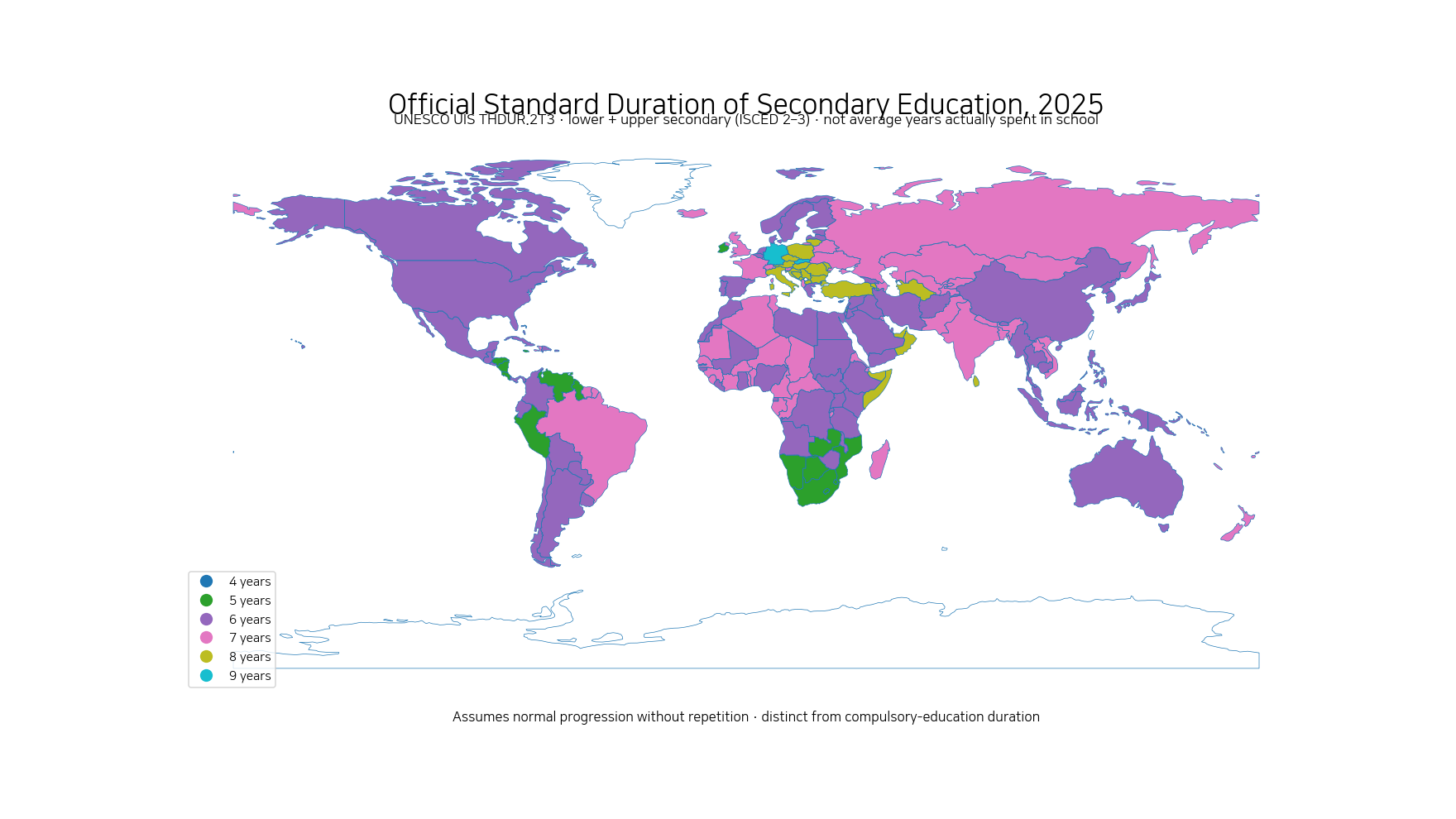
Table of Contents
Secondary education combines ISCED levels 2 and 3
UIS defines secondary education as ISCED levels 2 and 3. Lower secondary builds on primary education, while upper secondary prepares students for labour-market entry or further education.
The duration in this indicator therefore covers both lower and upper secondary education. It should not be read as the length of only one stage such as junior secondary school.
Theoretical duration is not the average time students actually spend in school
Theoretical duration is the standard number of years needed to complete an education programme assuming full-time participation and normal progression without grade repetition.
An individual student may take longer because of repetition, interruption or other factors, while some pathways may differ from the standard route. THDUR.2T3 describes the formal structure of the education system rather than observed student trajectories.
Six years is the most common duration
94 of the 221 observations report six years, representing 42.5% of the dataset. Seven years is the second most common value with 73 observations.
Together, six- and seven-year structures represent 75.6% of the reporting set. The global pattern is therefore concentrated in a fairly narrow range even though official durations span from four to nine years.
| Standard duration | Countries and areas | Share |
|---|---|---|
| 4 years | 1 | 0.5% |
| 5 years | 28 | 12.7% |
| 6 years | 94 | 42.5% |
| 7 years | 73 | 33.0% |
| 8 years | 23 | 10.4% |
| 9 years | 2 | 0.9% |
Germany and Slovakia report nine years
Germany and Slovakia are the two observations at nine years, the maximum in the 2025 dataset. The number represents the combined official duration of programmes classified at ISCED levels 2 and 3.
A longer duration does not by itself mean greater educational quality or more learning. Entry ages, primary duration, stage boundaries and general or vocational pathways differ across education systems.
Singapore is the only four-year observation
Singapore reports four years, the minimum in the dataset. This should not be interpreted as the least education or the lowest learning intensity.
The mapping of national programmes to ISCED levels and the structure of student pathways can produce different official durations. A single total duration cannot capture every pathway in a diversified education system.
Five years appears in 28 observations and eight years in 23
28 countries and areas report five years and 23 report eight years. These values are less common than the six- and seven-year cluster but still represent a substantial part of the dataset.
The difference reflects system design rather than a simple policy ranking. Countries distribute grades differently between primary, lower-secondary and upper-secondary education, and may organize vocational pathways differently.
Major education systems range from five to nine years
The United States, China, Japan, Canada, Australia, Mexico, Indonesia, Spain, Norway, Sweden and Finland report six years. France, the United Kingdom, India, Brazil and New Zealand report seven years.
Italy reports eight years, South Africa five and Germany nine. The Republic of Korea reports six years and is included only as one comparison case rather than a headline focus under the V9 country-focus contract.
| Country | 2025 standard duration of secondary education |
|---|---|
| Singapore | 4 years |
| Germany | 9 years |
| Slovakia | 9 years |
| United States | 6 years |
| China | 6 years |
| Japan | 6 years |
| Canada | 6 years |
| Australia | 6 years |
| Mexico | 6 years |
| Indonesia | 6 years |
| Spain | 6 years |
| Norway | 6 years |
| Sweden | 6 years |
| Finland | 6 years |
| Republic of Korea | 6 years |
| France | 7 years |
| United Kingdom | 7 years |
| India | 7 years |
| Brazil | 7 years |
| New Zealand | 7 years |
| Italy | 8 years |
| South Africa | 5 years |
The duration is different from compulsory-education years
A six-year secondary programme does not mean all six years are necessarily compulsory. Compulsory education is defined by the number of years or age span during which children are legally required to attend school.
Some systems make the entire secondary programme compulsory, while others require attendance only through lower secondary or part of upper secondary. The two indicators answer different questions.
It is also different from the number of years guaranteed tuition-free
Free-education indicators describe how many years children are legally entitled to attend without tuition fees. The theoretical duration indicator describes the official length of the programme regardless of whether tuition-free entitlement covers all of it.
A country can therefore have a seven-year secondary structure while guaranteeing a different number of years as free or compulsory. Programme structure and legal entitlement should not be conflated.
The duration does not reveal out-of-school rates or completion
Whether secondary education is designed to last six, seven or eight years does not tell us how many young people are actually enrolled or complete the programme.
Systems with the same official duration can have very different out-of-school rates, completion rates or learning outcomes. Participation and attainment require separate indicators.
Duration is not an education-quality score
A nine-year structure is not automatically better than a six-year structure. Annual instructional time, curriculum depth, teacher preparation, student support and programme pathways can all differ.
Theoretical duration is useful for comparing the architecture of education systems, but it is not designed to rank learning quality or system performance.
Cross-country ISCED mapping also matters
UIS uses the International Standard Classification of Education to map diverse national programmes into common levels. This enables comparison, but national education and qualification structures are not identical.
A one-year difference should therefore be read as a difference in the formal structure assigned to ISCED 2–3, not necessarily as one extra year of comparable learning content for every student.
The 2025 dataset has broad geographic coverage
With 221 countries and areas, the dataset provides unusually broad coverage of formal education-system structures. It includes countries as well as territories and other reporting areas.
The fact that six years is the most common value does not establish a mandatory global standard of six years. It simply means six years is the most frequently observed formal duration in this reporting set.
Blank map areas do not mean zero years
Of the 221 source observations, 171 match separate polygons in the low-resolution world boundary layer used here. Small islands and territories can have valid statistics without a visible polygon.
Missing map areas remain unclassified and are never filled with zero. The legend shows only the actual observed durations from four through nine years.
Data source and interpretation
Country values come from the UNESCO UIS Data Browser for THDUR.2T3, using the 2025 observations. The scope of secondary education follows the UIS definition of Secondary education (ISCED 2 and 3).
Theoretical duration is interpreted as the standard duration of a programme assuming full-time participation and normal progression without repetition. The package provider tag is corrected from World Bank to UNESCO UIS, and the generic unit ‘value’ is clarified as years.
Frequently Asked Questions
What does theoretical duration of secondary education mean?
It is the standard number of years needed to complete lower and upper secondary education assuming full-time participation and normal progression without grade repetition.
Is this the average number of years students actually spend in secondary school?
No. It describes the formal programme duration, not observed average time after repetition, interruption or dropout.
Is secondary duration the same as compulsory-education duration?
No. Secondary duration describes the formal length of ISCED 2–3 programmes, while compulsory education describes the years or ages during which attendance is legally required.
Does a longer secondary duration mean better education quality?
No. The indicator measures system structure only and does not measure learning outcomes, instructional time or education quality.
Related Articles
- Compulsory Education Duration by Country | 2025
- Out-of-School Rate for Upper-Secondary-Age Youth | 2024
- Out-of-School Rates for School-Age Children and Youth | 2024
Green Map creates custom-edited map images using open geographic data sources such as geoBoundaries, Natural Earth, OpenStreetMap, and government open data.
These maps are edited visual materials, not raw data files, and are provided for education, documents, presentations, and graphic reference.